
Trust in the Tempest: Navigating Police/Prepper Encounters in SHTF
It’s the second or third day of rioting that has swept your city, but you aren’t sure; you’ve been awake nearly the whole time. What you are sure of is that the rifle you clutch as you stand in front of your small business or home is why the looters won’t even look you in the eye, let alone try to enter. Yet today something is different.
The crowd is bolder now. Instead of fleeing, they are jeering from the safety of the opposing sidewalk, probing your resolve. Danger is more acute than it has been. It was hours ago that the police said they’d be there, and you have given up all hope.
Then miraculously, a troop of black-and-whites come around the corner. Officers pile out, forming a line between you and the crowd, but some have their guns out pointed at you. “What? Put down my rifle?” you repeat incredulously. As soon as you reluctantly comply, you’re whirled around and handcuffed.
This might sound like bad fiction, but no, this is actually what happened to Korean store owners in Los Angeles in 1992. Worse, in the aftermath of Hurricane Katrina police actually confiscated guns from legally armed citizens. What these and other incidents have in common is that prepared citizen/police encounters in SHTF is a fraught proposition. Both groups are likely to be mistrustful of each other and frazzled after hours, days, or weeks just trying to survive the most challenging events they’ve ever seen.
Dealing with an upset officer
Nothing might seem more infuriating to a prepared citizen than feeling like they have become the bad guy. A bad experience could make police/prepper relationships turn sour. While you can’t control why or how an officer is acting the way he is, you can influence the outcome through your behavior. Navigating a police/prepper encounters after SHTF requires an understanding of officers’ mentality and goals.
Both parties have differing motivations, but and shared emotions. For the latter, a major disaster or emergency creates heightened emotions like fear, anxiety, and distrust; all of which that are compounded by fatigue. An officer doesn’t know if he’s dealing with an upstanding prepared citizen who has his back or a clever bad guy. The citizen might take umbrage with being detained when he feels abandoned by his government.
While the emotional angle is understandable on both sides, police have different goals than a prepper who only has to watch over himself or bug-out to safety. The first duty of police in an emergency is to gain control of a situation. That means officers will detain, disarm, and restrain people if necessary. It can be infuriating to be cuffed up, but usually the situation is cleared up quickly as long everyone stays calm.
Many times I’ve seen situations escalate precisely because citizens didn’t stay calm and didn’t understand why police wouldn’t let them do X. Police often “hold the line” and follow orders in an emergency, which can seem (or be) unreasonable. For better or for worse, police have a mission to reign in chaos and a desire to protect. That often means protecting you from yourself. “Someone could get hurt,” is what an officer might say about your survival activities. You may be able to navigate the hazards safely, but cops can’t know that.
Less charitably, police maintain order and much of that is political. Permitting citizens to “self-police” or get themselves into danger looks bad to the politicians. Law enforcement is a paramilitary organization. If a cop fails in his duties to keep bad stuff from happening, or lets it happen, he can be disciplined by his superiors. What might be prudent for you would be dereliction of duty if the officer lets it happen. Not all cops are insensible. It could be that an officer just wants you to drive off or go inside long enough that he can honestly report that you complied.
Cops and armed citizens
Whether you bug-in or bug-out, during SHTF you will probably encounter some sort of official roadblock or checkpoint, even if it’s just roving traffic stops. Your survival or freedom might depend on how you navigate this moment. Defiance is a near-guarantee that you will not like the outcome.
Police interactions go sideways because people don’t listen to the police, whether the cop is right or wrong. Many cops do have a chip on their shoulder and allow their office to override reason. Some won’t be able to disconnect their ordinary reaction of “don’t block the street” from the reality that the city is falling apart. You may receive a negative reaction based on the perception you are usurping police authority or causing more problems for officers.
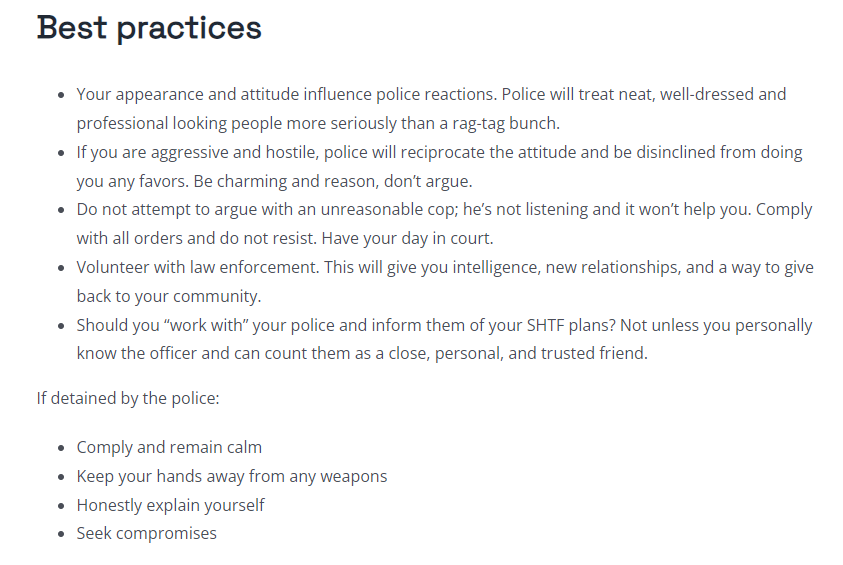
Arguing with police is pointless. I don’t mean reasoning—like presenting an argument—I mean a loud oral disagreement. Anyone who has seen Cops or Live PD knows what I’m talking about. A suspect who is dead to rights going to jail will try to yell, scream, debate, threaten, or whine their way out of trouble. Once a cop has made up his mind, it is all noise. He isn’t even listening to you at that point. All you are doing is aggravating him, meaning he is less likely to do you any favors or cut you any slack.
Reasoning with an officer is different. Reasoning implies both parties are trying to achieve a compromise. A cop who vetoes your self-defense activities may sympathize with you but is acting under external influences. They may be willing to reach some sort of deal with you or could help mitigate your problem some other way. In these situations, you might bargain for an increased police presence, which a good cop should feel honor bound to provide. You will have to feel this out to know when compromise is viable.
Realize that the officer is operating under his own emotions. He may be afraid, exhausted, or feeling guilty because he can’t help you. He may respond emotionally, not based what you are actually saying or doing. If you understand this, you can empathize and stay calm, even perhaps address his unconscious concerns.
Always stay calm, be polite, and respectful. The more intense your language or behavior the more likely the reaction will be to your words or behavior rather than the substance of what you are saying. No cop will want to, or have any reason to, be accommodating if you are foaming at the mouth. Have a friendly and witty person talk to the officer, one that might deliver a well-timed joke to break the tension.
Try and come to an understanding of goals; what the officer is trying to protect and what you need. Using a checkpoint as an example, it may be that he’s screening out non-residents, keeping cars from jamming up emergency vehicle traffic, or the area is cordoned off because it is radioactive. There may be alternatives such as parking and walking or having your bug-out host come vouch for you.
What You Can Do
In nearly all jurisdictions, if you have a negative encounter with the police, i.e. they are detaining you, expect to be disarmed. From a safety standpoint, assume police will always disarm you unless the encounter is purely positive and consensual. Should a cop want to disarm you, don’t fight. Comply immediately and fully. Have someone record the interaction. When the disarming, pat-down, and cuffing is done, then politely and calmly speak with the officer.
Unless the alternative is worse than arrest, de-escalate the situation and feign compliance until you can get around the police problem. In a very tense situation, such as when guns are out, compliance is absolutely vital. It is better to fake compliance than force the issue. Non-compliance has to be backed up by force and that’s an ugly situation none of us want to contemplate. Are things really at the point where you want to escalate stuff until you’re shooting it out with the cops?
Police are often wary or uncompromising because they don’t know the people they’re dealing with. At a local level, you can mitigate this by getting to your officers, troopers, or deputies. Become a known quantity to them so they don’t have to wonder if you are a bad guy or a potential liability. Consider volunteering as a civilian or a part-time officer; at least participate in the outreach programs like citizen academies. Volunteers, relief workers, or just familiar, friendly faces get more professional courtesy than a random person.
It’s the second or third day of rioting that has swept your city, but you aren’t sure; you’ve been awake nearly the whole time. What you are sure of is that the rifle you clutch as you stand in front of your small business or home is why the looters won’t even look you in the eye, let alone try to enter. Yet today something is different.
The crowd is bolder now. Instead of fleeing, they are jeering from the safety of the opposing sidewalk, probing your resolve. Danger is more acute than it has been. It was hours ago that the police said they’d be there, and you have given up all hope.
Then miraculously, a troop of black-and-whites come around the corner. Officers pile out, forming a line between you and the crowd, but some have their guns out pointed at you. “What? Put down my rifle?” you repeat incredulously. As soon as you reluctantly comply, you’re whirled around and handcuffed.
This might sound like bad fiction, but no, this is actually what happened to Korean store owners in Los Angeles in 1992. Worse, in the aftermath of Hurricane Katrina police actually confiscated guns from legally armed citizens. What these and other incidents have in common is that prepared citizen/police encounters in SHTF is a fraught proposition. Both groups are likely to be mistrustful of each other and frazzled after hours, days, or weeks just trying to survive the most challenging events they’ve ever seen.
Dealing with an upset officer
Nothing might seem more infuriating to a prepared citizen than feeling like they have become the bad guy. A bad experience could make police/prepper relationships turn sour. While you can’t control why or how an officer is acting the way he is, you can influence the outcome through your behavior. Navigating a police/prepper encounters after SHTF requires an understanding of officers’ mentality and goals.
Both parties have differing motivations, but and shared emotions. For the latter, a major disaster or emergency creates heightened emotions like fear, anxiety, and distrust; all of which that are compounded by fatigue. An officer doesn’t know if he’s dealing with an upstanding prepared citizen who has his back or a clever bad guy. The citizen might take umbrage with being detained when he feels abandoned by his government.
While the emotional angle is understandable on both sides, police have different goals than a prepper who only has to watch over himself or bug-out to safety. The first duty of police in an emergency is to gain control of a situation. That means officers will detain, disarm, and restrain people if necessary. It can be infuriating to be cuffed up, but usually the situation is cleared up quickly as long everyone stays calm.
Many times I’ve seen situations escalate precisely because citizens didn’t stay calm and didn’t understand why police wouldn’t let them do X. Police often “hold the line” and follow orders in an emergency, which can seem (or be) unreasonable. For better or for worse, police have a mission to reign in chaos and a desire to protect. That often means protecting you from yourself. “Someone could get hurt,” is what an officer might say about your survival activities. You may be able to navigate the hazards safely, but cops can’t know that.
Less charitably, police maintain order and much of that is political. Permitting citizens to “self-police” or get themselves into danger looks bad to the politicians. Law enforcement is a paramilitary organization. If a cop fails in his duties to keep bad stuff from happening, or lets it happen, he can be disciplined by his superiors. What might be prudent for you would be dereliction of duty if the officer lets it happen. Not all cops are insensible. It could be that an officer just wants you to drive off or go inside long enough that he can honestly report that you complied.
Cops and armed citizens
Whether you bug-in or bug-out, during SHTF you will probably encounter some sort of official roadblock or checkpoint, even if it’s just roving traffic stops. Your survival or freedom might depend on how you navigate this moment. Defiance is a near-guarantee that you will not like the outcome.
Police interactions go sideways because people don’t listen to the police, whether the cop is right or wrong. Many cops do have a chip on their shoulder and allow their office to override reason. Some won’t be able to disconnect their ordinary reaction of “don’t block the street” from the reality that the city is falling apart. You may receive a negative reaction based on the perception you are usurping police authority or causing more problems for officers.
Arguing with police is pointless. I don’t mean reasoning—like presenting an argument—I mean a loud oral disagreement. Anyone who has seen Cops or Live PD knows what I’m talking about. A suspect who is dead to rights going to jail will try to yell, scream, debate, threaten, or whine their way out of trouble. Once a cop has made up his mind, it is all noise. He isn’t even listening to you at that point. All you are doing is aggravating him, meaning he is less likely to do you any favors or cut you any slack.
Reasoning with an officer is different. Reasoning implies both parties are trying to achieve a compromise. A cop who vetoes your self-defense activities may sympathize with you but is acting under external influences. They may be willing to reach some sort of deal with you or could help mitigate your problem some other way. In these situations, you might bargain for an increased police presence, which a good cop should feel honor bound to provide. You will have to feel this out to know when compromise is viable.
Realize that the officer is operating under his own emotions. He may be afraid, exhausted, or feeling guilty because he can’t help you. He may respond emotionally, not based what you are actually saying or doing. If you understand this, you can empathize and stay calm, even perhaps address his unconscious concerns.
Always stay calm, be polite, and respectful. The more intense your language or behavior the more likely the reaction will be to your words or behavior rather than the substance of what you are saying. No cop will want to, or have any reason to, be accommodating if you are foaming at the mouth. Have a friendly and witty person talk to the officer, one that might deliver a well-timed joke to break the tension.
Try and come to an understanding of goals; what the officer is trying to protect and what you need. Using a checkpoint as an example, it may be that he’s screening out non-residents, keeping cars from jamming up emergency vehicle traffic, or the area is cordoned off because it is radioactive. There may be alternatives such as parking and walking or having your bug-out host come vouch for you.
What You Can Do
In nearly all jurisdictions, if you have a negative encounter with the police, i.e. they are detaining you, expect to be disarmed. From a safety standpoint, assume police will always disarm you unless the encounter is purely positive and consensual. Should a cop want to disarm you, don’t fight. Comply immediately and fully. Have someone record the interaction. When the disarming, pat-down, and cuffing is done, then politely and calmly speak with the officer.
Unless the alternative is worse than arrest, de-escalate the situation and feign compliance until you can get around the police problem. In a very tense situation, such as when guns are out, compliance is absolutely vital. It is better to fake compliance than force the issue. Non-compliance has to be backed up by force and that’s an ugly situation none of us want to contemplate. Are things really at the point where you want to escalate stuff until you’re shooting it out with the cops?
Police are often wary or uncompromising because they don’t know the people they’re dealing with. At a local level, you can mitigate this by getting to your officers, troopers, or deputies. Become a known quantity to them so they don’t have to wonder if you are a bad guy or a potential liability. Consider volunteering as a civilian or a part-time officer; at least participate in the outreach programs like citizen academies. Volunteers, relief workers, or just familiar, friendly faces get more professional courtesy than a random person.
• • •
Missing some Tweet in this thread? You can try to
force a refresh






