
I injected the horse tranquilizer Ketamine and tracked my brain data for 15 days. It completely scrambled my brain.
In a world-first we answered the question ‘what happens to the brain before, during, and after ketamine treatment?’ We also discovered how long it took for my brain to return to ‘normal’.
The results surprised me. 🧵
In a world-first we answered the question ‘what happens to the brain before, during, and after ketamine treatment?’ We also discovered how long it took for my brain to return to ‘normal’.
The results surprised me. 🧵
0/ Before taking ketamine, my brain activity followed fixed, predictable patterns, as observed over 10 days of measurement. Imagine the brain as a global air traffic network, where each airport (or brain region) has consistent flight routes and traffic volumes—like the steady flow of planes between New York and London.
After ketamine, my brain’s activity patterns were completely scrambled. Instead of predictable routes between major hubs, traffic was rerouted to smaller, less-used airports across the U.S., Europe, and Asia.
This means brain activity that was once rigidly structured became more flexible and varied, potentially unlocking new connections and ways of thinking.
Top images: My absolute functional connectivity (brain traffic patterns) for minutes 5-15 after I received 57.75mg intramuscular injection of ketamine.
Bottom images: My relative functional connectivity (brain traffic patterns) changes after the ketamine took effect, starting at minutes 15-25.
After ketamine, my brain’s activity patterns were completely scrambled. Instead of predictable routes between major hubs, traffic was rerouted to smaller, less-used airports across the U.S., Europe, and Asia.
This means brain activity that was once rigidly structured became more flexible and varied, potentially unlocking new connections and ways of thinking.
Top images: My absolute functional connectivity (brain traffic patterns) for minutes 5-15 after I received 57.75mg intramuscular injection of ketamine.
Bottom images: My relative functional connectivity (brain traffic patterns) changes after the ketamine took effect, starting at minutes 15-25.

1/ After three days, my previous patterns started to take hold again, closing what many refer to as the "therapeutic window” that opens post a ketamine or psychedelic administration.
Top images: Baseline measurements of my brain 5 days prior to receiving ketamine.
Bottom images: My brain activity for days 7-11 after having received ketamine.
Top images: Baseline measurements of my brain 5 days prior to receiving ketamine.
Bottom images: My brain activity for days 7-11 after having received ketamine.

2/ This image shows my functional connectivity (traffic patterns) was stable for days 1-5 prior to ketamine and showed large changes during the ketamine session. Post Ketamine, my functional connectivity decreases for days and then begins trending to normalize back to his baseline.

3/ Normally it would be hard and next to impossible to get this kind of high fidelity brain data, but it was made easy with Kernel Flow.
Flow is the non-invasive brain interface technology I dedicated seven years of my life building (and personally investing $64 million). The technology in Flow is similar to the device you’ve put on your finger to get your heart rate and blood oxygenation.
Flow is the non-invasive brain interface technology I dedicated seven years of my life building (and personally investing $64 million). The technology in Flow is similar to the device you’ve put on your finger to get your heart rate and blood oxygenation.

4/ I founded Kernel in 2015 because I thought it pairing the human mind with AI was going to be really important to the future.
Then, when becoming the most biologically measured person in history (Blueprint + Don’t Die), I discovered that getting high quality, functional brain biomarkers was expensive and nearly impossible. Yet critically important for measuring the effects of drugs and therapies, cognitive performance, disorders and decline.
fMRI could do it in some contexts, but the barriers made it practically infeasible. It was nearly impossible to get functional measurements of my brain.
Our inability to easily and cheaply measure our brains/minds is a big problem especially because we have a global mental wellness crisis.
So, an exceptionally talented team and I built Kernel Flow from scratch, including building a custom ASIC (Application-Specific Integrated Circuit), the entire electronics stack, signal processing and interpretation algorithms.
It's the world's first, high fidelity mass market brain interface that could be used at scale.
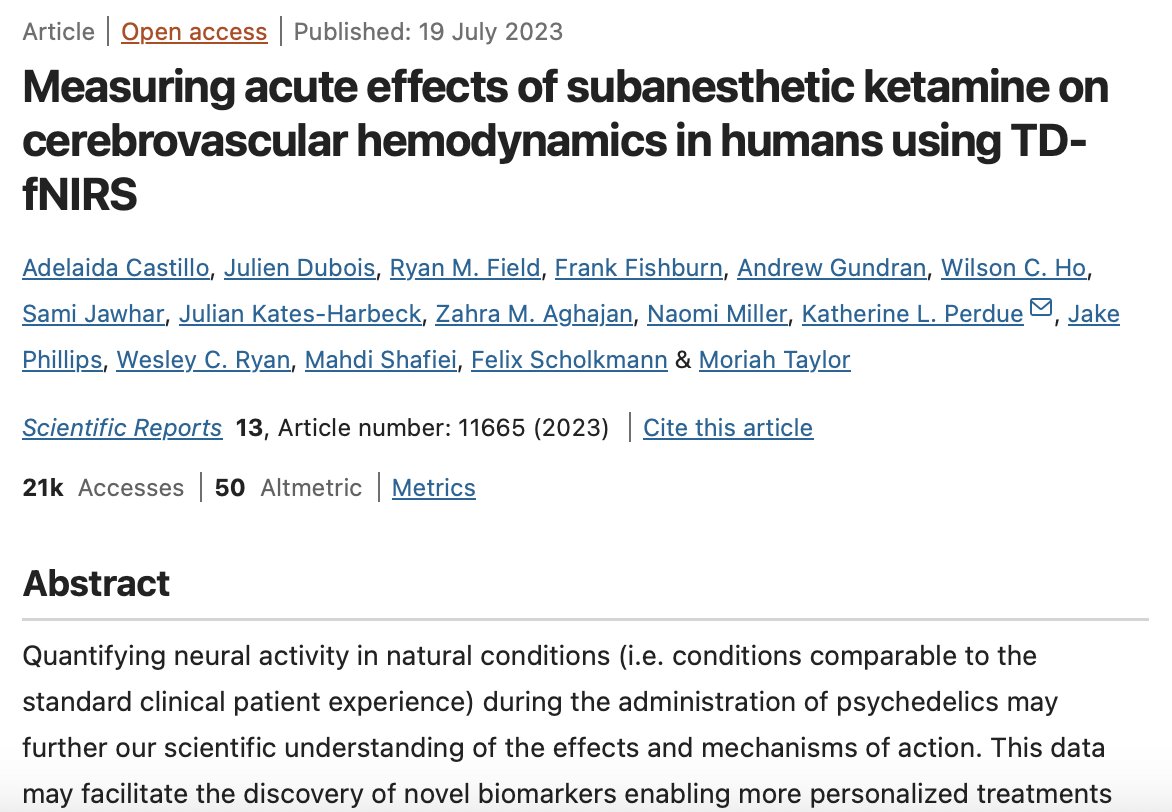
We did the heavy lifting of publishing several papers on its reliability and capabilities including demonstrating cognitive impairment from alcohol and the effects of ketamine (in which I participated).
Then, when becoming the most biologically measured person in history (Blueprint + Don’t Die), I discovered that getting high quality, functional brain biomarkers was expensive and nearly impossible. Yet critically important for measuring the effects of drugs and therapies, cognitive performance, disorders and decline.
fMRI could do it in some contexts, but the barriers made it practically infeasible. It was nearly impossible to get functional measurements of my brain.
Our inability to easily and cheaply measure our brains/minds is a big problem especially because we have a global mental wellness crisis.
So, an exceptionally talented team and I built Kernel Flow from scratch, including building a custom ASIC (Application-Specific Integrated Circuit), the entire electronics stack, signal processing and interpretation algorithms.
It's the world's first, high fidelity mass market brain interface that could be used at scale.
We did the heavy lifting of publishing several papers on its reliability and capabilities including demonstrating cognitive impairment from alcohol and the effects of ketamine (in which I participated).

5/ The early data is impressive.
Flow measurements of brain function in response to cognitive and emotional stimuli have been shown to predict with 90% accuracy if a patient will respond to treatment from depression before they have their first dose.
Flow measurements of brain function in response to cognitive and emotional stimuli have been shown to predict with 90% accuracy if a patient will respond to treatment from depression before they have their first dose.
6/ If you're interested in brain health, you can now join one of two clinical trials:
1) Healthy aging - Kernel has distinguished normal cognitive changes from early disease signs using brain activity patterns.
Kernel Flow is a promising tool to detect mild cognitive impairment (MCI), and achieve high accuracy in distinguishing between MCI and healthy individuals. Healthy volunteers can participate and will also receive a free, detailed report of brain function at the study’s end.
Location: Culver City, CA.
Sign up at kernel dot com / life
1) Healthy aging - Kernel has distinguished normal cognitive changes from early disease signs using brain activity patterns.
Kernel Flow is a promising tool to detect mild cognitive impairment (MCI), and achieve high accuracy in distinguishing between MCI and healthy individuals. Healthy volunteers can participate and will also receive a free, detailed report of brain function at the study’s end.
Location: Culver City, CA.
Sign up at kernel dot com / life
7/ Sign up for the clinical study on Depression
Kernel has developed a new brain imaging technology with potential breakthroughs in treatment-resistant depression. While early, results have been shared with scientists and psychiatrists. They aim to secure regulatory approvals, expanding into neuropsychiatric disorders to transform psychiatric diagnosis, treatment, and monitoring for more precise patient care.
Cities where sites are currently located: California locations: Costa Mesa, La Jolla, Los Angeles, Sunnyvale. Other locations: Seattle, WA and Columbus, OH
Full clinic list with details is at kernel dot com / research
Kernel has developed a new brain imaging technology with potential breakthroughs in treatment-resistant depression. While early, results have been shared with scientists and psychiatrists. They aim to secure regulatory approvals, expanding into neuropsychiatric disorders to transform psychiatric diagnosis, treatment, and monitoring for more precise patient care.
Cities where sites are currently located: California locations: Costa Mesa, La Jolla, Los Angeles, Sunnyvale. Other locations: Seattle, WA and Columbus, OH
Full clinic list with details is at kernel dot com / research
8/ Kernel papers


• • •
Missing some Tweet in this thread? You can try to
force a refresh






