A paper was published that presented a new model to predict airborne disease transmission. There were many features included in this model that make it interesting.
I have some thoughts.
I have some thoughts.
https://twitter.com/DrInfoSec/status/1894769199773372812
The first author of article was written by @ScientistAndre. If you have any questions about it, I’m sure he would be more than happy to discuss.
Moreover, if I get anything wrong, I hope he jumps in to correct me!
Moreover, if I get anything wrong, I hope he jumps in to correct me!
@ScientistAndre Context: I am not a modeller. That said, I work with them, and feel that they are very important for understanding these processes. My reading of this paper will assume all the math is accurate. Rather, I am just looking at what the authors have considered/included in the model.
@ScientistAndre History: Precovid, the standard model used for airborne disease transmission was the Wells-Riley model.
@ScientistAndre EVERY model makes assumptions. In the Wells-Riley model, the main assumption was that the air within the room was well mixed. CFD models of aerosol in a room show that this is not accurate. 

@ScientistAndre For this to be true, a few things would need to be true. First, that exhaled aerosol is immediately and evenly mixed throughout a room once exhaled. Second is that the decay rate of a virus is on a scale relative to the air being mixed throughout the room.
@ScientistAndre Meaning, if the exhaled dose is low, and the virus decays very slowly, the Wells-Riley prediction of transmission is probably going to give a decent estimate of transmission.
@ScientistAndre The Problem: Since 2020, we have learned a lot about both the complex decay dynamics of exhaled viruses:
nature.com/articles/s4146…
nature.com/articles/s4146…
@ScientistAndre And the amount of virus that is exhaled:
pubmed.ncbi.nlm.nih.gov/38040798/
pubmed.ncbi.nlm.nih.gov/38040798/
@ScientistAndre What this means, is that airborne disease transmission is exceedingly more complicated than what we can predict based solely on the Wells-Riley model. What is clever in the current work is that they are differentiating between short and long distance transmission.
This is key
This is key
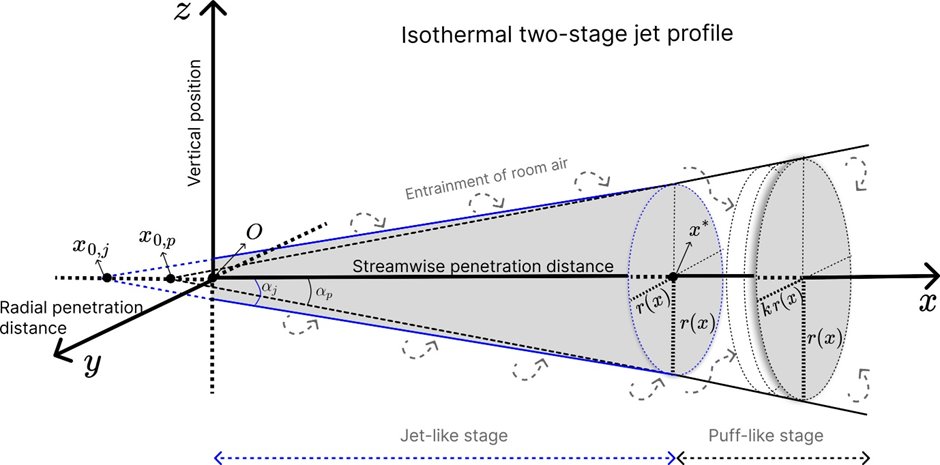
@ScientistAndre They do this a number of ways, even by including a jet profile for exhalation:
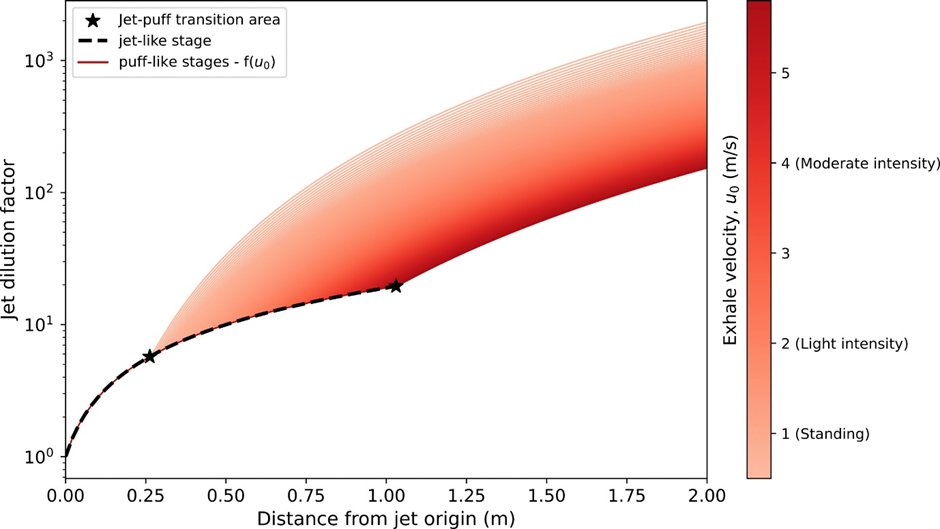
@ScientistAndre And including activities such as breathing vs speaking to alter the initial dose:
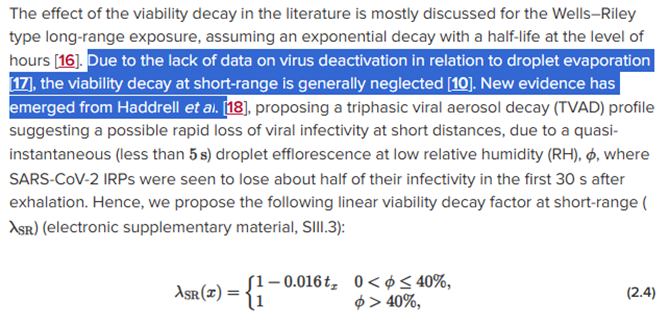
@ScientistAndre And they include the complex viral decay dynamics of SARS-CoV-2 (shameless self promotion…):
@ScientistAndre The utility of this overall approach is that the model describes airborne disease transmission in a way that better describes what is actually happening. For example, clearly short distance transmission is more likely and important to consider.
@ScientistAndre This is some good work, and an excellent sign of the field moving forward in a positive way. @ScientistAndre, let me know where I got anything wrong. Congrats on this, well done! Looking forward/curious to seeing how this is received by the modelling community.
• • •
Missing some Tweet in this thread? You can try to
force a refresh