Yesterday I posted a thread about American weapons and components in fighter aircraft and how Europe has to wean itself off them.
Today let's look at transport, tanker, maritime patrol, and airborne early warning aircraft.
(Tomorrow then trainer aircraft and drones)
1/25
Today let's look at transport, tanker, maritime patrol, and airborne early warning aircraft.
(Tomorrow then trainer aircraft and drones)
1/25

Transport aircraft come in two sizes: for strategic airlift or tactical airlift.
Simplified: strategic airlift transports materiel between continents and tactical airlift within a theater of operations.
For strategic airlift the choice for Europe is easy: A400M Atlas, because
2/n
Simplified: strategic airlift transports materiel between continents and tactical airlift within a theater of operations.
For strategic airlift the choice for Europe is easy: A400M Atlas, because
2/n

it is the only strategic airlifter in production (C-17 Globemaster production ceased in 2015) and because the French were involved in its design the A400M Atlas comes with all key parts "Made in Europe".
Yes, it carries only half the payload of the C-17 Globemaster, but for
3/n
Yes, it carries only half the payload of the C-17 Globemaster, but for
3/n

Europe this is more than enough.
In regards to tactical airlift the West's choice has always been the C-130 Hercules... even though Italy built the Aeritalia G.222 and France/Germany the Transall C-160.
Even today many European air forces (even the French and German) fly
4/n
In regards to tactical airlift the West's choice has always been the C-130 Hercules... even though Italy built the Aeritalia G.222 and France/Germany the Transall C-160.
Even today many European air forces (even the French and German) fly
4/n

either C-130 Hercules (🇦🇹🇬🇷🇳🇱🇵🇱🇵🇹🇷🇴🇸🇪) or C-130J Super Hercules (🇩🇰🇫🇷🇩🇪🇮🇹🇳🇴🇹🇷).
To replace the C-130 is an issue for European air forces... the only similar aircraft is the Brazilian Embraer C-390 Millennium, which already the air forces of 🇦🇹🇨🇿🇭🇺🇳🇱🇵🇹🇸🇰🇸🇪 have chosen.
5/n
To replace the C-130 is an issue for European air forces... the only similar aircraft is the Brazilian Embraer C-390 Millennium, which already the air forces of 🇦🇹🇨🇿🇭🇺🇳🇱🇵🇹🇸🇰🇸🇪 have chosen.
5/n

The C-390 Millennium carries more further and faster than the C-130J Super Hercules, but it includes American parts (besides Portuguese, Czech and Argentinian parts).
It uses the V2531-E5 engine, a variant of the IAE V2500... and here things become tricky: that engine was
6/n
It uses the V2531-E5 engine, a variant of the IAE V2500... and here things become tricky: that engine was
6/n

a joint US-British-Japanese-German-Italian development for the Airbus A320, but the Italy's Avio left and the UK's Rolls-Royce sold its shares to Pratt & Whitney... nonetheless there are still two production lines: a P&W owned in Connecticut and a R&R owned near Berlin, which
7/n
7/n
means I have no idea if Trump could block the use of V2531-E5 engines.
As the C-390 Millennium is produced in Brazil European air forces should look at the European made tactical airlifters, but they all come with issues: production of the Ukrainian Antonov An-178 has ceased
8/n
As the C-390 Millennium is produced in Brazil European air forces should look at the European made tactical airlifters, but they all come with issues: production of the Ukrainian Antonov An-178 has ceased
8/n

due to obvious reasons.
The Italian C-27J Spartan is full of American parts, as it was designed as a "baby Herc" with the same avionics, cockpit layout and engines as the C-130J Super Hercules.
The engines are AE2100-D2A made by Rolls-Royce North America, and thus not safe
9/n
The Italian C-27J Spartan is full of American parts, as it was designed as a "baby Herc" with the same avionics, cockpit layout and engines as the C-130J Super Hercules.
The engines are AE2100-D2A made by Rolls-Royce North America, and thus not safe
9/n

from the whims of a Trump administration.
The Spanish made CASA CN-235 and C-295 (photo) are smaller than the C-130J Super Hercules, and neither uses a European made engine. The CN-235 uses so many US made avionics that the US has already vetoed the export of the CN-235.
10/n
The Spanish made CASA CN-235 and C-295 (photo) are smaller than the C-130J Super Hercules, and neither uses a European made engine. The CN-235 uses so many US made avionics that the US has already vetoed the export of the CN-235.
10/n
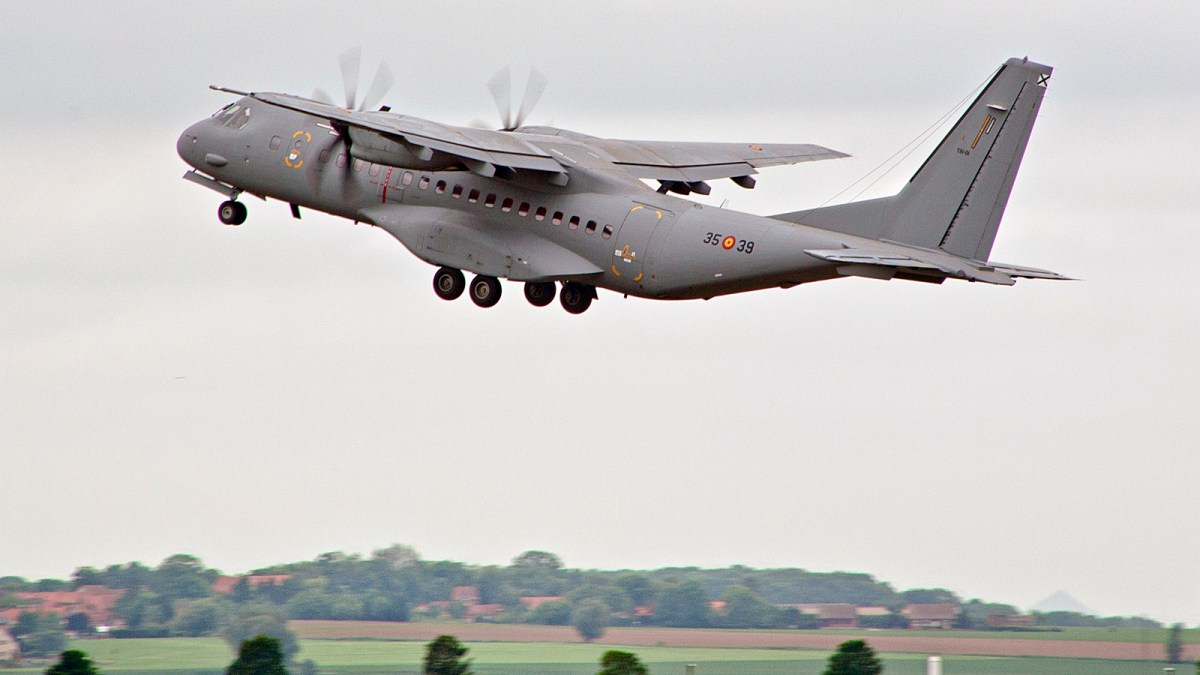
While the CN-235 uses GE CT7-9C3 engines, the C-295 uses Canadian developed and made Pratt & Whitney Canada PW127G engines... which poses the interesting question: how safe is Pratt & Whitney Canada from White House interference?
In short: when it comes to tactical airlift
11/n
In short: when it comes to tactical airlift
11/n
Europe has home made options... but none is free of American components.
This leaves Europe with two pricey options: either buy more expensive A400M Atlas, which can also perform tactical airlift roles like dropping paratroopers (photo), or develop either a Europeanized
12/n
This leaves Europe with two pricey options: either buy more expensive A400M Atlas, which can also perform tactical airlift roles like dropping paratroopers (photo), or develop either a Europeanized
12/n

version of the C-390 Millennium (or the similar sized Japanese Kawasaki C-2), or develop a "baby A400M", or design US components out of C-27J and C-295.
However as the threat to Europe comes nearby russia buying more airlift isn't as urgent as i.e. improving rail transport.
13/n
However as the threat to Europe comes nearby russia buying more airlift isn't as urgent as i.e. improving rail transport.
13/n

Next tanker aircraft for aerial refueling: there are two ways to refuel an aircraft in flight:
• flying boom (favored by the US)
• probe-and-drogue (favored by Europe)
Flying booms extend from an aircraft's rear and are guided by an operator onto a receiver's receptacle.
14/n
• flying boom (favored by the US)
• probe-and-drogue (favored by Europe)
Flying booms extend from an aircraft's rear and are guided by an operator onto a receiver's receptacle.
14/n


Booms have higher fuel flow rates, which are important when you refuel i.e. transporters or bombers.
Probe-and-drogue consists of a flexible hose with a drogue at its end, into which a pilot has to guide his plane's probe. This allows to refuel 2 aircraft at the same time.
15/n
Probe-and-drogue consists of a flexible hose with a drogue at its end, into which a pilot has to guide his plane's probe. This allows to refuel 2 aircraft at the same time.
15/n

Eurofighter, Gripen and F-35B have retractable probes for probe-and-drogue operation, while the Rafale and A400M have fixed probes.
The F-35A has receptacle for boom operations, but can be fitted with the same retractable probe as the F-35B (and the F-35C).
16/n
The F-35A has receptacle for boom operations, but can be fitted with the same retractable probe as the F-35B (and the F-35C).
16/n

Luckily Europe produces the Airbus A330 MRTT, which can refuel in both ways.
Both photos in tweet 14 show an Australian A330 MRTT refueling fighter with both systems.
The A400M Atlas, KC-130J Super Hercules and C-390 Millennium can also refuel aircraft... as can the Rafale.
17/n
Both photos in tweet 14 show an Australian A330 MRTT refueling fighter with both systems.
The A400M Atlas, KC-130J Super Hercules and C-390 Millennium can also refuel aircraft... as can the Rafale.
17/n

As for Maritime Patrol Aircraft (MPA) to hunt for and sink russian submarines... the UK, Norway and Germany bought the American P-8 Poseidon, while Spain bought C-295W-MPA and Italy (as interim solution) P-72A ASW aircraft... this leaves just France, Portugal and Greece with
18/n
18/n

the need for a new MPA. Unless these three nations (and Italy, Denmark and the Netherlands) band together and order Airbus' A319 MPA Europe won't have a competitive MPA for years to come... and everyone will remain depended on Boeing and the US.
For such niche capabilities
19/n
For such niche capabilities
19/n
European nations have to pool their orders or Europe's industry will never develop a system to rival the US' systems.
Last but not least for today: airborne early warning (AEW) aircraft. Everyone knows the iconic Boeing E-3 Sentry with its rotodome above the fuselage.
20/n
Last but not least for today: airborne early warning (AEW) aircraft. Everyone knows the iconic Boeing E-3 Sentry with its rotodome above the fuselage.
20/n

Europe needs these aircraft as they maximize air-to-air capabilities. Currently there are three options on the market:
🇺🇸 Boeing E-7 Wedgetail aircraft
🇮🇱 EL/W-2085 or EL/W-2090 radars
🇸🇪 Saab Erieye radar (photo)
The two Israeli and the Swedish radar can be mounted on
21/n
🇺🇸 Boeing E-7 Wedgetail aircraft
🇮🇱 EL/W-2085 or EL/W-2090 radars
🇸🇪 Saab Erieye radar (photo)
The two Israeli and the Swedish radar can be mounted on
21/n

different aircraft. So far Italy has mounted the Israeli EL/W-2085 and on both sides of a Gulfstream G550 (photo 1), while Spain has developed a prototype, which mounts EL/W-2090 radome on a CASA C-295 (photo 2).
The UK, Türkiye and NATO itself ordered E-7 Wedgetail.
22/n
The UK, Türkiye and NATO itself ordered E-7 Wedgetail.
22/n


I would hope the rest of Europe follows Greece, Poland, Sweden and Ukraine and orders the European made Erieye AND mounts it on a European made plane (which in this size-class is difficult... as even some of the French Dassault Falcon business jets use Pratt & Whitney Canada
23/n
23/n
engines).
Summary: Europe's aviation industry can provide European air forces with every kind of aircraft needed... but for niche capabilities like MPA and AEW Europe has to band together and order one type for all air forces to get production numbers to viable level.
24/n
Summary: Europe's aviation industry can provide European air forces with every kind of aircraft needed... but for niche capabilities like MPA and AEW Europe has to band together and order one type for all air forces to get production numbers to viable level.
24/n
And stop buying US made engines: buy Safran, MTU or
Rolls-Royce. The same applies to avionics etc. Only if we buy European can Europe thrive and be safe from the orange russian flunkey in the White House.
25/25
Rolls-Royce. The same applies to avionics etc. Only if we buy European can Europe thrive and be safe from the orange russian flunkey in the White House.
25/25
• • •
Missing some Tweet in this thread? You can try to
force a refresh