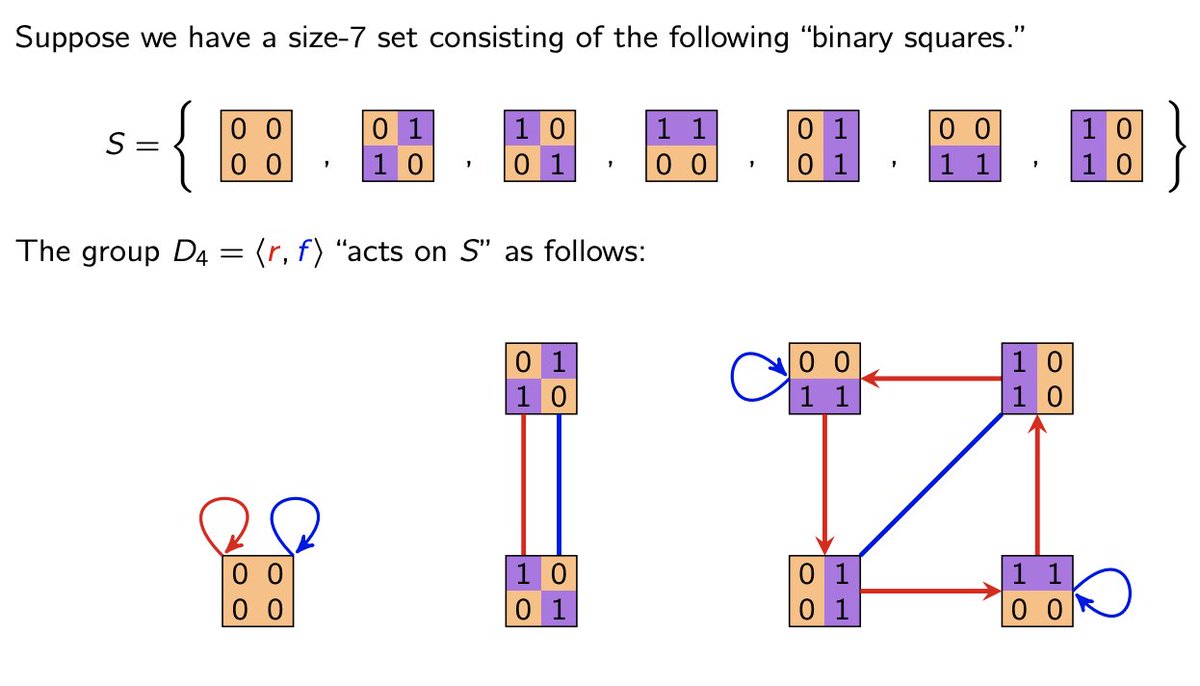
This week, I recorded 4 new #VisualAlgebra YouTube videos on group actions. I heavily use the following concepts:
1. G-sets
2. Action graphs
3. Group switchboards
4. Fixed point tables.
Interested? I'll give you a preview here. Please share!
🧵👇1/16
1. G-sets
2. Action graphs
3. Group switchboards
4. Fixed point tables.
Interested? I'll give you a preview here. Please share!
🧵👇1/16

If G acts on S, via ϕ:G→Perm(S), imagine that G has a "group switchboard", w/ a button for each element. Pressing it permutes elements of S, with the rule:
"Pressing the a-button followed by the b-button is the same as pressing the ab-button." This means:
ϕ(a)ϕ(b)=ϕ(ab)
2/16
"Pressing the a-button followed by the b-button is the same as pressing the ab-button." This means:
ϕ(a)ϕ(b)=ϕ(ab)
2/16

A G-set is a set w/ an action. This endows it w/ an algebraic structure.
Many books don't define this, which is a mistake.
Note the difference b/w the G-set vs. action graph, which depends on the generating set.
Lecture 5.1: G-sets & action graphs
3/16
Many books don't define this, which is a mistake.
Note the difference b/w the G-set vs. action graph, which depends on the generating set.
Lecture 5.1: G-sets & action graphs
3/16

The fixed point table of an action ϕ:G→Perm(S) has a checkmark in the (g,s) entry if g fixes s.
We can read the stabilizers off the columns, and the fixators off the rows. These are "dual" concepts.
We should also interpret these using switchboards & action graphs.
4/16
We can read the stabilizers off the columns, and the fixators off the rows. These are "dual" concepts.
We should also interpret these using switchboards & action graphs.
4/16


The kernel of an action is the intersection of the stabilizers. The fixed point set is the intersection of the fixators.
These are dual in the fixed point table. The group switchboard analogy is useful.
Lecture 5.2: Five features of group actions
5/16
These are dual in the fixed point table. The group switchboard analogy is useful.
Lecture 5.2: Five features of group actions
5/16


An important observation is that elements in the same orbit have conjugate stabilizers. Here's a picture for why, the "action graph" interpretation on the right is the most helpful:
If x is a loop from s, and g:s↦s' a path, then g⁻¹xg is a loop from s'
6/16
If x is a loop from s, and g:s↦s' a path, then g⁻¹xg is a loop from s'
6/16

Intuitively, elements in larger orbits tend to have smaller stabilizers, and vice-versa.
Also, more checkmarks in the fixed table lead to more orbits.
These observations can be quantified with the orbit-stabilizer and orbit-counting theorems.
7/16
Also, more checkmarks in the fixed table lead to more orbits.
These observations can be quantified with the orbit-stabilizer and orbit-counting theorems.
7/16


The orbit-stabilizer theorem says that there is a bijection b/w elements in the orbit of s, and cosets of the stabilizer of s.
Here's a visual for why this is true. To prove it, just show that the map below is a bijection.
8/16
Here's a visual for why this is true. To prove it, just show that the map below is a bijection.
8/16

The orbit-counting theorem says the avg # of checkmarks per row (i.e., the avg size of a fixator) is the number of orbits.
It's worth comparing this to our running example of D₄ acting on binary squares.
Lecture 5.3: Two theorems on orbits
9/16
It's worth comparing this to our running example of D₄ acting on binary squares.
Lecture 5.3: Two theorems on orbits
9/16

Next, we'll see 4 examples: a group G acting on...
1. Its elements by multiplication
2. Its elements by conjugation
3. Its subgroups by conjugation
4. Its cosets by multiplication
Here's the first one, and a 1-line proof of Cayley's theorem.
10/16
1. Its elements by multiplication
2. Its elements by conjugation
3. Its subgroups by conjugation
4. Its cosets by multiplication
Here's the first one, and a 1-line proof of Cayley's theorem.
10/16

Here's the action of G on its elements by conjugation.
It's worth characterizing our "five fundamental features":
1. orbits
2. stabilizers
3. fixators
4. kernel
5. fixed point set
11/16
It's worth characterizing our "five fundamental features":
1. orbits
2. stabilizers
3. fixators
4. kernel
5. fixed point set
11/16


Here's the action of G on its subgroups by conjugation.
Once again, we'll characterize our "five fundamental features", and revisit our two theorems on orbits.
It's helpful to superimpose the action graph on the subgroup lattice.
12/16
Once again, we'll characterize our "five fundamental features", and revisit our two theorems on orbits.
It's helpful to superimpose the action graph on the subgroup lattice.
12/16


One of my favorite examples is A₄, and it's something we've seen since Chapter 3.
These last 2 pictures are from an old lecture, way back when we introduced normal subgroups:
Lecture 3.4: Normalizers and normal subgroups
13/16
These last 2 pictures are from an old lecture, way back when we introduced normal subgroups:
Lecture 3.4: Normalizers and normal subgroups
13/16


Our last action is new, but arguably the most important: G acting on cosets of some subgroup H≤G.
Also, *every* transitive G-set is isomorphic to such a G-set!
This is constructed by collapsing the *right* cosets in a Cayley graph.
14/16
Also, *every* transitive G-set is isomorphic to such a G-set!
This is constructed by collapsing the *right* cosets in a Cayley graph.
14/16


**Don't let someone tell you that you can only take the quotient by a subgroup if it's normal!**
You can ALWAYS quotient by the right cosets and get a G-set. If it's normal, that G-set happens to be a group.
[In Ch 3, we constructed G/H by collapsing by *left* cosets.]
15/16
You can ALWAYS quotient by the right cosets and get a G-set. If it's normal, that G-set happens to be a group.
[In Ch 3, we constructed G/H by collapsing by *left* cosets.]
15/16

Here's a summary of our 4 examples actions and the fundamental features.
Please share, I think this will be helpful to algebra students and instructors alike!
Lecture 5.4: Examples of actions
16/16
Please share, I think this will be helpful to algebra students and instructors alike!
Lecture 5.4: Examples of actions
16/16

One more thing! You can find the entire playlist (currently have 45 lectures, am planning about 100) at the following webpage. I have the slides posted as well.
17/16math.clemson.edu/~macaule/visua…
17/16math.clemson.edu/~macaule/visua…
• • •
Missing some Tweet in this thread? You can try to
force a refresh