
🚨🚨 $ASTS WEEK IN REVIEW🚨🚨
Son, are we winning? Apparently, but last week it didn't feel like it. Ligado got signed, the future is bright but macro and FUD separate the men from the boys...that, and more on this week's Weekly...
Son, are we winning? Apparently, but last week it didn't feel like it. Ligado got signed, the future is bright but macro and FUD separate the men from the boys...that, and more on this week's Weekly...

🤗SpaceMobile Cares
The Company respects its shareholders
The Company respects its shareholders
https://x.com/scottwisniews/status/1905084078761623576
📡Ligado Signed
The DA is signed. The implications of this are enormous. ASTS is ever-evolving and capitalizing on opportunities to maximize the value of their innovative technology
The DA is signed. The implications of this are enormous. ASTS is ever-evolving and capitalizing on opportunities to maximize the value of their innovative technology
https://x.com/topsecretstocks/status/1904432604377452967
🛋️Last Week's Weakness: Hedging
Best explanation is usually the simplest
Best explanation is usually the simplest
https://x.com/spacanpanman/status/1904526810668286000
Ligado Upside
You have to understand the alchemy of $ASTS and its tech to why it can capture so much value. It's not like others are not aware of how much this spectrum is worth
You have to understand the alchemy of $ASTS and its tech to why it can capture so much value. It's not like others are not aware of how much this spectrum is worth
https://x.com/PK_Fund/status/1904363748850274784
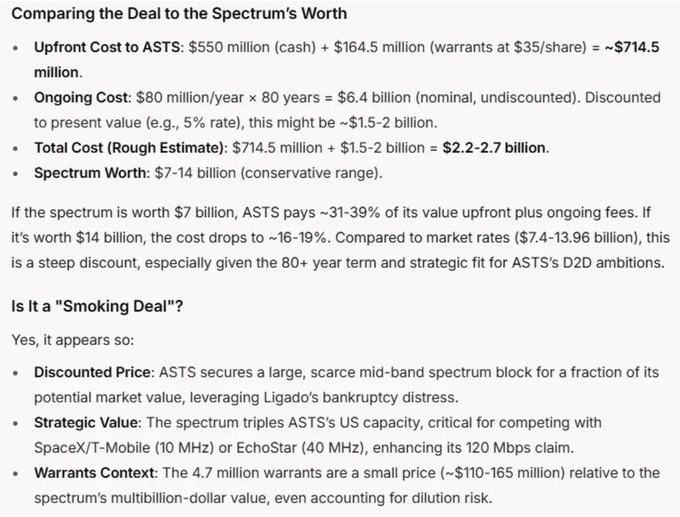
🪙More Gold
What's interesting is now that ASTS controls L-band for the US and can light it up, it might (and should be) the natural consolidator of this spectrum worldwide. The spectrum is impaired for anyone else without access to the US, which gives ASTS a very strong negotiating position to get global lease deals done
What's interesting is now that ASTS controls L-band for the US and can light it up, it might (and should be) the natural consolidator of this spectrum worldwide. The spectrum is impaired for anyone else without access to the US, which gives ASTS a very strong negotiating position to get global lease deals done
https://x.com/spacanpanman/status/1904282342933553340
🤑Monetization Opportunity
This is neat to see a third party study on the consumer's propensity to pay
This is neat to see a third party study on the consumer's propensity to pay
https://x.com/spacanpanman/status/1904135547251023959
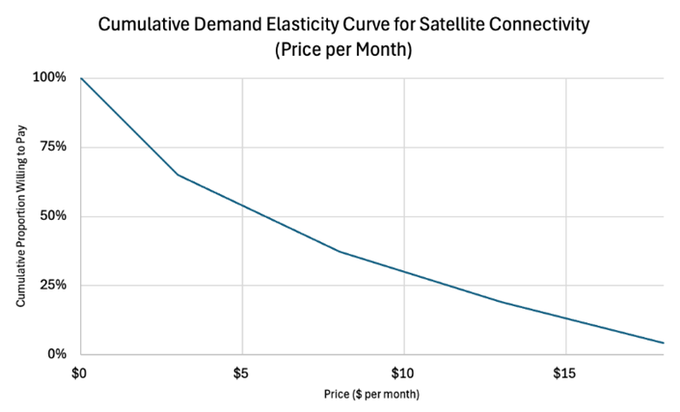
🫰Premium Features and Attach Rates
MNOs are desperate for ARPU growth and have to deliver value
MNOs are desperate for ARPU growth and have to deliver value
https://x.com/pluggingaway/status/1904589914861429113
🥹Sentiment Check
I'm a good barometer of general sentiment. Usually this creates tradeable bottoms.
I'm a good barometer of general sentiment. Usually this creates tradeable bottoms.

🐳But Instant Gratification Is Closer Each Day
It's important to keep perspective, as hard as that might be
It's important to keep perspective, as hard as that might be
https://x.com/alc2022/status/1904879287594819861
🔫Military Uses Coming
Note that ASTS will be connected to MILSATCOM with the optical interlinks.
Note that ASTS will be connected to MILSATCOM with the optical interlinks.
https://x.com/TheodorusAtheos/status/1904650922569195789
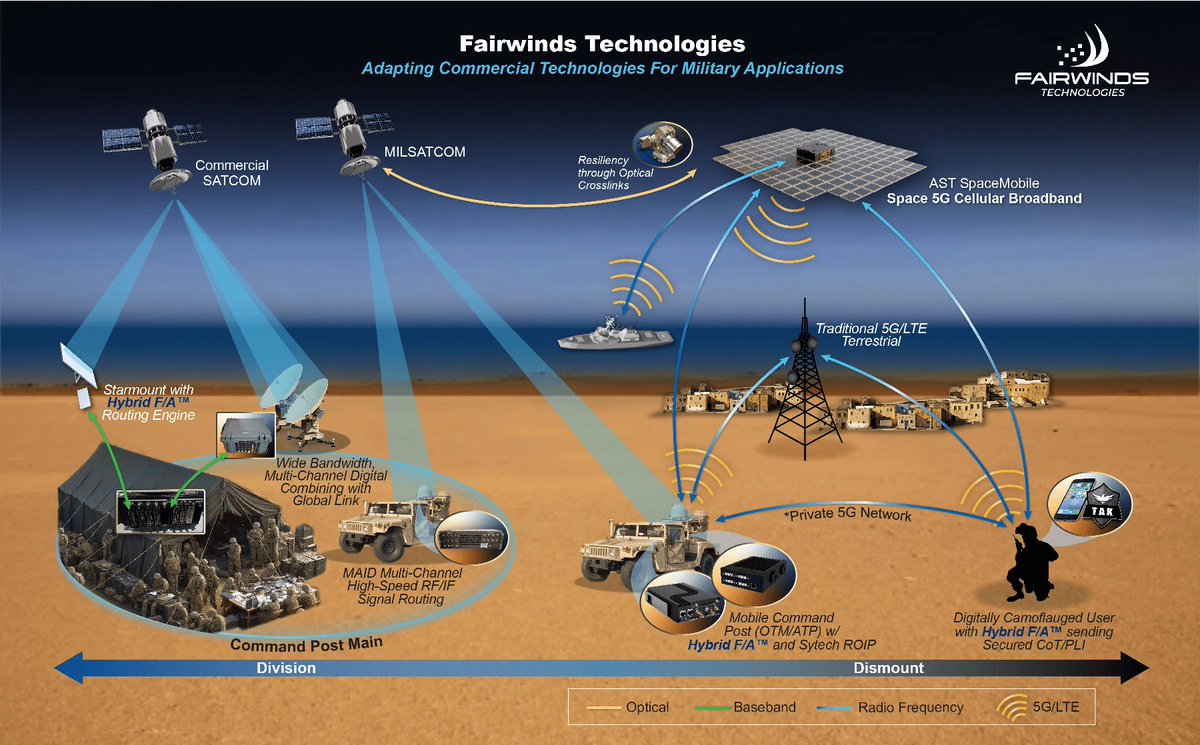
🪖Still Huge Military Opportunity
Fairwinds is out there selling
Fairwinds is out there selling
https://x.com/first1AAA/status/1857156872744128898
🐁Demand for Connectivity is Everywhere
Smaller units will be a good thing
Smaller units will be a good thing
https://x.com/chandan_ganwani/status/1905006153924309255
🔵AT&T Talks about ASTS
AT&T stands ready to support DOD’s mission through our partnership with @AST_SpaceMobile
By combining terrestrial and space-based mobile solutions, AT&T is advancing greater possibilities that provide reliable end-to-end coverage. This partnership will enable our DOD customers to access state-of-the-art commercial solutions that improve network interoperability and agility, for transformative, efficient and effective decision-making to support our warfighters’ needs.
x.com/peterlindmark/…
AT&T stands ready to support DOD’s mission through our partnership with @AST_SpaceMobile
By combining terrestrial and space-based mobile solutions, AT&T is advancing greater possibilities that provide reliable end-to-end coverage. This partnership will enable our DOD customers to access state-of-the-art commercial solutions that improve network interoperability and agility, for transformative, efficient and effective decision-making to support our warfighters’ needs.
x.com/peterlindmark/…
🚑FirstNet Is Coming
We had the FirstNet President say last week a deal had been reached…
We had the FirstNet President say last week a deal had been reached…
https://x.com/CatSE___ApeX___/status/1904993893713637628

🚒FirstNet Coming
3) Most interestingly, "documentation demonstrating FirstNet's consent is forthcoming and will be uploaded into the ELS as an exhibit". I find the wording to #3 interesting. Speculation territory but AST seemed to dodge saying something like "Yes, a spectrum consent letter will be filed". Instead, they chose to vaguely describe the forthcoming exhibit as "documentation demonstrating FirstNet's consent". Will this be a definitive agreement? Or is it just word salad for a consent letter? Stay tuned!
x.com/defiantclient/…
3) Most interestingly, "documentation demonstrating FirstNet's consent is forthcoming and will be uploaded into the ELS as an exhibit". I find the wording to #3 interesting. Speculation territory but AST seemed to dodge saying something like "Yes, a spectrum consent letter will be filed". Instead, they chose to vaguely describe the forthcoming exhibit as "documentation demonstrating FirstNet's consent". Will this be a definitive agreement? Or is it just word salad for a consent letter? Stay tuned!
x.com/defiantclient/…
🗺️FCC Wants More GPS
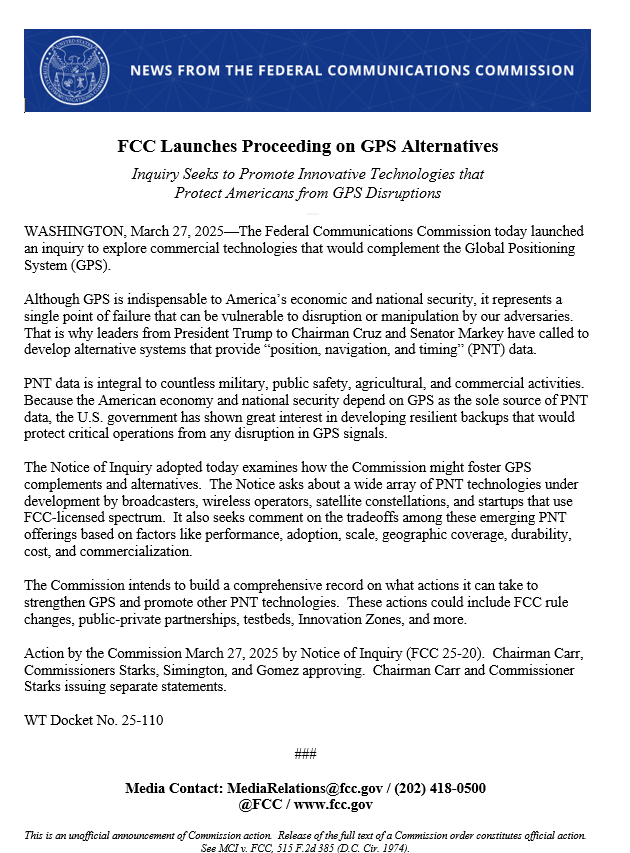
You can bet ASTS is going to show up here.
x.com/PK_Fund/status…
fcc.gov/document/fcc-l…
You can bet ASTS is going to show up here.
x.com/PK_Fund/status…
fcc.gov/document/fcc-l…
❔SDA Questions
Bad headline, but seems like nothing firm yet:
Cramer asked Meink if he thought the move would be a good idea given potential negative effects on smaller “innovators” in the space industrial base. Meink replied that he was unaware of such discussions at the Pentagon, but would be “diving into” the recommendations and making an assessment of “where they’re going” should he be confirmed.
Importantly, if capricious decisions are made - they will get challenged:
SDA is recompeting its Tranche 2 Transport Layer award to Tyvak Nano-Satellite Systems (now owned by Lockheed Martin) following a lawsuit by Viasat.
x.com/Tim_X94/status…
Bad headline, but seems like nothing firm yet:
Cramer asked Meink if he thought the move would be a good idea given potential negative effects on smaller “innovators” in the space industrial base. Meink replied that he was unaware of such discussions at the Pentagon, but would be “diving into” the recommendations and making an assessment of “where they’re going” should he be confirmed.
Importantly, if capricious decisions are made - they will get challenged:
SDA is recompeting its Tranche 2 Transport Layer award to Tyvak Nano-Satellite Systems (now owned by Lockheed Martin) following a lawsuit by Viasat.
x.com/Tim_X94/status…
⚙️Tech Review
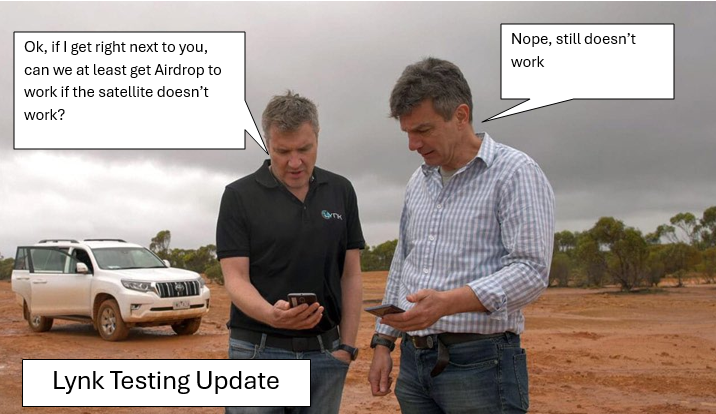
True validation vs parlor tricks
True validation vs parlor tricks
https://x.com/spacanpanman/status/1905659158411489570
🎯More Investors Dig In
Let's normalize $ASTS. Antonio did a great overview that reached a wide audience
Let's normalize $ASTS. Antonio did a great overview that reached a wide audience
https://x.com/alc2022/status/1904542339244150809
📿BEAD Program
The Commerce Department is largely focused on how states can better incorporate alternative technologies, such as unlicensed fixed wireless and Low Earth Orbit (LEO) satellite services, into their overall deployment plans. They are also focused on cost effective deployment of high-speed internet.
We also recognize that in more remote locations across the U.S. that private capital has historically struggled to reach, LEO satellite and unlicensed fixed wireless services are sensible solutions. Satellite technology is particularly useful to terrestrial networks seeking to fill gaps in coverage. In fact, AT&T is using satellite to augment our own mobile network offerings through our agreement with AST SpaceMobile.
attconnects.com/changes-to-bea…
Musk’s Broadband Satellites Have Long-Term Costs, States Say
Summary by Bloomberg AI
The Trump administration is changing the $42 billion Broadband Equity and Access Deployment Program to benefit satellite internet providers like Elon Musk's Starlink, but some state and federal officials worry that satellite technology is not robust enough to connect Americans on a mass scale at affordable rates.
The shift towards satellites is a result of extensive lobbying by Musk and has gained Republican support, but critics argue that satellite service costs consumers more over time and is not as reliable as fiber-optic lines.
The change is raising red flags among state broadband leaders and former officials, who warn that the new approach could lead to worse internet service in rural areas and benefit Starlink at the expense of taxpayers.
By Kelcee Griffis
(Bloomberg) -- The Trump administration is making changes to a $42 billion broadband subsidy program that will benefit satellite internet providers like Elon Musk’s Starlink, but some state and federal officials worry the technology isn’t robust enough to connect Americans on a mass scale and at affordable rates.
The Biden administration’s vision for the Broadband Equity and Access Deployment Program (BEAD), designed to deliver fast, reliable home internet service to every US household, leaned heavily on fiber-optic lines, a technology that’s expensive to install but can last for decades. The shift toward satellites is a result of extensive lobbying by Musk and has gained Republican support, including from Senate Commerce Committee Chairman Ted Cruz.
State and former federal officials, several of whom spoke to Bloomberg on the condition of anonymity, described pitfalls with Commerce Secretary Howard Lutnick’s new approach, which gives more opportunities for satellite terminals that are initially inexpensive, but can cost more over time. One state official shared internal data that showed satellite service costs consumers 53% more over the course of 30 years. Satellite service would also cost more than twice as much to maintain over that time frame, according the data.
“There does not seem to be a clear understanding of the difference in these technologies, nor in the long-term impacts of making one choice versus another,” said Evan Feinman, the former director of the broadband program under Biden, who left the Commerce Department this month.
Lutnick said recently that he was reviewing the BEAD program, which was approved by Congress in 2021, due to the previous administration’s “favoritism towards certain technologies.” Lutnick’s department, which also cited a lack of progress in rolling out the service, is revamping the initiative to give it a more “tech neutral approach” that will deliver internet access “at the lowest cost to taxpayers,” according to a statement from his office.
Howard Lutnick, US commerce secretary, wants to change the Broadband Equity and Access Deployment Program
The change is raising red flags among some state broadband leaders who distribute the federal subsidies, and former officials at the National Telecommunications and Information Administration, the Commerce branch leading the effort.
Under the original plan, satellite providers were generally only allowed to compete to provide access if the cost of installing fiber exceeded a certain cost per location, a threshold states were allowed to determine themselves. Louisiana, for example, is prepared to spend as much as $100,000 on a single fiber connection.
Lutnick is mulling whether to remove that discretion and set a national benchmark, Feinman said, among other options for reforming the program. Any formula that emphasizes the lowest initial cost to the government will rely heavily on satellites, state and federal officials said.
Read more: Musk’s Starlink Pushed by GOP for $42 Billion Broadband Buildout
“The BEAD program is being revamped to take a technology-neutral approach – a needed fix from the prior administration’s one-size-fits-all approach,” said a spokesperson for the National Telecommunications and Information Administration, which is in charge of the program. “Instead of putting a thumb on the scale for a particular technology, the BEAD program will be rigorously driven by outcomes, so states can provide internet access for the lowest cost.”
Fiber, which involves stringing cable to a user’s home, costs at least $1,500 per location to install, according to an analysis shared by one state broadband official who asked not to be identified. However, costs can vary widely depending on where a home is located and how much existing infrastructure surrounds it, among other factors. Texas estimates it can build fiber to a home for roughly $10,000.
By contrast, Starlink, which is part of Musk’s Space Exploration Technologies Inc., offers a standard residential kit for around $600, though those costs too can fluctuate.
But Starlink’s satellites need replacing every five years, making their total cost to consumers much higher in the long run, according to the state analysis. Fiber’s overall cost to serve a quarter-million homes is roughly $4 billion less than satellite service over 30 years, according to the state analysis, and would save an individual household $15,600 over the same period.
A shift toward satellite generally translates into profit for Starlink, which is one of two low-earth orbit satellite providers that’s operational in the US right now, with 7,000 satellites. The other, Eutelsat Communications SA’s OneWeb, has 630 satellites in orbit. Amazon.com Inc.’s Project Kuiper plans to launch its first satellites later this year and emerge as another competitor, although the company has faced recent setbacks to its rollout. The Wall Street Journal reported that Starlink is in line to receive $4.1 billion under the current Biden-era BEAD rules, but that a change to favor more satellite use could steer $10 billion to $20 billion to the company.
As a final missive in his old role, Feinman sent an email to colleagues warning that the Commerce Department is on a collision course to “stranding all or part of rural America with worse internet so that we can make the world’s richest man even richer.”
SpaceX, Amazon and OneWeb didn’t respond to a request for comment.
Any new federal edict that caps state spending on fiber will require states to renegotiate contracts and potentially delay the program by another year to 18 months, a state official said. States like West Virginia and Missouri, which recently finished selecting infrastructure partners, would be sent back to the drawing board even though the former plans to connect the entire state with fiber, and the latter will reach the vast majority of the state with the technology while remaining within their budgets.
There are other reasons the original BEAD program favored fiber networks. Fiber delivers high speeds at lower latency levels than satellites, which can suffer from network congestion and environmental interference, according to the state data.
Fiber is capable of achieving one gigabit upload and download speeds, enough to stream high-definition videos on multiple devices, transmit large files and run nearly a dozen smart home devices at once without any buffering. Starlink’s standard home service offers 100 megabits per second download and 20 mbps upload speeds — the Federal Communications Commission’s baseline for modern internet speeds — which is typically enough to support some high-quality streaming across several devices and fast file downloads.
State leaders also like fiber projects for their local economic impact. Whereas satellite infrastructure concentrates economic growth in manufacturing centers, fiber builds rely on workers inside a community to install and maintain the networks.
Satellite broadband proponents note that the industry is rapidly adding capacity as more satellites come online, and government subsidies typically help fiber providers keep their consumer prices low — something satellite internet doesn’t yet benefit from.
“There are multiple satellite companies that are capable of providing broadband today,” said Tom Stroup, president of the Satellite Industry Association. “We’re hopeful that the examinations that are underway will make multiple satellite companies eligible for funding.”
A Starlink satellite on the roof of a home in Galisteo, New Mexico,
Starlink applied several years ago for nearly $900 million in subsidies from the FCC’s Rural Digital Opportunity Fund, but was denied because the agency found Musk’s company hadn’t shown it could fulfill the requirements to deploy a network of the scale required.
The Starlink system has expanded since then and Musk has aggressive plans to build it out even further. But the saga left a lingering question of whether the company is being realistic about its capabilities, according to another state official who asked not to be identified.
Federal and state officials have been quick to say they don’t believe Starlink is inherently a bad company or that low-earth orbit satellite internet isn’t good technology. They just don’t see it as the best solution for connecting large swaths of the country.
Satellite service was always expected to “be a big part of the program and a necessary part of the program,” said Alan Davidson, the former NTIA head who oversaw the Biden administration’s rollout of the program. “We just wanted to give states the flexibility to choose how much.”
Amazon’s Project Kuiper is already included in Nevada’s broadband infrastructure plan and many other states plan to cover a small percentage of their hard-to-reach areas with satellite service.
The nonprofit Information Technology and Innovation Foundation said in paper published in January that states could provide cheaper service in many locations with Starlink, and it suggested fiber spending shouldn’t exceed $1,200 per location — twice the cost of a Starlink terminal at the time.
Ellis Scherer, one of the paper’s authors, said that the group is generally hopeful that other technologies will get a fair shot at competing for funding with the addition of reasonable financial guardrails. He suggested that $75,000 or more is too much to spend on a single fiber location.
“Our biggest concern is that there’s not egregious spending on fiber just for fiber’s sake,” he said in an interview.
Arielle Roth, who is poised to shape the future of the BEAD program as the next nominated NTIA head, is scheduled to appear for a confirmation hearing on March 27 where her policies will take center stage. Roth has publicly criticized the program and said it should be technology neutral.
In the meantime, states are left in a holding pattern, with several unable to begin building approved projects until regulators in Washington sign off on their final budgets. Others are left wondering whether they should continue selecting infrastructure partners amid the uncertainty.
There’s still time to tweak the program without impeding states’ progress or forcing them to prioritize satellite in areas where it doesn’t make sense, Feinman said.
The Commerce Department is largely focused on how states can better incorporate alternative technologies, such as unlicensed fixed wireless and Low Earth Orbit (LEO) satellite services, into their overall deployment plans. They are also focused on cost effective deployment of high-speed internet.
We also recognize that in more remote locations across the U.S. that private capital has historically struggled to reach, LEO satellite and unlicensed fixed wireless services are sensible solutions. Satellite technology is particularly useful to terrestrial networks seeking to fill gaps in coverage. In fact, AT&T is using satellite to augment our own mobile network offerings through our agreement with AST SpaceMobile.
attconnects.com/changes-to-bea…
Musk’s Broadband Satellites Have Long-Term Costs, States Say
Summary by Bloomberg AI
The Trump administration is changing the $42 billion Broadband Equity and Access Deployment Program to benefit satellite internet providers like Elon Musk's Starlink, but some state and federal officials worry that satellite technology is not robust enough to connect Americans on a mass scale at affordable rates.
The shift towards satellites is a result of extensive lobbying by Musk and has gained Republican support, but critics argue that satellite service costs consumers more over time and is not as reliable as fiber-optic lines.
The change is raising red flags among state broadband leaders and former officials, who warn that the new approach could lead to worse internet service in rural areas and benefit Starlink at the expense of taxpayers.
By Kelcee Griffis
(Bloomberg) -- The Trump administration is making changes to a $42 billion broadband subsidy program that will benefit satellite internet providers like Elon Musk’s Starlink, but some state and federal officials worry the technology isn’t robust enough to connect Americans on a mass scale and at affordable rates.
The Biden administration’s vision for the Broadband Equity and Access Deployment Program (BEAD), designed to deliver fast, reliable home internet service to every US household, leaned heavily on fiber-optic lines, a technology that’s expensive to install but can last for decades. The shift toward satellites is a result of extensive lobbying by Musk and has gained Republican support, including from Senate Commerce Committee Chairman Ted Cruz.
State and former federal officials, several of whom spoke to Bloomberg on the condition of anonymity, described pitfalls with Commerce Secretary Howard Lutnick’s new approach, which gives more opportunities for satellite terminals that are initially inexpensive, but can cost more over time. One state official shared internal data that showed satellite service costs consumers 53% more over the course of 30 years. Satellite service would also cost more than twice as much to maintain over that time frame, according the data.
“There does not seem to be a clear understanding of the difference in these technologies, nor in the long-term impacts of making one choice versus another,” said Evan Feinman, the former director of the broadband program under Biden, who left the Commerce Department this month.
Lutnick said recently that he was reviewing the BEAD program, which was approved by Congress in 2021, due to the previous administration’s “favoritism towards certain technologies.” Lutnick’s department, which also cited a lack of progress in rolling out the service, is revamping the initiative to give it a more “tech neutral approach” that will deliver internet access “at the lowest cost to taxpayers,” according to a statement from his office.
Howard Lutnick, US commerce secretary, wants to change the Broadband Equity and Access Deployment Program
The change is raising red flags among some state broadband leaders who distribute the federal subsidies, and former officials at the National Telecommunications and Information Administration, the Commerce branch leading the effort.
Under the original plan, satellite providers were generally only allowed to compete to provide access if the cost of installing fiber exceeded a certain cost per location, a threshold states were allowed to determine themselves. Louisiana, for example, is prepared to spend as much as $100,000 on a single fiber connection.
Lutnick is mulling whether to remove that discretion and set a national benchmark, Feinman said, among other options for reforming the program. Any formula that emphasizes the lowest initial cost to the government will rely heavily on satellites, state and federal officials said.
Read more: Musk’s Starlink Pushed by GOP for $42 Billion Broadband Buildout
“The BEAD program is being revamped to take a technology-neutral approach – a needed fix from the prior administration’s one-size-fits-all approach,” said a spokesperson for the National Telecommunications and Information Administration, which is in charge of the program. “Instead of putting a thumb on the scale for a particular technology, the BEAD program will be rigorously driven by outcomes, so states can provide internet access for the lowest cost.”
Fiber, which involves stringing cable to a user’s home, costs at least $1,500 per location to install, according to an analysis shared by one state broadband official who asked not to be identified. However, costs can vary widely depending on where a home is located and how much existing infrastructure surrounds it, among other factors. Texas estimates it can build fiber to a home for roughly $10,000.
By contrast, Starlink, which is part of Musk’s Space Exploration Technologies Inc., offers a standard residential kit for around $600, though those costs too can fluctuate.
But Starlink’s satellites need replacing every five years, making their total cost to consumers much higher in the long run, according to the state analysis. Fiber’s overall cost to serve a quarter-million homes is roughly $4 billion less than satellite service over 30 years, according to the state analysis, and would save an individual household $15,600 over the same period.
A shift toward satellite generally translates into profit for Starlink, which is one of two low-earth orbit satellite providers that’s operational in the US right now, with 7,000 satellites. The other, Eutelsat Communications SA’s OneWeb, has 630 satellites in orbit. Amazon.com Inc.’s Project Kuiper plans to launch its first satellites later this year and emerge as another competitor, although the company has faced recent setbacks to its rollout. The Wall Street Journal reported that Starlink is in line to receive $4.1 billion under the current Biden-era BEAD rules, but that a change to favor more satellite use could steer $10 billion to $20 billion to the company.
As a final missive in his old role, Feinman sent an email to colleagues warning that the Commerce Department is on a collision course to “stranding all or part of rural America with worse internet so that we can make the world’s richest man even richer.”
SpaceX, Amazon and OneWeb didn’t respond to a request for comment.
Any new federal edict that caps state spending on fiber will require states to renegotiate contracts and potentially delay the program by another year to 18 months, a state official said. States like West Virginia and Missouri, which recently finished selecting infrastructure partners, would be sent back to the drawing board even though the former plans to connect the entire state with fiber, and the latter will reach the vast majority of the state with the technology while remaining within their budgets.
There are other reasons the original BEAD program favored fiber networks. Fiber delivers high speeds at lower latency levels than satellites, which can suffer from network congestion and environmental interference, according to the state data.
Fiber is capable of achieving one gigabit upload and download speeds, enough to stream high-definition videos on multiple devices, transmit large files and run nearly a dozen smart home devices at once without any buffering. Starlink’s standard home service offers 100 megabits per second download and 20 mbps upload speeds — the Federal Communications Commission’s baseline for modern internet speeds — which is typically enough to support some high-quality streaming across several devices and fast file downloads.
State leaders also like fiber projects for their local economic impact. Whereas satellite infrastructure concentrates economic growth in manufacturing centers, fiber builds rely on workers inside a community to install and maintain the networks.
Satellite broadband proponents note that the industry is rapidly adding capacity as more satellites come online, and government subsidies typically help fiber providers keep their consumer prices low — something satellite internet doesn’t yet benefit from.
“There are multiple satellite companies that are capable of providing broadband today,” said Tom Stroup, president of the Satellite Industry Association. “We’re hopeful that the examinations that are underway will make multiple satellite companies eligible for funding.”
A Starlink satellite on the roof of a home in Galisteo, New Mexico,
Starlink applied several years ago for nearly $900 million in subsidies from the FCC’s Rural Digital Opportunity Fund, but was denied because the agency found Musk’s company hadn’t shown it could fulfill the requirements to deploy a network of the scale required.
The Starlink system has expanded since then and Musk has aggressive plans to build it out even further. But the saga left a lingering question of whether the company is being realistic about its capabilities, according to another state official who asked not to be identified.
Federal and state officials have been quick to say they don’t believe Starlink is inherently a bad company or that low-earth orbit satellite internet isn’t good technology. They just don’t see it as the best solution for connecting large swaths of the country.
Satellite service was always expected to “be a big part of the program and a necessary part of the program,” said Alan Davidson, the former NTIA head who oversaw the Biden administration’s rollout of the program. “We just wanted to give states the flexibility to choose how much.”
Amazon’s Project Kuiper is already included in Nevada’s broadband infrastructure plan and many other states plan to cover a small percentage of their hard-to-reach areas with satellite service.
The nonprofit Information Technology and Innovation Foundation said in paper published in January that states could provide cheaper service in many locations with Starlink, and it suggested fiber spending shouldn’t exceed $1,200 per location — twice the cost of a Starlink terminal at the time.
Ellis Scherer, one of the paper’s authors, said that the group is generally hopeful that other technologies will get a fair shot at competing for funding with the addition of reasonable financial guardrails. He suggested that $75,000 or more is too much to spend on a single fiber location.
“Our biggest concern is that there’s not egregious spending on fiber just for fiber’s sake,” he said in an interview.
Arielle Roth, who is poised to shape the future of the BEAD program as the next nominated NTIA head, is scheduled to appear for a confirmation hearing on March 27 where her policies will take center stage. Roth has publicly criticized the program and said it should be technology neutral.
In the meantime, states are left in a holding pattern, with several unable to begin building approved projects until regulators in Washington sign off on their final budgets. Others are left wondering whether they should continue selecting infrastructure partners amid the uncertainty.
There’s still time to tweak the program without impeding states’ progress or forcing them to prioritize satellite in areas where it doesn’t make sense, Feinman said.
🥳UK Confirms Inside Date for Service
UK first country in Europe to move ahead with innovative plans for standard smartphones to make satellite calls. Ofcom proposals would enable mobile networks and satellite operators to connect customers from space. People and businesses in hard-to-reach areas to benefit most
UK first country in Europe to move ahead with innovative plans for standard smartphones to make satellite calls. Ofcom proposals would enable mobile networks and satellite operators to connect customers from space. People and businesses in hard-to-reach areas to benefit most
https://x.com/kingtutcap/status/1904562865995931749
🕵️Blackbirds Might Be Cloaked
I could see the case where AST might not disclose their involvement. Yes, it's good for the stock price to pump it up. But if they aren't issuing equity (a question mark), then keeping under the radar might have benefits as they seek to move fast without drawing attention
spacenews.com/companies-in-t…
I could see the case where AST might not disclose their involvement. Yes, it's good for the stock price to pump it up. But if they aren't issuing equity (a question mark), then keeping under the radar might have benefits as they seek to move fast without drawing attention
spacenews.com/companies-in-t…
🙋♂️Me Second Mentality
Kevin nailed it. This is why constant research and normalization matters. People want to make sure the water is warm.
Kevin nailed it. This is why constant research and normalization matters. People want to make sure the water is warm.
https://x.com/KevinLMak/status/1904360534201278927
🍎What is Apple Doing??
Apple are driving standardisation of 5G NTN for every MSS band in existence (apparently even without the spectrum holders' backing) with the likely goal to create an open D2D ecosystem. Rather than protecting their investment in Globalstar, they are fostering a competitive D2D landscape with multiple operators and universal handset compatibility.
x.com/Megaconstellat…
x.com/Megaconstellat…
Apple are driving standardisation of 5G NTN for every MSS band in existence (apparently even without the spectrum holders' backing) with the likely goal to create an open D2D ecosystem. Rather than protecting their investment in Globalstar, they are fostering a competitive D2D landscape with multiple operators and universal handset compatibility.
x.com/Megaconstellat…
x.com/Megaconstellat…
💩Tim FUD
Fear mongering. Remember that AT&T, Verizon, Vodafone have talked about the extensive cooperation of their engineering teams and the extensive testing.
Fear mongering. Remember that AT&T, Verizon, Vodafone have talked about the extensive cooperation of their engineering teams and the extensive testing.
https://x.com/ASTS_Investors/status/1905343985289494843
🌞"Hearing" is Code for "Start Random Rumor"
Tut shines light on BS
Tut shines light on BS
https://x.com/kingtutcap/status/1905312485772566725
Plan on Spaces tonight at 8:05 PST / 11:05 EST.

• • •
Missing some Tweet in this thread? You can try to
force a refresh






