“Ruination Day”: The new Economist cover amid Trump’s tariff war.
Trump has launched a global trade war, calling it a “Liberation Day.” As an economist, I know a thing or two about tariffs. So here are some predictions of what we should expect if this tariff war continues.
1/n
2/ First, let’s clarify what tariffs will not do:
- Tariffs will not fix the U.S. trade deficit. That’s simply wishful thinking. Tariffs will reduce both exports and imports, leaving the overall balance of trade largely unchanged.
3/ - Tariffs will not rebuild U.S. manufacturing. First, tariffs will make American exports less competitive in global markets. Second, tariffs will put upward pressure on the U.S. dollar, making U.S. goods more expensive to foreign buyers.
4/ As a result, it will become costly to produce “American products” — and nobody will want to buy them.
5/ Now, what will likely happen if tariffs persist:
- Americans will pay higher prices. Tariffs are a tax on domestic consumers. They raise the cost of imported goods, and that cost is passed on to Americans as inflation.
6/ - Other countries will retaliate. This will hurt American companies that sell products abroad — which includes nearly all major U.S. firms.
7/ - Reduced consumer choice. Some products will become too expensive or unavailable altogether, disappearing from store shelves.
8/ - Significant job losses in export-dependent industries. Sectors like agriculture and manufacturing will be hit hard.
9/ - Major supply chain disruptions. Many businesses rely on cheaper inputs from abroad. With tariffs, they’ll be forced to find more expensive alternatives, driving up costs and reducing competitiveness.
10/ - Slower economic growth — or even a recession. When you add it all up — higher prices, job losses, disrupted trade — the result is likely to be a significant economic slowdown.
• • •
Missing some Tweet in this thread? You can try to
force a refresh

I was recently cleaning up my Twitter account and noticed that some U.S. professors who are originally from russia had stopped following me. I couldn’t care less. But it is very telling.
1/n
2/ People in the West still believe in the russian opposition and the “good russians” hypothesis. They think that, somehow, it is all Putin’s fault. In reality, Putin is just a symptom of a much bigger problem, called “russian imperialism” or “great russian culture.”
3/ “Good russians” jubilantly cheer in the streets, welcoming the genocide of their neighbors.
“Good russians” openly dance and celebrate with russian flags in European countries while systematically attacking Ukrainian immigrants.
Satellite images prove that a russian LNG ship transferred cargo to a Chinese tanker off Malaysia.
1/n
2/ On October 18, 2025, a russian LNG tanker named Perle transferred approximately 170,000 cubic meters of liquefied natural gas — originating from the US-sanctioned russian Portovaya LNG facility in the Baltic Sea — to the Chinese tanker CCH Gas.
3/ The ship-to-ship transfer took place about 90 kilometers east of the Malaysian Peninsula, in international waters off Malaysia’s coast.
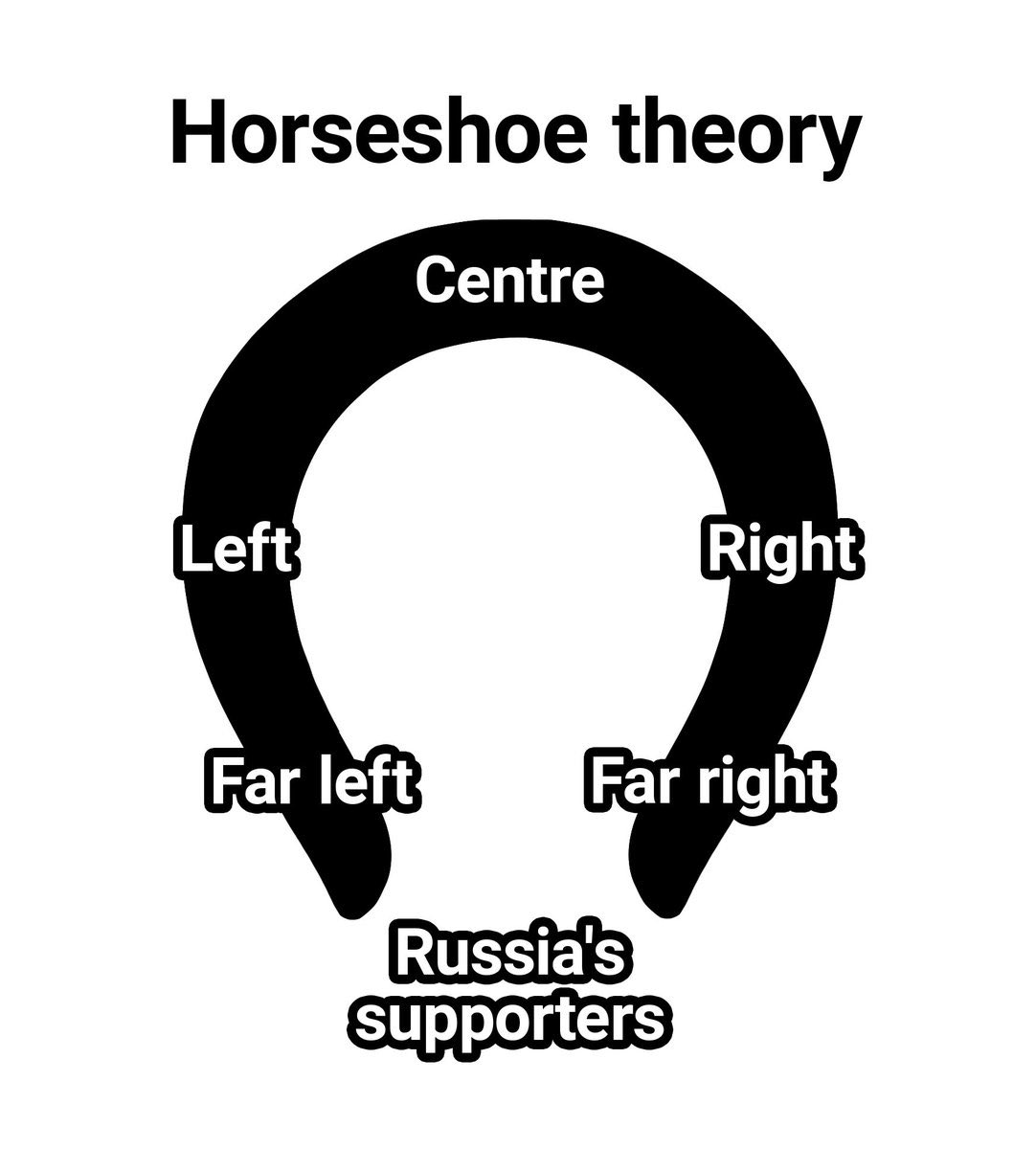
Far-right and far-left are often portrayed as polar opposites. In reality, they are two sides of the same coin. The fact that both are sympathetic to russia is just another nail in this coffin.
In political science, this is known as horseshoe theory.
1/n
2/ Horseshoe theory - an idea that the far left and right, rather than being at opposite ends of a straight line, actually curve toward one another like a horseshoe. They mirror each other in their rejection of the center and willingness to excuse or enable authoritarian regime.
3/ The clearest historical example is the Molotov–Ribbentrop Pact, when Nazi Germany and the Soviet Union signed a non-aggression agreement that allowed them to divide Poland between them.
In some sinister way, I think that many Europeans quietly hope the war between russia and Ukraine doesn’t end soon.
1/n
2/ Because once the war ends, russian troops will not simply disappear — they’ll move. The garrisons now pinned down in Eastern Ukraine will redeploy to Finland, to the Baltic borders. And make no mistake — russia will keep producing weapons and expanding its military complex.
3/ Ukraine is ready to defend its borders. Peace will only make Ukraine stronger. But Estonia, Latvia, and Lithuania cannot stop a russian onslaught on their own. Once russian units shift westward, they’ll be facing NATO directly — and Europe will have no more buffer.
That’s what the U.S. Secretary of Defense recently implied by suggesting that women are weaker, less able to handle the stress of war, not made for combat.
But the only problem: he is so completely wrong.
1/n
2/ There soon may come a time when the U.S. military will invite Ukrainian women to train their Marines — because these women have already proven what true courage looks like.
3/ More than 60,000 women now serve in Ukraine’s Armed Forces. Unlike men, they are not required to stay and fight. Under martial law, they could have left the country — but they chose to stay. They volunteered.
Russia will continue to escalate its aggressive actions against NATO countries.
Drones over Poland, military planes over Estonia, espionage and sabotage across other NATO members — all of it is part of a growing pattern.
1/n
2/ There are two reasons for this:
1.A strategic deadlock in Ukraine.
2.The perception that the West is not ready for a real fight — despite its overwhelming economic and demographic advantages.
3/ Yes, the russians have far fewer resources than NATO. And, yes, they’ve been undermined by Ukrainians.
But they see that, psychologically, the West is unprepared. And they will continue escalating their provocations — for now, hybrid and just short of open conflict.