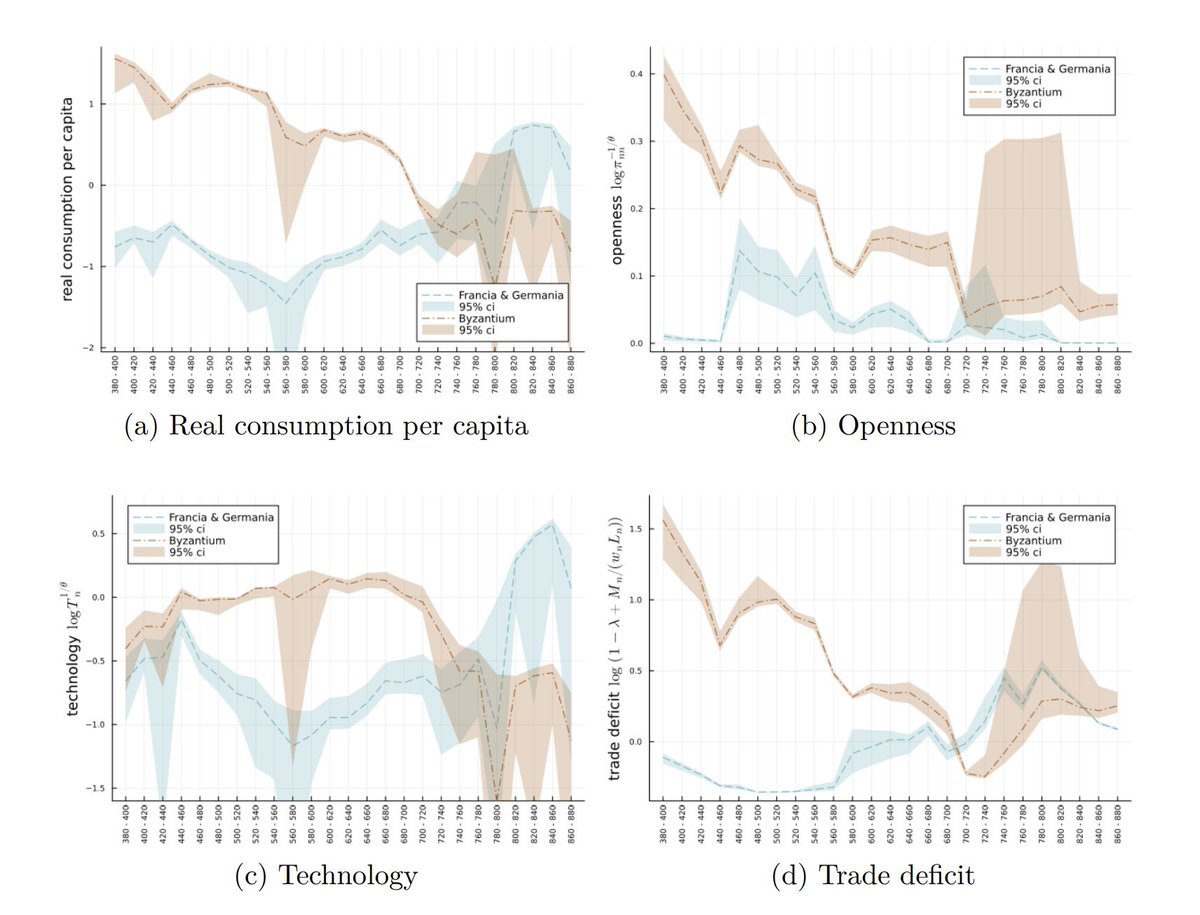
Pirenne's thesis holds that Antiquity—the period when economic activity concentrated in the Mediterranean—ended because the rise of Islam destroyed the flow of trade across it.
The decline in trade that resulted from differences in faith had profound consequences for the economic geography of Europe.
Byzantine economic activity depended on trade, and it collapsed, whereas the Frankish economy, which was never trade-dependent, transformed.
The Byzantines' minting stalled and the Arabs' and Franks' increased (perhaps partly because they were cut off from one another!), providing each of their states with divergent trends in seignorage revenues and a widening gulf in the ability to fund the government.
The decline of antiquity certainly can't be blamed entirely on the Arab conquests, but the collapse of trade resulting from that conflict of faith definitely has some interesting consequences.
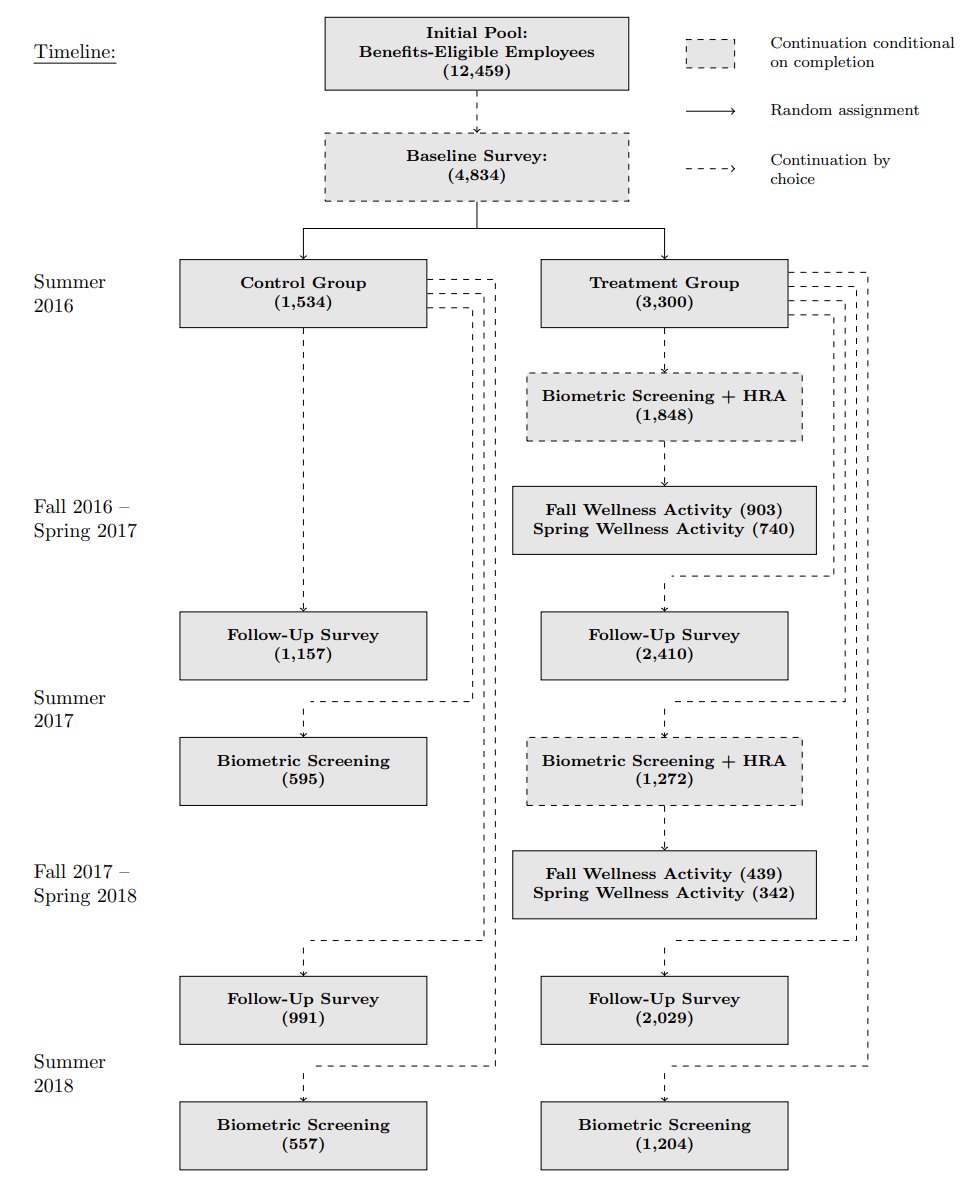
Researchers put together an incredible workplace wellness program that provided thousands of workers with paid time off to receive biometric health screening, health risk assessments, smoking cessation help, stress management, exercise, etc.
What did this do for their health?🧵
So, for starters, this program had a large sample and ran over multiple years.
Because of it, we have evidence on what people do with clinical health info, with exercise encouragement and advice, with nutritional knowledge, through peer effects, and so on.
Participants in the treatment group were prompted to participate with cash rewards ranging from $50 to $350.
Go to screening? Earn some money, help yourself by bolstering your knowledge about yourself and potentially improving your health.
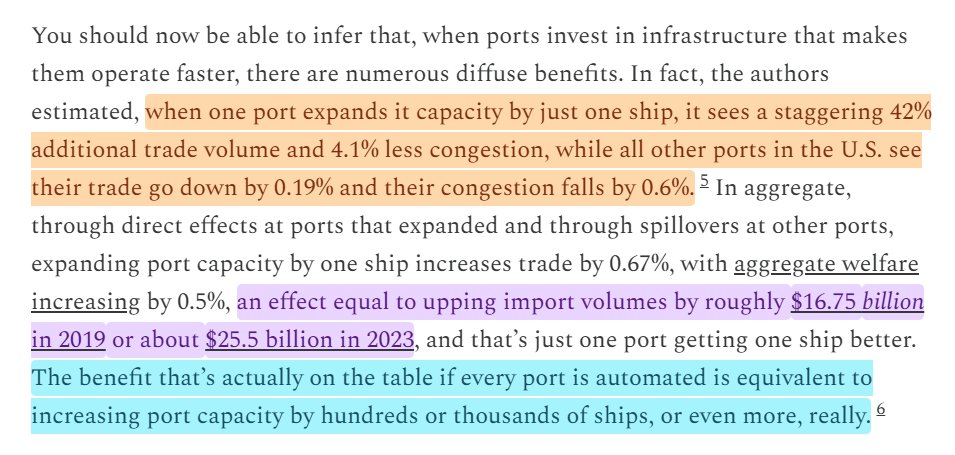
If the Trump administration wants to reshore economic activity, they need to increase the throughput of American ports or America will end up bottlenecked there.
They should subsidize port automation and crush the longshoremen union to make this happen.
Think about the effects:
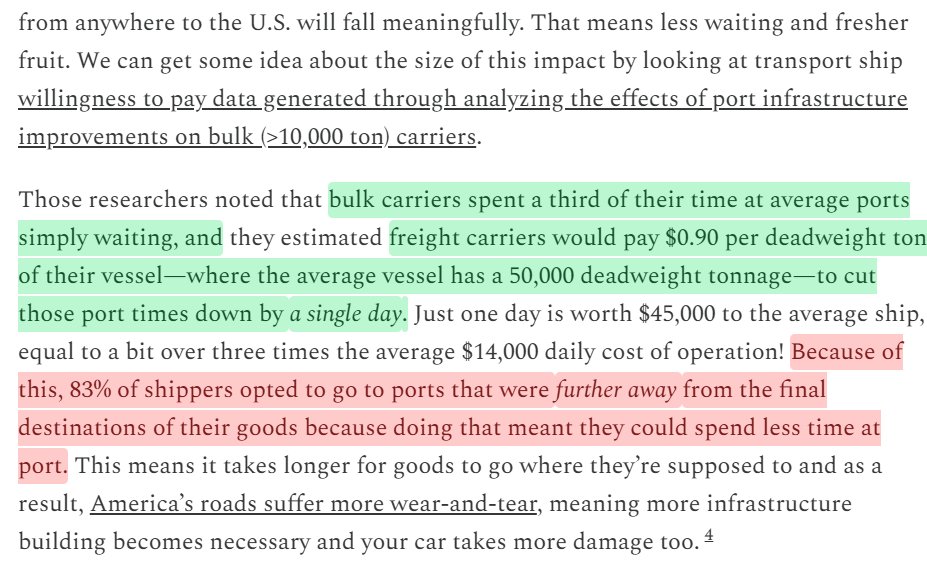
Another thing to keep in mind: knock-on effects!
If ports become more efficient, horrid arrangements like going to more distant ports to avoid waiting would come to an end, or at least be reduced in their extent:
And one more thing to keep in mind:
Skeptics of port automation often cite the need for higher export volumes to justify port automation. Without that, it can take a long time to pay off, and the benefits over a non-automated port might be too small, at least with current tech.
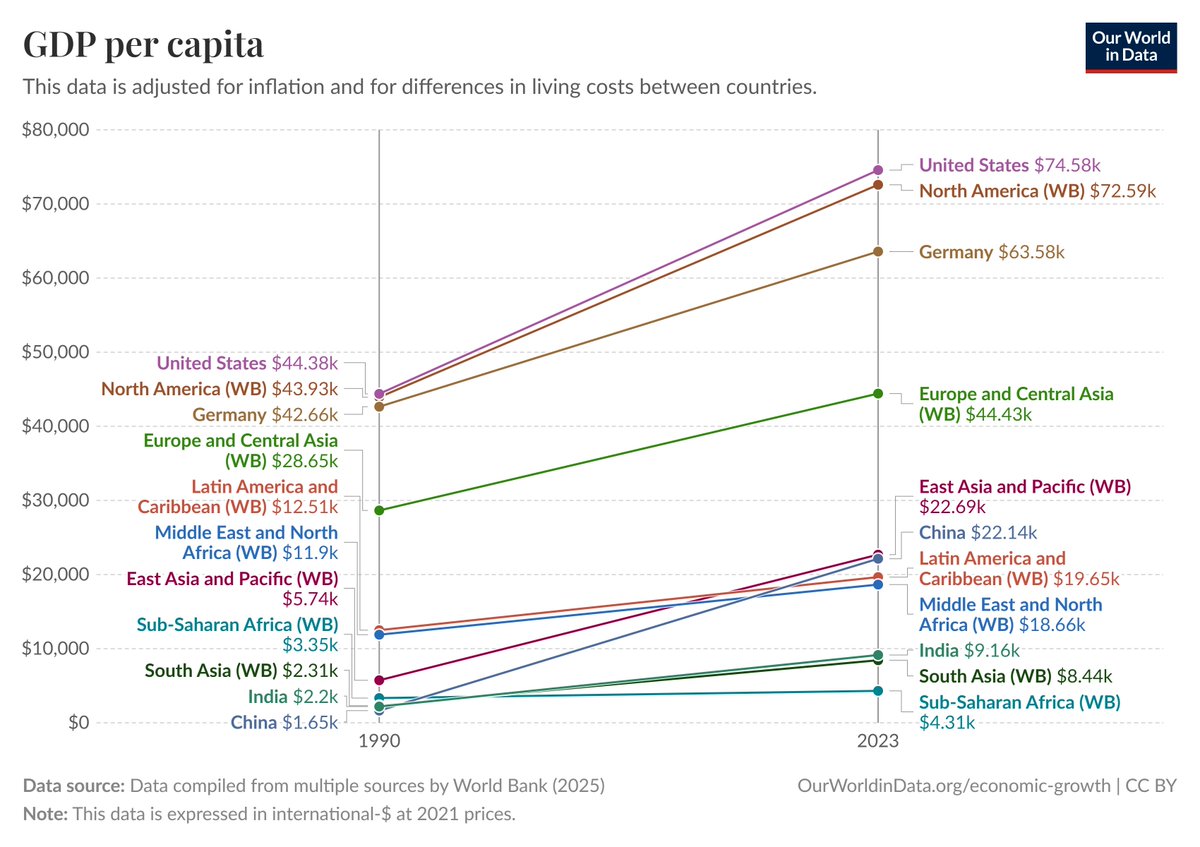
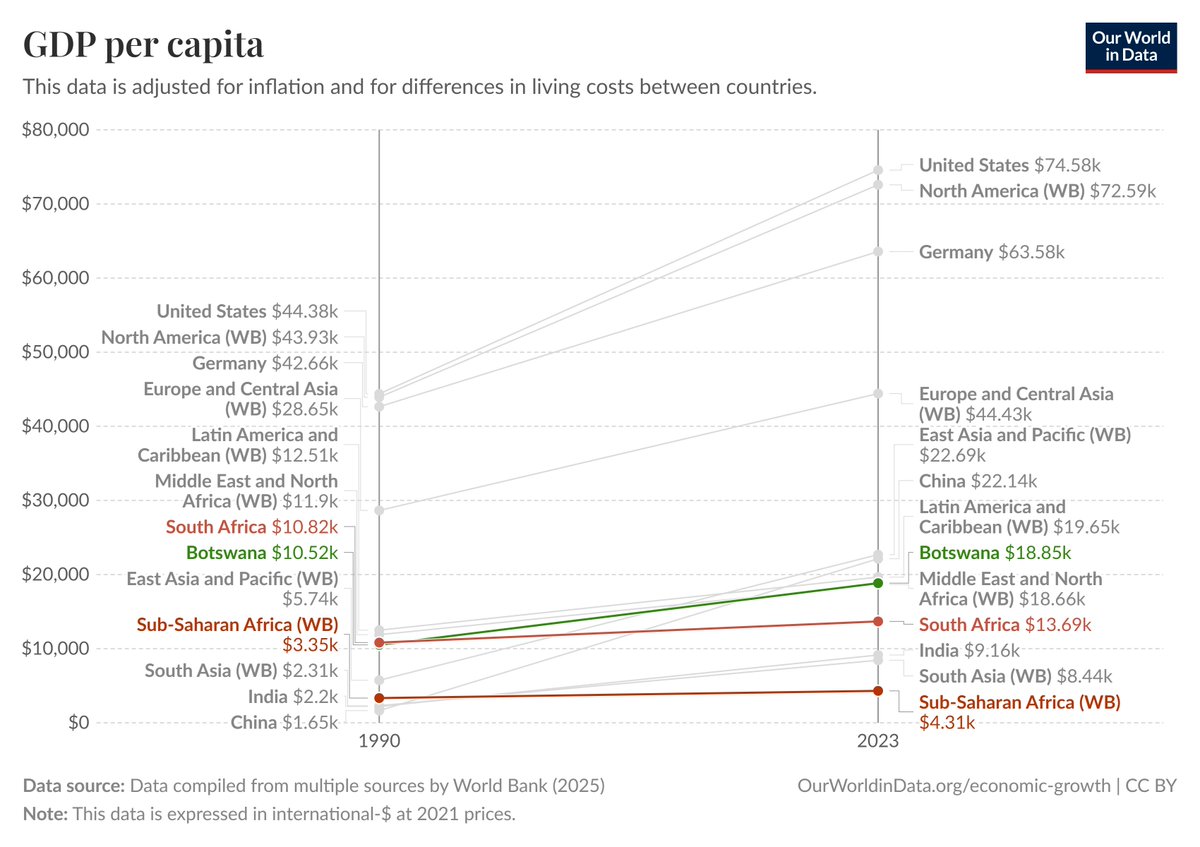
India and China were both poorer than Sub-Saharan Africa in 1990, but they liberalized their economies and pulled away.
Sub-Saharan Africa seemingly refuses to grow and has gained less than $1,000 in GDP PPP per capita over the past three decades.
Sub-Saharan Africa is the world's worst basket-case.
A very large share of the economies in the region are built on foreign aid, and even in relatively-prosperous South Africa, all growth from the 20th to 85th percentiles is due to redistribution!
My hopes are not high for Sub-Saharan Africa for many reasons.
Even the region's stand-out reformer, Botswana, is in a growth regime that's driven by natural resource exports. That has not proven to be sustainable.
The dual-use side of industrialization isn't just about the ability to convert one factory to another type of factory, but also about having the types of workers who know how to do that, and who know how to set up more factories.
Knowledge really does decay. Remember tritium?
With everything nuclear-associated, China has a positive learning curve, meaning that they get better at producing the same things, with the same materials, once they've done it once, twice, thrice, etc.
But in the U.S., nuclear has been neglected; all nuclear knowledge decays.
If you don't build things domestically, it will be harder to start building them domestically when the time comes. You have to have workers around who know what they're doing, and training takes time.
The state of Louisiana has managed to reduce its Hepatitis C death rate by nearly a sixth in just a few years through a clever public health program🧵
Louisiana's success has to do with the recent development of a miraculous change in how Hepatitis C (HCV) is treated.
Prior to 2013, HCV was primarily treated with drugs like interferon and ribavirin, but the drugs were not consistently effective at clearing the virus.
But then the FDA approved the first direct-acting antiviral (DAA), sofosbuvir, a liver-targeting NS5B protein inhibitor that, combined with another protein inhibitor (velpatasvir), is effective in treating 95-99% of HCV patients.
We finally have large-scale cross-sectional functional connectome scans for people aged young and old.
The finding that was most interesting to me in all this is that the brain's functional connectome seems to grow until about age 38, whereafter it starts shrinking.
Ignore the tails, because they're impacted by variance.
But speaking of, it seems that the global variance in the form of the connectome also grows until about age 28, whereafter it starts becoming less variable.
This is really interesting new data, and I'm happy to see it published.
Hopefully in a few decades, we'll have longitudinal data to see if what we see in the cross-section holds up within individuals, too!