
🧵NEW: Our latest paper is a meta-analysis of sex differences in upper- and lower-limb strength in kids aged 5-17 years old (3,497 boys; 3,137 girls).
Before, during, and after puberty, boys are stronger than girls on average. The sex difference in muscle strength is ~10% in 5–10-year-olds and increases to ∼40% in 14–17-year-olds. Throughout development, the sex difference in strength tends to be more pronounced in upper- than lower-limb muscles.
Co-author: @MatheusdPinto
Before, during, and after puberty, boys are stronger than girls on average. The sex difference in muscle strength is ~10% in 5–10-year-olds and increases to ∼40% in 14–17-year-olds. Throughout development, the sex difference in strength tends to be more pronounced in upper- than lower-limb muscles.
Co-author: @MatheusdPinto

2/5. All 299 effect sizes in the analysis. Positive effect sizes to the right of the dashed vertical zero line represent when the group of boys was stronger than the group of girls. Negative effect sizes to the left of the dashed vertical zero line represent when the groups of girls were stronger than the group of boys.

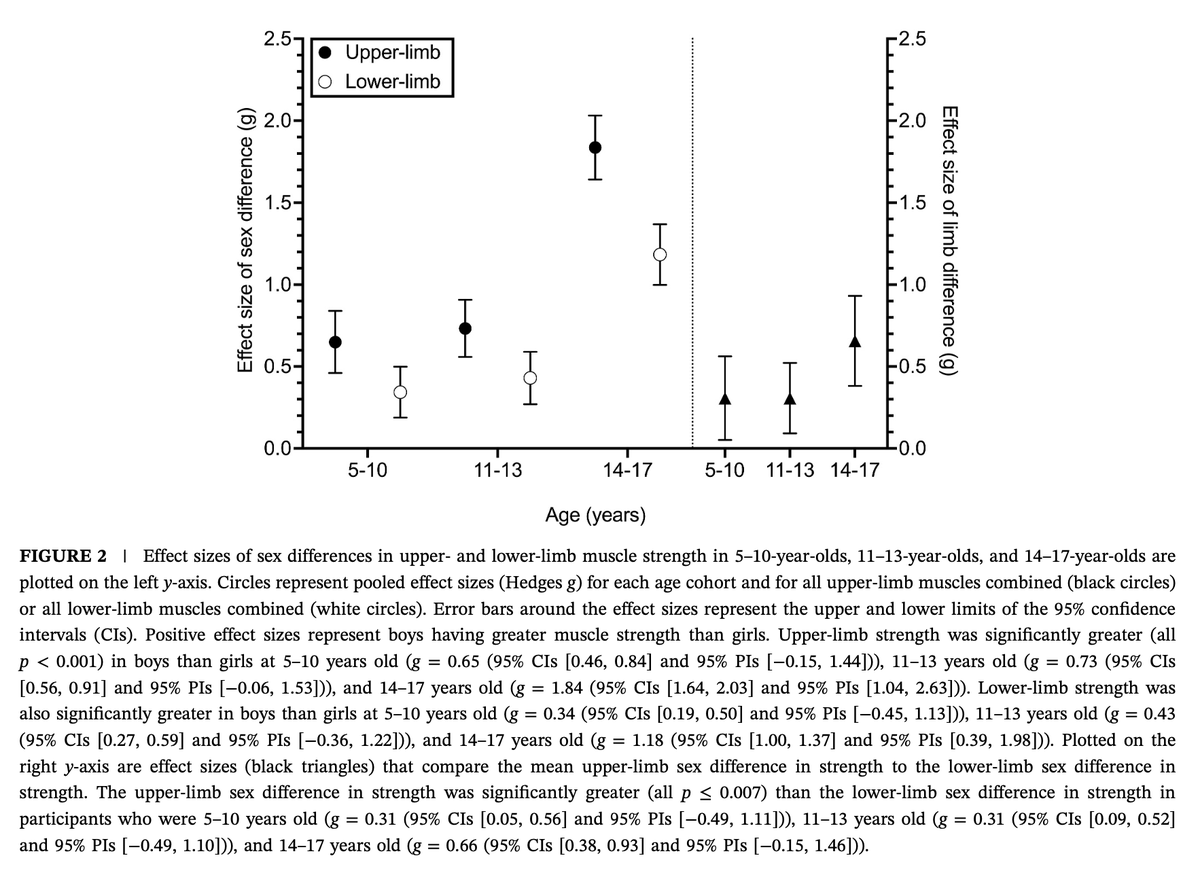
3/5. Effect sizes of sex differences in upper‐ and lower‐limb muscle strength in 5–10‐year‐olds, 11–13‐year‐olds, and 14–17‐year‐olds. Positive effect sizes represent boys having greater muscle strength than girls.
Boys are stronger than girls at all ages. The sex difference in strength tends to be greater in upper- than lower-limb muscles.
Boys are stronger than girls at all ages. The sex difference in strength tends to be greater in upper- than lower-limb muscles.
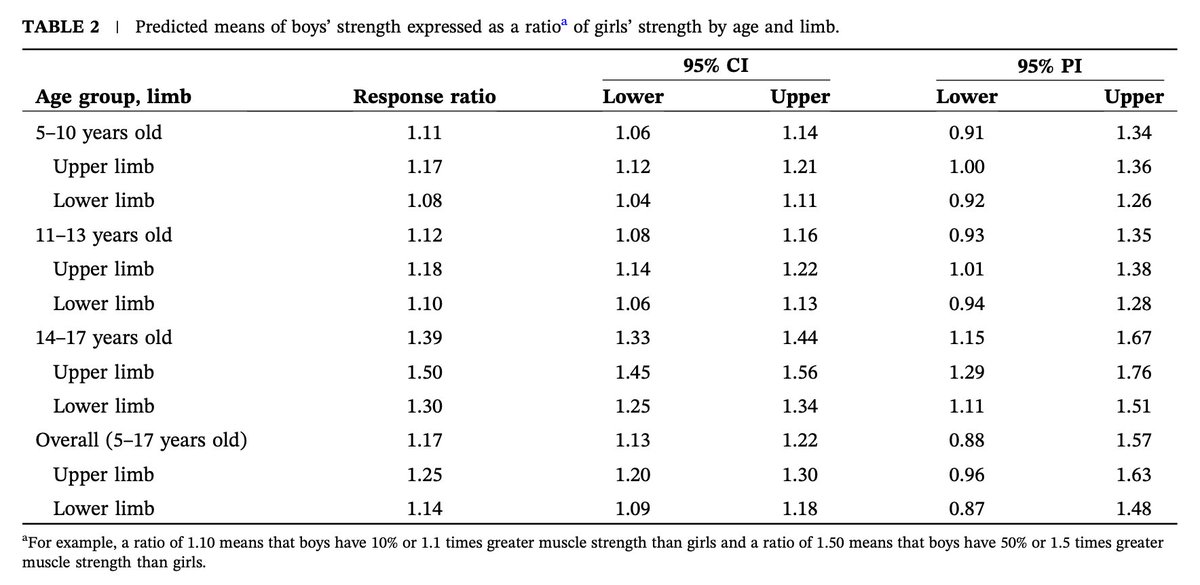
4/5. Table listing boys' strength relative to girls' strength by age and limb. For example, a ratio of 1.10 means that boys have 10% or 1.1 times greater muscle strength than girls, and a ratio of 1.50 means that boys have 50% or 1.5 times greater muscle strength than girls.
5/5. Sex Differences in Upper- and Lower-Limb Muscle Strength in Children and Adolescents: A Meta-Analysis
onlinelibrary.wiley.com/doi/10.1002/ej…
onlinelibrary.wiley.com/doi/10.1002/ej…
• • •
Missing some Tweet in this thread? You can try to
force a refresh




