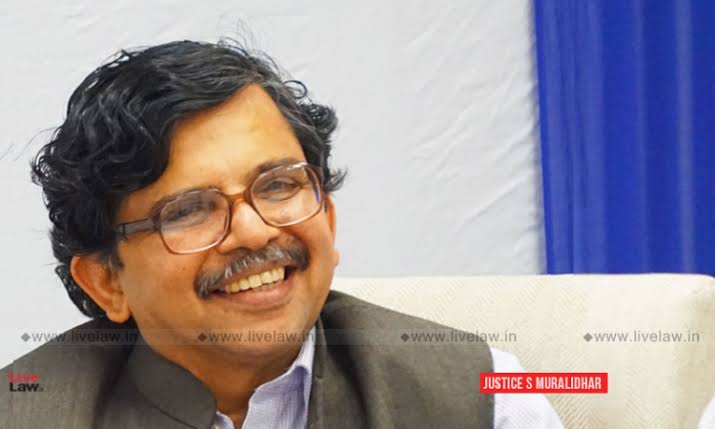
Justice (Retd.) Dr. S. Muralidhar to shortly deliver a lecture on Transformative Constitutionalism and the Role of the Judiciary.
The lecture is organized by Kochi International Foundation and NUALS.
The lecture is organized by Kochi International Foundation and NUALS.
Follow this thread for live updates.
Watch the lecture here:
Watch the lecture here:
Lecture begins.
J Muralidhar begins by playing a clip from a TV series called Samvidhan by Shyam Benegal.
J Muralidhar begins by playing a clip from a TV series called Samvidhan by Shyam Benegal.
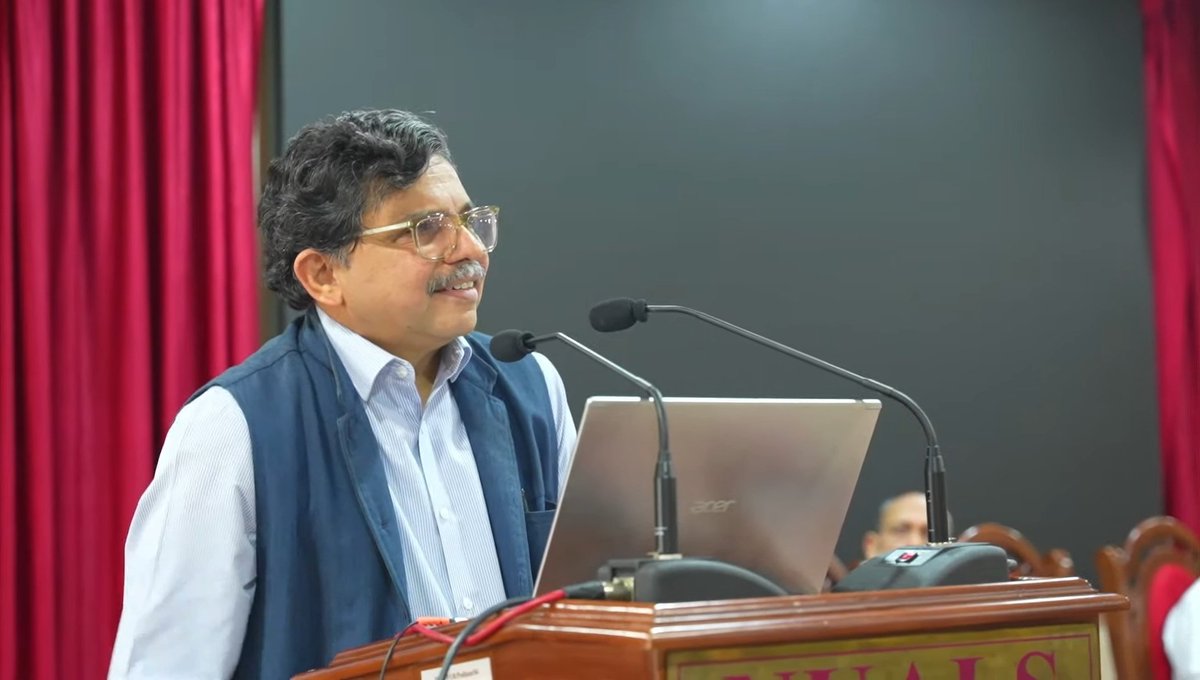
S Muralidhar: That was 26th November 1949. The idea of playing this clip was to show what the concerns were in the minds of the framers of the Constitution. Many of these questions have remained with us even after 75 years of the constitution
S Muralidhar: there is a lot of criticism that our constitution is full of borrowed provisions. The correct way to see that is that the framers studied a lot of constitutions over a period of over 2 years and adapted those provisions which they thought would work for India and very importantly added certain provisions which are unique to the Indian Constitution.
S Muralidhar: we begin the preamble by giving ourselves a constitution. Somebody didn't give us those rights. We proclaimed those rights for ourselves. The constitution doesn't give us rights, the constitution recognises the rights that we have.
S Muralidhar: preamble talks of distributive justice because it talks of equality, not formal equality, but substantive equality, effective equality. The word status connotes that there was an inequality in Indian society as of 1949.
S Muralidhar: Ambedkar pointed out two absences in the Indian society. One is equality and the other is fraternity.
S Muralidhar: The constitution incorporated many of the aspirations of the Indians of the day. They were all aspiring for a society which would be egalitarian and a society which will respect the dignity of the individual.
S Muralidhar: so when we were confronted with the question of decriminalization of section 377 in the Delhi High Court, the one thing which appealed to us as judges was this concept of dignity of individuals.
S Muralidhar: As law students, whenever you have whenever you have doubt on what choices to make, you may have the inclination to go to a philosophical text or to a religious text but the natural instinct should be to go to the Constitution because it give you a key to understanding how Indians must live their lives. It reminds you that India is a variegated society, it has diversity and that's the richness of India and you should learn to respect that.
S Muralidhar: Liberty, equality and fraternity were very close to Dr. Ambedkar's heart. He said Liberty cannot be divorced from equality, equality cannot be divorced from liberty, nor can liberty and equality be divorced from fraternity. The whole structure becomes weak if you remove one.
S Muralidhar: 10 or 15 years ago in Bangalore somebody passed on a message in social media about people from the North East. And within a few hours the Bangalore stations could not handle the population of people from North East trying to go back to their home. It told us how weak our arrangements are as a society to protect the constitutional value of fraternity
S Muralidhar: there are many identities in all of us. The constitution helps us to unravel those individual identities, and why those identities are so important. Why is it necessary for a Muslim girl from Bangalore to wear hijab and why we need to respect it.
S Muralidhar: why can't backward classes or scheduled castes celebrate the festivals or marriages the same way as the dominant class does. These are all questions posed to us directly on the reading of the constitution.
S Muralidhar: it tells us what we should do to make this constitution work not just for ourselves but all of those others who are weak, under privileged, deprived of opportunities. As per Ambedkar's understanding of fraternity, it means a sense of brotherhood for all Indians. All Indians being one people. It is the principal which gives unity and solidarity to social life
S Muralidhar: there are several provisions which are unique to the Indian Constitution, Which I call the transformative provisions. One is Article 15. It incorporates horizontal equality.
S Muralidhar: fundamental rights are vertical rights and first against the state. But this is one right which can be enforced against other individuals.
Young couples are approaching the courts seeking protection not from the state but from their parents. They are interfaith couples or intercaste couples with need protection from the parents and society.
Young couples are approaching the courts seeking protection not from the state but from their parents. They are interfaith couples or intercaste couples with need protection from the parents and society.
S Muralidhar: the writ of habeas corpus expects this recognition of horizontal equality, that you have horizontal rights. Another citizen is expected to respect your rights and your choice. It's all easier said than done.
S Muralidhar: This situation plays out every day in our courts. I will share with you how different judges approach this situation. I was having a conversation with a counterpart from another High Court from Northern part of India. I was telling that person the day and day out in Delhi High Court we are dealing with habeas Corpus petitions from young couples and we err on the side of caution.
S Muralidhar: I said we first give protection, ask the police to give the protection not disclosing their address, and then call the parents to the court. The other judge said my approach is different. When a young couple comes I ask myself what if this were my son or my daughter.
S Muralidhar: according to him, no parent would want to harm their own child. He genuinely believed that parents are incapable of harming their children. When I tried to have a conversation with him about honour killings, he said all those are aberrations and none of those things happen in our society.
S Muralidhar: something like a habeas corpus petition can become so subjective. This tells us what the barriers to the transformation are. Although we have the tools for transformation, we need to know when to pick up those tools, how to wield those tools, how to help ourselves become better persons.
S Muralidhar: some of my Indian friends abroad, in US, get very offended if someone mistakes them for Pakistani. We encounter discrimination abroad but when we come here we have no problem practicing such a discrimination. We live dichotomous lives.
S Muralidhar: Article 15 tells us what we need to do at an individual level to stop living dichotomous lives. Don't discriminate somebody because they eat crabs, beef, because they wear clothes in a certain way, they speak language in a certain way. As law students you have an extra responsibility to practice these things at an individual level
S Muralidhar: you have to learn to see the individual for who that individual is. Pick the constitution up every morning, once read the preamble, once read Article 15. For social life 15 is the best. Highly recommended for improvement of the self.
S Muralidhar: in rural areas there are areas where dalits cannot walk. There are in cities some people do not let out their homes to Muslims. There are many boards which say that this place will not be let out to people who eat non-vegetarian food. These are all the testing points of Article 15.
S Muralidhar: if you look into the US constitution or the Australian constitution or another constitution to find a similar thing to Article 15 you will not find it.
S Muralidhar: so many historical incident go into the making of this confident constitution. There have been agitation over Temple entry there have been agitations over sharing of well water. In some of our villages upper caste people can draw water from the villages and no dalit or lower caste person can do that. This is happening today.
S Muralidhar: many people will say "this is a very small percentage. No society is perfect. Yesterday they could not even come to these offices but today see the central secretariat where so many of them are there."
S Muralidhar: but is this an achievement? The true achievement would be when you do not recognise this as a difference. That is the true transformation. Transformative constitutionalism starts with the individual.
S Muralidhar: what is transformative about Kesavanandan Bharti? That fundamental right cannot be taken away by someone, it is so integral to the constitution. Tomorrow, brute majority comes in and controls both the houses and most of the states. True acche din comes in. And they say we will rewrite most of the constitution.
S Muralidhar: Many are indifferent, so we say someone got the majority in the election, it's really the majority of people who decided to vote. Your participation in the democratic is so important to make the constitution work
S Muralidhar: coming to Article 17 which criminalises untouchability. There is no constitution which criminalises something. There are penal laws for that. But our constitution does. This is the transformative aspect of this article 17
S Muralidhar: Same with Article 23. These provisions are social transformative provisions. If it were being enforced seriously, after 75 of the years of the Constitution we would not have people still practicing untouchability, we wouldn't have a ruling party MLA purifying his house because the person who occupied it before him was a dalit. He needs to be publicly reprimanded by his party from doing this but he did not think twice to do it.
S Muralidhar: there was a judge in Allahabad cleaned his chamber with gangaajal because the previous occupant was dalit. These are the harsh facts of our lives in India. Dalit men cannot ride a horse on their own wedding day.
S Muralidhar: There are several provisions which have a transformative effect but I will limit myself to political transformation which is the 73 and 74th amendments to the Constitution. Transformation doesn't come only through Court judgements, it comes through what parliament does what executive does and most importantly what the society does
S Muralidhar: these amendments decentralized power. They gave constitutional status to panchayati Raj and urban metropolitan bodies. It made reservations for people belonging to scheduled castes, it gave reservations for women. These are provisions in the constitution to transform
S Muralidhar: these planted the seeds of transformation. That transformation is happening slowly and surely. May not happen at the pace that we wanted to but it is happening slowly.
S Muralidhar: These amendments gave political power to the underprivileged. Then the Mandal agitation gave economic power to the under privileged. It gave reservations. I came from a very privileged family and was very resentful towards reservation. I had no idea what it is like to lead the life of a child of a sweeper.
S Muralidhar: I cannot even live that life vicariously. I had no understanding of what it means to be discriminated against. When you belong to a certain class you automatically discriminate against others because you don't know what it is to be on that side. It only takes a life in law to understand the true purport of these constitutional provisions.
S Muralidhar: there are villages in Madurai where the upper caste people will not allow a person belonging to a lower caste to file a nomination paper. When the left front government was in West Bengal booth capturing was routine. They would not allow people who don't vote for the left to come out
S Muralidhar: most brutal violence was practiced and that has become part of the whole culture now. This is you frustrated this whole experiment of political democracy if you don't have the underlying social conditions to be such that it allows the person to freely exercise their constitutional rights.
S Muralidhar: in Jammu and Kashmir the voter turnout never exceeds 10%. Militants will gun you down if they suspect you to be part of the state forces, the state forces will gun you down if they suspect you to be part of the militants. So you think why to get caught, let's stay at home. The whole democratic process is frustrated
S Muralidhar: coming to social democracy, the state shall strive to minimise inequality in income and eliminate inequality in status. Equality in status is achievable
S Muralidhar: Now we will see economic democracy. There are two approaches to law making - one is top down and one is bottoms up.
S Muralidhar: The top down approach invariably fails such as the Dowry Prohibition Act. There is not a single religious community in India which doesn't take dowry. I am talking about Christians I am talking about Muslim, I am talking about Hindus. Any community across religious denominations. We talk of Article 15 in such glowing terms but the matrimonial column will tell you of a very different India.
S Muralidhar: MNREGA was an attempt to bottom up law making for economic democracy. The RTI Act is also an example of bottom up approach. Not all bottom up laws succeed. Lokpal is a huge flop although it is a bottom up approach. So having a law is one thing, making it work is another.
S Muralidhar: Democracy has to be practiced by the people. If you don't exercise your rights you will forget that you have a right. The right to laugh for instance. Today what is being threatened seriously is the right to laugh. The Only living being that can experience happiness and Joy through sarcasm, through wit, through humour is the human being.
S Muralidhar: it's so inherent for you to laugh, don't take away the right to laugh. We should have the ability to laugh at least, that is the minimum that should be guaranteed to us
S Muralidhar: Ambedkar was very concerned about the "reverence for the Constitution". He knew that will all be business back to usual some Babu will sit in the table say OK what will I get if I sign on this application... He knew the old habits will continue, there's no incentive. The person sitting at the desk of a government office the constitution is not going to make him transform.
S Muralidhar: Do you know that at employment exchanges, if children of sanitation workers go for registration the person automatically registers them for sanitation work. This is how we get generations of sanitation workers, generations of rag pickers. We presume that they will be good at this. That's how we discriminate against them for years on end
S Muralidhar: we said we have a Varna system and each person is ordained to perform certain tasks. Brahmins are ordained to be learned. Who ordained? No questions asked. Women are ordained to take care of the family, ordained to serve their husbands and produce children.
S Muralidhar: who has seen the Great Indian Kitchen? Its stunning film, shows the mirror to us. These things are tying ourselves into knots of darkness. We have to educate ourselves, liberate ourselves. Constitutional morality is believing in the three values of liberty, equality and fraternity.
S Muralidhar: don't buy into the argument that the Directive Principles of State Policy are not enforceable. they are definitely enforceable because parliament has made statutes to make them enforceable.
S Muralidhar: one example is the Prohibition on Employment of Manual Scavengers. We have all the statutes but nothing is happening because there is no will because this constituency is numerically small but has no business being discriminated against in India of the 21st century.
S Muralidhar: Don't buy into argument that the number is very small. Remember Gandhiji's talisman. Our measures should be to improve the lives of the weakest person. In a democracy governed with the rule of law you have to think of everyone. If you look into the entire Kerala state the Biharis will be a few lakhs or a few thousands but that doesn't mean you can discriminate against them
S Muralidhar: Though we have all of the statutes meant to address all these challenges, unless we work them for the benefit of those for whom it is meant we will not achieve the transformation that we are looking for.
S Muralidhar: there are inflection points in the Indian political and legal history. Every time there has been a transformative move, that has been a backlash. Initially the judiciary was very conservative and judges were drawn from a strata of society which did not understand the problems of the under privileged. It took a long time for this to register that the will of the parliament should not be easily tampered with if it is advancing the constitutional goal.
S Muralidhar: land distribution was one of the major moves which was immediately struck down by the courts.
In 1973, the supreme court had to assert parliamentary supremacy subject to the basic structure of the constitution.
In 1973, the supreme court had to assert parliamentary supremacy subject to the basic structure of the constitution.
S Muralidhar: Indira Gandhi was at the peak of power and everything was for the asking. The court had to step in to say that there are limits to parliamentary power in the constitution. And this is what subsequent brute majorities want to resurrect. You will always have some person holding a constitutional office who will say "no no there is no basic structure"
S Muralidhar: "this is all a borrowed concept. Even the Indian Constitution is borrowed and we should go back to our traditions and rewrite the constitution". This is not just in India. This is the temptation always of a person who comes in with the populist mandate. History is replete with this. We have to be alert of such inflection points
S Muralidhar: Keshavananda Bharati judgement is important for limits on State Power. The Constitution itself is a document of limits on State power and the Kesavananda case forcefully asserted those limits on exercise of state power. It asserted judicial independence.
S Muralidhar: another important case is Indira Gandhi versus Raj Narain in which the Supreme Court struck down some amendments which would have resulted in transformation in the reverse. Transformation is not always positive it can even be negative.
S Muralidhar: technology and the internet and now the AI are reminding us constantly that not every transformation is something to be pined for to be yearned for.
S Muralidhar: transformations will happen with the passage of time but there are some transformations that we have to resist to achieve the constitutional goal.
S Muralidhar: the courts have played a role which has supported the transformation or halted at the transformation. The 1991 economic policies liberalised the whole scene of investment and the courts went along with this.
S Muralidhar: it has resulted in sharp inequalities. For economic policies the courts were deferential, for legislative supremacy the courts put a check. SR Bommai is a very important judgement for executive supremacy. Constitution bench then said that even presidential order for presidential rule in a state is open to judicial review
S Muralidhar: if you allow executive supremacy then all elective governments can be thrown out, you can simply get a report from the governor saying that law and order is broken down so badly that you have to take presidential rule with means federalism goes for a toss and Central Government takes over the administration of the state and the constitutional experiment is at challenge.
S Muralidhar: SR Bommai judgement was an important infection point as after this judgement the number of instances of presidential rule came down drastically. Every attempt at imposing presidential rule thereafter has failed.
S Muralidhar: Because of Supreme Court judgement in Odisha mining Corporation versus state of Orissa, Vedanta was not permitted to have its bauxite plant. The supreme court is so important as an institution to halt negative transformation. The constitutional experiment has to guard itself against negative transformation and encouraging positive transformation that improves the lives of people. What we find in India today is not very encouraging.
S Muralidhar: there are extreme levels of inequality in India. Economists use the term trickle down. They believe that if the GDP increases the jobs will increase and benefits will trickle down to the rest of the population. But this tells us a very different story. It says that the wealth share of the top 1 percent stood 40.1% in 2023.
S Muralidhar: the human Development index says that merely because income level increases doesn't mean that quality of life increases. Money is not going to get you better health if you are in a city which is polluted. Other factors are a long and healthy life, access to knowledge and a decent standard of living.
S Muralidhar: There are other development indicies. In the global hunger index India ranks 105th out of 127 countries. It is very disturbing that 2.9 percent of 5 children die in India before they are five in India.
S Muralidhar: When you study the constitution it has to be a multi disciplinary study. Your information of the constitution and what it stands for should not be only through judgements. Judgments are important to know how to translate some of the provisions into entitlements. Those are important studies to undertake.
S Muralidhar: you should also keep your ears and eyes open to look at society through other lenses of other disciplines - economics sociology political science because how else will you address this issue of having 6,31,000 persons in India displaced on account of violence, 2.5 million due to natural disasters 21 million due to development....
S Muralidhar: 18 million children live on the streets in India and this is not out of choice. You will hear someone say that they must have done something in the past life but the Constitution does not allow you to have such facile explanations. We have to take ourselves seriously.
S Muralidhar: we are the persons responsible for this. Unless we take responsibility we can't do it. In our head we don't have to clean our toilets, we don't have to collect our garbage. We can create the mess but somebody else will clean it up. That thinking has to go. Only then you can have a personal transformation only then you can have a societal transformation only then you can have a transformation in the country.
S Muralidhar: So what do we mean by transformative constitution? It is using the provisions of the constitution to better the lives to transform the lives of people who are under privileged who are discriminated against who are weak and who have had traditional historical injustice done to them. Unless we improve the lives of those people then this experiment of transformation will fail. But for that we need to alter ourselves as a society. It can't come from the top.
S Muralidhar: merely because I have reserved seats for government jobs, I have reserved seats in the parliament, I have got quotas, I have given scholarships, that by itself will not mean anything. How you treat others how do you respect the dignity of others what do you impart, all that matters.
S Muralidhar: you should know what discrimination you are causing to others. That has to be deeply ingrained. You have to take the proactive measure of going to the person, talk to them, look into the eyes, smile at the person, put a hand on the shoulder. We are talking of fraternity, this is so basic.
S Muralidhar: You should read Nancy Fraser's Scales of Justice where she talks about the redistributive concept of justice and recognition concept of justice. That nobody should be misrecognised, misrepresented like 'all Christians are like this, all Muslims are like this all Sikhs are like this'
S Muralidhar: the constitution was written with the blood and sweat of the lived experience of the framers of the Constitution. The only way to protect it is to practice it, otherwise it will die.
Lecture ends
• • •
Missing some Tweet in this thread? You can try to
force a refresh