
Some thoughts on the strategic rationale behind the "Brandmauer” – the cordon sanitaire vis-à-vis the AfD – and the challenges associated with maintaining it. Seems pertinent, given that senior CDU/CSU figures regularly float the idea of ditching it and exploring avenues for
closer cooperation.
As for the strategic rationale, let me make two points.
1. I am sceptical that “Entzauberung” is a good strategy – betting on the AfD revealing itself as incompetent once in power *and* voters punishing the AfD for such incompetence.
First, the welfare
As for the strategic rationale, let me make two points.
1. I am sceptical that “Entzauberung” is a good strategy – betting on the AfD revealing itself as incompetent once in power *and* voters punishing the AfD for such incompetence.
First, the welfare
costs of such a strategy would be high -- something that we shouldn't lose sight of. Funke, @MSchularick, and @Ch_Trebesch have impressively documented this. The importance of their findings is reinforced by Bellodi et al. @SeanGailmard and Gailmard
aeaweb.org/articles/pdf/d…
aeaweb.org/articles/pdf/d…

as well as @grattonecon and @bartonelee2.
Fundamentally, these contributions show that having populists in power will likely erode bureaucratic capacity -- at a time when liberal democracies are confronted with immensely complex challenges -- and in do so gratton.org/papers/DrainTh…
Fundamentally, these contributions show that having populists in power will likely erode bureaucratic capacity -- at a time when liberal democracies are confronted with immensely complex challenges -- and in do so gratton.org/papers/DrainTh…


in a way where temporary spells in power can create lasting damage. The latter point, it seems to me, is often overlooked by those advocating "Entzauberung".
One riposte might be that -- while the above provides a good argument for retaining the cordon sanitaire at the federal
One riposte might be that -- while the above provides a good argument for retaining the cordon sanitaire at the federal
https://twitter.com/seangailmard/status/1885186155349762346
federal level in Germany -- we should be less worried about doing away with it at the state level. In fact, this could be close to a free lunch: the AfD can then only do so much damage, while voters get a taste of what it would be like if they had "real" power. My response is
twofold. Via the Bundesrat (Germany's state-based upper chamber) the AfD can still exercise a fair amount of influence on federal policy. Once again, this has real welfare costs. The other point is less obvious: precisely because the AfD is more constrained at the state level, it
is less likely to appear as grossly incompetent to voters -- who would then have less reason to desert it. As is usually the case, stronger constraint *reduce* the cost of voting for "bad" politicians.
There is, in fact, another twist to this argument. Citizens may well have
There is, in fact, another twist to this argument. Citizens may well have
incentives to vote for radical parties if they think that doing so will allow them to extract more fiscal transfers for their region.
This brings me to the second component of the "Entzauberungs" argument, namely the assumption that voters will sanction
sciencedirect.com/science/articl…
This brings me to the second component of the "Entzauberungs" argument, namely the assumption that voters will sanction
sciencedirect.com/science/articl…
the AfD for the negative effects of its policies. While this might be the case, this claim ignores the body of work that shows that -- under certain conditions (e.g. polarisation, persistent geographic inequalities, low trust) -- don't just fail to punish populists, but might in
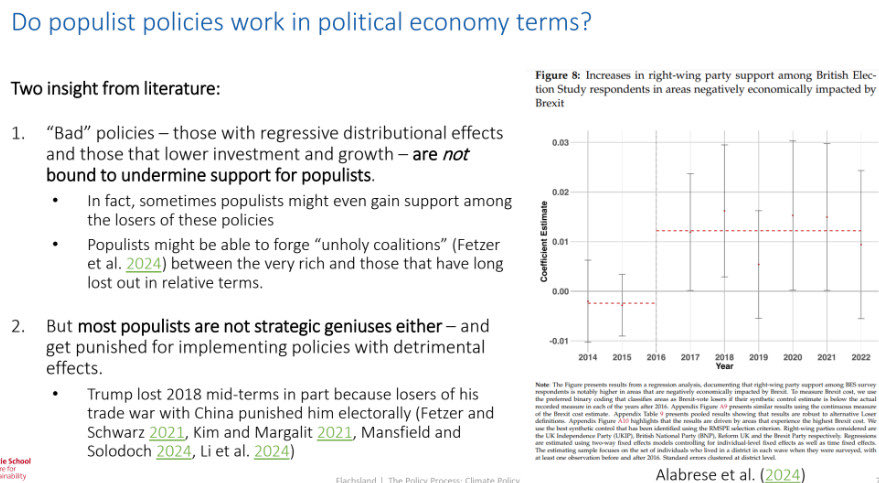
fact become more supportive. This is what we — @EleAla, @fetzert, and S Wang — document in the case of Brexit. @beimwort had a nice summary of one of the paper's bottom lines: right-wing populists can thrive on conditions that they themselves can
brexitcost.org
brexitcost.org
help create. These papers may not be directly applicable to the German context, but they do caution against blithely assuming that voters will negatively sanction the AfD for being bad at governing. So, one rationale for the "firewall" is to prevent the
beimwort.substack.com/p/der-kampf-um…
beimwort.substack.com/p/der-kampf-um…
AfD from doing damage with little political accountability.
2. The second rationale is about "intertemporal insurance" -- buying the time that is necessary for longer-term policy investments to yield tangible returns. Even if we knew what policies would help us back AfD voters
2. The second rationale is about "intertemporal insurance" -- buying the time that is necessary for longer-term policy investments to yield tangible returns. Even if we knew what policies would help us back AfD voters
(on net), with low trust it will likely take time for these voters to desert the AfD and come back into the fold of the mainstream. As an aside: There are many other risks with accommodation that I ignore here (see below). The difficulty is, of course, that the cordon sanitaire


increases the size and ideological heterogeneity of coalitions, which makes it not only more arduous to form them, but also to adopt the big reforms needed to win back the trust of disllusioned voters. In addition, bigger and more heterogenous coalitions
journals.sagepub.com/doi/full/10.11…
journals.sagepub.com/doi/full/10.11…
might dilute party brands and fuel the perception that the mainstream parties are much of a muchness and all in cahoots with one another. So, the cordon sanitaire comes with real costs.
That said, let us now turn to the scenarios in which the Brandmauer might crumble,
That said, let us now turn to the scenarios in which the Brandmauer might crumble,
though I'll note that for now it seems to hold.
1. To build some intuition, let's start with the simplest scenario: the CDU forms a coalition government at the federal level with the AfD. There are definitely some people - like Roedder and his ilk - who
wzb.eu/de/pressemitte…
1. To build some intuition, let's start with the simplest scenario: the CDU forms a coalition government at the federal level with the AfD. There are definitely some people - like Roedder and his ilk - who
wzb.eu/de/pressemitte…
are pushing for this. To assess the probability, we need to know the relative weighting of the ‘vote-seeking’, ‘office-seeking’ and ‘policy-seeking’ motivations of the "culture warrior" faction within the CDU. If the first two motivations are dominant,
jstor.org/stable/2111461
jstor.org/stable/2111461
it makes little sense for the CDU to enter into a coalition with the AfD. If they did so, the other parties would pursue a ‘grim trigger’ strategy in order to maintain their reputation as pro-democratic forces strategy and rule out a coalition with the CDU for quite some time.
In this case, the CDU's access to power would depend on the electoral performance of a single party, the AfD. If the CDU stuck to its cordon sanitaire strategy, the SPD, the Greens, and probably also the FDP would remain as possible coalition partners. The prospect of political
power would thus be higher. Of course, this logic no longer applies if the federal CDU is dominated in the medium to long term by hard-line ‘policy-seeking’ conservatives who are willing to accept a reduction in their prospects of power if, in return, the probability of the
federal government pursuing conservative-nationalist policies increases. My personal guess is that at the moment, the ‘vote-seeking’ motivation is still dominant (but I might be wrong). This leaves us with three other scenarios.
2. Minority government of CDU/CSU at the federal
2. Minority government of CDU/CSU at the federal
level supported by AfD
I'd guess that this is what Jens Spahn and his allies are working towards. In fact, I'd argue that from a vote-seeking perspective this construct is "less" dangerous (now) than it might seem for the CDU -- setting aside the fact that the policy-seeking
I'd guess that this is what Jens Spahn and his allies are working towards. In fact, I'd argue that from a vote-seeking perspective this construct is "less" dangerous (now) than it might seem for the CDU -- setting aside the fact that the policy-seeking
motivations of this faction likely reinforce that incentive.
Why? On the one hand, they can spin this as being the only way to avoid a situation of "Unregierbarkeit" or paralysis. Knowing our media, I doubt they would be called out by many. On the other hand, the "special
Why? On the one hand, they can spin this as being the only way to avoid a situation of "Unregierbarkeit" or paralysis. Knowing our media, I doubt they would be called out by many. On the other hand, the "special
purpose fund" that the lame-duck Bundestag approved reduces the cost of having to govern with the AfD because it ties the hands of the governments -- though, of course, there is still wiggle room. This is the case for both
the party itself and marginal CDU voters. For these reasons, I would be surprised if such a construct led to massive sanctioning by voters in a federal election. I very much hope I am wrong. What worries me, however, is that this scenario seems to be actively being prepared
within the CDU. Indeed, this is one way to interpret the reluctance of people like Carsten Linnemann and Jens Spahn to join Merz's cabinet. They think he sold out the CDU to the SPD and see a cabinet position as a reputational risk for their future career prospects. In this sense
Merz seems like a dead men walking at the moment.
Finally, the other two scenarios relate to the multi-level dynamics of Germany's federal system.
2. It is quite conceivable that the next state elections in the Easter states (for now, we have dodged a bullet) will result in a
Finally, the other two scenarios relate to the multi-level dynamics of Germany's federal system.
2. It is quite conceivable that the next state elections in the Easter states (for now, we have dodged a bullet) will result in a
constellation with the AfD at the state level being the only option for the CDU to remain in power. Due to the sympathy for the AfD among large sections of the eastern CDU, it would then be difficult for the federal CDU to prevent a blue-black coalition.
If such a coalition
If such a coalition
were to be forged, a normalisation process would most likely kick in, as suggested in particular by the work of @ValentimVicente, which also makes a blue-black coalition at the federal level more likely in the medium term. The extent to which the federal CDU would try to prevent

@ValentimVicente the eastern associations from entering into such a coalition depends largely on two factors: (a) the beliefs of the party leadership about whether and to what extent voters would punish the CDU in the next federal election for a coalition with the AfD at the state level, and
@ValentimVicente (b) the relative weighting of ‘vote/office seeking’ and ‘policy seeking’ motivations among the right wing of the CDU.
If the potential for sanctions by voters at the federal level is considered low and the ‘policy-seeking’ motivation dominates, the firewall at the state level
If the potential for sanctions by voters at the federal level is considered low and the ‘policy-seeking’ motivation dominates, the firewall at the state level
@ValentimVicente will fall and, by virtue of the normalisation logic, a coalition at the federal level will also become more likely.
2. The ‘Kemmerich+’ scenario. It is conceivable that there could be a CDU minority government at the state level, supported by the AfD. In my view, this scenario is
2. The ‘Kemmerich+’ scenario. It is conceivable that there could be a CDU minority government at the state level, supported by the AfD. In my view, this scenario is
@ValentimVicente the most attractive and therefore the most dangerous for the right wing of the CDU, for two reasons First, it enables cooperation with the AfD. Secondly, the construct of a minority government at state level conceals this cooperation from the electorate, thereby reducing the risk
@ValentimVicente of being severely punished in a federal election for openly abandoning the firewall strategy.
If the right wing of the federal CDU is "smart", it will encourage the eastern associations to try out such minority government constellations. To prevent the firewall from finally
If the right wing of the federal CDU is "smart", it will encourage the eastern associations to try out such minority government constellations. To prevent the firewall from finally
@ValentimVicente collapsing, the CDU leadership must believe that the federal electorate will see through these
machinations and punish them at the polls. I very much hope that we, as the German electorate, will be able to solve this ‘collective action problem’ – but I am sceptical.
machinations and punish them at the polls. I very much hope that we, as the German electorate, will be able to solve this ‘collective action problem’ – but I am sceptical.
• • •
Missing some Tweet in this thread? You can try to
force a refresh






