Mr. Poilievre is resuscitating COVID-era arguments that inflation is a 'tax' (caused by Justin Trudeau's deficits and Tiff Macklem's ATM), and that he can 'cancel the tax' with federal spending cuts. Here are the top 4 reasons his economics are all wrong: #cdnecon #cdnpoli /2
1. International Comparisons: Post-COVID inflation was a global phenomenon, affecting almost all countries, with no correlation to deficits or government spending. Canada's inflation since 2019 has been relatively mild, well below the US and the OECD average. /3
2. Timing: The federal deficit (huge during COVID lockdowns) was approaching balance (in national accounts terms, which is what matters for macroeconomics) by the time inflation accelerated in latter 2021 and 2022. Purported 'excess demand' from CERB benefits was long gone. /4
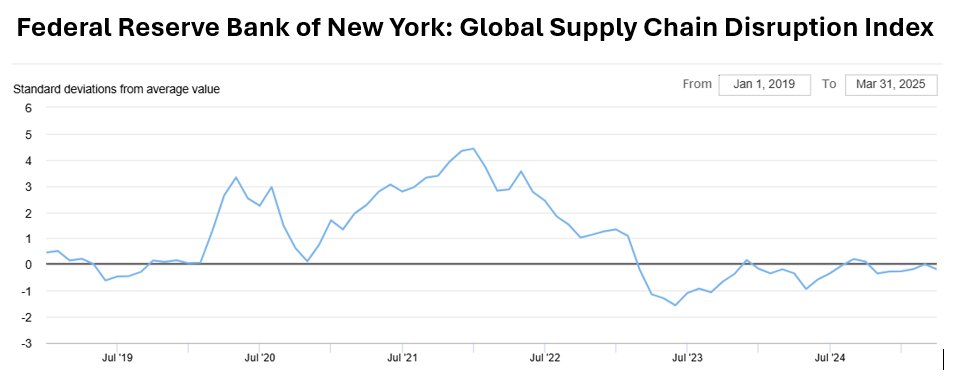
3. Supply Chains: Poilievre ignores the key spark for post-COVID inflation: unprecedented disruptions in supply chains (health restrictions, transport problems, shortages of key commodities). They eased by late 2022 (and inflation then fell quickly), and are in good shape now. /5
4. Profits: Predictably, Poilievre also ignores the role of record profits in accelerating inflation. Corp. profits reached an all-time high as a share of 🇨🇦 GDP in 2022, coincident with peak inflation. Profits have since moderated, coincident with slowing inflation. /6
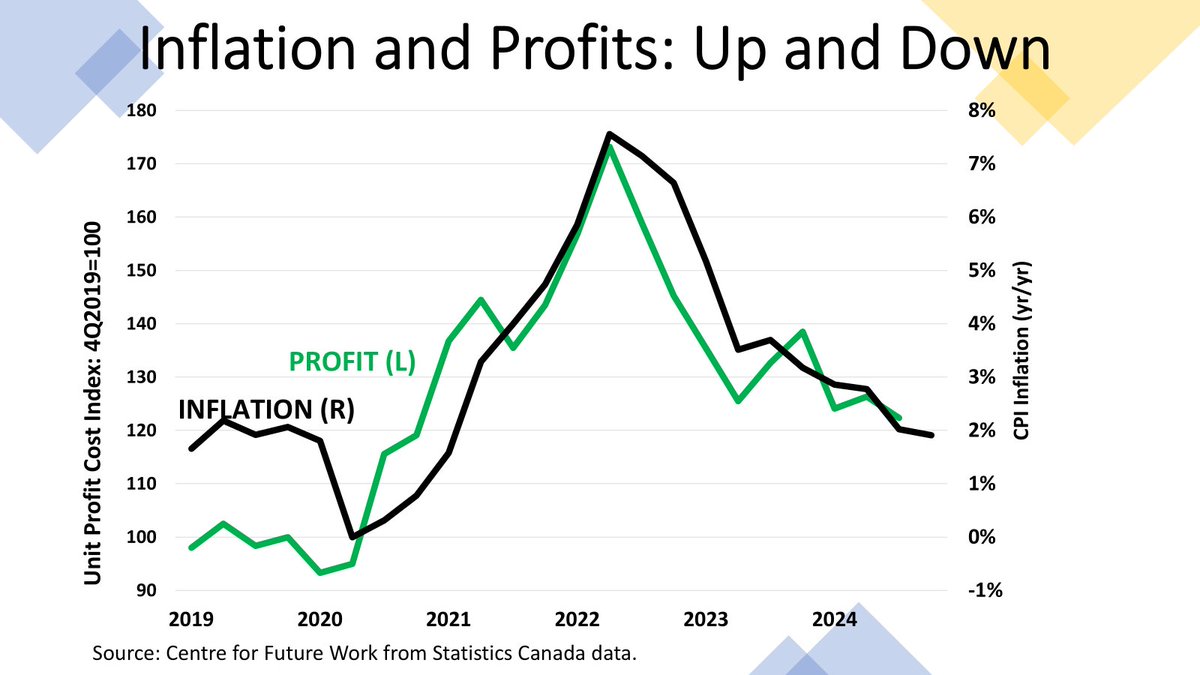
The unique problems that caused post-COVID inflation (in 🇨🇦 and most countries) in 2021 & 22 have normalized. Poilievre's claim that increases in federal capital spending of the scale proposed by Mr. Carney (1.5% of GDP) would bring back rapid inflation, is not credible. /7
And Poilievre's claim that he can 'cancel' inflation through fiscal austerity is dangerous. Canada's likely heading into a recession thanks to Trump; spending cuts would make it worse. He's scapegoating government for a crisis that was part pandemic, part private sector greed. /8
For a review of the true causes of inflation, a refutation of false scapegoats, & an overview of better solutions to challenges in living standards (like higher wages, non-market housing, limits on corporate power) see the Centre for @futurework_cda video:
• • •
Missing some Tweet in this thread? You can try to
force a refresh

Certain partisans have been citing Canada's performance on per capita GDP as evidence of a supposed 'lost decade' and economic mismanagement. In @IRPP Policy Options, I deconstruct this arbitrary and misleading statistic, in two parts. #cdnecon #cdnpoli /2
Part I: The numerator of 🇨🇦's per capita GDP has done reasonably well: 2nd best GDP growth in the G7 over the last decade. The denominator (population) has grown unusually fast (esp. since 2021), and that is what has suppressed the value of the ratio. /3policyoptions.irpp.org/magazines/apri…
I also show flaws in the methodology of calculating per capita GDP. The world leaders in per capita GDP are all tax havens: that's phony. In Canada, Newfoundland & Labrador has above-avg per capita GDP (hence no equalization) despite lower personal incomes. A flawed measure! /4
Crude oil prices are down $14/b (20%) in the last week. Apart from acute embarrassment for Danielle Smith (who called Trump's tariffs last week a "big win for Alberta & Canada"), there's an important lesson to be learned here about how crude oil futures markets work. #cdnecon /2
This thread draws on analysis of oil futures markets from @futurework_cda's recent report, "Counting the Costs": . It computes the costs of the 2022 oil price spike: directly & indirectly it cost the average Canadian household $12,000 over 3 years. /3 falseprofits.ca/reports
Prices for various specific crudes are set in relation to key benchmarks (mostly WTI & Brent) which are set on futures markets. Futures markets are financial markets. They don't trade in oil; they trade in contracts which are promises to deliver oil at some time in the future. /4
Trump says any car “not made in America” gets a 25% tariff. That means EVERY car gets a tariff, cuz there’s no such thing as a “car made in America.” Only cars made in NORTH America. Every one of which has a lot of 🇨🇦🇺🇸 and 🇲🇽 content in it. #cdnecon /2
More Americans will be hurt by this than Canadians and Mexicans, cuz far more Americans are employed making North American cars… and their plants will all be screwed up by this, too. /3
Trump’s musings about pro-rating the tariff to reflect US parts content in imported vehicles, all by next Wednesday, are laughable. It would take years and enormous data & bureaucracy to set up a system like that. These clowns can’t even run a private group chat. /4
“Who’s Subsidizing Whom?” I have written a new report for the Centre for Future Work @futurework_cda rebutting Trump’s arguments that the U.S. “subsidizes” Canada through its bilateral trade deficit: . #cdnecon #cdnpoli #canlab /2centreforfuturework.ca/wp-content/upl…
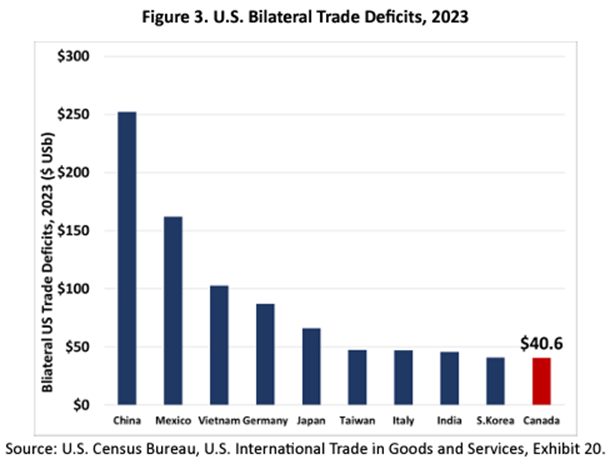
First, that deficit is 1/5 as large as Trump claims ($40bUS not $200b), US trade is more balanced with us than other partners (they sell us 92c for every $ they buy) & a deficit isn’t a “subsidy” anyway. Their big surplus in services offsets much of the deficit in merchandise. /3
In fact I identify 3 ways Canada-US trade diverges from normal practice. In effect, these are ways WE subsidize THEM: 1. Cheap secure oil, with access for US corp's to profit 2. Huge services imports--underreported, largely untaxed 3. Cheap credit to help finance their deficit /4
Odd framing in @TorontoStar's cvg of the strike by (uncertified) Amazon workers in the US: . Of course their 'Cdn counterparts will not be joining': as @TheLawofWork has explained, non-certified workers in 🇨🇦 have no rights to protected concerted action. /2thestar.com/business/amazo…
Before anyone jumps to the conclusion that US workers therefore have more power, remember that once Canadian workers get a certification (as they have in Quebec, and are seeking in BC & elsewhere), they have far more power--including to get an arbitrated 1st contract. /3
And 🇨🇦's Rand formula then guarantees that the union (duly certified by a majority of workers, and via a contract then ratified by another majority of workers) can collect dues to stably fund the infrastructure of bargaining and representation. /4
We have released a new report today from @CntrFutureWork on the economic benefits that are already visible from 🇨🇦's new $10-a-day national early learning & child care (ELCC) program: #cdnpoli #cdnecon /2 centreforfuturework.ca/wp-content/upl…
Economists have long shown ELCC's many economic gains, via:
* Direct jobs in the ELCC sector
* Indirect / induced activity in upstream (supply chain) & downstream (consumer) industries
* Increased female labour supply
* Long-run gains from enhanced learning capacity in kids
/3
So it's gratifying to see this actually happening in real-time from the new national 🇨🇦 program:
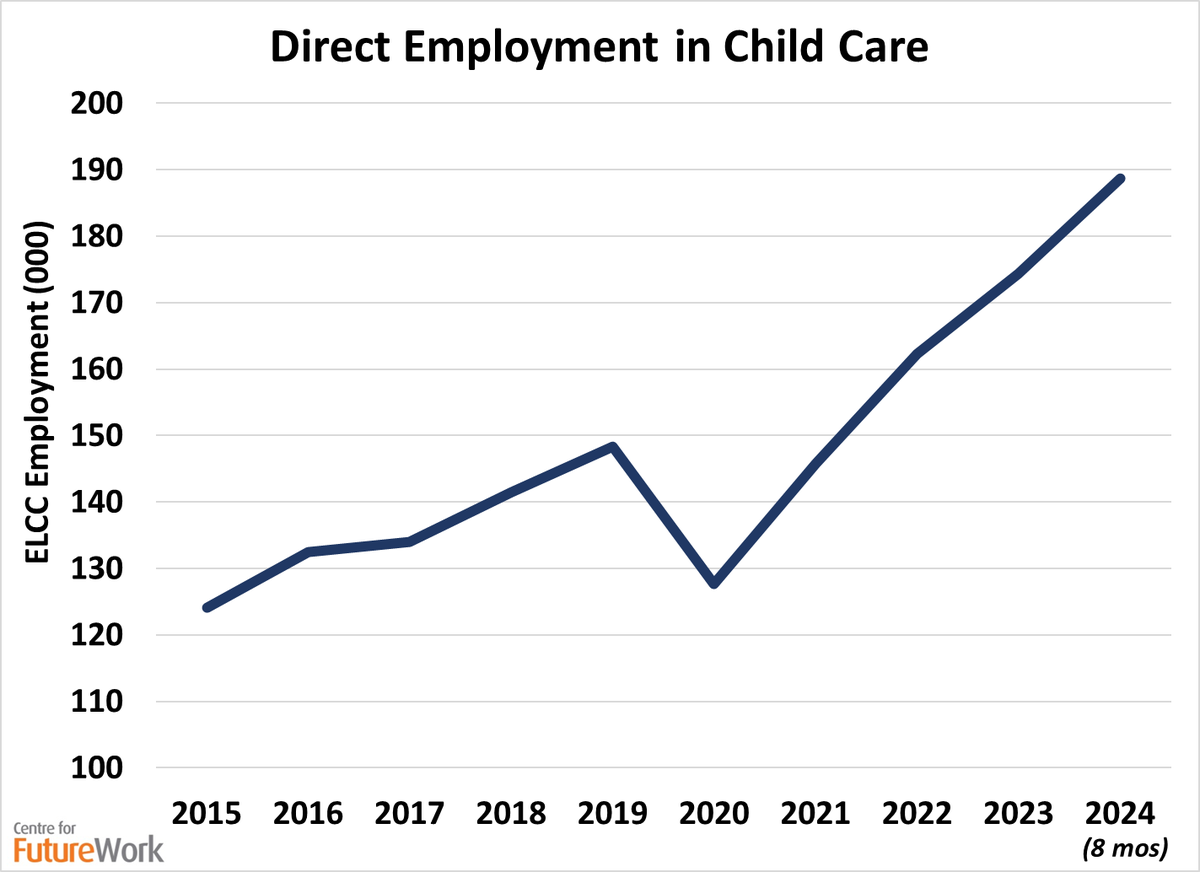
* 40,000 new jobs in ELCC since 2019
* Better earnings and hours for ELCC workers
* 175,000 new female FTE labour supply (from higher participation & more full-time work)
/4