Alexander Stahel 🌻 Profile picture
Apr 28 10 tweets 6 min read Read on X
Here is my theory how the major incident - a so called blackout - occurred at 12:30 CET today in the power system of Spain & Portugal:

1/n Image
At the time of the incident, Spain and Portugal operated the grid at very high renewables share of about 66% - i.e solar (55%) and wind (11%; eolica)

2/n Image
Image
While this isn’t unusual for Spain, it does mean that the grid operates with little inertia (resistance to change) during such time. The grid is therefore vulnerable to external effects…!

3/n Image
In contrast, nuclear and fossil fuel power plants provide large amounts of rotating mass, delivering vital inertia to the grid — essential for a strong and resilient electrical system. This is why some grid operators cap renewable penetration at 25–35%.

Here’s a comparison between a typical nuclear plant and a standard wind turbine:

5/nImage
Image
It gets worse. Solar power generates direct current (DC), but the grid runs on alternating current (AC) — like trying to fit a square peg into a round hole. Solar must be converted first, and, as you might guess, it contributes virtually zero inertia to the grid.

6/n Image
Image
Inertia isn’t reported in real time by operators but I fed ChatGPT 4.0 with the data at the time of the blackout and here is the preliminary result: the grid was extremely fragile (low resistance to change)!

7/n Image
Image
Another unusual thing I noticed is the demand (or load) data development in the hours before the major incident. It went down (yellow line).

This could be another source of unplanned problems for the operator. REE perhaps had to export more power than planned. IDK.

8/n Image
Then came reports of a forest fire and temperature-driven oscillations that may have further strained the already limited cross-border capacity between Spain and France. Either way, when the system needed emergency support, there simply wasn’t enough export capacity available fast enough to stabilize the grid.

9/n Source: VariousImage
Image
Image
Image
Putting it all together with the help of ChatGPT - step-by-step:

1. Very low inertia
Spain & Portugal were operating with 65+% levels of solar generation (>55%) and wind. Synchronous inertia across the peninsula was therefore low and far below historical averages, making the system vulnerable.

2. High northbound power transfers
Due to hot weather in France and Italy and abundant cheap Iberian solar, transmission corridors from Spain northward were heavily loaded, operating close to their stability thresholds. This left little room to export sudden shocks.

3. Initiating fault
A disturbance occurred on a major 400kV transmission line (likely between Spain and France). Possible causes include wind-driven line galloping, a lightning flashover, a wildfire affecting infrastructure, or simple equipment failure. Critically, two circuits opened nearly simultaneously.

4. Inter-area oscillation
With low spinning mass (due to solar & wind dominance), frequency oscillations between Iberia and continental Europe became unstable instead of being dampened. The frequency separation between the two areas grew rapidly — reported divergences exceeded 200 mHz.

5. Wide-area separation
Automatic grid protections activated. Under-frequency relays triggered widespread generation and load tripping. Several synchronous condensers and smaller plants disconnected. The Iberian Peninsula effectively “islanded” itself electrically from the main European grid.

6. Collapse in parts of Spain
PV inverters (solar farms) disconnected quickly due to fast frequency changes, and further generators tripped off due to extreme rate-of-change-of-frequency (RoCoF). Large regions blacked out, requiring black-start operations to gradually restore power.

10/n
Please note that this remains a preliminary theory based on incomplete information.

Entso-e will have to establish a full report of this major incident in the coming weeks at which time we hopefully know more.

11/11 End/thx

• • •

Missing some Tweet in this thread? You can try to force a refresh

 

Keep Current with Alexander Stahel 🌻

Alexander Stahel 🌻 Profile picture

Stay in touch and get notified when new unrolls are available from this author!

Read all threads

This Thread may be Removed Anytime!

PDF

Twitter may remove this content at anytime! Save it as PDF for later use!

Try unrolling a thread yourself!

how to unroll video
  1. Follow @ThreadReaderApp to mention us!

  2. From a Twitter thread mention us with a keyword "unroll"
@threadreaderapp unroll

Practice here first or read more on our help page!

More from @BurggrabenH

Dec 5
Oil forecasts for 2025 have a wide range of outcomes, from balanced to a surplus of 4mbpd (IEA). Which one is it?

I’ve counted too many barrels over the years to engage in the debate. The oil market is dynamic while forecasts are static by nature.

But…

1/n
…we know that…

1) oil on water (includes floating storage) and oil in transit well surpassed Covid levels.

Part of it reflects inefficiency of the sanctioned Russian & Iranian oil trade as well as the recent US sanctions on Rosneft & Lukoil.

Part of it is an outright bearish oil market = too many barrels chasing too few buyers -> needs lower prices.

2/n: Oil in transitImage
2) Weak Chinese petroleum product consumption:

China is in recession due to its property bust and despite the CCPs desire to steer clear of it by forcing every other industry to build what isn’t required domestically (overcapacity issue) and then dump goods onto global trade.

Because of the latter most observers still don’t get the painful economic status China is in. But China is in it.

Also, the CCP prefers coal fuelled transportation as well as LNG truck driving for the purpose of geopolitics.

Both requires less, not more, diesel and gasoline in 2026 vs 2025. Jet and Naphtha are different story but won’t drive oil buying by refineries => Oil demand by 2nd largest economy globally is bearish. Accept.

However, the CCP may take the absurd to the next level in 2026 and force refineries to build even more floating-roof oil tank storage (as part of meeting an artificial Soviet 2.0 plan within its Investment-led Growth Model) in which case refineries may buy more oil next year, but not for the purpose of producing more petroleum products but solely for storages. If they do so, however, their crude oil buying will be EXTREMELY price sensitive.

Time and State companies oil quotas will tell.

PS: If u care to understand China’s property bust structurally, here is a link to my 7 part Stack series. It remains as valid then as now.

3/n
open.substack.com/pub/alexanders…
Read 13 tweets
Aug 4
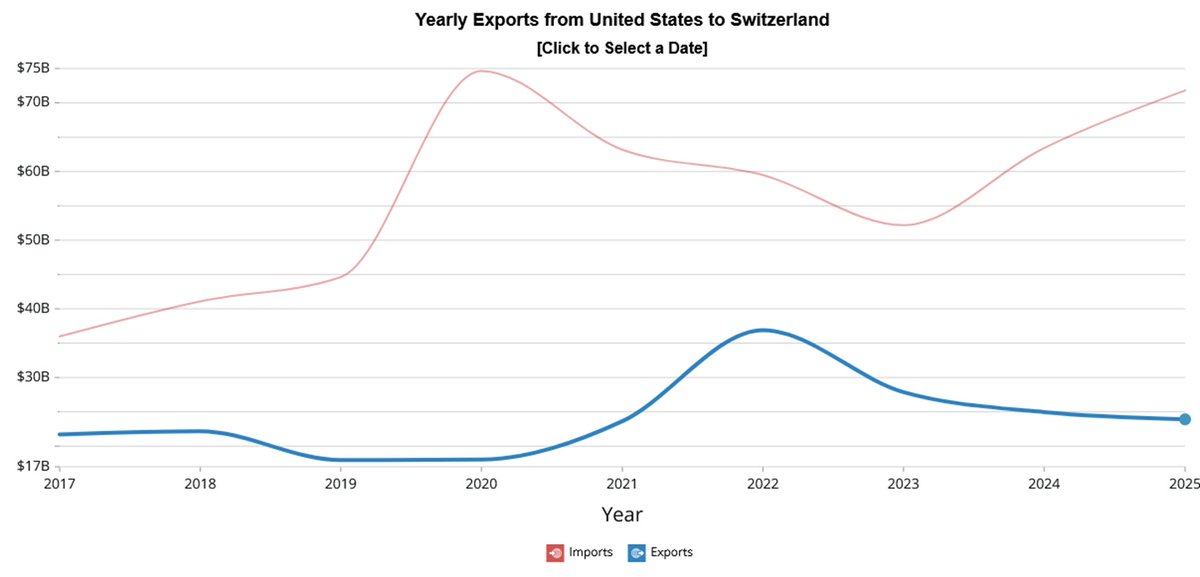
Let me add a few more facts & figures and some high level observations about the United States goods trade deficits with Switzerland of some $20bn annually.

A thread

1/8
Upfront and from a Swiss patriotic view:

The Swiss government and certain companies have little reason to lament—these tariffs were foreseeable.

Yes, the real issue is their scale: 39% compared to Europe’s 15%, which clearly puts some Swiss exports at a competitive disadvantage. It is what it is.

And while I still believe this situation is fixable, we must be prepared for the worst-case scenario to persist—or even worsen, with potential new tariffs on pharmaceuticals (currently exempted).

So, who is at fault? As some of us learned in officer school during military service: the Bundesrat misjudged the fundamentals of strategic assessment—Lagebeurteilung (judgement of enemy situation). That needs to be addressed. Trump wants balanced trade. Address it. Period.

History is not kind to those who choose dreams over reality—or to the weak who paint themselves as victims.

Therefore, whether Trump’s trade deficit logic makes any sense whatsoever (which it clearly doesn't in the Swiss case) is beside the point.

He’s the president. He has communicated his views clearly and consistently for decades. Adapt. Take the man seriously.

Trustworthy or not, as lamented by President Keller Sutter is none of our business.

2/n @SecScottBessent @BobgonzaleBob
Let’s now take a closer look at Switzerland’s goods trade surplus with the United States.

At Burggraben, we rely on the OEC tool (a paywalled MIT spin-off) for robust global trade data as part of our investment analysis process of all sorts—so we can assess this with confidence. I hope our readers will appreciate the data quality shared herewith for free.

While the annual trade surplus has fluctuated in recent years, the underlying—or let’s call it intrinsic—gap consistently hovers around $20 billion, as the data below will show.

3/nImage
Read 8 tweets
Jun 12
Let’s break down the current Iran–US–Israel situation, based on the latest facts and statements.

1) What’s the @POTUS stance?
Trump has been consistent for years — and reiterated just yesterday: “Iran cannot have the bomb. Period.”

1/n
2) Does Iran already have the bomb?
We don’t know for sure — but here’s what the latest IAEA report says:

🔎 Iran remains in non-compliance with key nuclear commitments. This finding could pave the way for renewed sanctions.

2/n
iaea.org/newscenter/sta…
More concretely, Iran likely enriched some 250kg of HEU stockpiles since 2021. Worse, it also said to adds significant new capacities.

That material so far could quickly be turned into the fuel for the equivalent of 10 bombs, should Iran’s leadership take the political decision to pursue weapons, according to Bloomberg.

3/nImage
Image
Image
Read 8 tweets
Apr 3
On this platform, certain perma bulls keep pushing a bullish crude narrative based on relative U.S. inventories—day after day, for three years now.

Their logic: Total U.S. crude inventories (including the SPR) are at 838 million barrels (orange line), 200 million barrels below the 10-year average → bullish!

Yet, inventories keep falling, and prices remain stuck in a range. Clearly, they are wrong.

1/9 @UrbanKaoboy @Iris62655179 @BrentRuditLeoImage
The problem with their logic?

a) The U.S. is no longer the marginal importer of crude oil—Asia is (or was).

b) U.S. inventories are artificially high on a 10-year average due to the shale boom, which took off in 2014. Shale growth and Covid distort the data, keeping inventories (ex SPR) elevated. So any 5- or 10-year comparison is meaningless—period.

2/n US Crude Oil Inventory ex SPRImage
Including SPRs, the picture looks more normalised - but not tight. But does the US really need 700mb of strategic reserves in 2025? I don't think so.

3/n US Crude Inv incl SPRs Image
Read 9 tweets
Mar 23
Yesterday, I shared a few thoughts that I’d like to expand on, especially given how volatile the current tariff landscape under this admin has become.

Navigating it isn’t just difficult—it’s nearly impossible to avoid missteps. Hopefully some traders will expand on my thoughts...

1/n
What do we know?

As at 23 March 2025, Comex copper price in New York is trading at 14% premium to LME in London. Buying a tonne of copper in NY costs $11,213 versus 9,842 in London, $1,371 per tonne more than in London.

2/n Image
Why is that? Because of tariff FEARS, not tariffs.

Traders are hedging future risk of potential tariffs on all forms of the raw material, such as cathodes, concentrates, ores, and even scrap. But there aren't such tariffs in place for copper yet (unlike alumnium).

3/n
fastmarkets.com/insights/us-ta…
Read 9 tweets
Mar 22
A few thoughts on copper.

The current Comex price action in the U.S. is basically a Trump tariff trade mirage and is otherwise as misleading of fundaments as the May 2024 price action of which I warned on multiple occasions.

1/n $/pound Image
In May 2024 however, U.S. price action was more in synch with London. But it didn't reflect weak Chinese housing & construction fundamentals which has been 15-30% of GLOBAL copper use for the past two decades. Today, U.S. prices trade as if borders close tomorrow.

2/n Comex - LME arb in $/tImage
Unlike May 2024, copper blue chips like $FCX, however, do not buy the rally. So at least it seems that the equity market understands the tariff aspect of the copper price mirage.

3/n Change in % Image
Read 15 tweets

Did Thread Reader help you today?

Support us! We are indie developers!


This site is made by just two indie developers on a laptop doing marketing, support and development! Read more about the story.

Become a Premium Member ($3/month or $30/year) and get exclusive features!

Become Premium

Don't want to be a Premium member but still want to support us?

Make a small donation by buying us coffee ($5) or help with server cost ($10)

Donate via Paypal

Or Donate anonymously using crypto!

Ethereum

0xfe58350B80634f60Fa6Dc149a72b4DFbc17D341E copy

Bitcoin

3ATGMxNzCUFzxpMCHL5sWSt4DVtS8UqXpi copy

Thank you for your support!

Follow Us!

:(