Thoughts from yesterday's @KnowlexUK conference
Its not 2020. It is more akin to when harms from, the likes of "passive smoke", "lack of seat belts" & "asbestos" became undeniable - although not visible to all.
There are significant, persistent and undeniable harms.
1/6
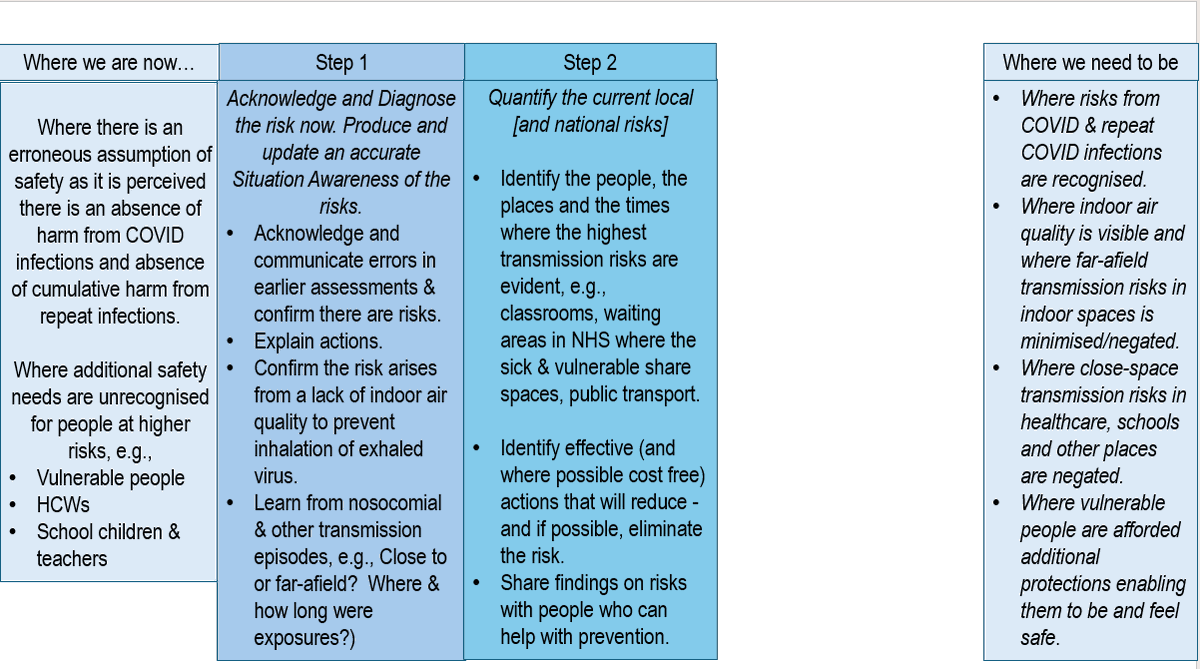
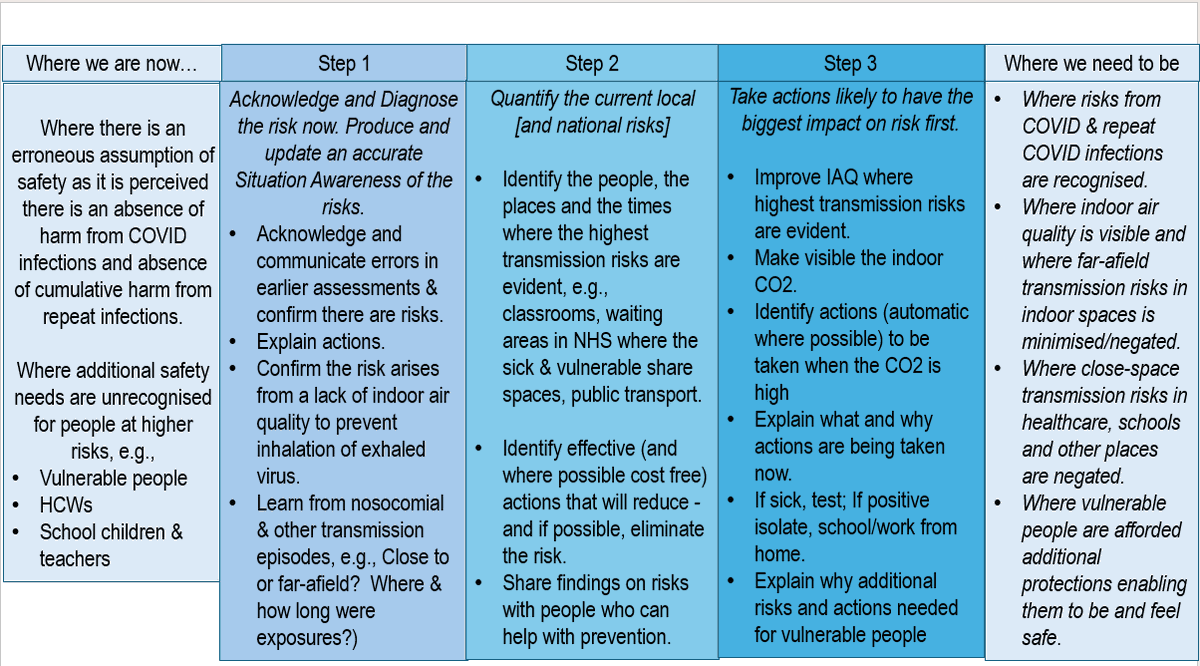
So where are we now, and where do we ?need to be to negate the harms
[starter for 10]
2/6
We will never get to where we need to be in one leap or by 1 action.
What is needed first?
Diagnose the problem and acknowledge the risks 3/6
Step 2 - quantify the risk - local and national 4/6
Step 3
Pareto the problem - what will bring the greatest safety leap first?
Get bang for your buck 5/6
Who is in charge of this disease & who is looking at & assessing data risks (apart from @1goodtern )
To whom is a case to be made and how much harm must arise before risks are accepted?
To reduce people needing / demanding healthcare you have to stop them getting sick.
end
I did a rehearsal for the presentation & recorded it: here it is.
There are a couple of minor errors, it was Guinea pigs and not hamsters for TB.
The audience was mainly IPC people.
Main message - we cant get to where we want to be in 1 step.
• • •
Missing some Tweet in this thread? You can try to
force a refresh

No exaggeration here - this is a major article. Forget your CERN collider, here is a method for obtaining mechanistic evidence of far-afield airborne transmission. It was undertaken in a facility designed to study TB.
1/10
The authors state that there should be evidence of the transmission route to inform guidance.
Could not agree more. If only...
"Unambiguous demonstration of transmission routes is important."
Yes, Yes, Yes
By the way this wont come from RCTs!
2/10
For all the implausibility of other routes, and the evidence during outbreak settings there were laggards...
3/10
After yesterday's 17:1 (one case of community acquired CVD leading to 17 others a driver diagram to reduce nosocomial transmission.
Let's start by agreeing that nosocomial transmission is unsafe. 1/8
Action 1 is to prevent transmission to patients, staff and visitors, i.e., everyone in the care environment.
2/8
Next the only 3 actions that can prevent inhalation of virus. Segregation of people who are infectious, IAQ, and respiratory protection.
Also there must be ongoing analysis of where and why transmission is happening in the care setting to identify further safer options 3/8
I have a patient with SARS and I want to keep my other patients and staff safe.
I look up the NIPCM Scotland and find that the Main (singular) mode of transmission is both Droplet / Airborne
@P_H_S_Official this thread merits "immediate action"
The Transmission Based Precautions Section tells me there are 3 modes of transmission.
It tells me what the different precautions are aiming to achieve
Of note the definitions of respiratory infections are erroneous
In the respiratory section
It tells me you only need RPE if the pathogen is "wholly" transmitted by the airborne route, i.e., not droplet / airborne, or AGP
Off for the literature review to find the evidence for this statement
I honestly believe IPC as a profession will NOT survive intact if it fails to accept airborne transmission as a significant ubiquitous risk and erroneously considers hand hygiene the single most important measure to prevent infection - it is not.
See below
Most important measures to prevent 🫁 non VAP pneumonia - patient positioning, mobility, oral hygiene
Most important measures to prevent surgical site infection 🩹: sterile instruments & theatre air quality
They have withdrawn masks in Scotland's Healthcare system and referred 'concerned staff' to complete a risk assessment. healthyworkinglives.scot/resources/form…
Lets fill out their risk assessment...
I am (for the form) a ward manager
Describe the task:
Any patient-to-HCW, HCW-to-HCW, patient-to-patient, or visitor-to-patient or HCW interaction in any close space, e.g. conversation or stethoscope range
or when ventilation poor just being on the ward.
Where is the task to be carried out?
Every minute of every day on this ward we are continuously interacting and at risk of inhaling someone else's exhaled air + virus.
Inhalation at distance is also a risk because we have no idea of the indoor air quality - no indicators.