Ernie Tedeschi Profile picture
May 12, 2025 13 tweets 5 min read Read on X
New tariff update today from @The_Budget_Lab incorporating

1. Today's announcement of lower US-China tariffs (10% instead of 125% reciprocal tariffs);
2. The May 8 US-UK trade deal; and,
3. The April 29 auto tariff rebate announcement.

Some high level takeaways:
1/13
@The_Budget_Lab • In broad strokes, the lower China tariffs announced today have 2 main effects, assuming they stay in place:
1. They reduce the economic damage of 2025 tariffs by 40% (judged by price & GDP);
2. They raise $300bn *more* over 10Y, showing how suboptimal 145% was.
2/13
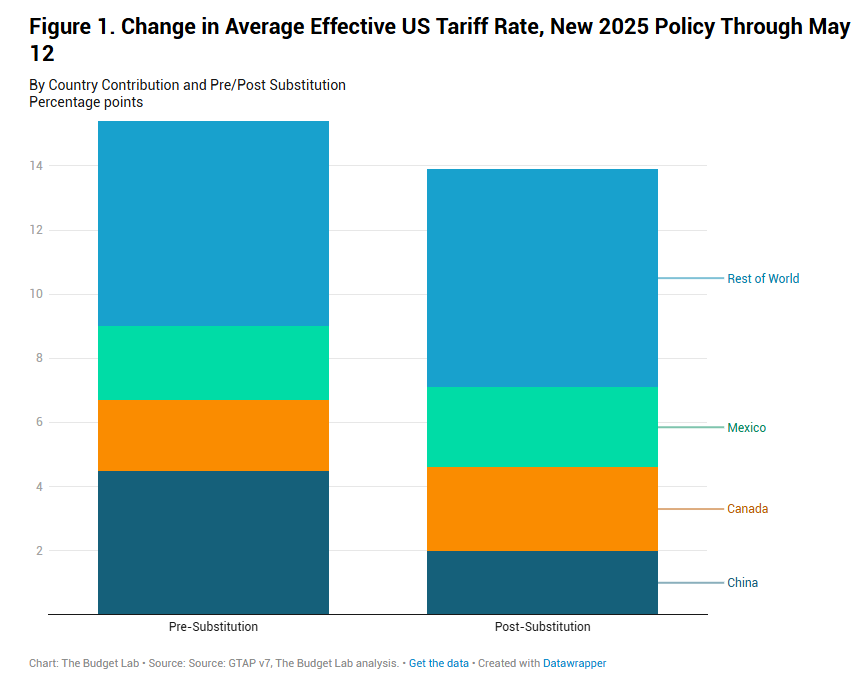
@The_Budget_Lab • The current US average effective tariff rate is now 17.8% pre-substitution, highest since 1934. Post-substitution, it's 16.4%, the highest since 1937. Virtually all of the fall since our April 15 report is due to the lower China tariffs; the US-UK deal has little effect.
3/13 Image
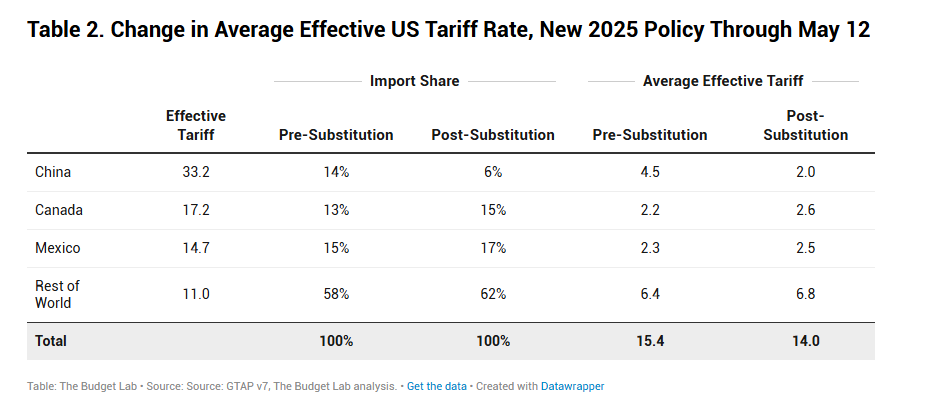
@The_Budget_Lab • The difference between the pre- and post-substitution average tariff rates is because the new 30% China tariff still causes China's share of US imports to contract meaningfully, from 14% to 6%, as businesses & consumers substitute away from Chinese goods.
4/13 Image
Image
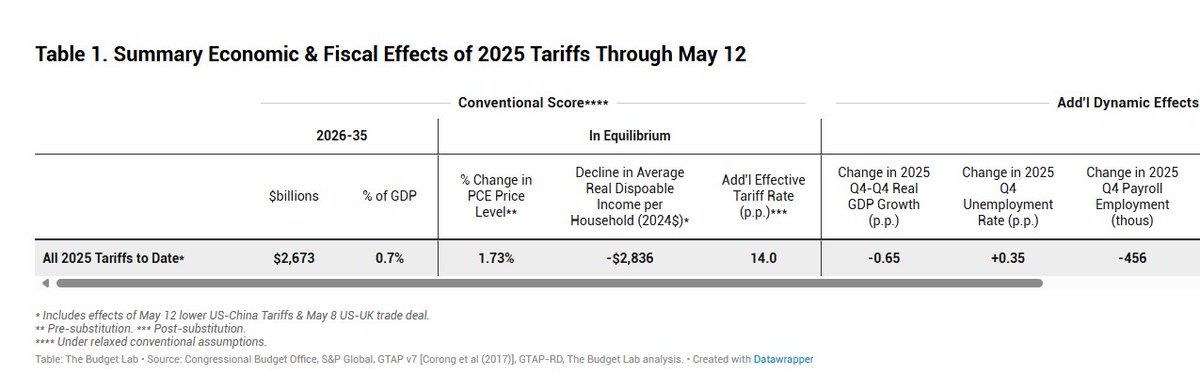
@The_Budget_Lab • The PCE price level rises by 1.7% pre-substitution assuming no Fed response. This is the equivalent of a loss in purchasing power of $2,800 per household per year in 2024$.
• Post-substitution, prices rise 1.4%, a $2,300 average loss.
5/13 Image
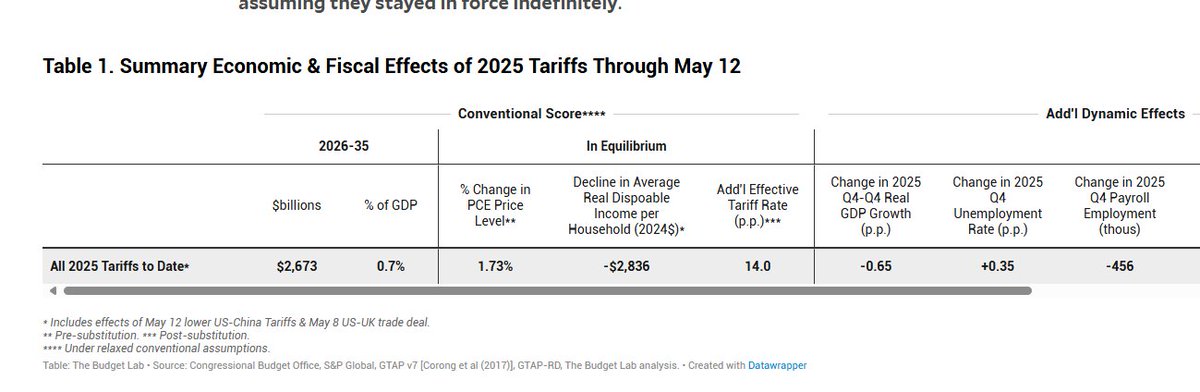
@The_Budget_Lab • US real GDP growth over 2025 is 0.7pp lower.
• The unemployment rate is 0.4pp higher in 2025 Q4, and employment is -456K lower.
• In the long-run, US real GDP is -0.4% smaller in level terms, the equivalent of a $110bn loss in 2024$ each year every year.
6/13 Image
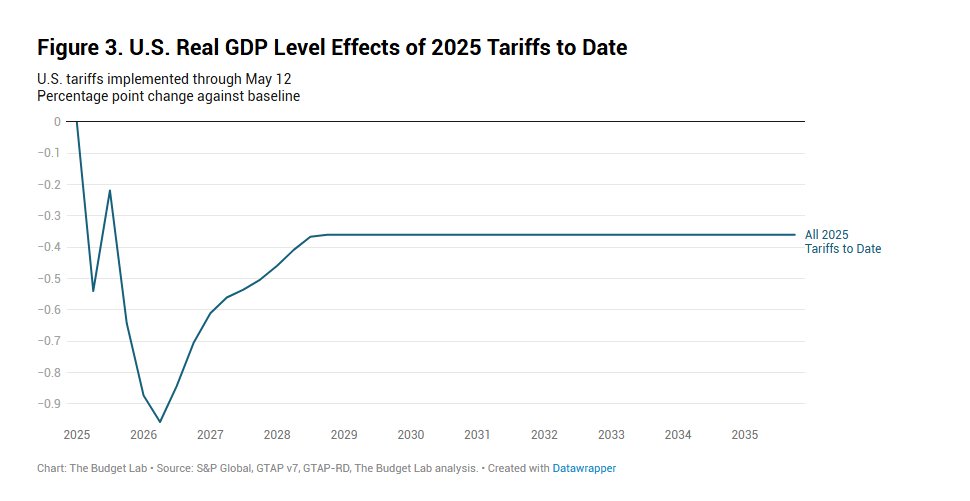
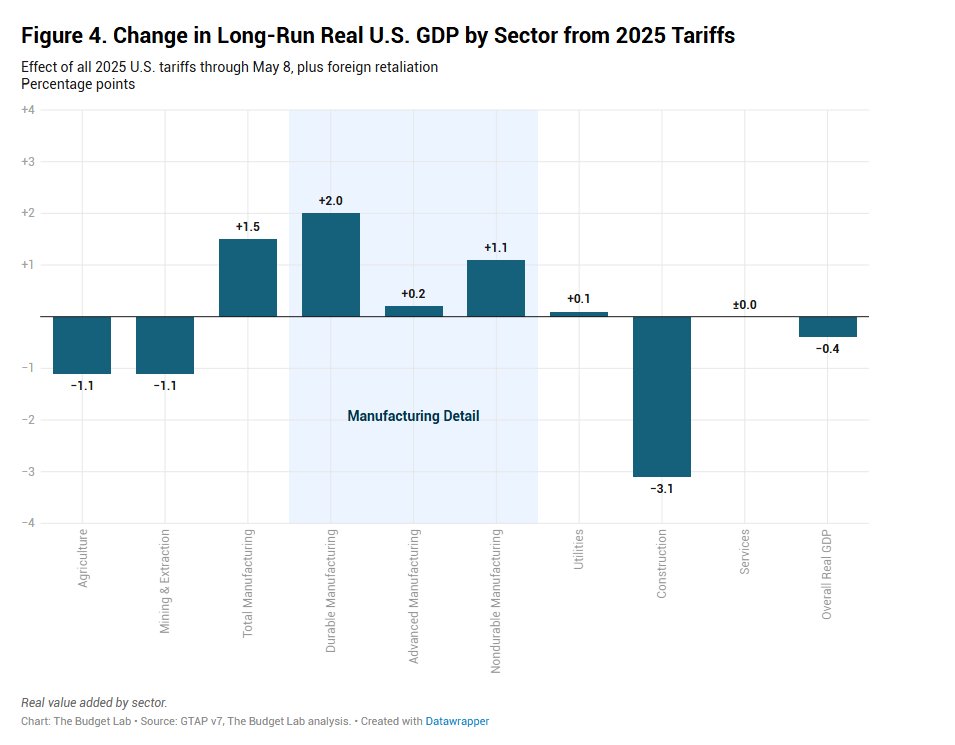
@The_Budget_Lab • In the long-run, tariffs present a tangible trade-off for the US economy. US manufacturing output expands by 1.5%, but this more than crowds out other sectors: construction output contracts by 3.1% and agriculture declines by 1.1%. Overall GDP is 0.4% smaller.
7/13 Image
@The_Budget_Lab • All tariffs to date in 2025 raise $2.7 trillion over 2026-35, with $394 billion in negative dynamic revenue effects. This is $300 billion more than under the higher 145% China tariffs, showing how far from revenue-optimal levels those rates were.
8/13 Image
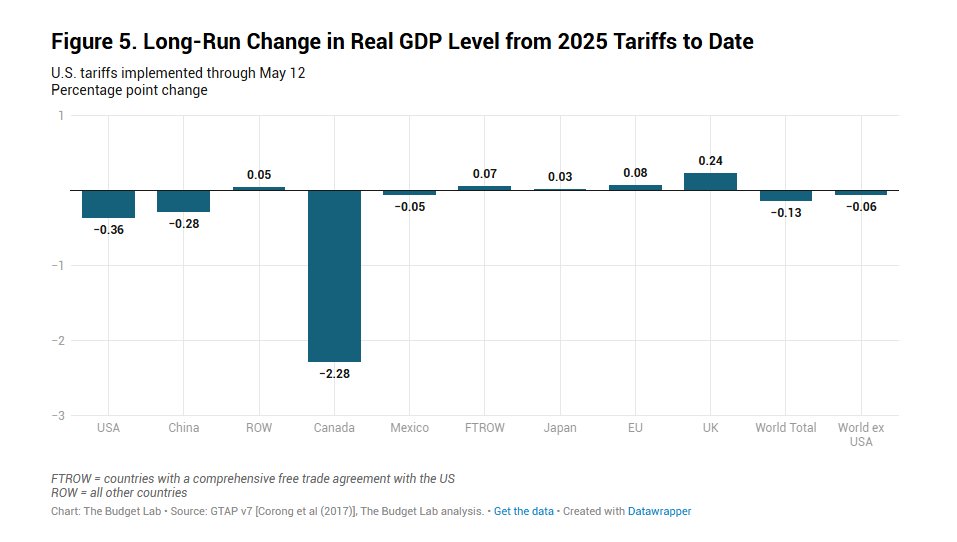
@The_Budget_Lab • Canada bears the brunt of the damage from US tariffs, with its long-run economy -2.3% smaller in real terms (reflecting both US tariffs and Canadian retaliation to date). China’s economy is -0.3% smaller, almost as large as the hit to the US.
9/13 Image
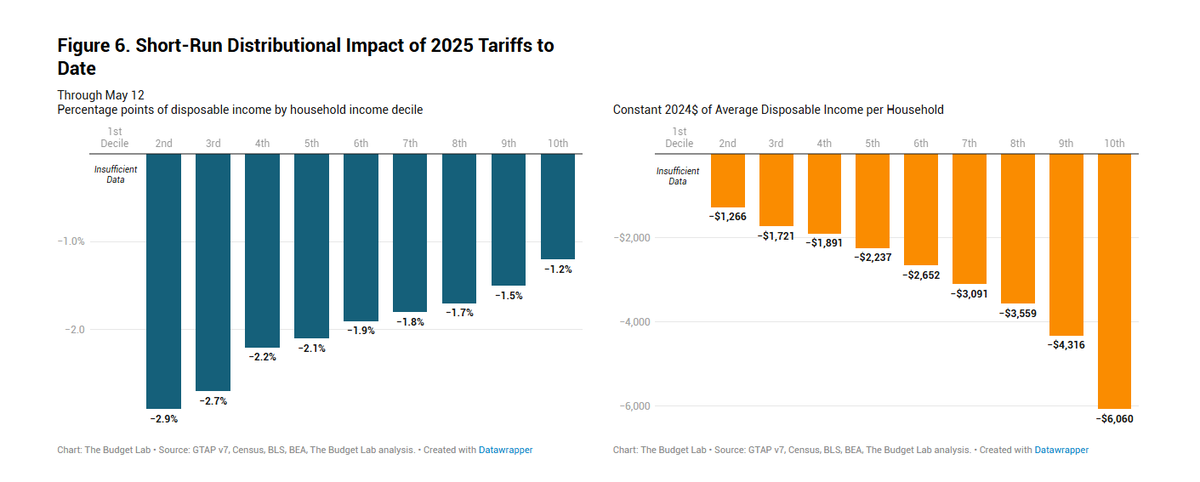
@The_Budget_Lab • Tariffs are a regressive tax, especially in the short-run. The burden on the 2nd decile is 2.5x that of the top decile (-2.9% versus -1.2%). The average annual cost to households in the 2nd, 5th, and top decile rise to $1,300; $2,200; and $6,100 respectively.
10/13 Image
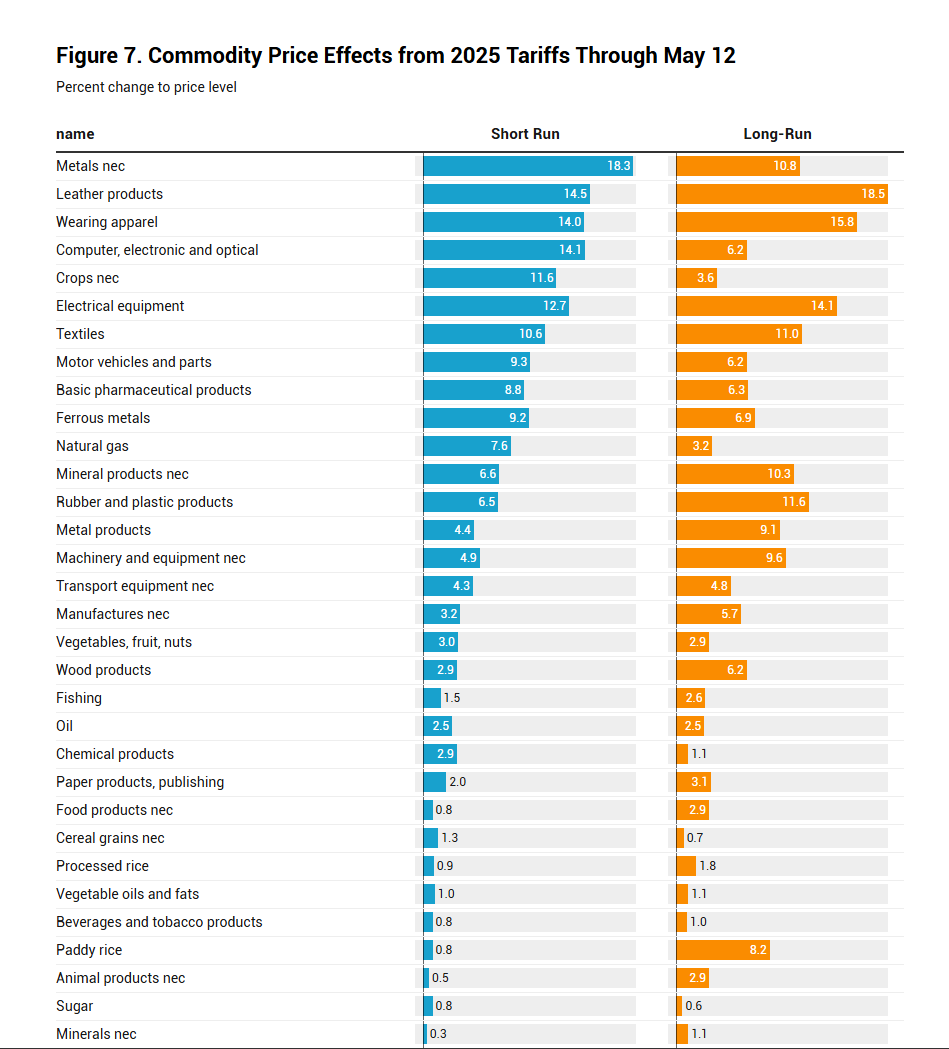
@The_Budget_Lab • The 2025 tariffs disproportionately affect clothing and textiles, with consumers facing 15% higher shoe prices and 14% higher apparel prices in the short-run. Shoes and apparel prices stay 19% and 16% higher in the long-run respectively.
11/13 Image
@The_Budget_Lab • Without the lower China tariffs—but with the US-UK trade deal & auto rebates—the average effective tariff rate would have been 27.6% pre-substitution, the highest since 1903, & prices would have been 2.9% higher in the short-run, a $4,800 per household loss.
12/13
@The_Budget_Lab Full report here:
13/13budgetlab.yale.edu/research/state…

• • •

Missing some Tweet in this thread? You can try to force a refresh

 

Keep Current with Ernie Tedeschi

Ernie Tedeschi Profile picture

Stay in touch and get notified when new unrolls are available from this author!

Read all threads

This Thread may be Removed Anytime!

PDF

Twitter may remove this content at anytime! Save it as PDF for later use!

Try unrolling a thread yourself!

how to unroll video
  1. Follow @ThreadReaderApp to mention us!

  2. From a Twitter thread mention us with a keyword "unroll"
@threadreaderapp unroll

Practice here first or read more on our help page!

More from @ernietedeschi

Oct 15, 2025
I'm in @Opinion today talking about three "partial truths" in the US economic narrative. "Partial truths" are not myths--they have more than a kernel of fact behind them--but they demand caution, asterisks, and grains of salt.

1/9bloomberg.com/opinion/articl…
@opinion Partial Truth #1: AI is driving a boom in GDP growth.
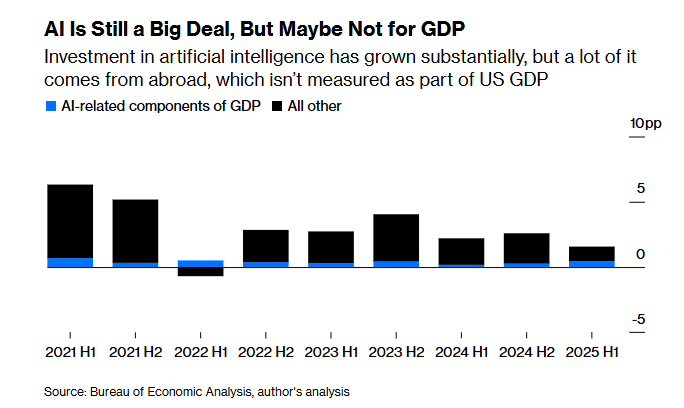
There's no question business investment in AI has surged. But on the question of **real GDP** effects specifically, it's important to note that a lot of the investment has been imported, which needs to be netted out.
2/9
@opinion If you just looked at the gross effects of software, information equipment, & data centers on GDP, you'd conclude they added 1.3 points to 2025 H1's 1.6% SAAR growth!
But net out imports & the contribution falls to ~0.5pp. Still big! But just enough to offset tariff effects.
3/9 Image
Read 9 tweets
Sep 27, 2025
New @The_Budget_Lab tariff update out tonight, incorporating the heavy truck, furniture, and pharmaceutical tariffs announced by President Trump yesterday. Details are still sparse; we will update in the future as more specifics about the policy are published.
In brief...
1/10 Image
@The_Budget_Lab TARIFF RATE: The September 25 announcement raises the average effective tariff rate by 0.5pp to 17.9% pre-substitution (as of Oct 1), the highest since 1934. After consumers & businesses shift their spending mix, the post-substitution rate is 16.7%, highest since 1936.
2/10 Image
Image
Image
Image
@The_Budget_Lab PRICES: The price level rises by 1.7% in the short-run (2-3 yrs) from all 2025 tariffs, assuming the Federal Reserve looks through their price effects. This is the equivalent of a $2,400 average per-household loss of purchasing power in 2025$.
3/10
Read 10 tweets
Sep 4, 2025
New @The_Budget_Lab tariff analysis incorporating all tariffs through Sept 3. This is a major update. We:

• incorporate higher assumptions about Canada & Mexico tariff-free import shares;
• show 2 scenarios: all tariffs & no IEEPA tariffs after Jun 2026.

In brief...
1/12 Image
Image
@The_Budget_Lab Under our all-tariff baseline, consumers face an effective tariff rate of 17.4%, a 15.0pp increase from 2024 & the highest since 1935. After shifts in spending in reaction to the tariffs, the effective tariff rate will be 16.4%, a 13.9pp increase & the highest since 1936

2/12 Image
Image
Image
@The_Budget_Lab The price level from all 2025 tariffs rises by 1.7% in the short-run under our all-tariff baseline, an average per-household income loss of $2,300 in 2025$. The post-substitution price increase settles at 1.4%, a $1,900 loss per household.
3/12
Read 12 tweets
Sep 3, 2025
We have a new @The_Budget_Lab report out today looking at the short-run effects of tariffs so far. Basically, we asked the questions, "What do we see in actual data to date, and how does it compare to our priors." In brief...
1/13
@The_Budget_Lab REVENUE & TARIFF RATES. New 2025 tariffs have raised ~$88B thru Aug, with $23B in Aug alone. The actual effective tariff rate was ~11.5% in Aug vs 18.2% statutory. The wedge b/t the actual & statutory rates is due to factors that lag revenues & low tariff shares from Canada.
2/13 Image
Image
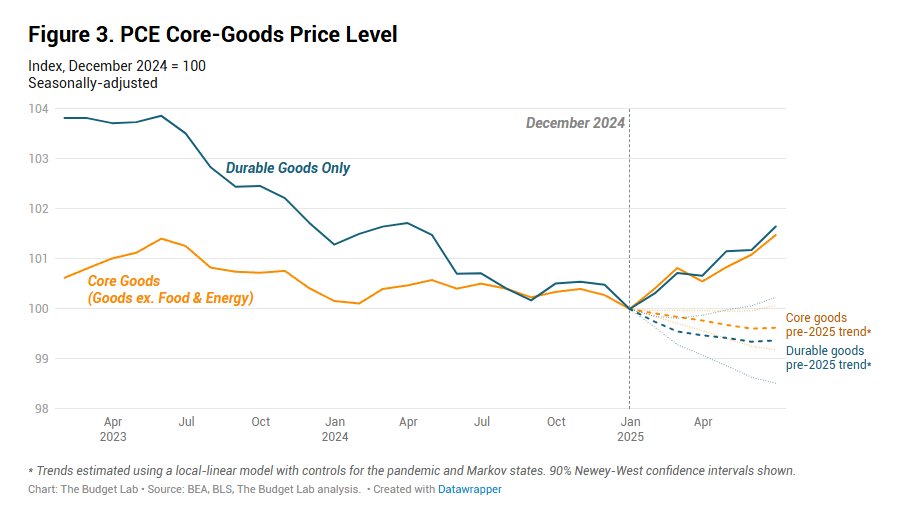
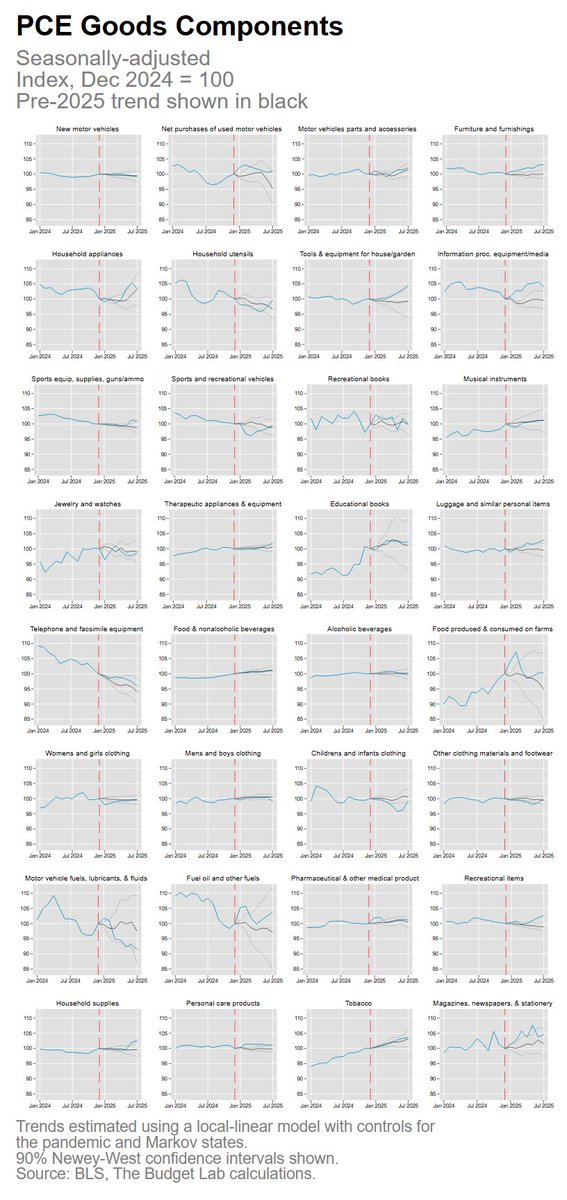
@The_Budget_Lab GOODS PRICES. Goods prices are higher than they would be absent tariffs. Durable goods prices (furniture, appliances, electronics, etc.) & all core goods prices (durables plus apparel & other nondurable goods) were 2.3% & 1.9% above their pre-2025 price levels in Jun & Jul.
3/13 Image
Image
Read 15 tweets
Aug 12, 2025
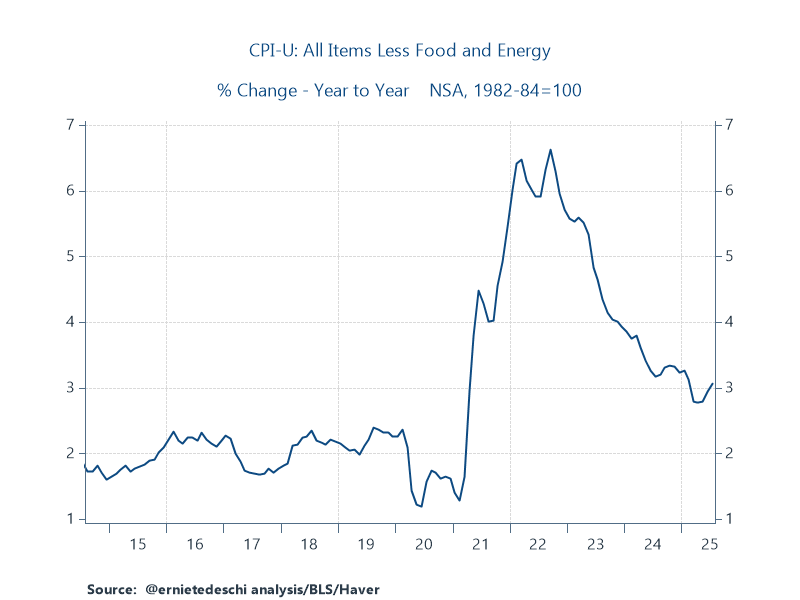
Headline CPI 0.29% MM/2.70% YY, core CPI 0.32% MM/3.06% YY. Small upside surprise on monthly headline inflation, rest in line with expectations.
Grocery & energy prices declined MM, core goods inflation stayed at a warm 0.2%, & core services inflation picked up to 0.4%. Image
In June, excess monthly core inflation was largely a goods story, in large part driven by tariff price adjustments.
In July, the excess is a bit larger on net but more split between goods & services. Image
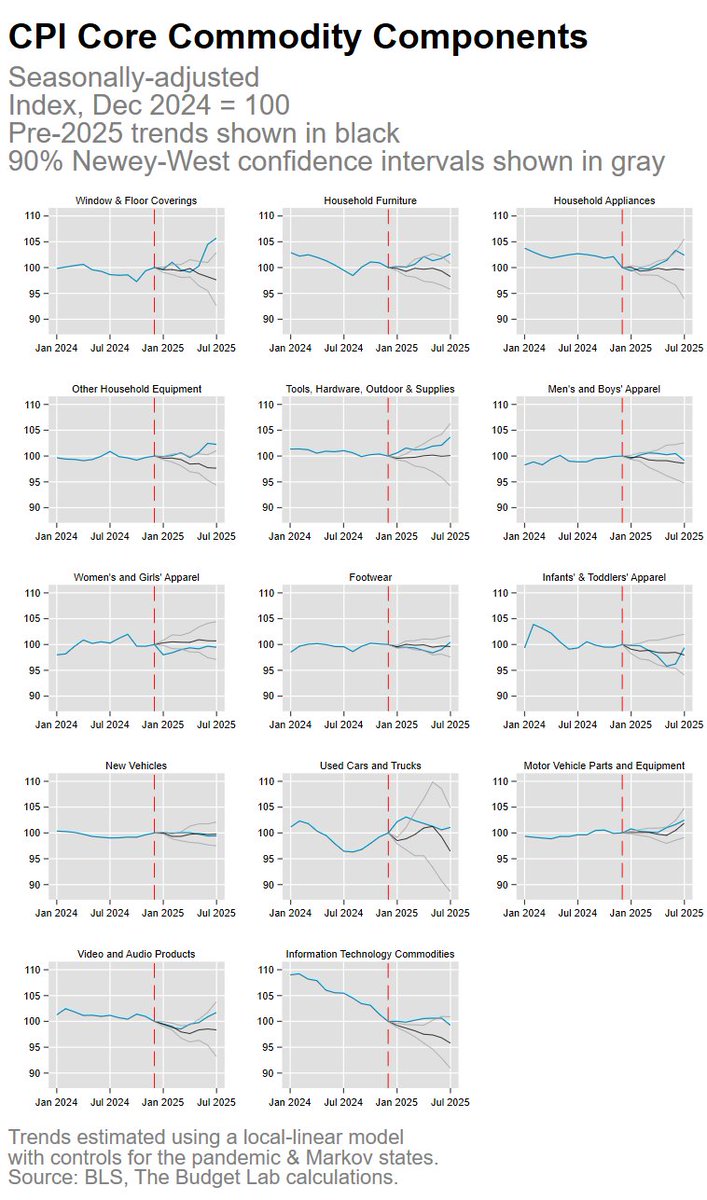
On the core goods side, several tariff-sensitive items are still above pre-2025 trend price levels. The most significant are furniture, windows/floor coverings, & household equipment. Appliances & electronics also above trend. Girl's apparel slightly below trend. Image
Read 5 tweets
Aug 1, 2025
New @The_Budget_Lab tariff analysis incorporating the Administration's new list of "reciprocal" tariffs published last night and going into effect August 7, as well as maintaining the 25% rate on Mexico. In brief...
1/10 Image
@The_Budget_Lab Consumers face an overall average effective tariff rate of 18.3%, a 15.9pp increase from 2024 & the highest since 1934. After consumers & businesses shift spending in reaction to the tariffs, the average tariff rate will be 17.3%, a 14.9pp increase & the highest since 1935

2/10 Image
Image
Image
Image
@The_Budget_Lab The price level from all 2025 tariffs rises by 1.8% in the short-run, an average per household income loss of $2,400 in 2025$, assuming no Fed reaction & full consumer passthrough. The post-substitution price increase settles at 1.5%, a $2,000 loss per household.
3/10 Image
Read 10 tweets

Did Thread Reader help you today?

Support us! We are indie developers!


This site is made by just two indie developers on a laptop doing marketing, support and development! Read more about the story.

Become a Premium Member ($3/month or $30/year) and get exclusive features!

Become Premium

Don't want to be a Premium member but still want to support us?

Make a small donation by buying us coffee ($5) or help with server cost ($10)

Donate via Paypal

Or Donate anonymously using crypto!

Ethereum

0xfe58350B80634f60Fa6Dc149a72b4DFbc17D341E copy

Bitcoin

3ATGMxNzCUFzxpMCHL5sWSt4DVtS8UqXpi copy

Thank you for your support!

Follow Us!

:(