1/ A new survey shows that global trust in the United States has plummeted since Donald Trump returned to office. Trump himself is less popular internationally than Vladimir Putin and Xi Jinping. Israel and Iran come out as the least popular countries in the world. ⬇️
2/ The Alliance of Democracies has published its annual Democracy Perception Index, the world's largest annual survey on democracy. 111,000 respondents across 100 countries were surveyed between 9-23 April 2025.
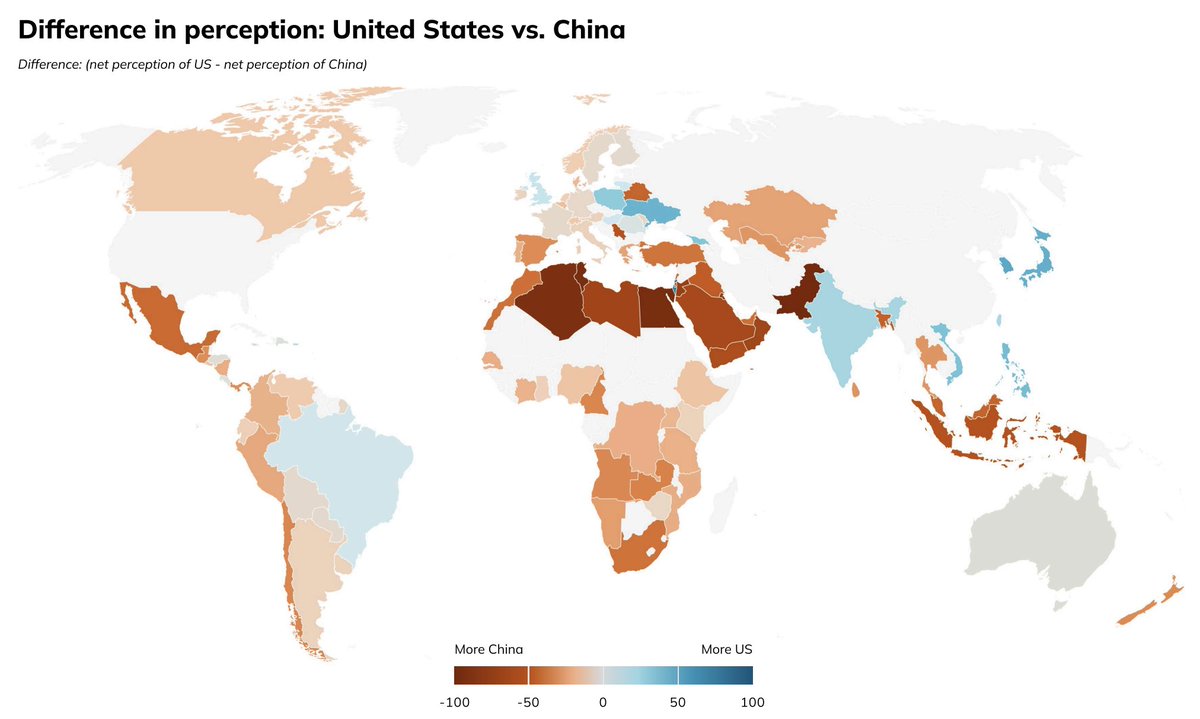
3/ The survey shows that the net perception rating of the United States fell from +22% last year to -5% this year, just ahead of Russia with -9%. The share of countries with a positive image of the US dropped from 76% last year to 45% this year. China went up from +5% to +14%.
4/ The US is now the seventh least popular country in the world in terms of respondents' perceptions. The bottom three are Belarus (-21%), Israel (-23%) and Iran (-25%). While Russia and China have improved their ratings significantly since 2022, the US has fallen sharply.
5/ Globally, perceptions of the US are now deeply negative in Canada, Mexico, most of Europe, the Middle East and North Africa, China, Australia and south-east Asia. Only Ukraine, sub-Saharan Africa, South America, India, Thailand and the Philippines are still net positive.
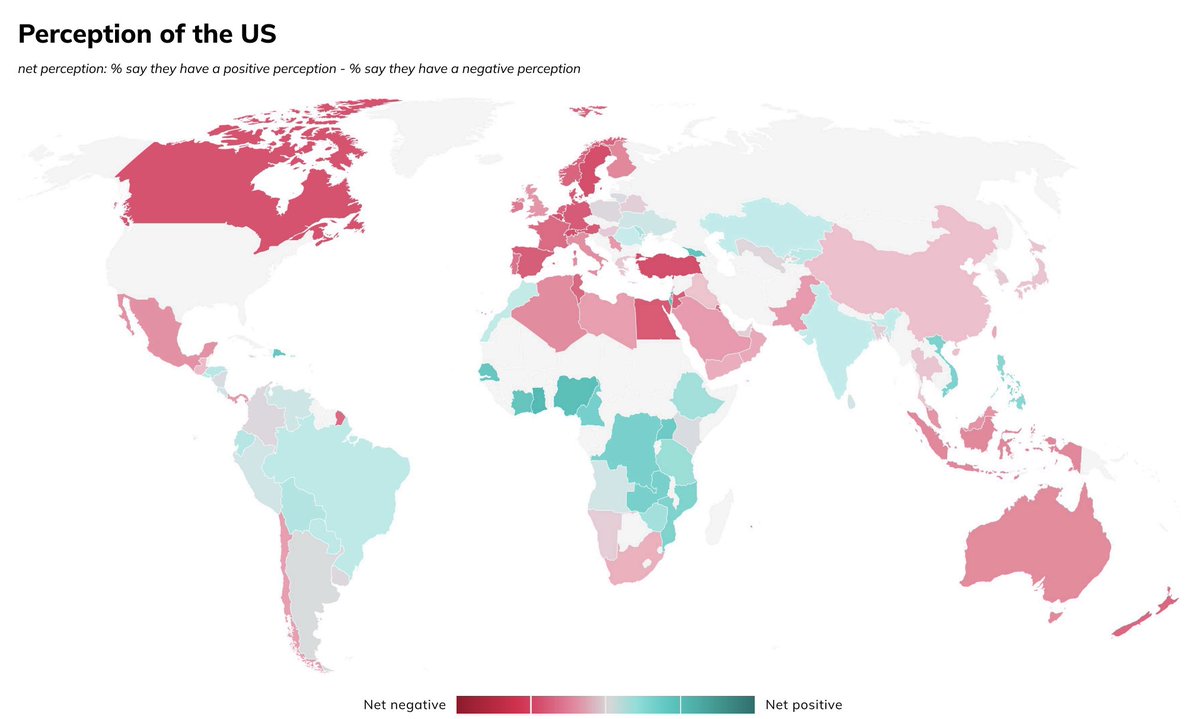
6/ Sentiment has swung in favour of China worldwide, with only Poland, Ukraine, Georgia and Japan standing out as still being strongly pro-US. Most other countries have become mildly or strongly pro-China.
7/ This is clearly being driven by Donald Trump and his policies, especially tariffs. In 82% of countries, more people view him negatively (57% on average) than positively (27%). This is worse than Putin (32% positive, 49% negative) and Xi (32% positive, 32% negative).
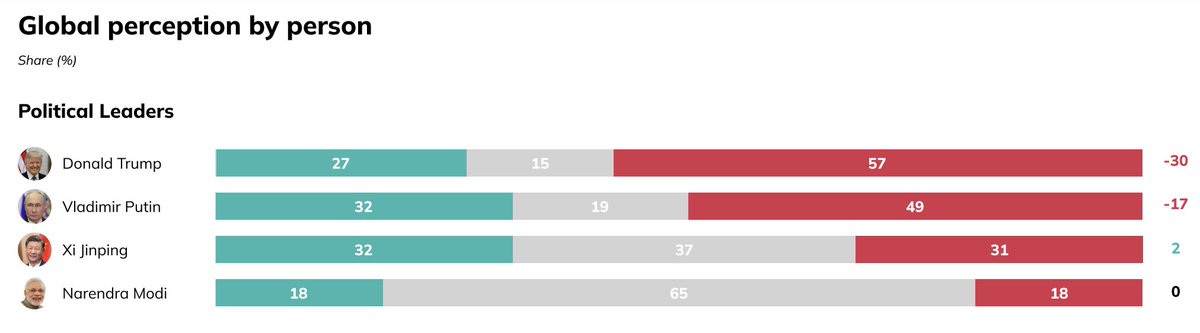
8/ In a striking contrast to the other two leaders, Trump is severely unpopular in both democratic and authoritarian countries, and in every part of the world except sub-Saharan Africa. Putin and especially Xi are popular in authoritarian countries, particularly in Africa. /end
1/ Why has Russia failed so abysmally at providing secure battlefield communications to its troops in Ukraine? The answer, concludes Russian warblogger Oleg Tsarev, is that the military communications budget has been looted for years by corrupt generals and contractors. ⬇️
2/ Tsarev relates the dismal history of Russia's military communications programmes:
"I remember how, at the beginning of the Special Military Operation, all units were buying Motorola radios. There was no other communications."
3/ "Now, Elon Musk has shut down the Starlink terminals our military used in the Special Military Operation, and our communications at the front have been disrupted. I'm talking to military personnel: many say we still have virtually no communications of our own.
1/ The attempted assassination of Lt Gen Vladimir Alekseyev in Moscow this morning has outraged Russian warbloggers, who regard him as a hero of Russia. They have highlighted his key role and contributions to the ongoing Russian invasion of Ukraine. ⬇️
2/ Vladimir Romanov writes:
"An assassination attempt was made on Lieutenant General Vladimir Alekseyev [who is known as 'Stepanich'], First Deputy Chief of the Main Intelligence Directorate (GRU) of the Russian Ministry of Defence."
3/ "An unknown assailant fired several shots into his back in the elevator lobby of a building on Volokolamsk Highway at 7:00 a.m. The assassin fled the scene. Alekseyev was hospitalised.
1/ Russia's battlefield communications are reportedly "in chaos" following the Starlink shutdown. Communications specialists are said to be scrambling to find alternative solutions, while warbloggers advocate torturing Ukrainian PoWs to get their Starlink passwords. ⬇️
2/ Yuri Podolyak writes:
"So, what everyone had long feared, but secretly hoped wouldn't happen until the end of the Special Military Operation has happened. Elon Musk flipped the switch, and 80% of Starlink terminals on the front line went down."
3/ "Moreover, it's highly likely that on our side, this will soon reach 100%, and only Russian ingenuity can attempt to circumvent it. And they will probably circumvent it somehow. But not with a return to 100% functionality as of yesterday morning.
1/ A Russian warblogger explains what the Russian army in Ukraine saw when they were disconnected en masse from Starlink yesterday. ⬇️
2/ "Starlink went down across the theatre of military operations in a rather strange way.
At around 22:00 Moscow time, it was like this:
3/ "– All terminals in the Ukraine theatre of operations are blocked. Both ours and those of the Armed Forces of Ukraine. Even from their "white list". All of them.
1/ Russian retailers are cashing in on Elon Musk's mass disabling of the Russian army's Starlink terminals by massively increasing the price of Russian alternatives. One such system has quadrupled in price overnight to over $2,600, but is said to be far inferior to Starlink. ⬇️
2/ 'Combat Reserve' complains that there has been a huge overnight increase in the price being asked for the Yamal 601 system, which uses Gazprom's Yamal satellite constellation. Units are now selling for 200,000 rubles ($2,612) apiece.
3/ Listings on Avito (Russia's answer to eBay) show that until yesterday, Yamal 601 units were being priced at between 45-60,000 rubles. They are however far less capable than Starlink, and Russian soldiers have avoided them in favour of the smaller and faster US-made system.
1/ Russian forces in Ukraine are experiencing a devastating loss of connectivity as the Starlink terminals they rely upon are systematically shut off. With Russia's own Starlink alternative years away from implementation, Russian warbloggers say the army is in crisis. ⬇️
2/ The Russian army has, like Ukraine's, become dependent on Starlink for battlefield communications. Unlike Ukraine, it cannot import Starlink terminals legally and has to rely on grey imports activated in third countries.
3/ After Russian UAV makers began installing Starlink in kamikaze UAVs, SpaceX responded by implementing technical measures to disconnect fact-moving terminals and Ukraine began whitelisting its own terminals – with all non-whitelisted terminals being disabled.