Craig Baird - Canadian History Ehx Profile picture
May 17 16 tweets 6 min read Read on X
When King George VI and Queen Elizabeth arrived in Canada on May 17, 1939, one of the biggest events in Canadian history began.
This is the story of the 1939 Royal Tour of Canada.

Listen to my episode about it here 👇


🧵1/15 pdst.fm/e/chtbl.com/tr…The black-and-white photo shows Queen Elizabeth and King George VI in an open car. Queen Elizabeth, wearing a light-colored dress and a wide-brimmed hat, waves with a smile. King George VI, in a suit, sits beside her, looking forward. A top hat and flowers are visible in the foreground.
Prior to 1939, various members of the Royal Family had visited Canada but no reigning monarch had ever done so.
The idea for a Royal Tour was started by Governor General Lord Tweedsmuir who saw it as something that could foster Canadian identity.

🧵2/15 The black-and-white photo depicts Lord Tweedsmuir in a formal suit with a tie and a pocket square. His hair is neatly combed back, and he stands against a plain, dark background, giving the portrait a classic, dignified appearance.
At the coronation of King George VI in 1937, Prime Minister William Lyon Mackenzie King consulted the monarch about a possible tour of Canada. He told the King it would bolster trans-Atlantic support for Britain in the event of war.

🧵3/15 The black-and-white photo captures King George VI's coronation, showing the royal family on a balcony. King George VI, in a crown and ornate robe, stands prominently. Queen Elizabeth, also crowned and adorned with pearls, is beside him. Others, including young princesses in tiaras and ceremonial attire, join them against a stone backdrop.
There were plans for the tour to happen in 1938 but after the death of Queen Elizabeth's mother, the Countess of Strathmore and Kinghorne on June 23, 1938, it was put on hold for a year.
On May 17, 1939, the Royal Couple arrived on the Empress of Australia.

🧵4/15 The black-and-white photo shows King George VI and Queen Elizabeth on a ship's deck. Queen Elizabeth, in a coat and hat, holds gloves, while King George VI, in a suit and captain's hat, holds a camera, both standing near a railing.
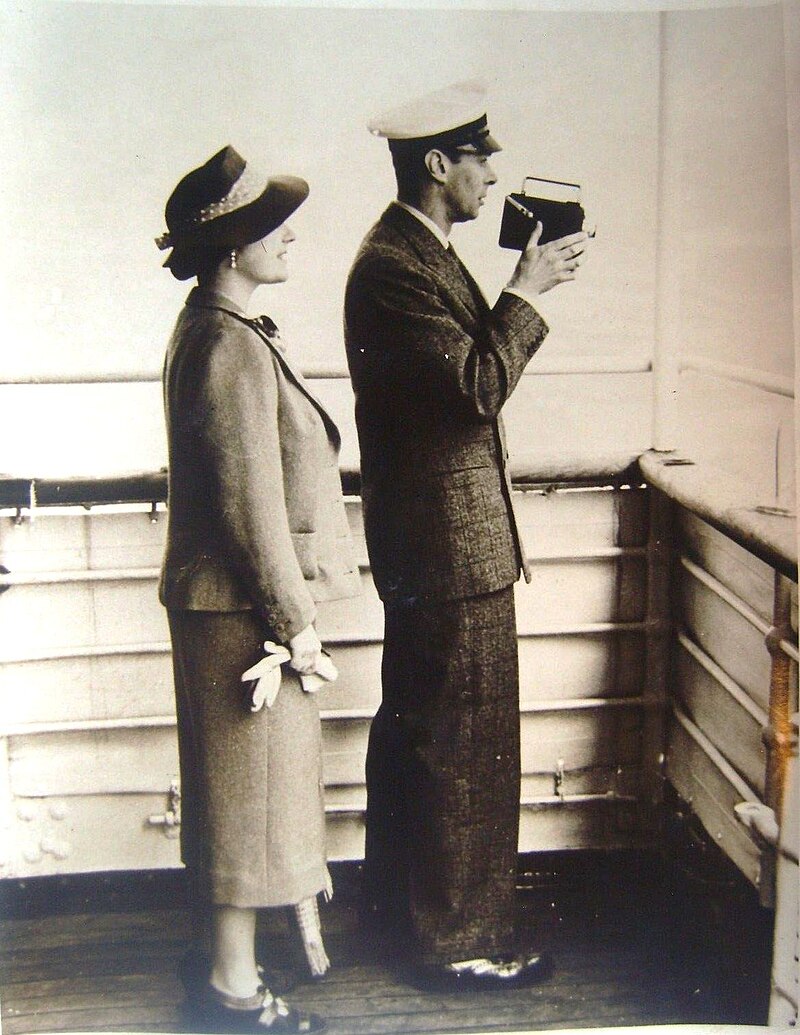
Upon their arrival in Canada, the couple were greeted by enthusiastic crowds in Quebec City, Trois-Rivieres and Montreal. King George VI addressed the crowds in French. He also held audience in the Legislative Council chamber of the Parliament Building.

🧵5/15 The black-and-white photo depicts a formal ceremony in an ornate hall with draped curtains and large paintings. At the center, a group of dignitaries, including a woman in a long gown and a man in a military uniform, stand on a raised platform. A large crowd, dressed in formal attire, is seated and facing the platform, while others observe from a balcony above. The setting includes intricate decor, a cross on the wall, and a coat of arms above the platform.
When the Royal Couple arrived in Ottawa on May 20, Queen Elizabeth laid the cornerstone of the new Supreme Court of Canada building. King George VI also dedicated the National War Memorial in front of 10,000 war veterans. The couple then walked amongst the crowd.

🧵6/15 The black-and-white photo shows a group of people, including a woman in a white dress, walking in front of a large war memorial with a statue on top and figures at its base. A crowd gathers around, with buildings and bare trees in the background.
The couple then went to Parliament where King George VI gave Royal Assent to nine bills. A parade was also held in the city to celebrate the Royal Couple.
The Royal Couple spent two days in Ottawa and then went to Toronto where they attended the King's Plate.

🧵7/15 The black-and-white photo shows King George VI and Queen Elizabeth seated on thrones under a draped canopy during a formal ceremony. Queen Elizabeth wears a gown and crown, while King George VI is in a ceremonial uniform. Attendants in ornate attire surround them, with a small audience seated in front, set against an intricately carved backdrop with a coat of arms.
They dedicated Coronation Park, Queen Elizabeth Way and the Rainbow Bridge at Niagara Falls. They also dedicated various monuments including stone pillars on the Henley Bridge in St. Catharines.
After this, they began their westward journey across Canada.

🧵8/15 The black-and-white photo shows King George VI and Queen Elizabeth in an open carriage during a procession. Queen Elizabeth, in a light dress, fur stole, and hat, waves, while King George VI, in a suit and hat, sits beside her. They are accompanied by formally dressed attendants and escorted by mounted guards in plumed helmets.
When The Royal Couple reached Winnipeg, 100,000 people greeted them despite heavy rain. The King also made his longest address to the British Empire at Government House in the city.
The journey continued through Saskatchewan and Alberta to a break in Banff.

🧵9/15 The black-and-white photo shows King George VI seated at a table with a patterned cloth, holding papers. He is in a suit, focused on his speech, with two vintage microphones in front of him. The room has framed pictures on the walls, a door, and a cabinet in the background.
The King and Queen stayed at the Banff Springs Hotel for a couple days to rest. At one point, they took a walk alone together for a break from the constant crowds and people around them.
The journey continued on through British Columbia to Vancouver and Victoria.

🧵10/15 The black-and-white photo shows William Lyon Mackenzie King, Queen Elizabeth, and King George VI standing on a stone patio with a low wall, backed by snow-capped mountains and evergreen trees. Mackenzie King and King George VI wear suits, while Queen Elizabeth is in a light coat and hat, all engaged in conversation.
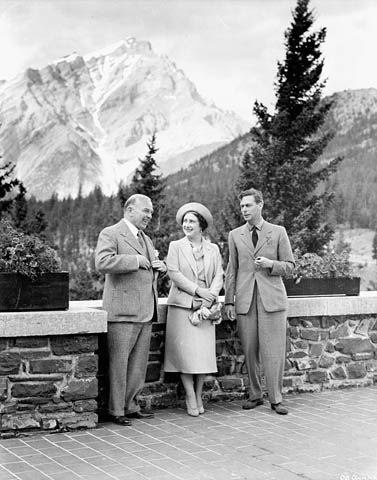
On the train journey east, the Royal Couple reached Edmonton on June 2 where 200,000 people welcomed them. Along the newly-named Kingsway, 70,000 people sat in grandstands.
On June 3, 150,000 came out to see the couple arrive in Saskatoon.

🧵11/15 The black-and-white photo shows a formal gathering on the steps of a grand building. A man speaks at a podium with microphones, while others, including a woman in a fur stole and hat, a man in a military uniform, and children, stand nearby. A crowd watches from the background.
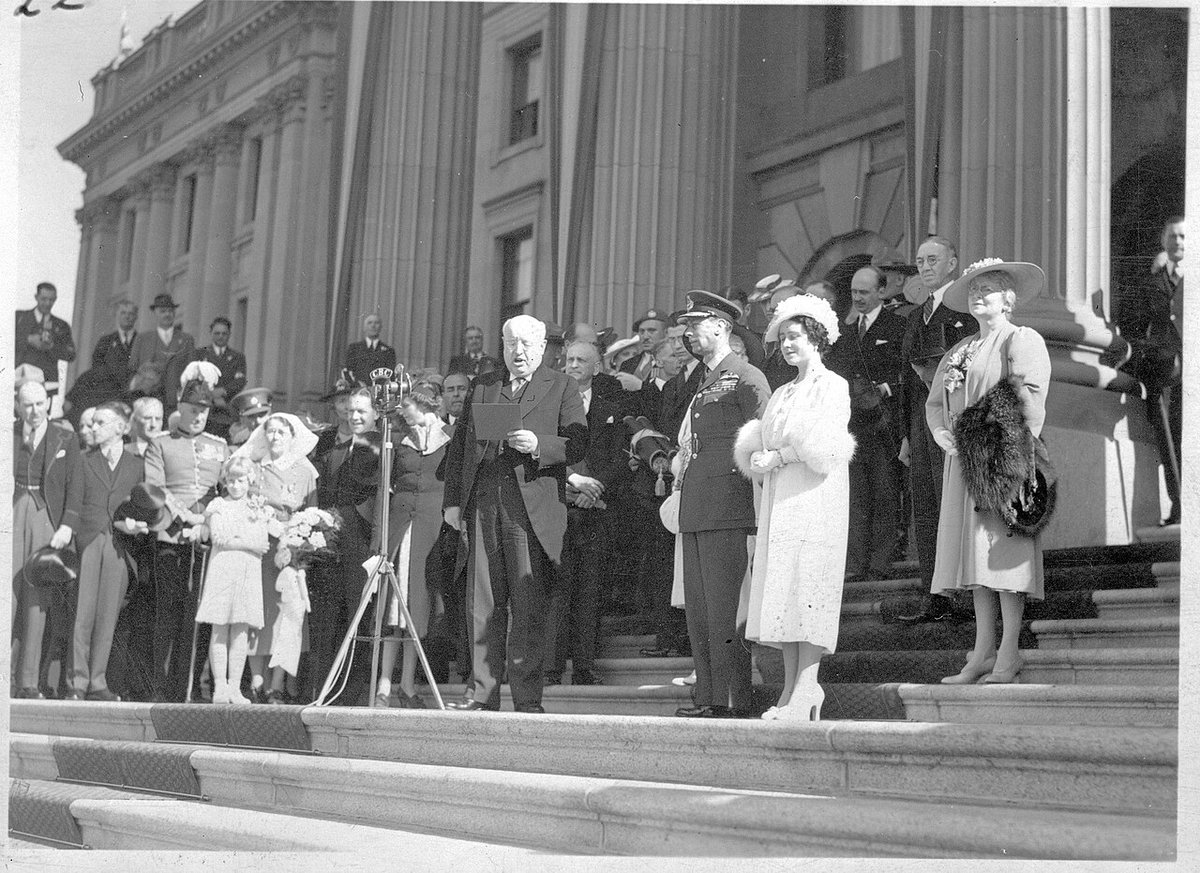
At 10 p.m. on June 3, the couple reached Melville, SK. The town of 3,000 swelled to 60,000 and was one of the largest communities in the province for a few hours. I will have a post about this in a couple weeks.
From June 7 to 12, the couple visited the United States.

🧵12/15 The black-and-white photo shows King George VI and Queen Elizabeth on a train balcony. King George VI, in a suit, waves, while Queen Elizabeth, in a light dress, fur stole, and hat, holds flowers and smiles. The backdrop includes a striped awning and a lantern.
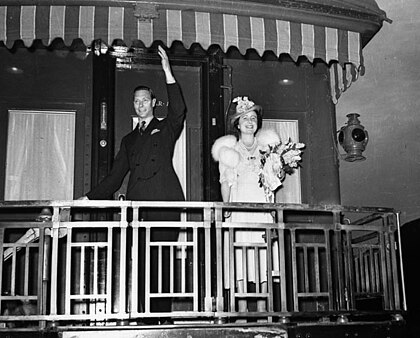
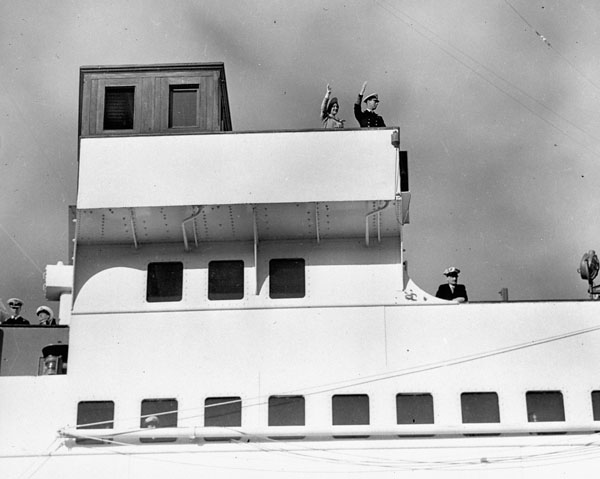
The couple then returned to Canada and toured Atlantic Provinces from June 12 to 15. A farewell luncheon was held in Halifax and then the couple boarded RMS Empress of Britain to do a separate tour of Newfoundland. After that, the couple returned to England.

🧵13/15 The black-and-white photo shows two people waving from the top deck of a ship, with naval officers nearby. The ship's structure includes small windows and a wooden cabin, set against a clear sky.
The Royal Couple said the tour was one of their happiest memories. While King George VI never returned, Queen Elizabeth did many times.
Their daughter, Queen Elizabeth II, did 22 official tours of Canada.

Learn more in my Deep Dive 👇


🧵14/15canadaehx.com/2022/01/01/the…
I hope you enjoyed that look at the 1939 Royal Tour.

If you enjoy my Canadian history content, you can support my work with a donation at 👇


*sources in next post*

🧵15/15buymeacoffee.com/craigu
Image

• • •

Missing some Tweet in this thread? You can try to force a refresh

 

Keep Current with Craig Baird - Canadian History Ehx

Craig Baird - Canadian History Ehx Profile picture

Stay in touch and get notified when new unrolls are available from this author!

Read all threads

This Thread may be Removed Anytime!

PDF

Twitter may remove this content at anytime! Save it as PDF for later use!

Try unrolling a thread yourself!

how to unroll video
  1. Follow @ThreadReaderApp to mention us!

  2. From a Twitter thread mention us with a keyword "unroll"
@threadreaderapp unroll

Practice here first or read more on our help page!

More from @CraigBaird

May 17
Elijah Harper was a Member of the Legislative Assembly of Manitoba, little known outside of the province.
But when he refused to accept the Meech Lake Accord and voted against it while holding an eagle's feather, he became an icon of resistance.
This is his story.

🧵1/12 The black-and-white photo shows Elijah Harper seated at a desk, wearing a suit with a patterned tie and a large circular pendant. He holds an eagle feather in one hand, with an earpiece visible, and a microphone on the table in front of him, suggesting a formal or parliamentary setting.
Elijah Harper was born on March 3, 1949 at Red Sucker Lake, Manitoba.
As a young man, he studied at the University of Manitoba and then worked as a community development worker and program analyst for the Manitoba Department of Northern Affairs.

🧵2/12 The photo shows Elijah Harper in a suit, with his hair tied back, seated against a backdrop of vertical wooden panels. A microphone is partially visible on the left, suggesting a formal or speaking event.
In 1978, he was elected Chief for Red Sucker Lake Band, serving for four years.
In 1981, he was elected as an NDP MLA to the Manitoba Legislature. He was the first Treaty Indigenous to be elected.
In 1990, the Meech Lake Accord was being debated in Canada.

🧵3/12 The photo shows Elijah Harper wearing a traditional headdress with white feathers, yellow accents, and blue diamond patterns. He is dressed in a fringed leather jacket with a beaded necklace over a collared shirt, standing against a plain white background.
Read 13 tweets
May 14
Until 1969, homosexual acts in private or public in Canada were listed under the Criminal Code as "gross indecency".
A person caught in a same sex relationship faced jail time. That all changed (somewhat) with the Criminal Law Amendment Act of 1968/69.

🧵1/12 A black-and-white photograph shows a group of people marching on a wet street, holding banners and signs. Prominent banners read "TORONTO GAY ACTION" and "CANADA TRUE NORTH STRONG & GAY," while another sign says "WE DEMAND FREEDOM TO LOVE." Some participants hold umbrellas, and a large building is visible in the background, suggesting an urban setting during a rainy protest.
Since colonization began in Canada, laws prohibited sexual relations between two men. In 1892, a law made what was termed "gross indecency" between men illegal. That included touching, dancing and kissing.
The gross indecency law extended to women in 1953.

🧵2/12 A black-and-white newspaper clipping with the headline "Homosexuals haven't grown up" in bold, large font. The text below reads: "Another cause for worry is homosexuality, which is far more widespread than many older people ever dream. Homosexuals are simply fixated at a more immature stage in emotional development." The font and style suggest an older publication.
Up until 1869, two men engaging in sexual relations would be put to death. This was later commuted to imprisonment.
Things began to change in the 1965 after George Klippert was convicted on 18 charges of gross indecency and sentenced to four years in prison.

🧵3/12 A person in a light blue shirt holds a rotary phone receiver to their ear while sitting in a room. Behind them, an open closet reveals hanging clothes and shelves with items, including a pink bottle. A wall chart or map is partially visible on the right, and the setting has a vintage feel with wooden doorframes and a coiled phone cord.
Read 13 tweets
May 12
While the Prime Minister's residence 24 Sussex has fallen into disrepair and is unoccupied, the residence of the Leader of the Opposition continues to be used.
Maintained yearly by the government, its history dates back many decades.
This is the story of Stornoway.

🧵1/12 A two-story house with a stucco exterior and red-tiled roof features a prominent entrance with a blue door, white-framed windows, and a small porch. The front yard is well-maintained with green grass, bushes, and potted flowers, surrounded by tall trees under a clear sky.
Stornoway was built in 1914 for Ascanio Major. It was not until the second owners, Irvine Gale Perley-Robertson and his wife Ethel, moved in in 1923 that it was given the name of Stornoway. The named honoured the ancestral home of the Perley family in Scotland.

🧵2/12 A black-and-white photo of a two-story house with a gabled roof and a central entrance, flanked by tall bushes and trees. A pathway leads to the front door, with bare trees and shadows suggesting a winter or early spring setting.
From 1941 to 1945, the Perley family offered the home to Juliana of the Netherlands and the Dutch Royal Family while they were in exile during the Second World War.
In 1950, it became the home of the Leader of the Official Opposition.

🧵3/12 A black-and-white photo shows a family group outdoors near a gazebo. Two adults and three young children, dressed in formal attire, sit and stand together, with one child holding a baby. Trees and a clear sky form the background.
Read 13 tweets
May 6
Farley Mowat was one of Canada's most successful and beloved authors.
His books have sold more than 17 million copies in 52 languages, but he was also a decorated Second World War veteran and an Arctic researcher.
This is his story.

🧵1/16 The photo shows Farley Mowat sitting outdoors near a body of water, possibly a coastline, with a rocky and driftwood-filled background. He is wearing a dark jacket with a fur-lined hood, which is pulled up around his shoulders. The jacket appears to be designed for cold weather, with a zipper down the front and fur trim around the hood. Mowat has a relaxed pose, with one hand resting on the driftwood beside him. The overall scene suggests a rugged, natural environment, fitting for Mowat's reputation as a writer deeply connected to nature and the wilderness.
Farley Mowat was born on May 12, 1921 in Belleville, Ontario. His great-great-uncle was Ontario Premier Sir Oliver Mowat, the longest-serving premier in Ontario's history. His father Angus fought at Vimy Ridge and was an influential librarian in Ontario and Saskatchewan.

🧵2/16 The photo features two black-and-white portraits. On the left, Sir Oliver Mowat, an older man with white hair and a beard, wears glasses and a formal suit with a bow tie. On the right, Angus Mowat, a younger man with short hair and a mustache, is dressed in a suit with a tie and a pocket square.
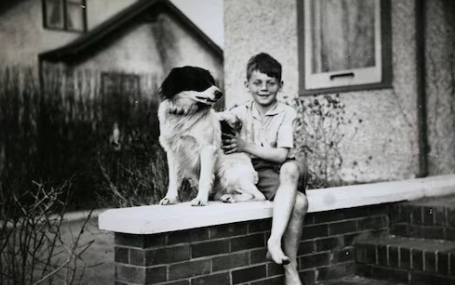
His childhood was spent in Richmond Hill and briefly in Windsor. In the 1930s, the family moved to Saskatoon where Mowat wrote columns about birds for the Saskatoon Star-Phoenix. He also wrote a nature newsletter called Nature Lore during this time.

🧵3/16 The black-and-white photo shows a young boy sitting on a brick ledge outside a house, with a large dog beside him. The boy, wearing a short-sleeved shirt and shorts, smiles at the camera while holding the dog's paw. The background includes a house with a window and some bushes.
Read 17 tweets
May 4
The story of David Thompson is well known in Canada, but the story of his wife of 58 years, Charlotte Small, is not.
Yet she was integral to his success as a surveyor and explorer.
This is her story.

Listen to my episode about her here 👇


🧵1/10 pdst.fm/e/chtbl.com/tr…The photo is a pencil sketch of Charlotte Small, depicting her with a serious expression. She wears a headscarf and has her hair in two braids. She has triangular earrings and is dressed in a high-neck garment. The sketch is signed "Mel Hynes" in the bottom right corner.
Charlotte Small was born on Sept. 1, 1785 to Patrick Small and a Cree woman who is unnamed in records. Her father left when she was young to go back east.
This was common for country marriages. The fur trader husband often abandoned his Indigenous wife and children.

🧵2/10 The photo shows a bronze bust of a woman on a wooden pedestal in a museum exhibit. Behind the bust are informational panels titled "La Grande Carte," "Aboriginal Mapping," and "Cartographie Autochtone," discussing cartography and Indigenous contributions. Two wooden crates are on either side, and the background features a large map.
On June 10, 1799, she married David Thompson.
Together, the two had 13 children.
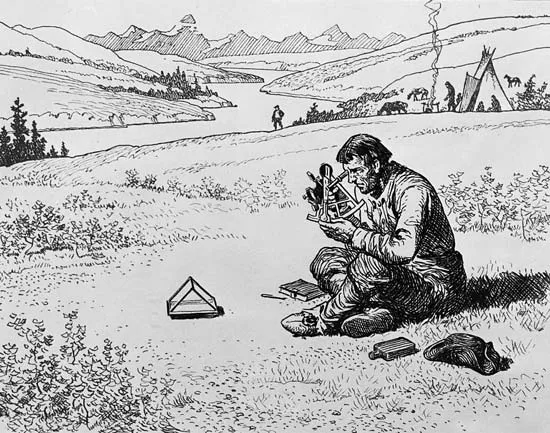
Throughout Thompson's journeys across present-day Western Canada, Charlotte was with him. She raised five of their children during this time.
She was far from just tagging along.

🧵3/10 The photo is a black-and-white illustration of a man sitting on the ground in a landscape, using a surveying instrument. He is surrounded by tools, including a small tripod. The background features mountains, a river, teepees, and a person with horses, depicting a historical surveying scene.
Read 11 tweets
May 1
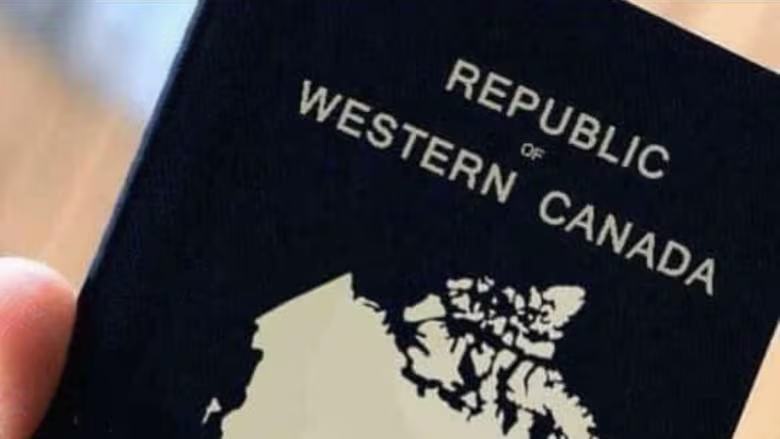
Alberta Separation is once again in the news, but it is far from a new thing.
Separation talk dates back decades, rising and falling with political trends.
Let's learn more about Western Separation Movements!

Listen to my episode from 2019 👇


🧵1/18 pdst.fm/e/chtbl.com/tr…The photo shows a hand holding a black passport with "REPUBLIC OF WESTERN CANADA" written on it. The passport features a map of Canada, highlighting the western region.
I'm not including Quebec separatist movements in this thread. That will be one of its own.
In our first election in 1867, the Anti-Confederation Movement out of Nova Scotia won 18 seats. They called for Nova Scotia seceding from Canada.
By 1870, the movement had failed.

🧵2/18 The photo shows a framed, weathered flag with a blue border and a triangular design. The flag has the text "THREE CHEERS FOR THE ANTIES." written on it in black letters. The wooden frame has screws at the corners.
From 1867 to 1870, a store owner in Thomas Spence tried to create an independent republic in the Portage La Prairie area called New Caledonia, and later the Republic of Manitobah. This failed but Spence later served on the council of Louis Riel.

🧵3/18 The photo is a black-and-white portrait of a bearded man with short hair, wearing a suit jacket and a bow tie, looking directly at the camera with a serious expression.
Read 18 tweets

Did Thread Reader help you today?

Support us! We are indie developers!


This site is made by just two indie developers on a laptop doing marketing, support and development! Read more about the story.

Become a Premium Member ($3/month or $30/year) and get exclusive features!

Become Premium

Don't want to be a Premium member but still want to support us?

Make a small donation by buying us coffee ($5) or help with server cost ($10)

Donate via Paypal

Or Donate anonymously using crypto!

Ethereum

0xfe58350B80634f60Fa6Dc149a72b4DFbc17D341E copy

Bitcoin

3ATGMxNzCUFzxpMCHL5sWSt4DVtS8UqXpi copy

Thank you for your support!

Follow Us!

:(