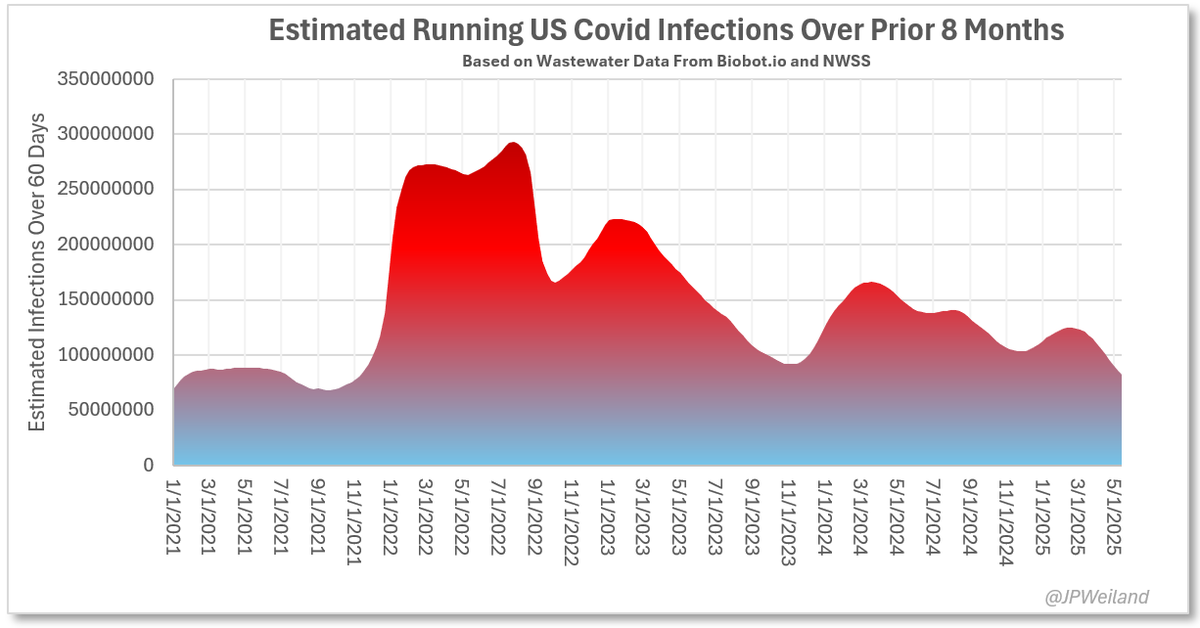
This is such a cherry-picky (and incorrect) claim that I keep seeing repeated. The baseline between waves is not getting higher. Over the past 3 years, the lulls between waves are level or down, especially fall. Let's look at all of the other data sets available too.
The more informative look at "what's been happening with case trends lately" is by evaluating running totals over a period of time. Right now we're at the lowest since 2021, and this running total will continue trending down for at least few more weeks.
• • •
Missing some Tweet in this thread? You can try to
force a refresh

XFG* looks to me like the likely summer wave generator. From modeling NY growth:
🔸️~65% wkly advantage
🔸️Fastest since JN.1 or KP.2
🔸️Slower than the combo of KP.2/KP.3/KP.3.1.1
🔸️Dominance in NY within 2 weeks
🔸️Dominance in US in June
I focused on New York state because XFG* is far ahead there relative to anywhere else, and they still have a lot of sequencing. It will take some time to evaluate it in other places to confirm the growth rates.
I used @RajlabN 's Tableau to determine sequence frequencies over time. Thanks Raj
I'm not sure if we'll get quite as low in transmission this spring as the minimums the last 2 years because of a very low winter peak not as efficiently cleaning up the susceptables. A bit of uncharted territory, since immunity is waning but we don't have strong variant growth.
Even without a strongly growing variant, I'm still confident we will have a decently sized summer wave. Parts of the south and west basically had no wave at all in the winter, thus the susceptibility is slowly increasing.
But the question is, how long will the decline hold on until we start the summer increase without a new fast variant? If the decline hangs on until late May or June, we may get below 2023/24's lows.
We witnessed a huge weekly growth advantage in new variants for the first year after Omicron arrived, and then to a lesser extent after Pirola. Now we have 9 months of the lowest growth advantages since 2020. 🧵
Both Alpha and Delta had only moderate divergence from their predecessors, but they increased transmission in a time with a mountain of people with no immunity to severe disease. Their waves of cases were moderate, but the waves of death and hospitalization were huge.
Omicron came in and wiped more than half of immunity to infection without heavily impacting resistances to severe disease. What it also did was open up a lot of new evolutionary potential for immune escape, and BA.2, BA.5, and XBBs demonstrate that impact well
▶️ An interesting saltation was found yesterday by variant trackers.. 3 samples of a highly divergent BA.3 in South Africa with 57 AA spike mutations. Samples were taken Nov-Jan, so it doesn't have a ton of speed (at least yet), but is worth watching. 1/
It currently lacks both 455 and 456 mutations that have been critical for immune escape in the last 16 months. If it is able to find those before its candle runs out, I think it has a chance to outcompete the current variants. 2/
I completely agree with this take from @LongDesertTrain - I was pessimistic about BA.2.87 due to the uphill battle against JN.1. The current relatively slow movement of variants could give this new BA.3 enough time to evolve mutations to jump start spread
How accurate are my infection estimates? The calibration is based on 2020-early2022 historical WW&case data, so we have no easy way to validate today's calibration in the US.
But we do have *measured* UK prevalence in December 2023 that arrives very close to my US estimates.
This is unfortunately about as good of validation as we can have since we don't measure prevalence directly in the US. UK and US are obviously not the same entity, but they do tend to spike together in December each year. Their data was not used to feed my calibration, so it..
..is reassuring that they arrived at very similar numbers on their actual prevalence measurements.
It would be great if the US did a similar measured prevalence study of their own, but we don't have anything like that at the moment.
The sequence from the 2nd severe H5N1 case in North America (Louisiana) has been released, and again, ⚠️has mutations that favor a2,6. Is it simply a coincidence that both severe cases have 2,6 favoring mutations? Or is this an indication of severity with 2,6?
I don't like this.



