This is just a quick read-through, not a line-by-line comparison with the previous version, so we may comment on things that are not new.
There is a clear acknowledgment here that biological sex is a thing, and (by implication) everyone is either male or female. In other words, the ETBB rejects gender identity theory and acknowledges material reality.

That's refreshing, because judges have a great tendency to insist that they're not "picking sides" in the debate between gender identity theory and belief in reality, otherwise known as "gender critical".
But of course courts and tribunals must always pick the side of truth and reality: it's literally their job.
And that after all is what the SC did in finding that for the purposes of the EqA, it is biological sex that matters.

"Non binary" isn't legally meaningful.

This is obviously right.
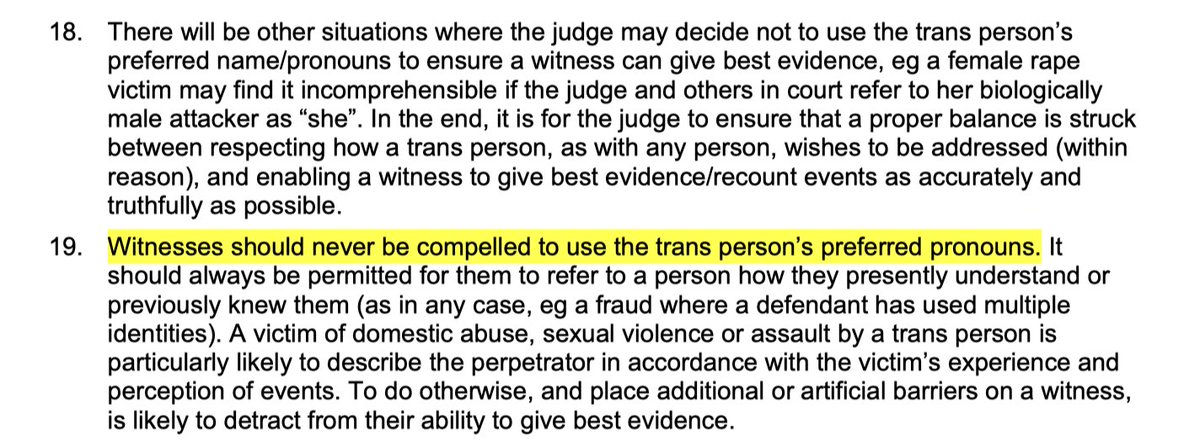
This is good so far as it goes, but judges should not pay lip-service to gender identity theory by using "preferred pronouns" in any case in which conflict between gender identity theory and reality is in issue.
More on pronouns. Still the "default" assumption that it may often be appropriate or polite to use wrong-sex pronouns, but progress at least towards a recognition that other people have relevant rights.
• • •
Missing some Tweet in this thread? You can try to
force a refresh

There’s an astonishing quantity of nonsense being talked about the Supreme Court’s FWS judgment, still, including by otherwise reputable lawyers who should know better.
So let's get a few things straight.
Generally, in law, sex doesn’t matter. But it goes further than that: in many contexts — work, education, services etc — thanks to the Equality Act 2010, it’s positively not allowed to matter. Sex discrimination is prohibited.
Some comments in response to this disappointing piece by employment solicitors @traverssmith
There’s still a lot of misguided and inaccurate advice being disseminated by lawyers about the Supreme Court judgment in For Women Scotland. It’s a worry.traverssmith.com/knowledge/know…
1. There are only complex questions now because employers have been unlawfully operating self-ID policies for years.
2. The idea that trans people (with or without GRCs) should be allowed to use opposite-sex facilities was supported in the @EHRC’s 2011 Services Code of Practice. It was wrong.
There will be a great deal of this, and it will be infuriating. More employees will lose their jobs for trying to persuade their employers to comply with the law.
A few thoughts about how to put pressure on your employer while minimising the risk to your job.
First, always remember that "They can't sack me or discipline me for reasonable manifestation of a protected belief/asserting my statutory rights/asserting my right not to suffer discrimination or harassment" is wrong.
It's a long judgment, and there will be plenty to digest, so this is just a first impression of some of the key points.
The headline is that words like "man", "woman" and "sex" in the EqA bear their natural, everyday meanings, unmodified by the operation of gender recognition certificates. So far as the EqA is concerned, a "trans woman" is still a man, even if he has a GRC.
A short🧵 on @barstandards' proposal to require barristers to "act in a way that advances equality, diversity and inclusion" (proposed new Core Duty 8).
"Gender-critical" barristers have expressed anxieties that the proposed new duty will be used to suppress dissent from fashionable orthodoxies, including gender identity theory.
Those concerns have so far been either ignored or brushed aside; nothing, it would seem, could be further from the BSB's collective mind.



