UPenn economist @JesusFerna7026 just gave an important talk called The Demographic Future of Humanity.
Key points: (1) Birth data is much worse than the UN reports, (2) UN projections are absurdly rosy, (3) Economic growth will be low, and (4) Immigration cannot fix this.
🧵
First, Fernández-Villaverde notes that in country after country, the UN's birth figures are far higher than what those countries officially report.
For example, the Colombian government reports births 25% lower than what the UN claims. In Egypt and Türkiye, the gap is ~12%. 2/8
On top bad birth data, the UN's population projections are absurdly optimistic. In most countries birthrates have been dropping like a rock. Yet the UN projects birthrates will bounce right back up.
There is no evidence for this. The causes of low birthrates haven't reversed. 3/8
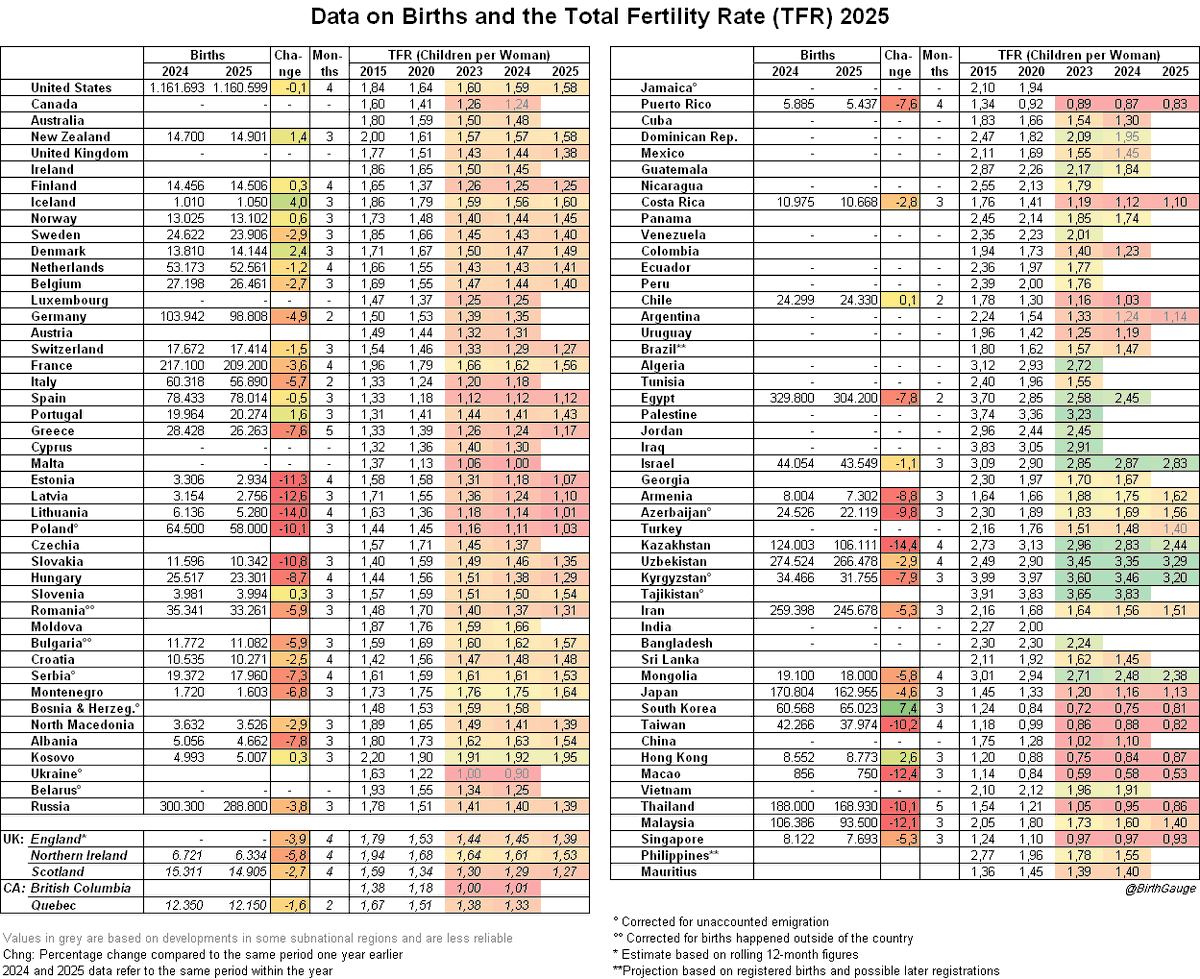
In fact, yesterday @BirthGauge (a must-follow account) released new fertility data, based on the latest 2025 reporting by national governments.
Contra UN projections, the birth decline is accelerating around the world, with many countries seeing double digit drops in 2025. 4/8
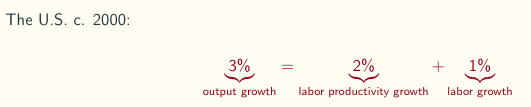
Economic growth will be low, Fernández-Villaverde explains, and the math is simple.
Output growth is just productivity growth times workforce growth. Even if productivity keeps growing at 2%, a shrinking workforce means that GDP growth would average just 1% instead of 3%. 5/8
That 1% baseline growth is a huge problem for governments.
US debt is soaring, and the stated plan is for GDP growth to outrun the debt, as it has in the past.
But low birthrates mean that even if productivity keeps improving, GDP growth will be much too low for this to work. 6/8

Immigration can't fix this. Professor Fernández-Villaverde explains that 'most immigrants worsen the fiscal position of the government' and only the top fraction of immigrants are net payers.
And globally, every country's gain is another country's loss. 7/8
What does Fernández-Villaverde recommend for solutions? Here his presentation is thin. He suggests cheaper housing but emphasizes that urban housing is 'deeply antifamily'. Education needs to be reformed.
He promises more in the coming days in terms of policy ideas. 8/8

• • •
Missing some Tweet in this thread? You can try to
force a refresh

Resisting Birthrate Decline Through Culture: How one part of Japan bucks the trend
Japan's woes are well known, its population long in decline, it's economy stagnating.
Yet one prefecture continues to grow, not through policy but through a pronatal culture.
🧵, please share!
For more than forty years, Okinawa has had far higher fertility than any other prefecture (Stone, 2024).
But Okinawa's fertility used to be lower than the 🇯🇵 average (map by @yz7sha).
How did Okinawa manage to develop a pronatal culture, so different from the rest of Japan? 2/9
The story starts after World War II.
Unlike the United States or most countries that participated in the war, Japan never had a postwar baby boom, and a 2016 paper explains why.
Facing defeat and a loss of resources, Japan embarked on a crash program of population control. 3/9
A wonderful paper by Spears et al. showed that population reduction would have almost no impact on climate change.
Why? The main reason is that a baby born today will emit much less carbon than someone born a generation ago, and their children will emit even less carbon. 🧵
Most previous forecasts of how population would impact climate assumed that carbon emissions would continue at the same rate indefinitely.
But per-capita carbon consumption has been falling sharply and will fall even faster in the future as renewable energy takes over. 2/4
Meanwhile, because of population momentum, total population takes decades to change meaningfully.
By the time depopulation kicks in, per capita carbon emissions will be much lower than they are today, and so the climate impacts of population by then will be much lower. 3/4
Knowing birthrates are driven by a stack of factors lets us figure out what is happening in each country and what its 👶 bottlenecks are.
Things like beliefs about children, marriage, housing conditions, religiosity, work culture and more all have a big impact.
🧵, please share!
In Spain (TFR 1.12), big hurdles include a huge fraction of young people living with their parents (driven by relatively poor employment for young people), the high share of housing that is small apartments, and declining faith among the young. 2/13
Poland (TFR 1.11) has a culture that is obsessive about work, with the longest work hours in Europe. After the fall of Communism, almost 70% of young Poles regularly practiced religion; today, less than 25% do. Housing is small and crowded. 3/13
Fertile No More!
For more than a hundred years, Ireland was both the most religious and the most fertile country in Europe.
But in recent years, Ireland experienced rapid secularization, and its fertility fell to just 1.47 in 2024.
What happened to 🇮🇪, and what comes next?
🧵!
First, a bit of history.
By the 1800s, Ireland had become almost entirely reliant on just one crop. Potato blight struck in 1845, and soon famine and mass migration cut the Irish population from 8 million down to 4. Ireland's population is still well below its 1845 peak. 2/7
Ireland gained independence in 1921, and Catholicism was central to Irish identity, partly in defiance of protestant England.
For most of the 20th century, 🇮🇪 was deeply religious, with church attendance above 90%.
The Irish idealized large families, and fertility was high! 3/7
Getting old without ever getting rich
Thailand, with a TFR of just 0.95 in 2024, never even had a chance to get rich before its birthrate collapsed.
A look at how over-zealous family planning combined with cultural factors to put 🇹🇭 on a demographic downward spiral.
New 🧵!
Unlike its neighbors Korea and Taiwan, Thailand with a per-capita GDP of just $7000 never got to get rich before facing ultra-low birthrates.
For Thailand, the biggest cause was family planning run amok.
(Below, a wedding dress in Thailand made of entirely of condoms!) 2/9
The father of Thai birth control is Mechai Viravaidya, an enthusiastic family planner who led round after round of family planning efforts. As its birthrates plunged, Thailand was lauded as a huge success.
But then these efforts blew far past the mark. When Thailand hosted the International Conference on Family Planning in 2022, its fertility was already down to 1.01 and still dropping fast. With January 2025 data already reported, Thai births were down another 8.4% from January 2024.
Here is Viravaidya posing proudly with a tree made out of... Guess what? 3/9
The fastest fertility collapse in the world
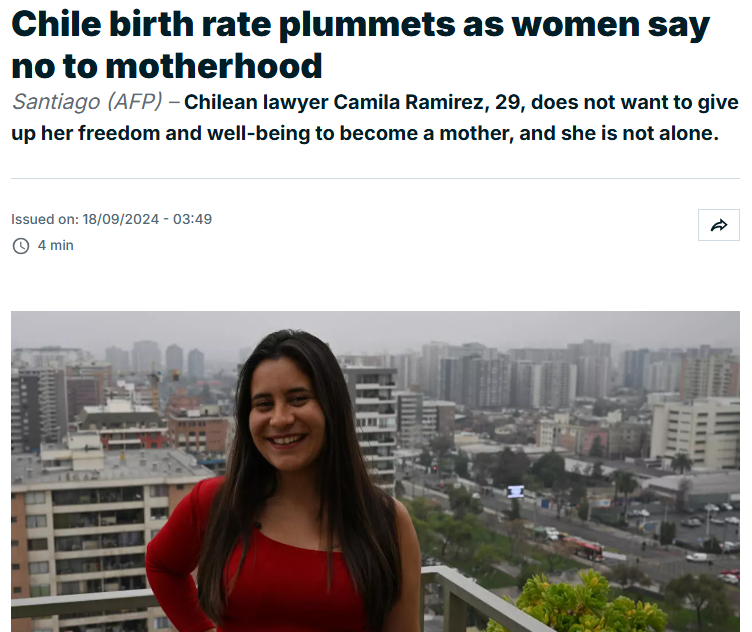
In 2024 Chile recorded a fertility rate of just 0.88 births per woman, a drop of 23% in a year and 51% since 2015. No country has seen fertility fall as fast.
A look at how social changes have overwhelmed 🇨🇱 and threaten its future.
🧵!
In recent years, Chile has been wracked with protest. In 2018, there were some 151 feminist protests across the country.
Then from 2019 to 2021, these mixed with large youth-led anti-establishment protests, which turned violent and often resulted in brutal police responses. 2/7
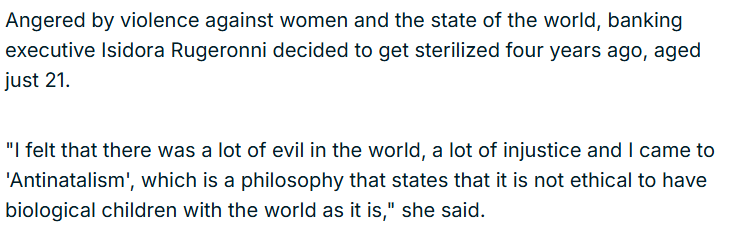
In the aftermath of the protests and the subsequent crackdown, many women have sworn off of childbearing, and anti-natal beliefs have taken hold.
This has analogues to South Korea's gender tension and its notorious 4B movement (women rejecting dating, sex, marriage & kids). 3/7