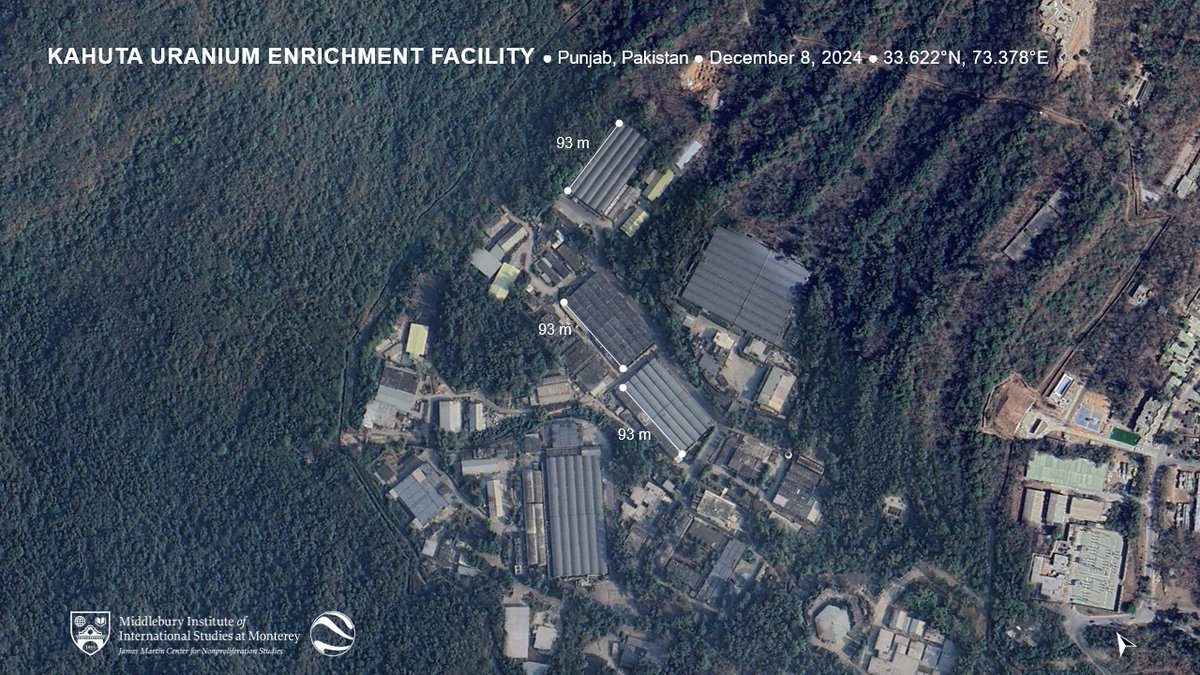
This is probably the the new North Korean uranium enrichment facility that @iaeaorg DG @rafaelmgrossi briefed the Board of Governors about. @sam_lair and I have a summary on the blog. Nice shot by our friends at @planet. armscontrolwonk.com/archive/122048…
The dimensions, layout and other features do resemble the Kangson UEP when it was constructed. Here is a 2002 image of the Kangson under construction -- the central enrichment hall is about 93 m long, which is the right length for two 164-centifuge cascades end-to-end.
You remember the Kangson Uranium Enrichment Plant, surely. (Good times with @DaveSchmerler and @nktpnd.) thediplomat.com/2018/07/exclus…
That's the same set up as the first two enrichment halls at Yongbyon, as well as the early enrichment halls at Kahuta in Pakistan. Pakistan's AQ Khan was, of course, an important source of assistance to North Korea's centrifuge program (as well as others) in the 1990s.
The big question is how many centrifuges will it hold? If the new facility is a copy of the OG hall at Kangson -- and it is about the same size -- the new facility might hold ~24 cascades or 3,936 centrifuges. At 4 kg per machine, that's ~15,744 kg SWU or 73 kg of HEU a year.
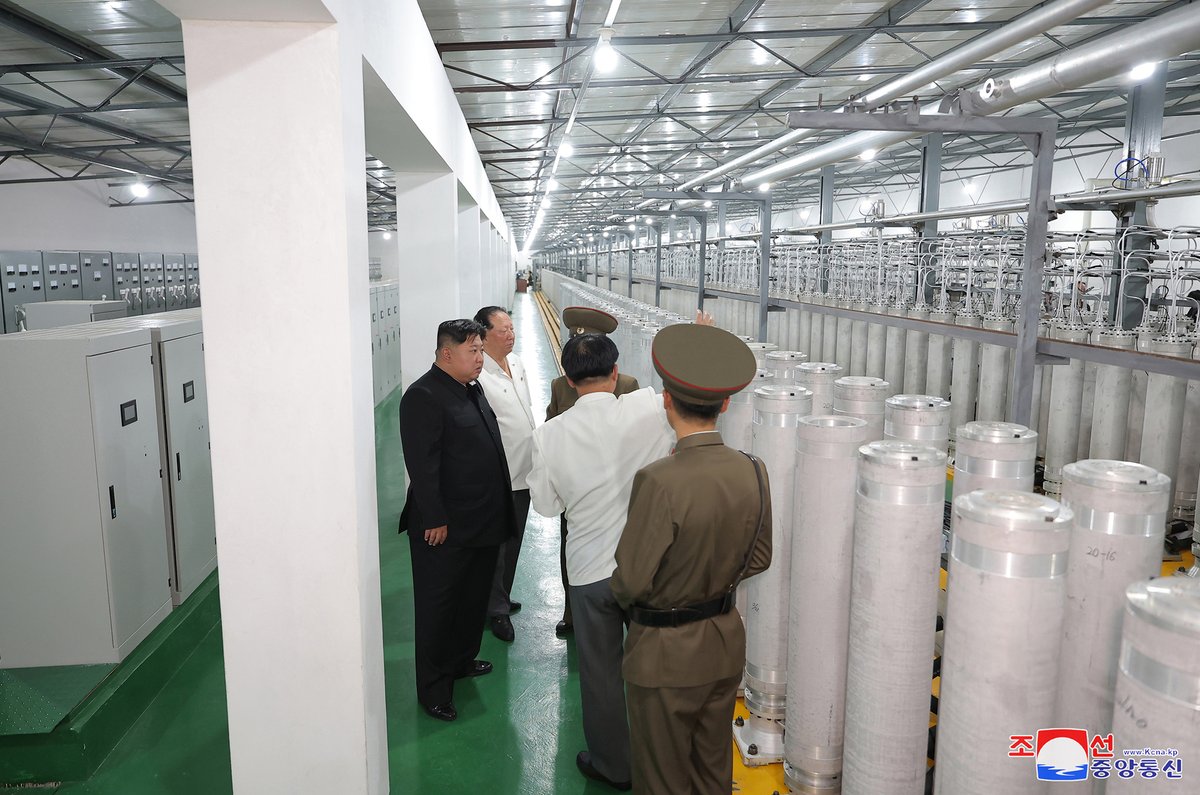
However, North Korea has been squeezing more and more centrifuges into the smaller spaces in recent years. We really saw that when Kim visited the Kangson and Yongbyon UEPs. Here's a table showing the meters per centrifuge at different facilities and the meters per cascade width.
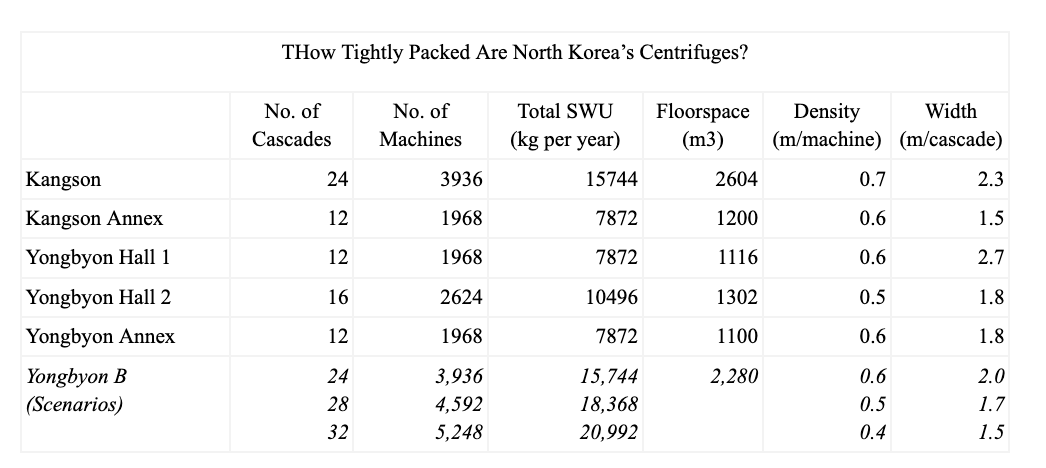
All the above estimates on numbers come from looking at the pictures, geolocating and then measuring the buildings in satellite images. You get the idea.
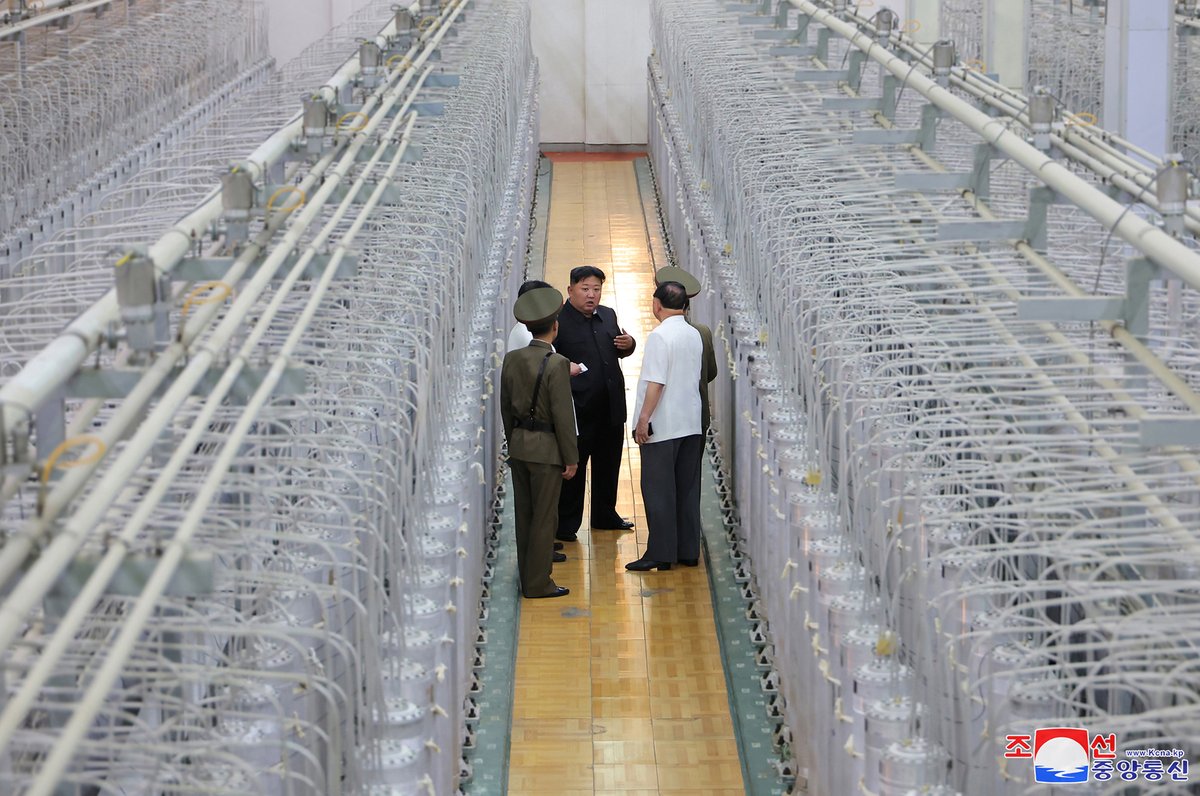
If North Korea squeezes in 28 or even 32 cascades, which is not impossible given other places we've seen, then the number could be a lot higher -- 3,936-4,592
5,248 centrigues or 85-98 kg of HEU a year.
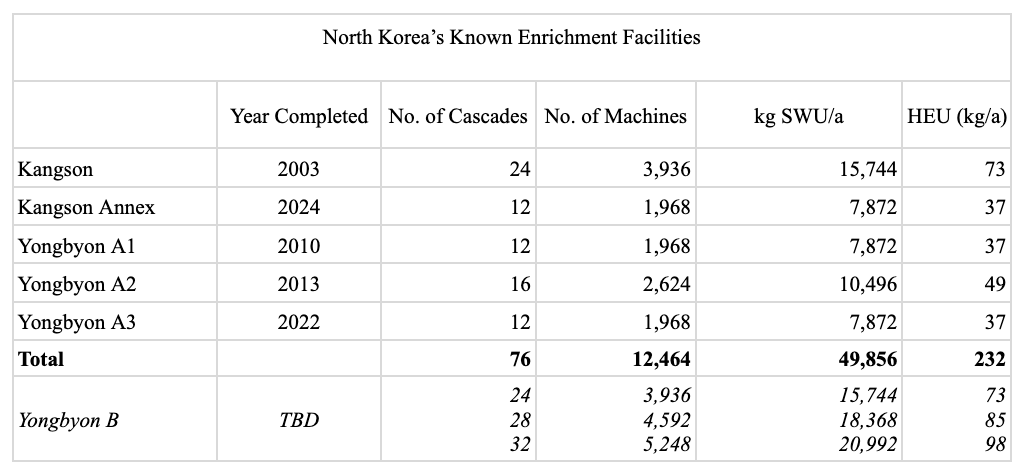
I'd probably guess 28 cascades or 4,592 machines if I had to, but we won't really know unless Kim Jong Un decides to visit. Which, given the way things have been going lately, seems more likely than not.
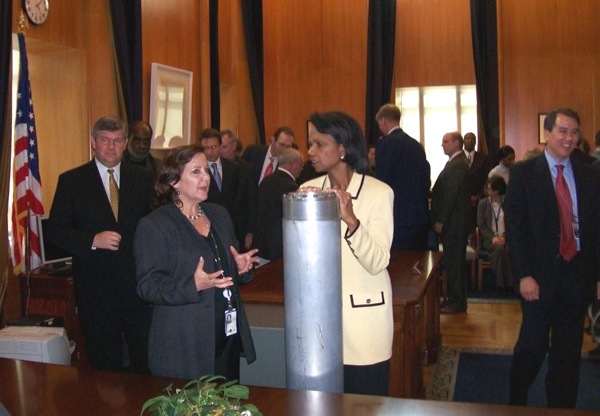
How many bombs is 73, 85 or 98 kg of HEU? I hoped you wouldn't ask me that! The @iaea "significant quantity" is 25 kg of HEU. The Iraqi design used ~15 kg of HEU. Pakistan probably does better than that. Tom Cochran thinks the number should be 3 kg. ambienteparco.it/pdf/fissionwea…
The question probably isn't worth answering, anyway, since North Korea likely uses composite pits, which would layer both Pu and HEU, has a mix of fission and staged thermonuclear weapons. So, a lot depends on what kind of arsenal one assumes they are building.
*One of the above posts was to read: "If North Korea squeezes in 28 or even 32 cascades, which is not impossible given other places we've seen, then the number could be a lot higher than 3,936 -- 4,592 or 5,248 centrifuges/85 or 98 kg of HEU a year."
• • •
Missing some Tweet in this thread? You can try to
force a refresh

Trump's offer to Iran, as reported by @BarakRavid, is a dollar-store-JCPOA.
The JCPOA -- which Trump abandoned -- had all of these provisions, usually in ways that were stronger or more carefully constructed.
He's trying to put Humpty Dumpty back together again. A thread.
@BarakRavid Here is the original story. The proposal was "described to Axios by two sources with direct knowledge — one of whom provided a point-by-point breakdown." This is a paraphrase, so sometimes its hard to know what they are getting at. axios.com/2025/06/02/ira…
@BarakRavid Here is the text of the JCPOA. You don't have to take my word for it; you can look it up yourself. europarl.europa.eu/cmsdata/122460…
The claim of 25 missiles a month is falsely attributed to the @DI_Ukraine. What @DI_Ukraine says, according to other news outlets, is 25 IRBMs per YEAR, not per MONTH. babel.ua/news/113282-ro…
Oreshnik is the first two stages of the Yars missile. Oreshnik production rates should be similar to Yars production rates, which the Russians claim is "about 20 launchers and their supporting systems per year." web.archive.org/web/2021041112…
Russia has issued a new (2024) "Fundamentals of the State Policy of the Russian Federation in the Field of Nuclear Deterrence" (основы Государственной Политики Российской Федерации В Области Ядерного Сдерживания). Same wine, new bottle. 🧵. static.kremlin.ru/media/events/f…
BLUF/TLDR: Four significant changes from 2020 but these changes are all (1) at the margin, (2) consistent with past Soviet/Russian policy, and (3) stuff that I believed was the policy in fact, even if it had been unstated.
1. The report was written by a think tank, not technical experts from the 🇺🇦 gov't. 2. 🇺🇦 has ~7 tons of reactor Pu, enough for several hundred simple-fission weapons. 3. The Pu is sitting in spent fuel. To use it, 🇺🇦 would have to build a separation plant, which would take years and cost hundreds of billions. web.archive.org/web/2024111318…
First, some context. The document is just a report prepared by a think tank that will be presented at a conference. This very much stretches the definition of "news."👇
According to Kim Yo Jong, the explosive power or "yield" of the Hwasan-31, pictured below, is the same as 900 tons of TNT -- that's much smaller than the bombs dropped on Hiroshima (15,000 tons) or Nagasaki (21,000 tons).
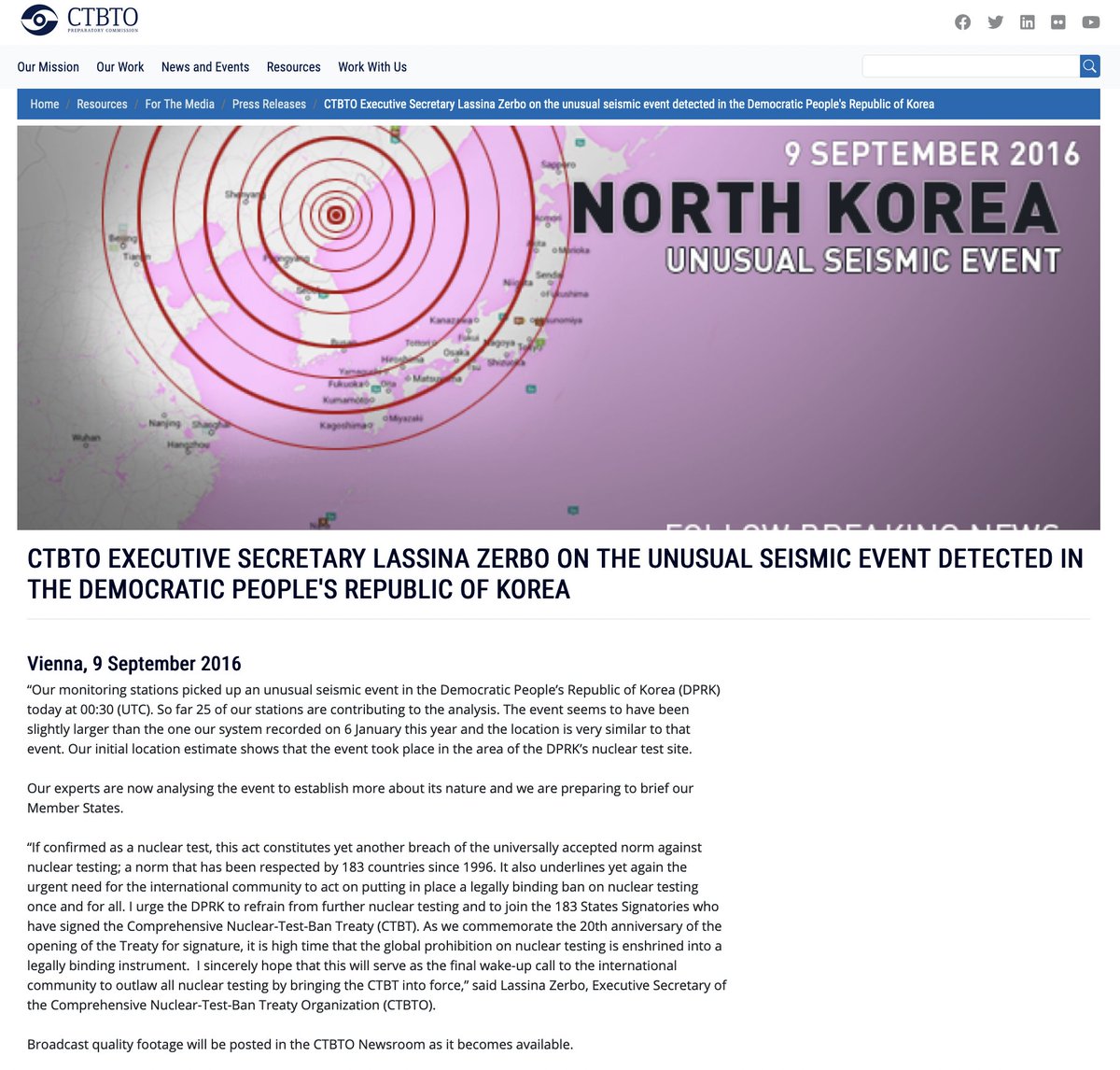
The first indication will be a statement from @USGS_Quakes. Some time after that, the @CTBTO will also issue a statement. Here is what those looked like for the last test.
I am coming around to the idea that Israel's stocks of Arrow-2 and -3 interceptors are either depleted from April or are being saved for more sensitive targets. A little thread on cost effectiveness at the margins.
The US fired 12 interceptors during this engagement from the destroyers Bulkeley and Cole. Assuming they were SM-3 interceptors, that represents the production run for an entire year, at a cost of about $400 million total. (Each interceptor is about $30 million.)
Arrow-2 and -3 production rates are classified, but Arrow-3 is more expensive than SM-3 at about $50 million per interceptor. You can see lots of Israeli officials talking about the need to reduce the cost of interceptors and increase production rates. defensedaily.com/israeli-arrow-…