Restructuring__ Profile picture
Jun 18, 2025 • 12 tweets • 3 min read • Read on X
COATUE East Meet West Deck

102 Pages on Public Markets every investor should read

My highlights đź§µ

1/ Tech Trends - higher returns & volatility
2/ Change in Stock Leadership - hard to stay on top
...
10/ The AI Flywheel
11/ Long the $USA Image
1/ Tech Trends - higher returns but more volatility and drawdowns Image
2/ Change in Stock Leadership - hard to stay on top Image
3/ What happens to the dropouts? Image
4/ Are Mag 7 slowing down? Image
5/ BTC, the new risk / reward opportunity Image
6/ Hyperscaler Capex and Chat GPT Breakout Image
7/ AI starting to show its effects on spend and search Image
8/ Elevated valuations Image
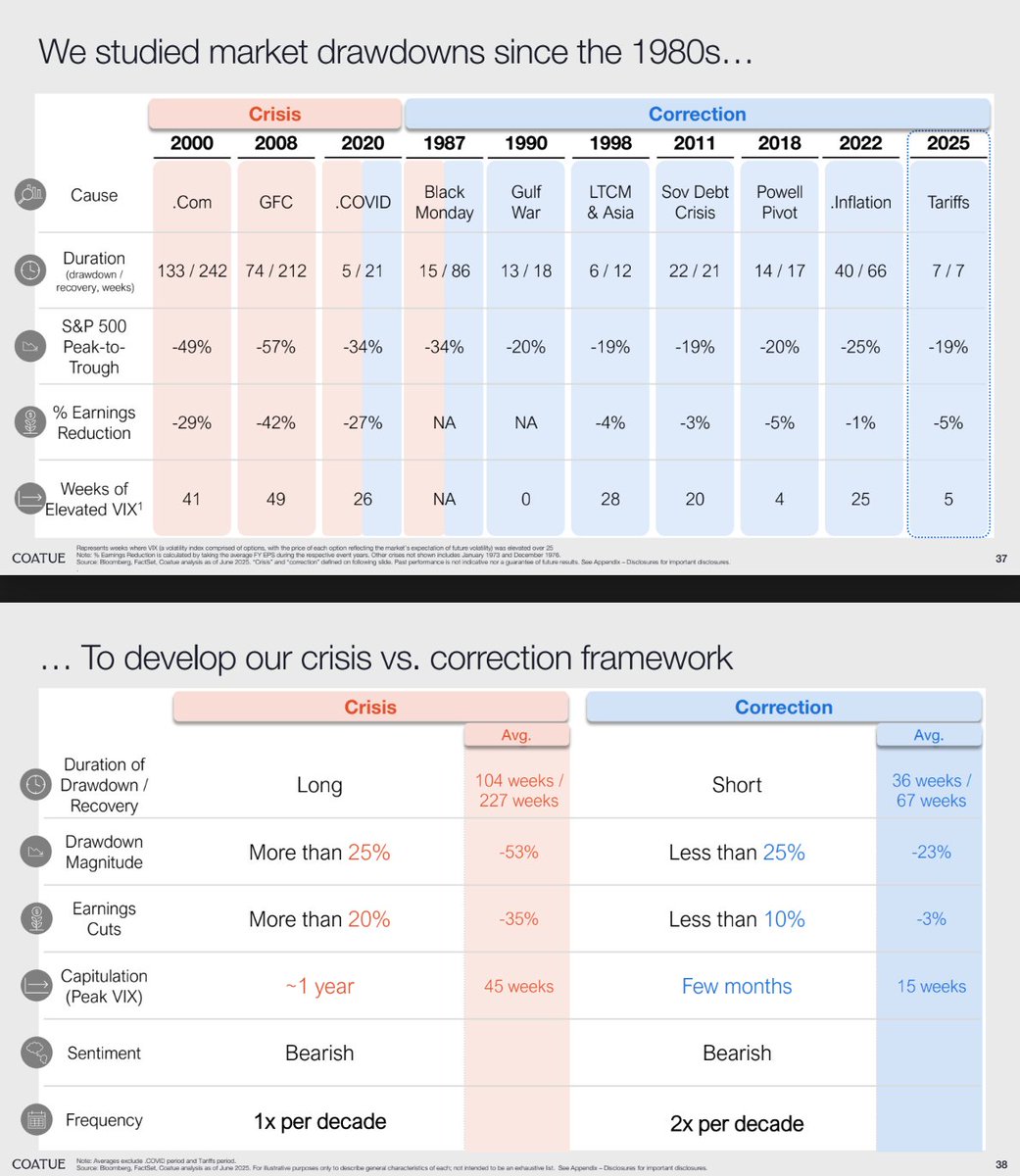
9/ Studying drawdowns Image
10/ The AI Flywheel Image
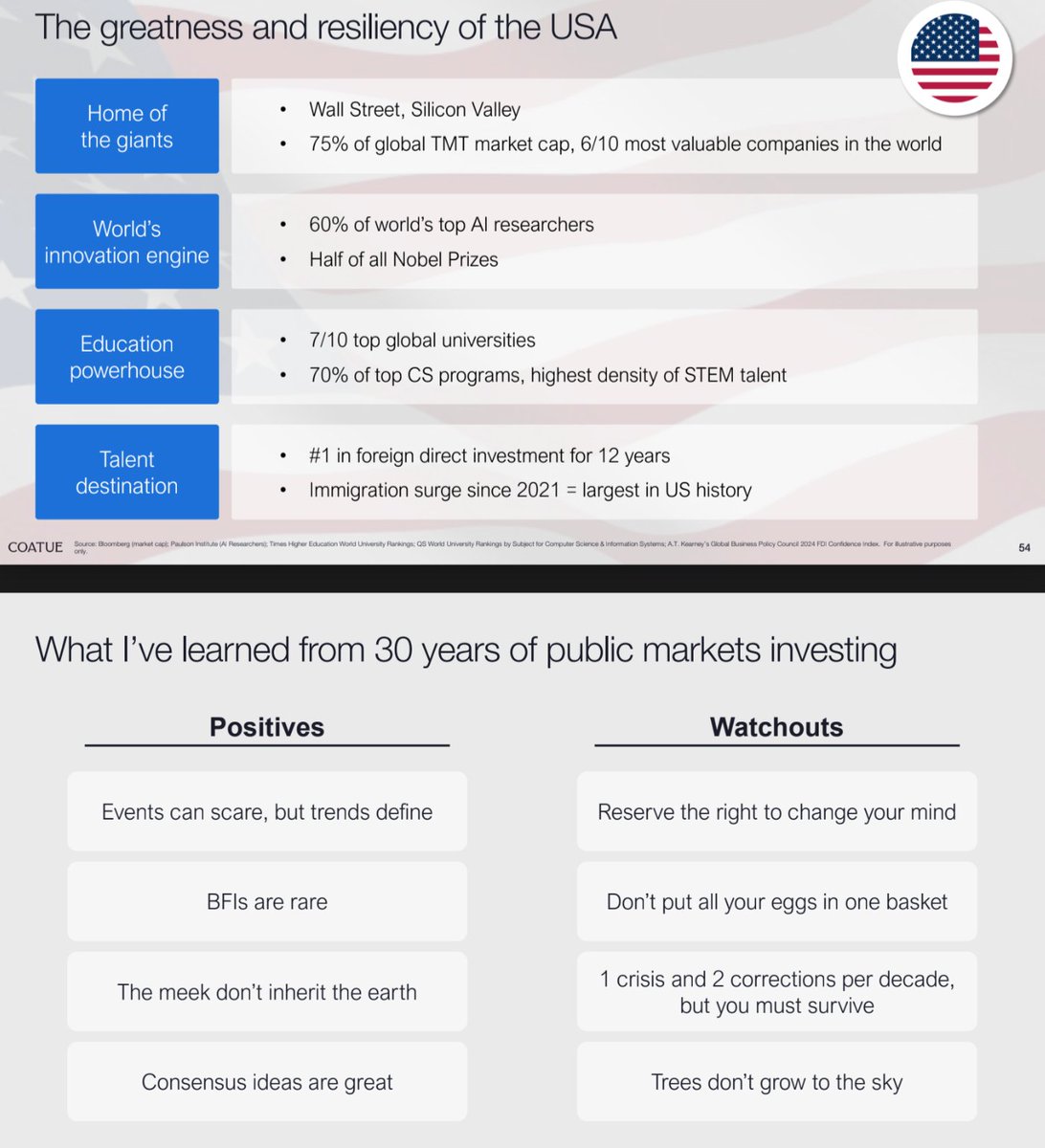
11/ Long the $USA Image

• • •

Missing some Tweet in this thread? You can try to force a refresh

 

Keep Current with Restructuring__

Restructuring__ Profile picture

Stay in touch and get notified when new unrolls are available from this author!

Read all threads

This Thread may be Removed Anytime!

PDF

Twitter may remove this content at anytime! Save it as PDF for later use!

Try unrolling a thread yourself!

how to unroll video
  1. Follow @ThreadReaderApp to mention us!

  2. From a Twitter thread mention us with a keyword "unroll"
@threadreaderapp unroll

Practice here first or read more on our help page!

More from @Restructuring__

Dec 11, 2025
This is Kelly Granat

The Co-CIO at Lone Pine Capital, one of the most storied and successful hedge funds in history

She sat down today with ILTB and revealed how to pick stocks and lead an investment firm
Here are 7 key insights:
1) What Every Great Business Has in Common
2) Lone Pine’s Biggest Mistake & How They Fixed It
3) The Short-Termism Epidemic
4) Strategies & Opinions on AI
5) Finding Value Beyond Tech
6) Balancing Fundamental & Macro Awareness
7) The Investing Mindset That Separates the Best from the Rest

A (Long) Thread đź§µImage
1) What Every Great Business Has in Common

Kelly believes the best investments have a competitive moat, strong business models, and outstanding leaders. A great company has a desirable product, scales efficiently, and can continue to grow for years with minimal risk. However, paying too much for a company can make it a negative investment, even if it is good. Valuation and timing are crucial.

One major signal is a leadership change. If a good CEO takes over a company that has a strong base but isn't doing well, the upside can be massive. Ulta Beauty is a good example. It had a fundamentally strong business, but its marketing and culture were bad. When Mary Dillon, who is experienced in consumer goods, became CEO, she changed the company's strategy and image. This unlocked huge value. Lone Pine kept an eye on her career and invested early because they knew she could fix the problems.

The best turnaround investments happen when a company’s biggest weakness aligns perfectly with a new leader’s expertise. Some businesses, however, don’t need superstar leadership to succeed. Their models are so strong that they compound naturally over time. Visa and Mastercard are great examples. Their revenue grows as global transactions increase, and their business model is nearly impossible to disrupt. Lone Pine invested in them early but should have held longer. For these companies, leadership matters less than buying at the right price. Great investing is about balancing leadership-driven turnarounds with long-term compounders—and knowing when the market is mispricing both.
2) Lone Pine’s Biggest Investing Mistake & How They Fixed It

In 2021, 2022, the market was rewarding high-growth firms that were burning through their cash flow. Lone Pine’s valuations focused more on long-term projections than near-term realities.

Lone Pine recognized early that the Fed was behind on inflation and that a rate-hiking cycle was coming. While they started adjusting their portfolio, they didn’t move quickly or aggressively enough to reduce exposure to high-growth names before the market turned. When the sell-off hit in early 2022, all high-growth stocks collapsed together.

The mistake wasn’t just in valuation. It was also a portfolio imbalance. Lone Pine had too much exposure to e-commerce, payments, and software, sectors that had thrived in a low-interest-rate environment. When the market changed, having so much invested in just a few stocks hurt them. In early 2022, they totally revamped their investments.

They sold off a lot of their tech stocks and put their money into industries they had experience in. This shift led Lone Pine to try a wider, more diversified investing plan. Instead of depending on just a few big names, like Nvidia, they went with a mix of industries and investing methods that fit their main philosophy.
Read 8 tweets
Nov 9, 2025
Mauboussin just published its latest 88 pages research piece on “Capital Allocation”

These are the 7 key findings you should study and master:

1)Lack of Capital Reallocation
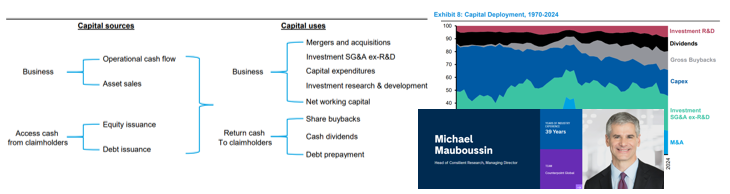
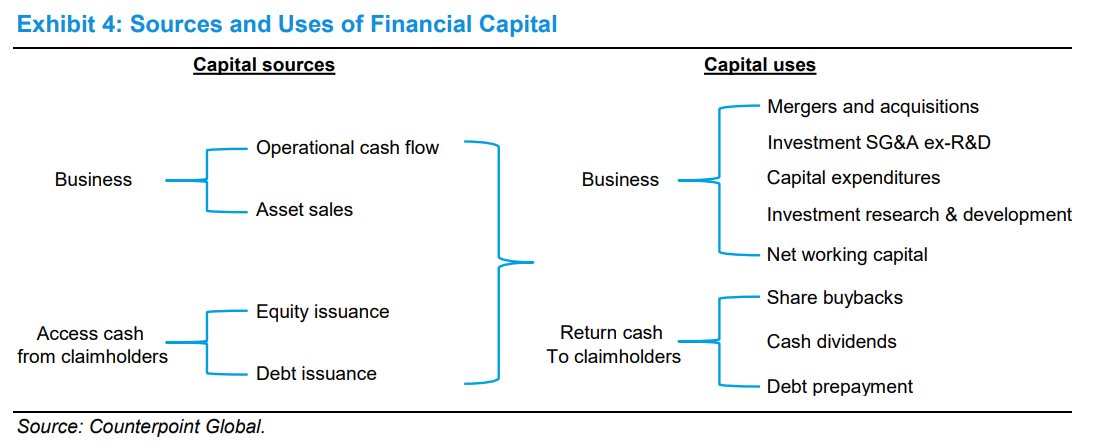
2)Sources and Uses of Financial Capital
3)Sources of Capital over Time
4)Debt-to-Total Capital over Time
5)Capital Deployment Breakdown + Overtime
6)Private Equity as a Percentage of Total M&A Volume
7)Cash Conversion Cycle by Sector

A Thread đź§µImage
1) Lack of Capital Reallocation

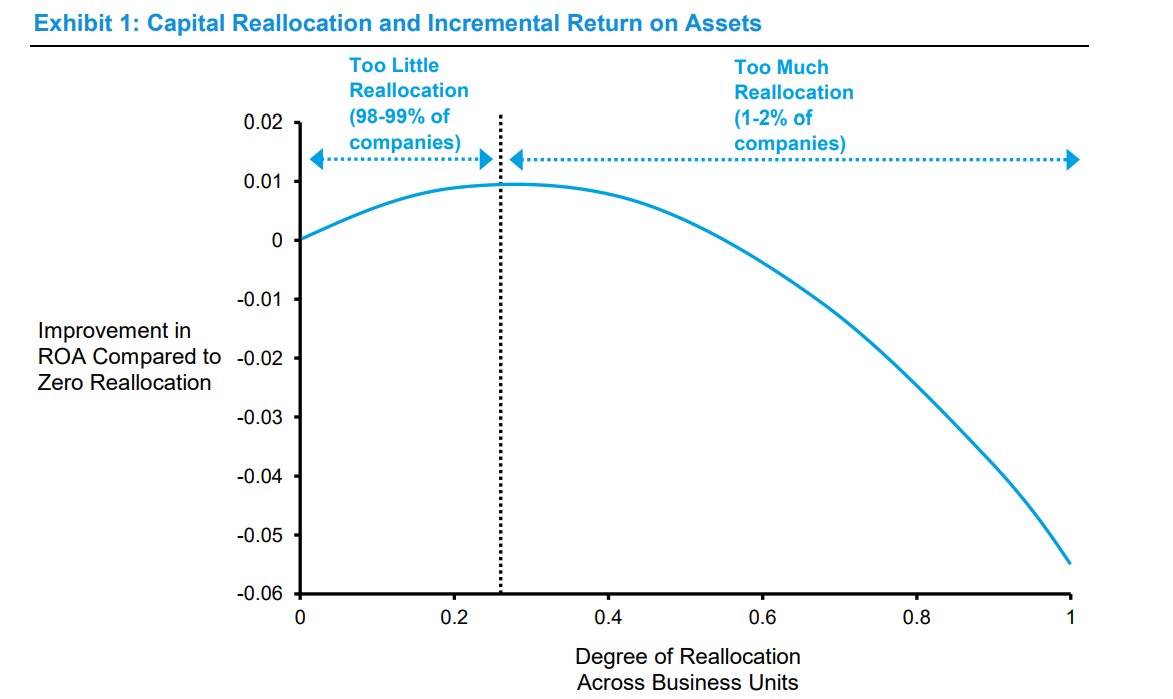
This behavior is consistent with status quo bias, which suggests that people tend to continue doing what they are doing even in the presence of preferable alternatives.

It is also compatible with the escalation of commitment, the idea that we would rather escalate a commitment to a prior action than change course.Image
2) Sources and Uses of Financial Capital

An important clarification is made here.

"One way to assess whether a company will require external capital is to compare its growth rate in net operating profit after taxes (NOPAT) to its return on invested capital (ROIC). Firms, young or old, that grow faster than their incremental ROICs need to access external capital. This is fine, indeed desirable, if the company’s ROIC is in excess of the cost of capital.

A classic example is Walmart, a global retailer, which grew faster than its ROIC in its first 15 years as a public company. The important point is that the company created a lot of value because its ROICs were well above its cost of capital. Even though Walmart required external capital to support its growth, the stock delivered an annual total shareholder return of 33 percent during that period, three times that of the S&P 500."Image
Read 8 tweets
Nov 3, 2025
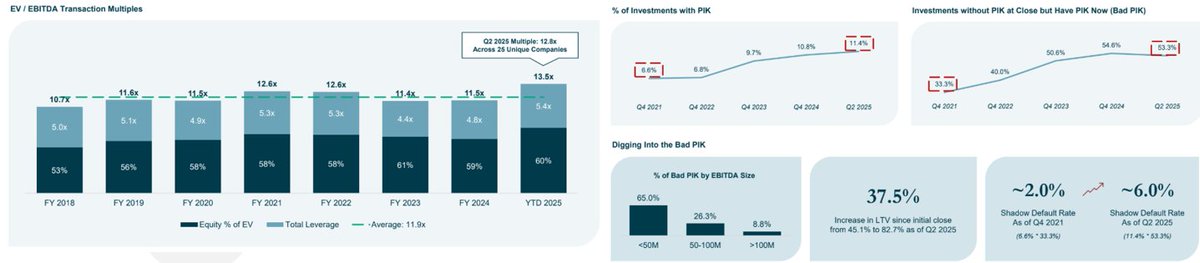
Great private market update including:

1) EV / EBITDA Transaction Multiples
2) Comparison of Transactions Over and Under $1.0 Billion of Enterprise Value
3) Size of Deal and EBITDA over Time
4) Maturity Wall
5) PIK Interest Usage – Trend Analysis
6) Lender Foreclosuresđź§µ Image
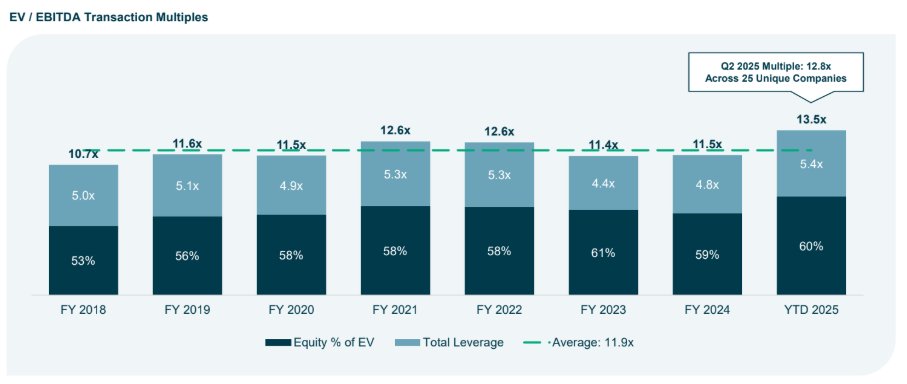
1) EV / EBITDA Transaction Multiples

Great PE datapoints:
- multiples are ATH (even above 2021 peak)
- sponsors are more conservative and leverage is down slightly Image
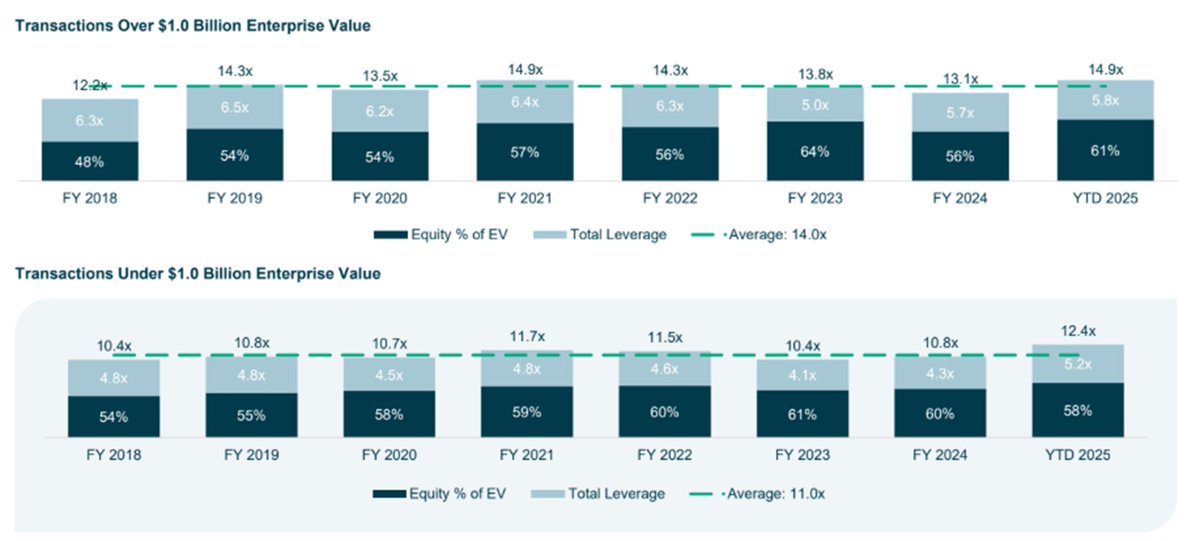
2) Comparison of Transactions Over and Under $1.0 Billion of Enterprise Value

Great data, perfect overview of size premium and multiple trajectory over time

Interesting that small businesses are highest multiple even, even higher than 2021 Image
Read 7 tweets
Oct 22, 2025
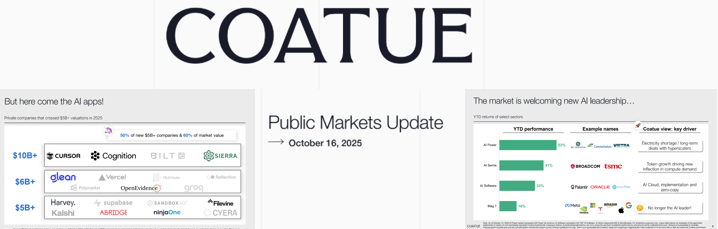
Coatue October 2025 State of the Markets Update

60 Pages on Public Markets every investor should read

Get the Full Deck below ⬇️

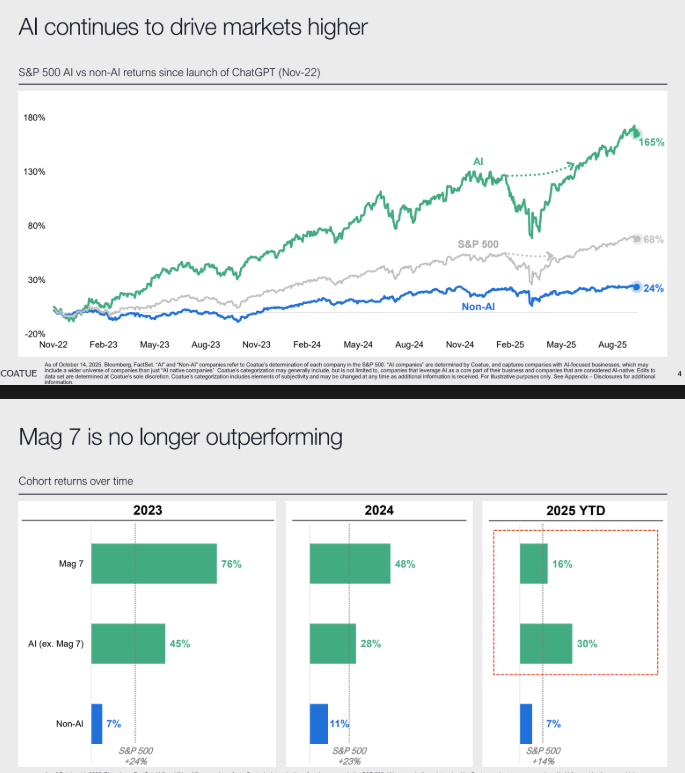
1) AI continues to drive markets higher while...
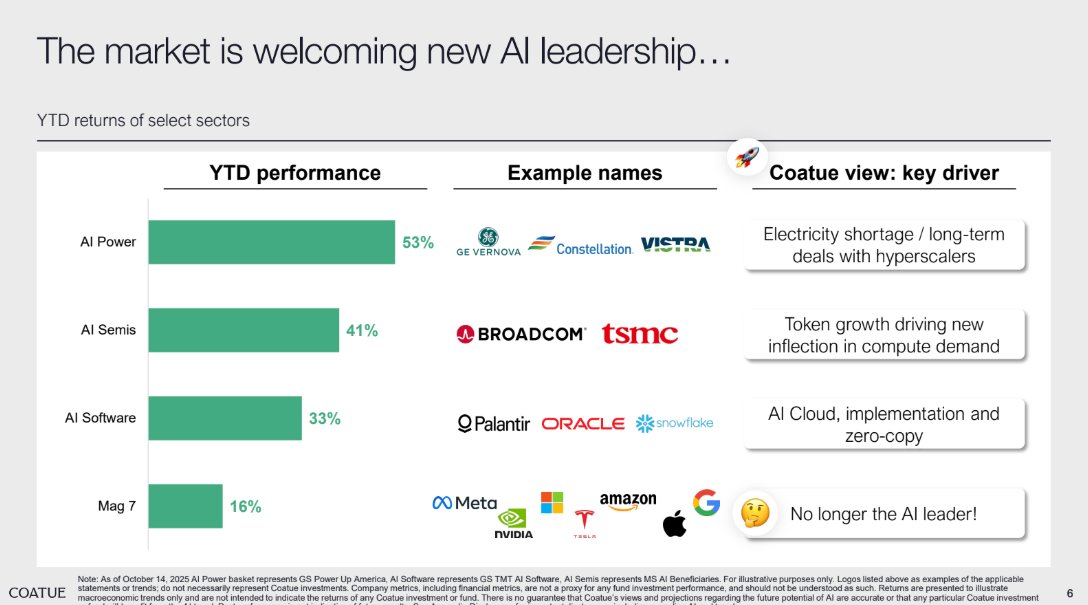
2) In addition, new names are winning the AI Race
3) The market is very expensive, but...
....
6) Coatue is not selling, the AI Bull Case
7) Coatue ROIC Math on AI
8) AI Bull and Bear Case comparison
9) AI Apps LandscapeImage
1) AI continues to drive markets higher but...
Mag 7 is no longer outperforming Image
2) In addition, new names are winning the AI Race Image
Read 11 tweets
Oct 14, 2025
"10 Years. 10 Hard-Earned Lessons in PE"

Beautiful piece, read it

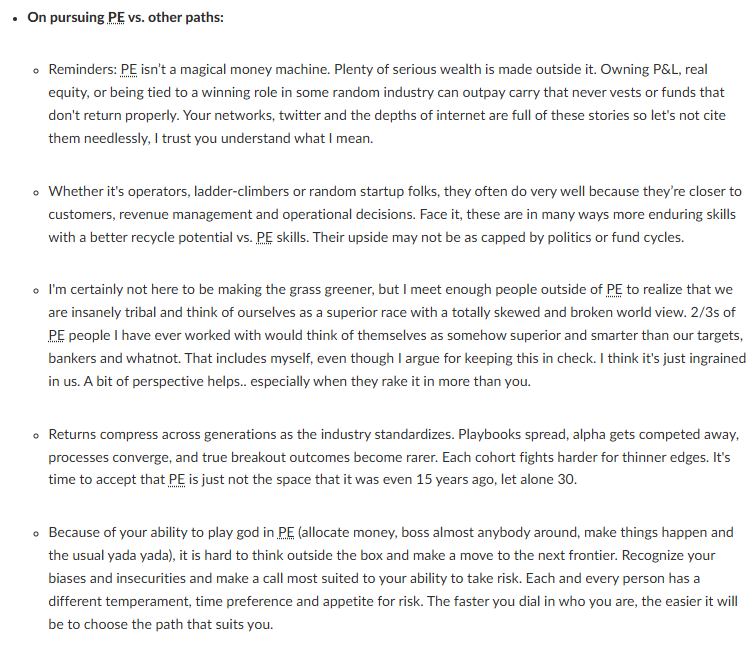
1) On pursuing PE vs. other paths
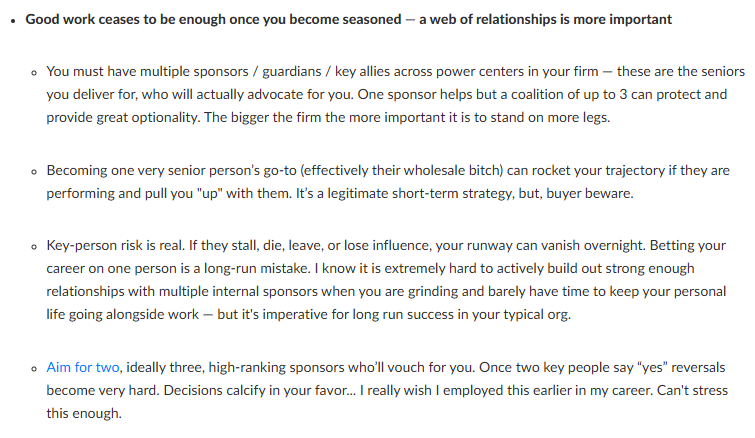
2) Good work ceases to be enough once you become seasoned — a web of relationships is more important
3) It's all just selling at the end of the day. Communication and charisma.
4) Don’t expect fairness. Respect the powers of collateral damage.
5) Founders, management and industry operators are sometimes very underrated
6) The myth of the mighty senior partner
7) Even PE work becomes just a people, projects and admin job after some years.
8) Don’t allow PE to be your main thing
9) You need to make some mistakes to learn from them. It probably won't make a difference that you read this post.
10) Careers are often made out of nothing, or everything đź§µImage
1) On pursuing PE vs. other paths Image
2) Good work ceases to be enough once you become seasoned — a web of relationships is more important Image
Read 11 tweets
Oct 13, 2025
We have all seen the email below, but what do it mean?

What are factoring facilities? And what is going on here?

1) Factoring Basics
2) Dummy Example
3) Common Factoring Structures
4) Reasons for Factoring
5) The infamous Weil email explained Image
1) Factoring Basics

Factoring is a form of financing that allows companies to convert their accounts receivable into immediate cash.

Traditionally, when a company sells goods or services, it issues an invoice to its customer, which is often not paid for thirty, sixty, or even ninety days. Instead of waiting for the cash payment, some companies opt to sell the invoice to a third party, known as a “factor”, at a discount, typically around 95 to 98% of the receivables face value (this discount represents the fee charged by the factor).

Importantly, factors often won’t advance the entire cash balance upfront. Typically, 75% to 90% of the receivable’s face value is advanced upfront, and the remaining balance is transferred, less the abovementioned discount, once customer accounts have been collected.

Therefore, once the customer has paid the invoice, the operating company will have collected the full receivables balance, less the factoring fee.

The Factor’s fee represents its earnings for providing upfront liquidity and assuming the risk that the customer may not pay on time, or at all.
2) Dummy Example

To numerically illustrate concepts, we’ll use ABC Co. as a hypothetical example.

First, imagine ABC Co. sells $100k worth of goods to a customer on sixty-day terms. Instead of waiting two months to collect, ABC Co. sells the invoice to Factor Co.

On the day of the sale, Factor Co. advances 85% of the invoice, or $85,000, to ABC Co.

When the customer eventually pays the full $100,000 on day 60, Factor Co. sends the remaining $15,000 back to ABC Co., but subtracts its $3,000 factoring fee.

In total, ABC Co. has collected $97,000, with $85,000 upfront and $12,000 later, with the $3,000 difference in cash collected and face value representing the cost of accelerating cash flow.
Read 6 tweets

Did Thread Reader help you today?

Support us! We are indie developers!


This site is made by just two indie developers on a laptop doing marketing, support and development! Read more about the story.

Become a Premium Member ($3/month or $30/year) and get exclusive features!

Become Premium

Don't want to be a Premium member but still want to support us?

Make a small donation by buying us coffee ($5) or help with server cost ($10)

Donate via Paypal

Or Donate anonymously using crypto!

Ethereum

0xfe58350B80634f60Fa6Dc149a72b4DFbc17D341E copy

Bitcoin

3ATGMxNzCUFzxpMCHL5sWSt4DVtS8UqXpi copy

Thank you for your support!

Follow Us!

:(