Ryan Hisner Profile picture
Jun 19 11 tweets 4 min read Read on X
Interesting recombinant showed up today from Texas. It's a mixture of B.1.595, BA.1, and some flavor of JN.1. Most of the genome is from B.1.595. The ancestry of this one is clear: it directly descends from a B.1.595 sequence collected in January 2023, also in Texas. 1/11 Image
When the B.1.595 was collected this infection was >1 yr old, w/no sign of Omicron. BA.1 ceased circulating ~1 year prior.
Now a BA.1 spike appears w/just 5 changes from baseline BA.1, none in the RBD—S12F, T76I, Q271K, R765H, S939F.

This is a zombie BA.1 spike. 2/ Image
There are only a few signs of JN.1, & they're scattered. In ORF1a, we see JN.1's V3593F, P3395H, & R3821K, but the NSP6 deletion btwn these—universal in Omicron—is absent. In
M has JN.1's D3H + T30A & E19Q (in JN.1 & BA.1), yet A63T—also in both BA.1 & JN.1 is absent. 3/11 Image
Oddly, it has the 3-nuc, loss-of-function ORF6:D61L—from JN.1 since BA.1 lacks it.

It also took N:P13L & ∆31-33 from BA.1/JN.1 but lacks N:R203K/G204R (& therefor N*).

Finally, it has the standard ∆27934-29759 s2m deletion, which all BA.2 descendants have. 4/11 Image
Also odd: None of the usual convergent chronic-infection muts are here. The Jan 2023 B.1.595 spike got 1 non-RBD spike mut—P1162S—in ~15 months & in ~2.5 years, the BA.1 spike has added just 4-5 subs, none in the RBD.

There's no sign of combat with an immune system. 5/11
It's nearly certain all these sequences are from the same person. When the B.1.595 sequence was collected in 2023, they were also infected with BA.1, but no sign of it showed up in the sequence.

Where was it hiding out? In the deep lung? In the GI tract? 6/11
But viruses that have spent long periods of time in the GI tract have distinct mutational signatures, as @SolidEvidence has documented. I've also discovered a distinct mutational pattern from bronchoalveolar lavage sequences (deep lung).

This sequence has none of them. 7/11
There's no chance this virus spreads in the current environment. But cases like this might have relevance in the long term. As immunity to successive Omicron variants grows, old variants may become newly fit.

But they long ago vanished.... or have they? 8/11
Apparently not. Usually, when old variants reappear after years, their spikes have transformed.

But this a 4.5-year-long infection that's never had a single RBD mutation.

In 5-10 yrs, something close to ancestral spike could be newly fit, esp. in children. 9/11
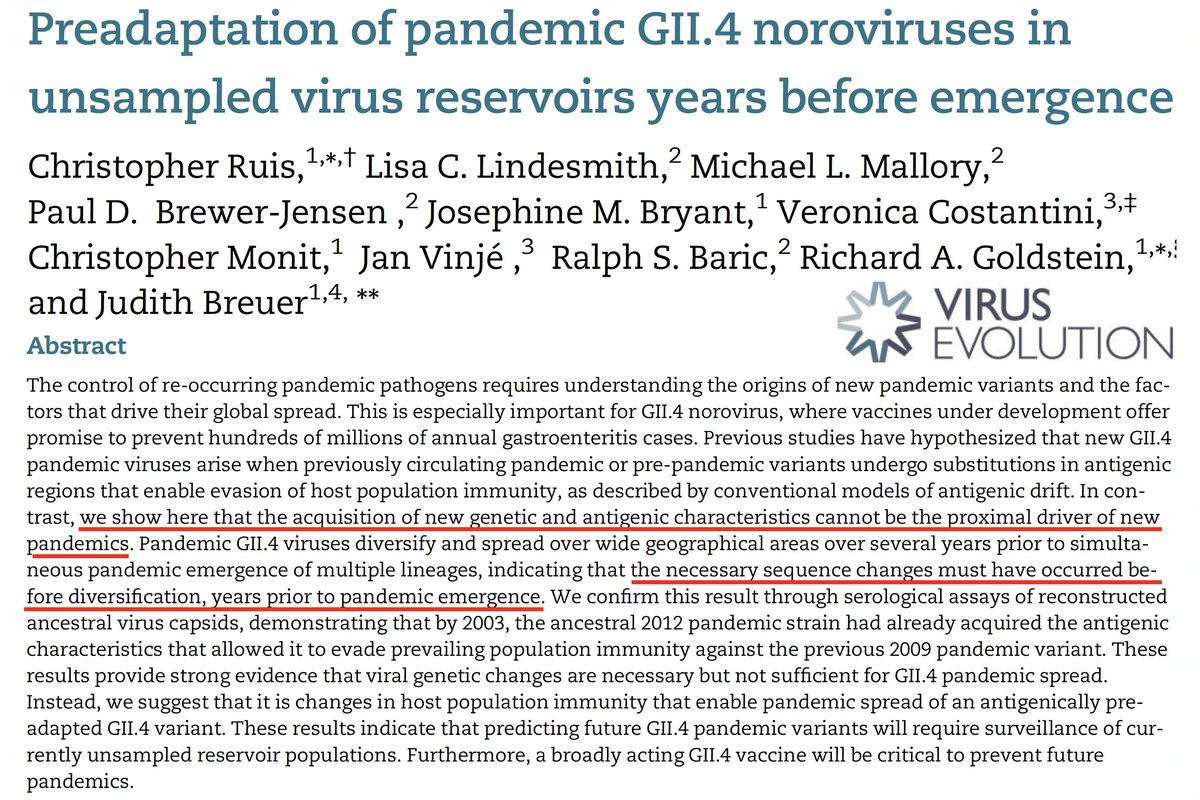
Could an ancient spike reappear at that time & take over? Something like this happens with norovirus. Norovirus variants that circulated years/decades ago sometimes reappear, relatively unchanged, & proceed to sweep the world. See paper by Chris Ruis. 10/ academic.oup.com/ve/article/6/2…Image
We've not seen this. When a new SARS-2 variant sweeps, it's honed its Ab-evasion skills in years of combat w/an immune system too weak to clear it but strong enough to challenge it. But in the long term, who knows? Maybe we'll see a zombie-spike sweep someday. 🧟‍♂️ 11/end

• • •

Missing some Tweet in this thread? You can try to force a refresh

 

Keep Current with Ryan Hisner

Ryan Hisner Profile picture

Stay in touch and get notified when new unrolls are available from this author!

Read all threads

This Thread may be Removed Anytime!

PDF

Twitter may remove this content at anytime! Save it as PDF for later use!

Try unrolling a thread yourself!

how to unroll video
  1. Follow @ThreadReaderApp to mention us!

  2. From a Twitter thread mention us with a keyword "unroll"
@threadreaderapp unroll

Practice here first or read more on our help page!

More from @LongDesertTrain

May 31
An awesome preprint on the novel, unsung SARS-CoV-2 N* protein came out recently, authored by @corcoran_lab & Rory Mulloy. I’ve previously written on N*’s demise in XEC, the top variant in late 2024/early 2025. But…
1/34
…this preprint, along with another great study by the @DavidLVBauer, @theosanderson, @PeacockFlu & others prompted me to take a closer look...
2/34biorxiv.org/content/10.110…
...and for reasons I’ll describe below, I now believe rumors of N*’s death are exaggerated.

First, XEC is in terminal decline, replaced by variants with full N* expression, so N* is back in fashion.
3/34
journals.plos.org/plosbiology/ar…
Read 35 tweets
May 15
@DameSunshine @SharonBurnabyBC B.1.1.529 wasn't/isn't a real variant; it's a placeholder that represents a putative ancestor of BA.1/BA.2/BA.3.

Bad sequences and/or coinfections tend to get categorized as B.1.1.529:—they have enough Omicron muts to be ID'd as Omicron but so much dropout/mixed signals...
1/
@DameSunshine @SharonBurnabyBC ...that a specific designation isn't possible. Travel sequencing in the US is done by Ginkgo Bioworks. Their sequences are generally poor quality & they upload *pooled* sequences—against database guidelines. The B.1.1.529 here are likely low-quality/pooled sequences from GBW.
2/
@DameSunshine @SharonBurnabyBC I think it's entirely possible that a new, divergent variant will emerge this summer. There are hints with BA.3.2 & a 50-spike-mutation BQ.1.1 that has transmitted at least once. Other similar chronic infection-derived variants are undoubtedly lurking all over, unsequenced.... 3/
Read 4 tweets
May 2
Incredible how quickly @yunlong_cao & co provide us w/info on the latest emerging SARS-CoV-2 variants.

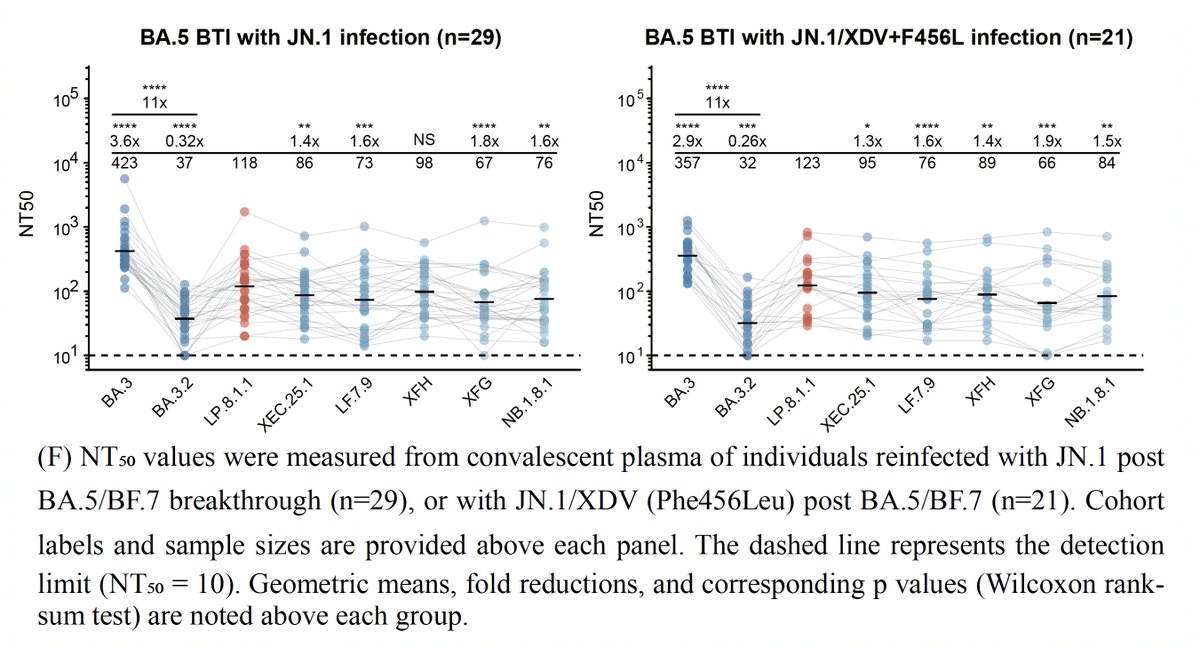
Already, we have great data on BA.3.2 (the divergent saltation lineage detected in South Africa & the Netherlands & NB.1.8.1, an emerging contender for global dominance. 1/9 Image
Image
BA.3.2 is a clear outlier on the antigenic cartography map—as expected given the enormous differences between its spike protein & every other circulating variant. 2/9
Image
It's unsurprising, therefore, that BA.3.2 evades antibodies from human sera more effectively than any other variant, though the degree of its superiority is striking. 3/9
biorxiv.org/content/10.110…Image
Read 9 tweets
Apr 25
About 1 month after this monster BQ.1.1 appeared, an even more extreme sequence has shown up in Alberta. Like the BQ, it has 50 private spike mutations, but it also has >40 AA mutations elsewhere in the genome. 1/6 Image
They include the full panoply of NSP3, NSP12, & N muts I've written about previously. ORF1a:S4398L is the most common mutation in the 4395-4398 region, this has ∆S4398, a rarity also seen in a few other extremely divergent seqs w/this constellation. 2/6 Image
In a theme that's become familiar, it's added two spike NTD glycans, N30 (via F32S) and N155 (via S155N+F157S).
Another chronic-infection leitmotif (first noted by @SolidEvidence): reversions to common or consensus residues in related Bat-CoVs, including SARS-1. 3/6 Image
Read 6 tweets
Apr 10
A fascinating SARS-CoV-2 sequence was recently uploaded—collected from a dog in Kazakhstan in July 2022.

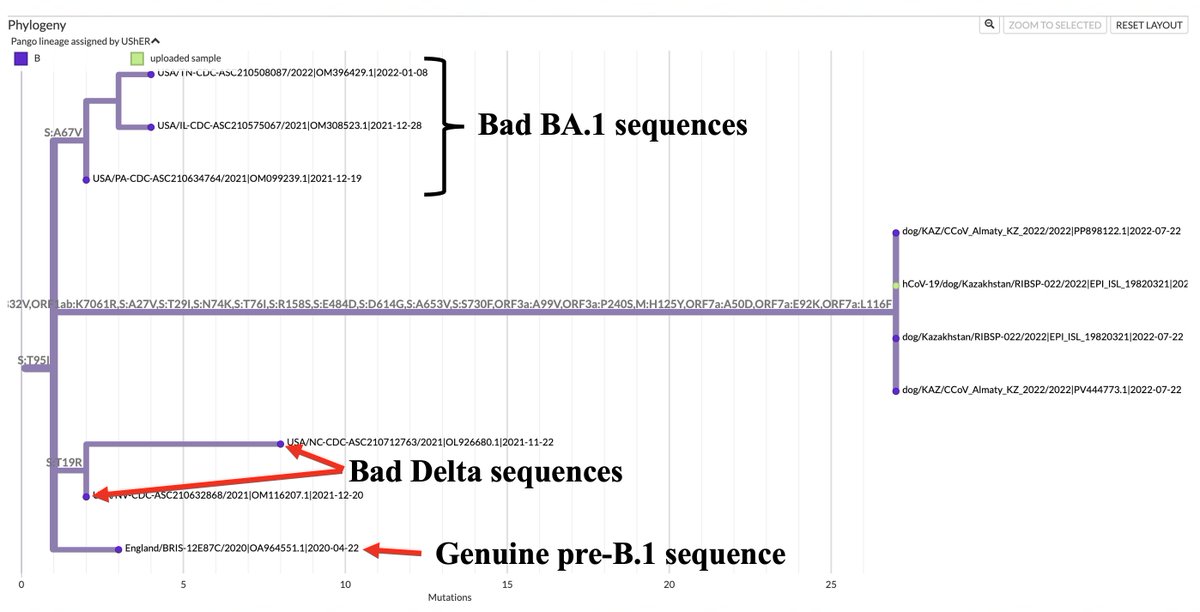
Usher places the seq 1 nuc mut from the Wuhan ref seq—C21846T/S:T95I—i.e. pre-D614G. Could this seq somehow have a close connection to the first days of the pandemic?
1/19 Image
Of the sequences near this one on the tree, all are low-quality & clearly bad BA.1 or Delta sequences. The only genuine one is from the UK, collected April 2020. So it's likely even S:T95I was not inherited.

This sequence has several fascinating aspects. 2/ Image
(This all assumes the sequence is accurate and that C241T & C14408T (ORF1b:P314L) are genuinely absent. Its mutational characteristics make me certain this is a good sequence, though it's not impossible there's dropout not indicated hiding C241T and/or C14408T.) 3/
Read 19 tweets
Mar 12
Do you remember BA.3—the weakling cousin of BA.1 & BA.2 that seemed to take the worst from each & had weaker ACE2 binding than even the ancestral Wuhan Virus?

After 3 years, BA.3 is back.

And it is transmitting.

Who saw this coming?
1/13 Image
While the full extent of the new BA.3’s spread is not known, it’s been detected in 2 different South African regions through regular (not targeted) surveillance by @Dikeled61970012, @Tuliodna, & the invaluable South African virology community.
2/13
github.com/cov-lineages/p…
After nearly 3 years of intrahost evolution in a chronically infected person, the new BA.3 is almost unrecognizable. It has ~41 spike AA substitutions (4 of which are 2-nuc muts) to go with 14 AA deletions (∆136-147+∆243-244). We’ve seen nothing like this since 2023.
3/13 Image
Read 13 tweets

Did Thread Reader help you today?

Support us! We are indie developers!


This site is made by just two indie developers on a laptop doing marketing, support and development! Read more about the story.

Become a Premium Member ($3/month or $30/year) and get exclusive features!

Become Premium

Don't want to be a Premium member but still want to support us?

Make a small donation by buying us coffee ($5) or help with server cost ($10)

Donate via Paypal

Or Donate anonymously using crypto!

Ethereum

0xfe58350B80634f60Fa6Dc149a72b4DFbc17D341E copy

Bitcoin

3ATGMxNzCUFzxpMCHL5sWSt4DVtS8UqXpi copy

Thank you for your support!

Follow Us!

:(