Today's big biotech win is that we might be on the verge of a cure for type-1 diabetes🧵
Twelve diabetics were injected with stem cell-derived pancreatic islets.
They started producing insulin again.
One year in, 10/12 participants no longer needed to inject insulin.
Twelve diabetics were injected with stem cell-derived pancreatic islets.
They started producing insulin again.
One year in, 10/12 participants no longer needed to inject insulin.

In that chart, you can see the response to a meal.
At baseline, blood sugar levels go dangerously high (right) because participants don't produce insulin at all (proxied by C-peptide levels, left).
But notice the blood sugar and C-peptide levels after treatment:
At baseline, blood sugar levels go dangerously high (right) because participants don't produce insulin at all (proxied by C-peptide levels, left).
But notice the blood sugar and C-peptide levels after treatment:

With treatment, the patients kept getting better and better.
Their pancreatic function improved over time, and they became more and more able to handle food, and to do so without the need to inject insulin.
Their pancreatic function improved over time, and they became more and more able to handle food, and to do so without the need to inject insulin.

In a little over a month after treatment, the A1C levels of the sample shifted towards the maximum recommended level, and shortly thereafter, they dropped down to prediabetic levels.
They weren't amazing by any means, but this is an incredible improvement for type-1 sufferers.
They weren't amazing by any means, but this is an incredible improvement for type-1 sufferers.

More importantly, it became clear that the treatment allowed people to maintain their blood glucose at levels that were pretty much acceptable, most of the time.
That is why becoming insulin-independent after this nearly one-shot therapy was possible for most of them.
That is why becoming insulin-independent after this nearly one-shot therapy was possible for most of them.
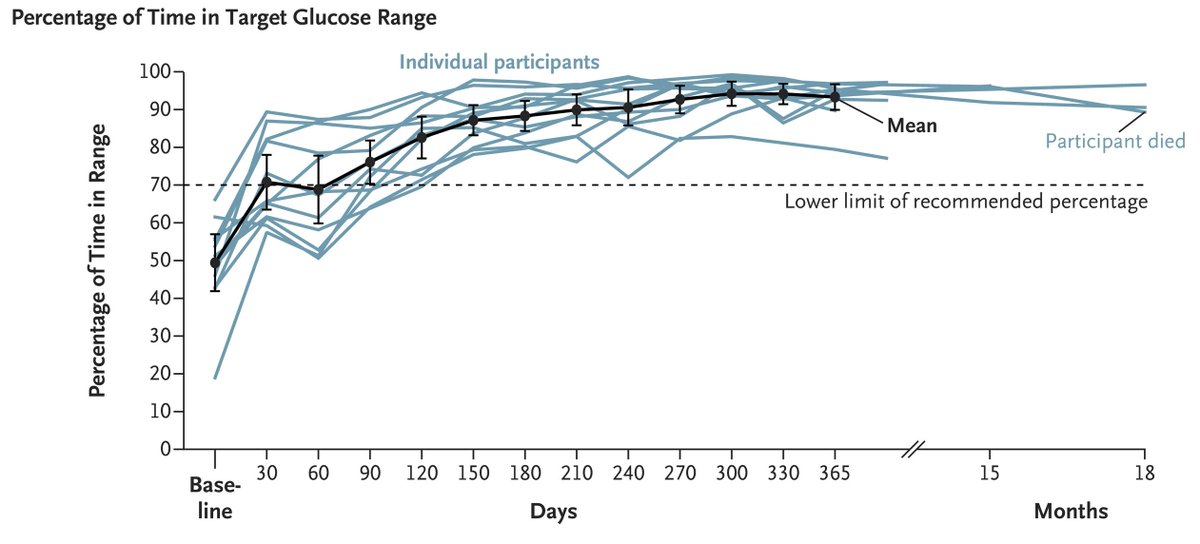
Now, you might've noticed that in those last two graphs, there's a section saying "Participant died".
Two patients did die, but not due to this therapy.
The first broke trial protocol due to a serious injury and died from meningitis. The second was due to pre-existing dementia.
Two patients did die, but not due to this therapy.
The first broke trial protocol due to a serious injury and died from meningitis. The second was due to pre-existing dementia.

Those deaths are tragic, but they do not speak against the success of this therapy.
And this therapy seems to be miraculous.
A single infusion and three days of immunosuppression resulted in everyone being cured of the need for insulin. Type-1 diabetes was beaten.
And this therapy seems to be miraculous.
A single infusion and three days of immunosuppression resulted in everyone being cured of the need for insulin. Type-1 diabetes was beaten.

The next steps for this therapy are simple.
Firstly, ramp it up. I think the government should throw money at this.
Secondly, the government has the ability to do some deregulation to make this very cheap. I'm not providing details here right now. This is in the HHS' hands.
Firstly, ramp it up. I think the government should throw money at this.
Secondly, the government has the ability to do some deregulation to make this very cheap. I'm not providing details here right now. This is in the HHS' hands.

If done right, perhaps we'll be able to eliminate type-1 diabetes in our lifetimes, and fewer and fewer people will have to suffer with a lifetime of management of a terrible, and once-deadly chronic disease.
God willing.
God willing.
You can read the study here: nejm.org/doi/full/10.10…
Edit:
They used rATG for induction and they do require sirolimus plus tacrolimus maintenance.
They used rATG for induction and they do require sirolimus plus tacrolimus maintenance.
The side effects are usually easily managed, and if they're not for some individual, that patient can just go back to being diabetic.
When artificial thymus cell work reaches maturity, islet transplantation will be among the first therapeutic beneficiaries.
When artificial thymus cell work reaches maturity, islet transplantation will be among the first therapeutic beneficiaries.
Or maybe this approach works, albeit with scaling issues to overcome:
https://x.com/kenbwork/status/1936287621036360019
• • •
Missing some Tweet in this thread? You can try to
force a refresh