Yuri Bezmenov's Ghost Profile picture
Jun 21, 2025 5 tweets 2 min read Read on X
I omitted Rousseau here on purpose looking for a loose thread.
Fun fact, Rousseau’s role as a librarian-secretary in the 1740s placed him in direct contact with aristocratic libraries, which, by the mid-18th century, often included esoteric works. The Kabbala Denudata (1677–1684) was commonly found in well-stocked French libraries, and Pico della Mirandola’s works were widely accessible. Aristocratic libraries, likely including those of the Dupins, contained esoteric works due to the 18th-century fascination with occultism, fueled by cheap printing and Parisian dealers. Rousseau’s task of indexing such collections makes it highly likely he handled these texts in the 1740s and thus influenced Discourse on the Origin of Inequality (1755) and The Social Contract (1762).
Another is that Rousseau, in the 1740s, was closely associated with the Dupin salon as secretary and tutor; that salon was a key Parisian intellectual hub. The exposure is also plausible here, considering prevalence of such ideas in 1740s Parisian intellectual circles.
At any rate, Hegel’s reference to volonte generale shows he read Rousseau closely, but his dialectic absolutely and clearly metaphysical, and draws a direct line to Böhme’s mystical, esoteric framework. At any rate, it's enough to link Hegel to Böhme here. The esoteric links are many. To wit, Hess himself has many more branches not discussed in the thread.
A draft Rousseau entry for the Esoteric Left so far, while I chase down threads:

Jean-Jacques Rousseau (1712–1778): In the Discourse on the Origin of Inequality (1755), he traces humanity's fall from natural freedom to the moment "The first man, who after enclosing a piece of ground, took it into his head to say, this is mine," inaugurating property and with it structural dependence and conflict. This act becomes a social rupture that, at a structural level, mirrors Luria's shevirat ha-kelim, an original wholeness shattering into contending fragments.

Rousseau presents property as the wellspring of inequality and a condition that anticipates the Hess and Marxian concept of alienation, itself a secular echo of Kabbalah's exile of divine sparks after shevirat ha-kelim. In the Social Contract (1762), the general will offers collective self-legislation able to re-knit citizens into civic unity, provided extremes of wealth are curbed.

Rousseau likely encountered Christian Kabbalistic texts (e.g., Kabbala Denudata, Pico della Mirandola, Johannes Reuchlin) while cataloging aristocratic libraries for the Dupin family (1745–1747) and engaging with their Parisian salon, a key intellectual hub where such ideas may have circulated. He may have concealed their influence, presenting their rupture-and-repair logic in secular Enlightenment terms.

Rousseau's narrative feeds the esoteric-left pattern of fracture and restoration, which Kant refines into moral autonomy, Fichte radicalizes into ethical striving, and Hegel integrates into Geist, drawing the cosmic dialectic from Böhme's Ungrund but grounding its political embodiment in Rousseau's volonté générale, a doctrine of popular sovereignty that channels the dialectic into the ethical State's institutional form.
Rousseau’s association with the Dupin family spans a range of years, but here’s a summary:
1743: Initial contact and possible informal work as a tutor or assistant.
1745–1747: Formal employment as a librarian-secretary, with significant access to the library and contributions to intellectual projects.
Up to 1751: Extended association, though his active secretarial role ended around 1747, with his departure around 1751.

• • •

Missing some Tweet in this thread? You can try to force a refresh

 

Keep Current with Yuri Bezmenov's Ghost

Yuri Bezmenov's Ghost Profile picture

Stay in touch and get notified when new unrolls are available from this author!

Read all threads

This Thread may be Removed Anytime!

PDF

Twitter may remove this content at anytime! Save it as PDF for later use!

Try unrolling a thread yourself!

how to unroll video
  1. Follow @ThreadReaderApp to mention us!

  2. From a Twitter thread mention us with a keyword "unroll"
@threadreaderapp unroll

Practice here first or read more on our help page!

More from @Ne_pas_couvrir

Feb 13
🧵Reading Moses Hess in 1837 and 1841, you can watch one rupture-repair arc come into focus: Zerwürfnis (rift) fractures the social world; Bewusstsein (historical consciousness) becomes the condition of freedom; Tat (deed) is the repair-operator; and Einheit (unity) is the return.
All of this is before Hess meets Marx.
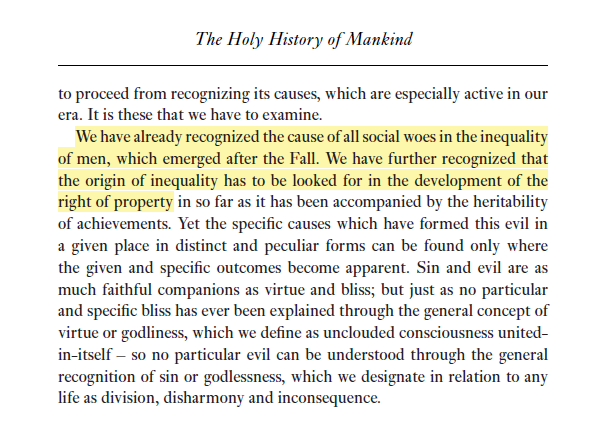
In 1837’s The Holy History of Mankind, Moses Hess frames the “Fall” as a this world rupture that appears as inequality among people. He traces that inequality to the historical development of property right, and he emphasizes that inheritance makes the inequality durable by carrying it across generations. He is not only diagnosing the cause. He is already naming a repair direction in Hegelian terms, arguing that “historical rights” must be aufgehoben (sublated) and that the right of inheritance must undergo Aufhebung so that a primordial equality can be restored through a mediated process rather than appearing all at once. He does not yet frame this in terms of "Tat" (action/deed) as the key operator of repair.Image
Image
Hess in 1837, making the point above very succinctly here.
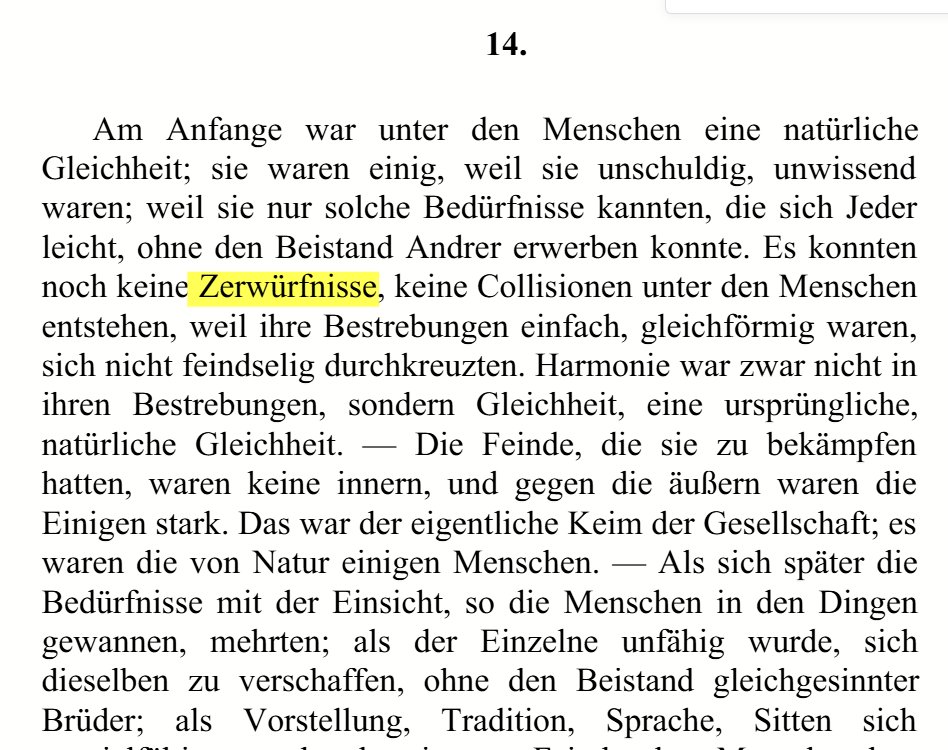
To be clear, Moses Hess is doing two things at once. He's historicizing the Fall via inequality tied to property/heredity (Eigenthumsrecht/Erblichkeit), while redefining sin/godlessness not abstractly but as a rupture in unity, using "Spaltung" (division/splitting) here rather than "Zerwürfnis" (which appears elsewhere in the text in discussions of pre-Fall harmony: "keine Zerwürfnisse" for no divisions/estrangements).
The idea is functionally the same, a shift from unity to divided existence. Hess develops this idea further in his 1841 publication.Image
Image
Read 25 tweets
Jan 26
🧵The Founders learned from the Articles that a republic can fail the Declaration’s standard without a tyrant by building a center that’s too weak. If limits and rights are to stay binding under stress, institutions must be strong enough to govern and constrained enough to obey.
Again, the Declaration gives moral clarity about rightful rule, but it does not supply governing capacity. It states legitimacy in first principles: consent, natural rights, just governance, and the right to alter a predatory regime. It is a standard, not a machine. It judges power with moral force. But it does not tell you how those limits stay binding on Tuesday afternoon when passions run high, money runs short, factions scheme, and rivals probe for weakness.
The Articles were the first attempt to translate that creed into an operating system, and they were deliberately weak. Fresh off a war against centralized abuse, the safest design seemed to be a loose league among sovereign states. Congress could request troops and money and could deliberate and exhort, but it could not compel. Each state stood as an equal unit in the national council, major acts required supermajorities, and amendments faced near-impossible thresholds. The center could ask. It could not command.

Then reality arrived. War debts mounted. Credit tightened. Inflation and monetary turmoil made politics more combustible. Trade friction rose as states pursued their own advantage. Trust thinned. Abroad, other powers watched and probed. The crucial point is not that human beings suddenly became worse. The point is that the design made national performance optional when optional performance becomes fatal.
Read 8 tweets
Jan 18
Core to the rupture → elect-led repair arc is an operational program of ontological & teleological inversion. From Hegel’s reconciliation-shape plus the Hess-style activist turn comes a 'politics' of world repair that functions as secular theurgy presented as “the Science™”.
You can thank @thepalmerworm for the snappy phrase “ontological and teleological inversion.” It packs the whole template into four words.

Simply put, it means two flips.

Ontological inversion flips what counts as most real and most authoritative. Instead of reality and moral order as the baseline, lived harm becomes the highest proof. Trauma becomes the marginalized group’s truth signal, and (false, oppressive) “systems” become the main actors.

Alienation is what makes that flip feel like realism. Alienation is the sense that the world is human-made but not ours, that institutions and norms confront people as an alien power. In that mood, “normality” stops looking neutral and starts looking like a cover story.

Teleological inversion flips the goal. Instead of aiming at a given human good like virtue, truth, or holiness, the aim becomes repair through negation. Identify the oppressor, name the false center, dismantle it, re-center the marginalized, and call that wholeness. The “elect” are the interpreters and organizers who raise collective consciousness to drive that repair.

By the way, that’s also the clean meaning behind the line “the leftist worldview is an inversion of reality.”
Read 5 tweets
Jan 15
🧵The Development of Karl Marx in Three Phases: Before and After Meeting Moses Hess.
The Thesis is Marx’s intellectual evolution can be traced as a shift in the meaning of “practice.” He moves from the Young Hegelian notion of critique as practice (the idea that theoretical criticism itself is a world-changing force) to Moses Hess’s notion of praxis as deed, a fusion of thought and organized action aimed at repairing social estrangement, and finally to Marx’s own materialist recoding of that praxis. Crucially, Marx preserves much of Hess’s functional architecture of alienation and reintegration even as he rejects Hess’s mystical or ethical idiom (what Marx and Engels later dismiss as “True Socialism”).
Marx Before Hess (Berlin Young Hegelian Phase, up to ~1842)
Before Hess’s influence, Marx was shaped by the Young Hegelian milieu in Berlin, especially the circle around Bruno Bauer. In the early 1840s Marx was a radical democratic intellectual and critic, not yet a socialist. As Hess later described him in 1841, the young “Dr. Marx” was “hardly 24 years old; but he will give the final blow to all medieval religion and politics”. This captures Marx’s baseline orientation: fiercely anti-clerical and anti-absolutist, wielding Hegelian philosophy as a weapon against archaic institutions.
At this stage, “action” for Marx meant public criticism, meaning attacking censorship, religion, and unjust laws under the premise that exposing an illusion or injustice was in itself a practical act. In other words, Marx initially treated critique as the lever of history, reflecting the Young Hegelian belief that negating ideas (e.g. criticising religion) would by itself negate the material relations sustained by those ideas.
This outlook was “post-Hegelian” in the sense that it drew on Hegel’s notion of world-history driven by the negation of the old by the new. But it was also limited: it targeted the realm of ideas (religious mystifications, reactionary philosophy) rather than the realm of social relations or political economy.
As we will cover, Hess’s impact on Marx would be to change the mode and target of action, from purely critical negation aimed at consciousness to organized revolutionary deeds aimed at material conditions.
Read 20 tweets
Jan 6
🧵Alienation is how it is sold. Praxis is how it is done. The victim–offender swap is how it moves, by controlling who counts as victim under the power principle.
Let’s do a little thread.
Alienation is the theory that makes inversion feel true here for the foot soldiers. It trains people to experience human-made realities, money, institutions, norms, and “structures,” as external forces that rule them. Once that move lands, frustration becomes victimhood, opponents become aggressors, and activism becomes moral duty. Activism is life lived inside that inverted map. Praxis is the offensive move sold as rescue and repair. Alienation sells the story. The victim-offender reversal weaponizes it. Praxis executes it.
Alienation for leftist theory is not just feeling unhappy or disconnected. It is separation from your own powers, your capacity to think, act, build, judge, and cooperate, followed by submission to those same powers as something outside you. What should belong to human life returns as an external authority.
Read 12 tweets

Did Thread Reader help you today?

Support us! We are indie developers!


This site is made by just two indie developers on a laptop doing marketing, support and development! Read more about the story.

Become a Premium Member ($3/month or $30/year) and get exclusive features!

Become Premium

Don't want to be a Premium member but still want to support us?

Make a small donation by buying us coffee ($5) or help with server cost ($10)

Donate via Paypal

Or Donate anonymously using crypto!

Ethereum

0xfe58350B80634f60Fa6Dc149a72b4DFbc17D341E copy

Bitcoin

3ATGMxNzCUFzxpMCHL5sWSt4DVtS8UqXpi copy

Thank you for your support!

Follow Us!

:(