Mike Honey Profile picture
Jun 22 8 tweets 3 min read Read on X
Here's the latest variant picture with a global scope, to early June.

The NB.1.8.1 "Nimbus" variant has been struggling lately, at around 25%.

Growth of the XFG.* "Stratus" variant accelerated to 28%, and it is now dominant.

#COVID19 #Global #NB_1_8_1 #Nimbus #XFG #Stratus
🧵 Image
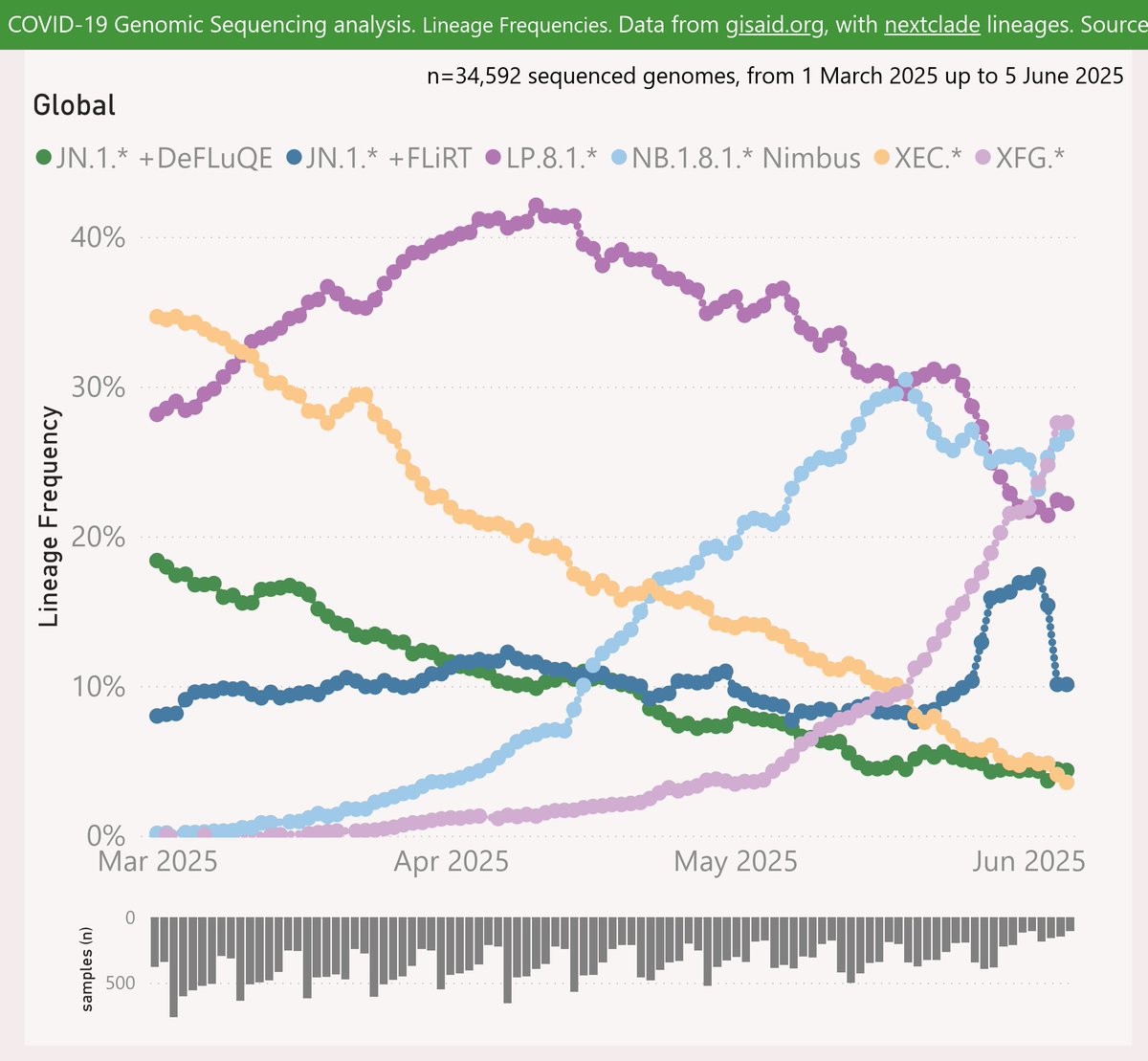
The odd-looking bump in the JN.1.* + FLiRT group is down to a relatively large batch of samples collected across 3 days in late May, from Kazakhstan. The LF.7.1.3 sub-variant was dominant.

That will likely be smoothed out as more data arrives from other countries.
🧵
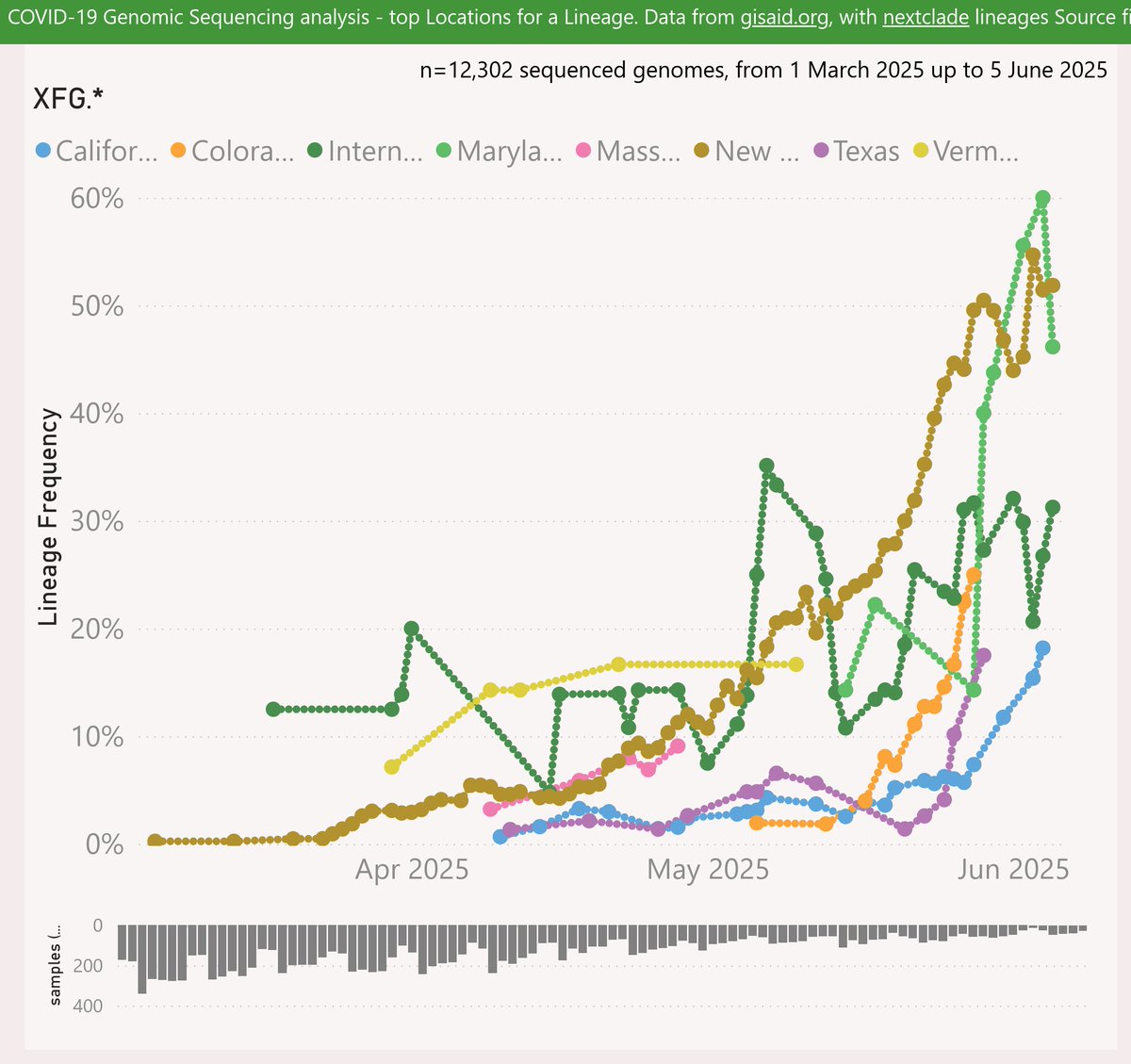
Here are the trends across all the International Traveller samples, with a roughly similar picture. However NB.1.8.1.* was higher at 35-45%.

This dataset (mostly arrivals in the US and Japan) is arguably more random, as it is not skewed by sequencing volumes.
🧵 Image
Globally, the NB.1.8.1 "Nimbus" variant is showing a slowing growth advantage of 3.6% per day (25% per week) over the LP.8.1.* variant, with a crossover in late May.
🧵 Image
Here are the leading countries reporting NB.1.8.1 "Nimbus". There seem to be 3 tracks:
- China, Hong Kong and Thailand are reporting a clean sweep
- Singapore and Australia show steady growth to around 50%
- growth in the US and Canada has only reached around 25%.
🧵 Image
Globally, the XFG.* "Stratus" variant is showing a stronger growth advantage of 6.4% per day (45% per week) over the LP.8.1.* variant. That shows a crossover in early June.
🧵 Image
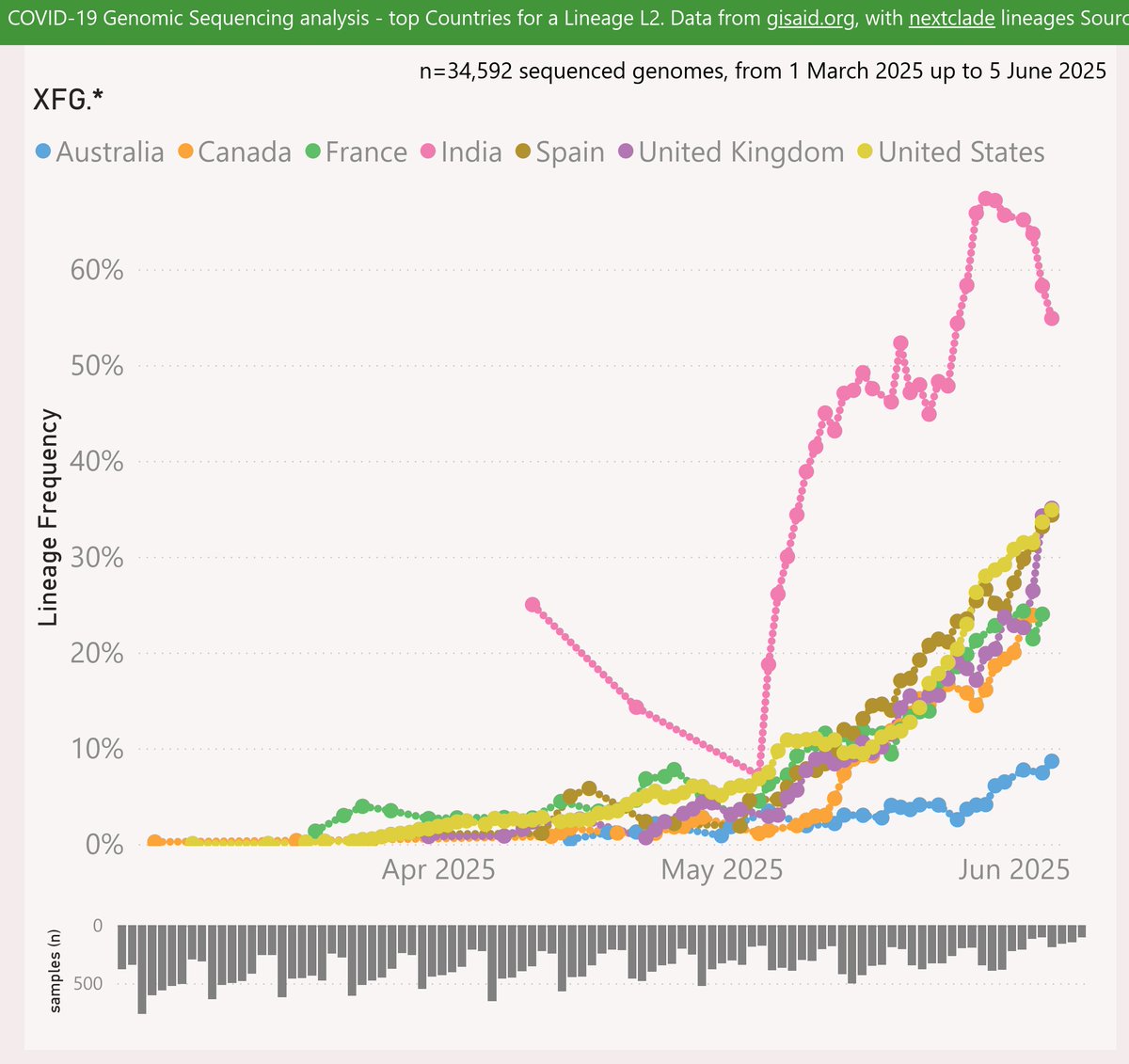
Here are the leading countries reporting XFG.* "Stratus". It reached 67% in India, before falling to finish at 55%. It has also shown sustained growth to 25-35% in Canada, France, Spain, the UK and US.
🧵 Image

• • •

Missing some Tweet in this thread? You can try to force a refresh

 

Keep Current with Mike Honey

Mike Honey Profile picture

Stay in touch and get notified when new unrolls are available from this author!

Read all threads

This Thread may be Removed Anytime!

PDF

Twitter may remove this content at anytime! Save it as PDF for later use!

Try unrolling a thread yourself!

how to unroll video
  1. Follow @ThreadReaderApp to mention us!

  2. From a Twitter thread mention us with a keyword "unroll"
@threadreaderapp unroll

Practice here first or read more on our help page!

More from @Mike_Honey_

Jun 22
Here's the latest variant picture for the "Global - Other" countries, to early June.

The NB.1.8.1 "Nimbus" variant rose as high as 57%, but fell back in later samples to 29%.

The XFG.* "Stratus" variant grew to 27%.

#COVID19 #GlobalOther #NB_1_8_1 #Nimbus #XFG #Stratus
🧵 Image
The odd-looking bump in the JN.1.* + FLiRT group is down to a relatively large batch of samples collected across 3 days in late May, from Kazakhstan. The LF.7.1.3 sub-variant was dominant.

That will likely be smoothed out as more data arrives from other countries.
🧵
This perspective excludes all the high-volume countries and regions that I routinely report on: Australia, NZ, Europe, Canada and the US. The remaining countries are aggregated into this report.
🧵
Read 8 tweets
Jun 22
Here's the latest variant picture for the United States, to early June.

The XFG.* "Stratus" variant grew strongly to 35%, while LP.8.1.* fell to 28%.

The NB.1.8.1 "Nimbus" variant grew strongly, to 24%.

#COVID19 #USA #XFG #Stratus #NB_1_8_1 #Nimbus
🧵 Image
For the US, the XFG.* "Stratus" variant shows a strong growth advantage of 5.8% per day (41% per week) over LP.8.1.*, which predicts a crossover in early June (the data routinely lags).
🧵 Image
XFG.* "Stratus" has mainly been reported from New York state, rising to 52% frequency. Maryland hit 60%. It has also been quite common among the International Traveller samples at 20-30%.
🧵 Image
Read 6 tweets
Jun 15
Here's an animated map showing the spread of the PY.1 variant. The first sample was reported in Ontario, Canada in early March.

It was soon reported across North America and Europe and then spread globally. It has been most successful in India.
#SARSCoV2 #COVID19 #PY_1
🧵
Locations are approximate - typically country and state/province.
🧵
Here’s the Global picture, comparing PY.1 (shown as “JN,1.* + FLiRT”) vs the leading NB.1.8.1 "Nimbus" and XFG* "Stratus" variants.

I show them here using a log scale, so you can compare their growth rates. PY.1 looks quite competitive so far, reaching 8% frequency.
🧵 Image
Read 10 tweets
Jun 14
Here's the latest variant picture for the "Global - Other" countries, to late May.

The NB.1.8.1 "Nimbus" variant rose as high as 56%, but fell back in later samples to 37%.

The XFG.* "Stratus" variant grew to 28%.

#COVID19 #GlobalOther #NB_1_8_1 #Nimbus #XFG #Stratus
🧵
This perspective excludes all the high-volume countries and regions that I routinely report on: Australia, NZ, Europe, Canada and the US. The remaining countries are aggregated into this report.
🧵
For the "Global - Other" countries, the XFG.* "Stratus" variant is showing a strong growth advantage of 6.4% per day (45% per week) over the NB.1.8.1 "Nimbus" variant. That predicts a crossover in mid-June (the data routinely lags).
🧵 Image
Read 7 tweets
Jun 14
Here's the latest variant picture for the United States, to late May.

The XFG.* "Stratus" variant grew strongly to 33%, overtaking the falling LP.8.1.* variant.

The NB.1.8.1 "Nimbus" variant is also present, but only at 13%.

#COVID19 #USA #XFG #Stratus #NB_1_8_1 #Nimbus
🧵 Image
For the US, the XFG.* "Stratus" variant shows a strong growth advantage of 6% per day (42% per week) over LP.8.1.*, which predicts a crossover in early June (the data routinely lags).
🧵 Image
XFG.* "Stratus" has mainly been reported from New York state, rising to 50% frequency. It has also been very common among the International Traveller samples. It rose in Colorado to 25%.
🧵 Image
Read 7 tweets
Jun 14
Here's the latest variant picture with a global scope, to late May.

The NB.1.8.1 "Nimbus" variant is just dominant, but appears stalled at around 30%.

The XFG.* "Stratus" variant accelerated to 22%, on track to take over.

#COVID19 #Global #NB_1_8_1 #Nimbus #XFG #Stratus
🧵 Image
Here are the trends across all the International Traveller samples, with a roughly similar picture. However both NB.1.8.1.* and XFG.* are a bit higher.

This dataset (mostly arrivals in the US and Japan) is arguably more random, as it is not skewed by sequencing volumes.
🧵 Image
Globally, the NB.1.8.1 "Nimbus" variant is showing a slowing growth advantage of 4.1% per day (29% per week) over the LP.8.1.* variant.
🧵 Image
Read 7 tweets

Did Thread Reader help you today?

Support us! We are indie developers!


This site is made by just two indie developers on a laptop doing marketing, support and development! Read more about the story.

Become a Premium Member ($3/month or $30/year) and get exclusive features!

Become Premium

Don't want to be a Premium member but still want to support us?

Make a small donation by buying us coffee ($5) or help with server cost ($10)

Donate via Paypal

Or Donate anonymously using crypto!

Ethereum

0xfe58350B80634f60Fa6Dc149a72b4DFbc17D341E copy

Bitcoin

3ATGMxNzCUFzxpMCHL5sWSt4DVtS8UqXpi copy

Thank you for your support!

Follow Us!

:(