
RFK Jr. Announces “Health Insurance Breakthrough” That Affects Nearly 260 Million Americans
This is a “monumental accomplishment,” Kennedy said. A breakthrough decades in the making.
Here’s what’s changing—and why it could save you time, stress, and money.
🧵 THREAD
This is a “monumental accomplishment,” Kennedy said. A breakthrough decades in the making.
Here’s what’s changing—and why it could save you time, stress, and money.
🧵 THREAD
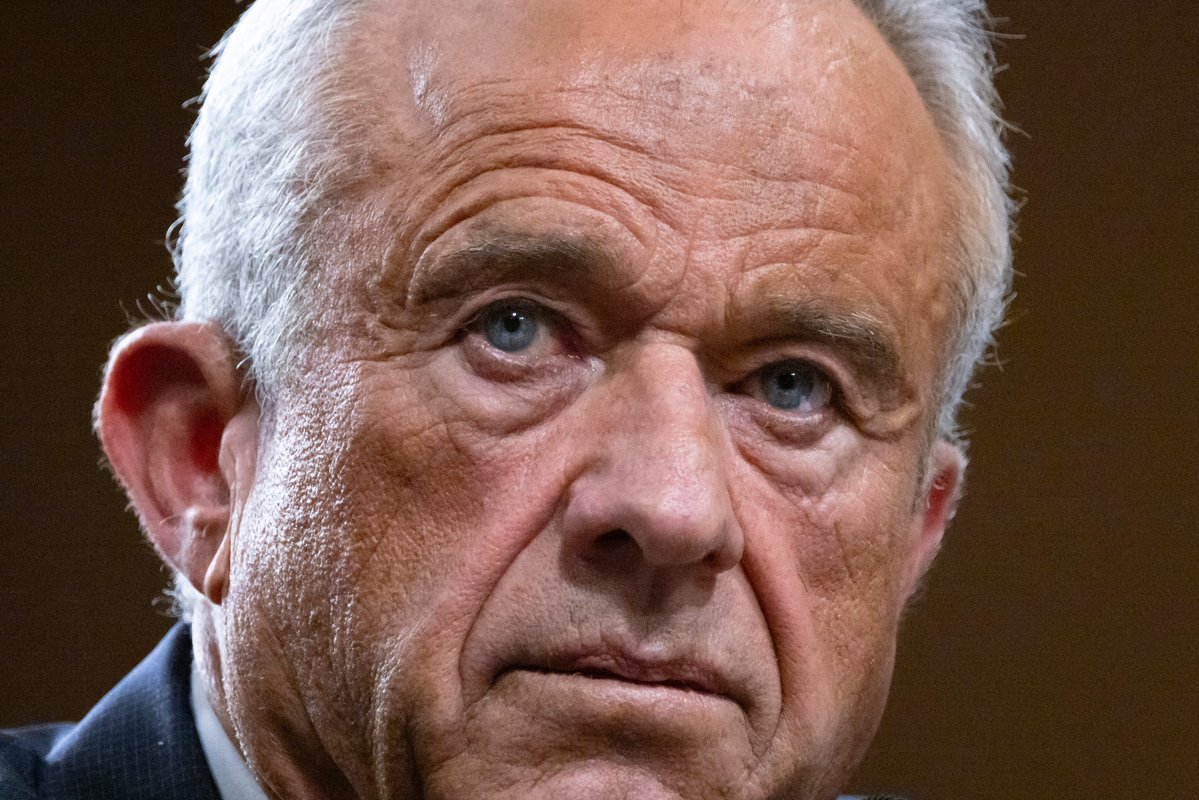
In a press conference hosted today, HHS Secretary Robert F. Kennedy Jr. and CMS Administrator Dr. Mehmet Oz announced a landmark agreement with the nation’s largest health insurers to tackle the number one healthcare problem plaguing hundreds of millions of Americans: prior authorization.
Prior authorization is the requirement for doctors and patients to get advance approval from insurance companies BEFORE certain treatments, tests, or procedures are covered. It was meant to control costs, but for 85% of Americans, it’s become a serious barrier to care.
“Doctors like myself are continually struggling with this issue,” Dr. said, explaining how the bureaucratic process not only delays treatment but deeply frustrates both providers and patients.
In 2023 alone, Medicare Advantage (which covers about 32 million people) initially denied 3.2 million prior authorization requests. Dr. Oz made clear these are not just numbers: they represent “individuals who often, in the most vulnerable time in their lives, needed something done and it was denied.”
The burden also falls heavily on physicians. On average, doctors spend 12 hours per week on paperwork, handling about 40 prior authorization cases weekly. Dr. Oz said it contributes to burnout, slows down care, and “erodes public trust in the health care system.”
Prior authorization is the requirement for doctors and patients to get advance approval from insurance companies BEFORE certain treatments, tests, or procedures are covered. It was meant to control costs, but for 85% of Americans, it’s become a serious barrier to care.
“Doctors like myself are continually struggling with this issue,” Dr. said, explaining how the bureaucratic process not only delays treatment but deeply frustrates both providers and patients.
In 2023 alone, Medicare Advantage (which covers about 32 million people) initially denied 3.2 million prior authorization requests. Dr. Oz made clear these are not just numbers: they represent “individuals who often, in the most vulnerable time in their lives, needed something done and it was denied.”
The burden also falls heavily on physicians. On average, doctors spend 12 hours per week on paperwork, handling about 40 prior authorization cases weekly. Dr. Oz said it contributes to burnout, slows down care, and “erodes public trust in the health care system.”
But under RFK Jr.’s leadership, things are changing for the better.
An HHS press release announced today that “health insurers pledged six key reforms aimed at cutting red tape, accelerating care decisions, and enhancing transparency for patients and providers.”
These changes aim to ensure that patients and their doctors no longer have to battle insurance companies just to access common treatments like imaging, outpatient surgery, or physical therapy.
hhs.gov/press-room/ken…
An HHS press release announced today that “health insurers pledged six key reforms aimed at cutting red tape, accelerating care decisions, and enhancing transparency for patients and providers.”
These changes aim to ensure that patients and their doctors no longer have to battle insurance companies just to access common treatments like imaging, outpatient surgery, or physical therapy.
hhs.gov/press-room/ken…
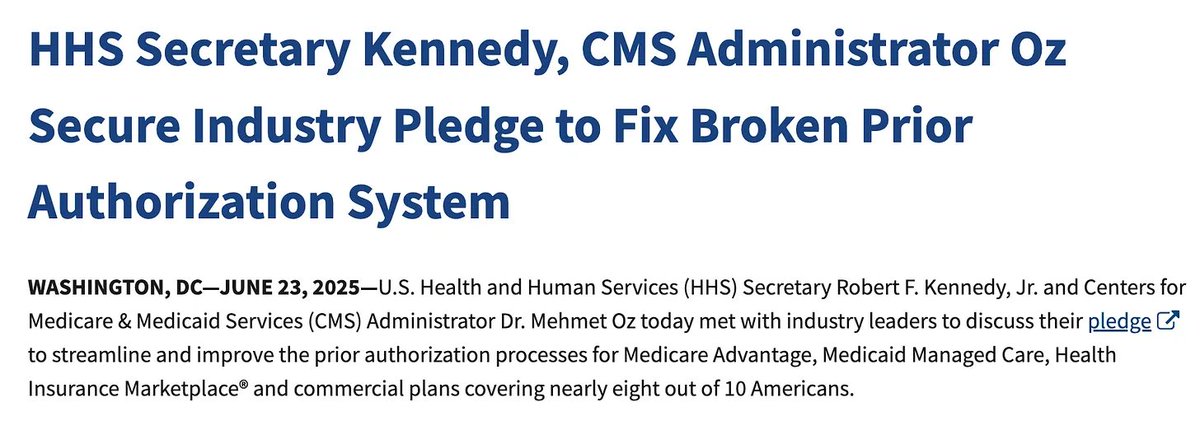
The cooperating insurers include UnitedHealthcare, Aetna, Blue Cross Blue Shield Association, Humana, Kaiser Permanente, The Cigna Group, Centene Corporation, Elevance Health, Highmark Health, CareFirst BlueCross BlueShield, and GuideWell, along with the industry trade group AHIP.
Participating insurers (which cover nearly 80% of Americans) have committed to:
• Standardize electronic prior authorization submissions using Fast Healthcare Interoperability Resources (FHIR®)-based application programming interfaces.• Reduce the volume of medical services subject to prior authorization by January 1, 2026.• Honor existing authorizations during insurance transitions to ensure continuity of care.• Enhance transparency and communication around authorization decisions and appeals.• Expand real-time responses to minimize delays in care with real-time approvals for most requests by 2027.• Ensure medical professionals review all clinical denials.
“These commitments represent a step in the right direction toward restoring trust, easing burdens on providers, and helping patients receive timely, evidence-based care,” said Dr. Mehmet Oz.
Participating insurers (which cover nearly 80% of Americans) have committed to:
• Standardize electronic prior authorization submissions using Fast Healthcare Interoperability Resources (FHIR®)-based application programming interfaces.• Reduce the volume of medical services subject to prior authorization by January 1, 2026.• Honor existing authorizations during insurance transitions to ensure continuity of care.• Enhance transparency and communication around authorization decisions and appeals.• Expand real-time responses to minimize delays in care with real-time approvals for most requests by 2027.• Ensure medical professionals review all clinical denials.
“These commitments represent a step in the right direction toward restoring trust, easing burdens on providers, and helping patients receive timely, evidence-based care,” said Dr. Mehmet Oz.
Eric Dane, best known for playing Dr. Mark “McSteamy” Sloan on Grey’s Anatomy, then took the stage.
Speaking not as an actor but as a patient, Dane revealed he is battling ALS (Lou Gehrig’s disease), a condition where the nervous system progressively breaks down, causing the body’s muscles to weaken and eventually stop working.
Dane described how a diagnosis like ALS brings “great uncertainty” and warned that unnecessary prior authorization only adds more stress to an already devastating situation.
“Anything we can do to give patients more certainty with fewer delays is a worthwhile endeavor,” he said. Though grateful for his ability to access top-tier care, Dane acknowledged, “I’m lucky. Not everyone is in the same position.”
He thanked CMS, HHS, and insurers for taking action, adding, “Today is about all those who need more certainty, faster answers, and more hope for recovery.”
Speaking not as an actor but as a patient, Dane revealed he is battling ALS (Lou Gehrig’s disease), a condition where the nervous system progressively breaks down, causing the body’s muscles to weaken and eventually stop working.
Dane described how a diagnosis like ALS brings “great uncertainty” and warned that unnecessary prior authorization only adds more stress to an already devastating situation.
“Anything we can do to give patients more certainty with fewer delays is a worthwhile endeavor,” he said. Though grateful for his ability to access top-tier care, Dane acknowledged, “I’m lucky. Not everyone is in the same position.”
He thanked CMS, HHS, and insurers for taking action, adding, “Today is about all those who need more certainty, faster answers, and more hope for recovery.”
When RFK Jr. stepped up to the podium, he shared that during the presidential transition, he was told the single most important thing he could do to improve the patient experience in America was to “end the scourge of pre-authorization.”
And that’s what Kennedy did by bringing together the nation’s largest health insurers and securing a landmark agreement to overhaul the system.
And that’s what Kennedy did by bringing together the nation’s largest health insurers and securing a landmark agreement to overhaul the system.
Kennedy shared a chilling account of what would happen when doctors dared to put patients before insurance company policies.
He described a patient from New Jersey who was suffering from severe heart failure and was transferred to New York-Presbyterian Hospital for a life-saving transplant.
The transplant itself had been approved by the insurance company, but shockingly, the mechanical heart pump needed to keep the patient alive until the transplant could take place was denied.
With the patient already in the operating room, the medical team faced an impossible choice: follow the insurer’s decision and let the patient die, or act to save his life, risking their careers. They chose to implant the device.
The patient survived and ultimately received the transplant. But Kennedy revealed that “my friend—the doctor—was then sued by the insurance company” for defying the denial.
That lawsuit was later dropped, but Kennedy said the ordeal highlights the madness of a system that punishes doctors for putting patients ahead of insurance companies.
He described a patient from New Jersey who was suffering from severe heart failure and was transferred to New York-Presbyterian Hospital for a life-saving transplant.
The transplant itself had been approved by the insurance company, but shockingly, the mechanical heart pump needed to keep the patient alive until the transplant could take place was denied.
With the patient already in the operating room, the medical team faced an impossible choice: follow the insurer’s decision and let the patient die, or act to save his life, risking their careers. They chose to implant the device.
The patient survived and ultimately received the transplant. But Kennedy revealed that “my friend—the doctor—was then sued by the insurance company” for defying the denial.
That lawsuit was later dropped, but Kennedy said the ordeal highlights the madness of a system that punishes doctors for putting patients ahead of insurance companies.
In case health insurers decide to flake out, Kennedy outlined the safeguards in place to ensure they follow through on their new prior authorization reforms—something he acknowledged they’ve failed to do in the past.
“This time is very, very different,” he said. One reason is scale: “257 million patients are covered by the group that we met with this morning,” Kennedy noted, calling it “unprecedented.”
But what truly sets this effort apart, Kennedy explained, is structure. “We have standards this time. We have deliverables. We have specificity on those deliverables. We have metrics. We have deadlines. And we have oversight.”
“This time is very, very different,” he said. One reason is scale: “257 million patients are covered by the group that we met with this morning,” Kennedy noted, calling it “unprecedented.”
But what truly sets this effort apart, Kennedy explained, is structure. “We have standards this time. We have deliverables. We have specificity on those deliverables. We have metrics. We have deadlines. And we have oversight.”
Kennedy ended his speech by calling the prior authorization reform a “monumental accomplishment”—a breakthrough decades in the making.
He highlighted that Congressman Greg Murphy has been fighting to address this issue for 35 years, and now, real change is underway.
Kennedy thanked the insurance companies and hospital systems for stepping up, and gave special credit to President Trump for providing the leadership that made the agreement possible.
“We hope to see the dividends of this success story immediately materialize, as a better experience for the American, for millions, hundreds of millions, literally, of American patients,” Kennedy said.
He highlighted that Congressman Greg Murphy has been fighting to address this issue for 35 years, and now, real change is underway.
Kennedy thanked the insurance companies and hospital systems for stepping up, and gave special credit to President Trump for providing the leadership that made the agreement possible.
“We hope to see the dividends of this success story immediately materialize, as a better experience for the American, for millions, hundreds of millions, literally, of American patients,” Kennedy said.
SUMMARY:
• 85% of Americans have been affected by prior authorization delays, making it the top complaint from both patients and doctors, according to Dr. Oz.
• In 2023, Medicare Advantage denied 3.2 million prior authorization requests—often for urgent, life-saving care.
• Doctors spend an average of 12 hours a week handling about 40 prior authorization cases, contributing to burnout and delayed treatment.
• RFK Jr. secured a landmark agreement with insurers covering 257 million Americans to overhaul the prior authorization system.
• Six major reforms were pledged: standardizing electronic submissions, reducing services requiring approval by 2026, honoring authorizations during plan changes, improving transparency, expanding real-time decisions by 2027, and ensuring clinical denials are reviewed by medical professionals.
• Unlike past efforts, this deal includes clear metrics, deadlines, and CMS oversight to hold insurers accountable. “We have standards… and we have oversight,” Kennedy said.
• Kennedy called it a “monumental accomplishment” and a long-overdue fix for a broken system.
• 85% of Americans have been affected by prior authorization delays, making it the top complaint from both patients and doctors, according to Dr. Oz.
• In 2023, Medicare Advantage denied 3.2 million prior authorization requests—often for urgent, life-saving care.
• Doctors spend an average of 12 hours a week handling about 40 prior authorization cases, contributing to burnout and delayed treatment.
• RFK Jr. secured a landmark agreement with insurers covering 257 million Americans to overhaul the prior authorization system.
• Six major reforms were pledged: standardizing electronic submissions, reducing services requiring approval by 2026, honoring authorizations during plan changes, improving transparency, expanding real-time decisions by 2027, and ensuring clinical denials are reviewed by medical professionals.
• Unlike past efforts, this deal includes clear metrics, deadlines, and CMS oversight to hold insurers accountable. “We have standards… and we have oversight,” Kennedy said.
• Kennedy called it a “monumental accomplishment” and a long-overdue fix for a broken system.

Watch the full press conference below:
Thanks for reading! This post took time and care to put together, and I did my best to give this story the coverage it deserved.
If you appreciate my work, the most effective way to support it is to sign up for news alerts at vigilantfox.com or subscribe to this page on X.
Your monthly subscription goes further than you think. Thank you so much for your support.
If you appreciate my work, the most effective way to support it is to sign up for news alerts at vigilantfox.com or subscribe to this page on X.
Your monthly subscription goes further than you think. Thank you so much for your support.
A little bit about me: I spent over a decade working as a licensed healthcare professional. But when the Biden administration rolled out its vaccine mandates, I couldn’t stay silent. My conscience simply wouldn’t let me.
That’s when I started this page.
Since then, I’ve shared thousands of clips featuring doctors and scientists who were brave enough to question the official COVID narrative.
Along the way, we’ve reached billions of views and helped millions of people understand the other side of the COVID story that the government didn’t want out.
If you’re looking for clear, honest information without corporate spin, you’re in the right place. Follow me for straight-to-the-point clips and threads that challenge the narrative.
Follow on 𝕏: @VigilantFox
Telegram: t.me/VigilantFox
Rumble: rumble.com/c/VigilantFox
Substack: vigilantfox.com
That’s when I started this page.
Since then, I’ve shared thousands of clips featuring doctors and scientists who were brave enough to question the official COVID narrative.
Along the way, we’ve reached billions of views and helped millions of people understand the other side of the COVID story that the government didn’t want out.
If you’re looking for clear, honest information without corporate spin, you’re in the right place. Follow me for straight-to-the-point clips and threads that challenge the narrative.
Follow on 𝕏: @VigilantFox
Telegram: t.me/VigilantFox
Rumble: rumble.com/c/VigilantFox
Substack: vigilantfox.com

• • •
Missing some Tweet in this thread? You can try to
force a refresh






