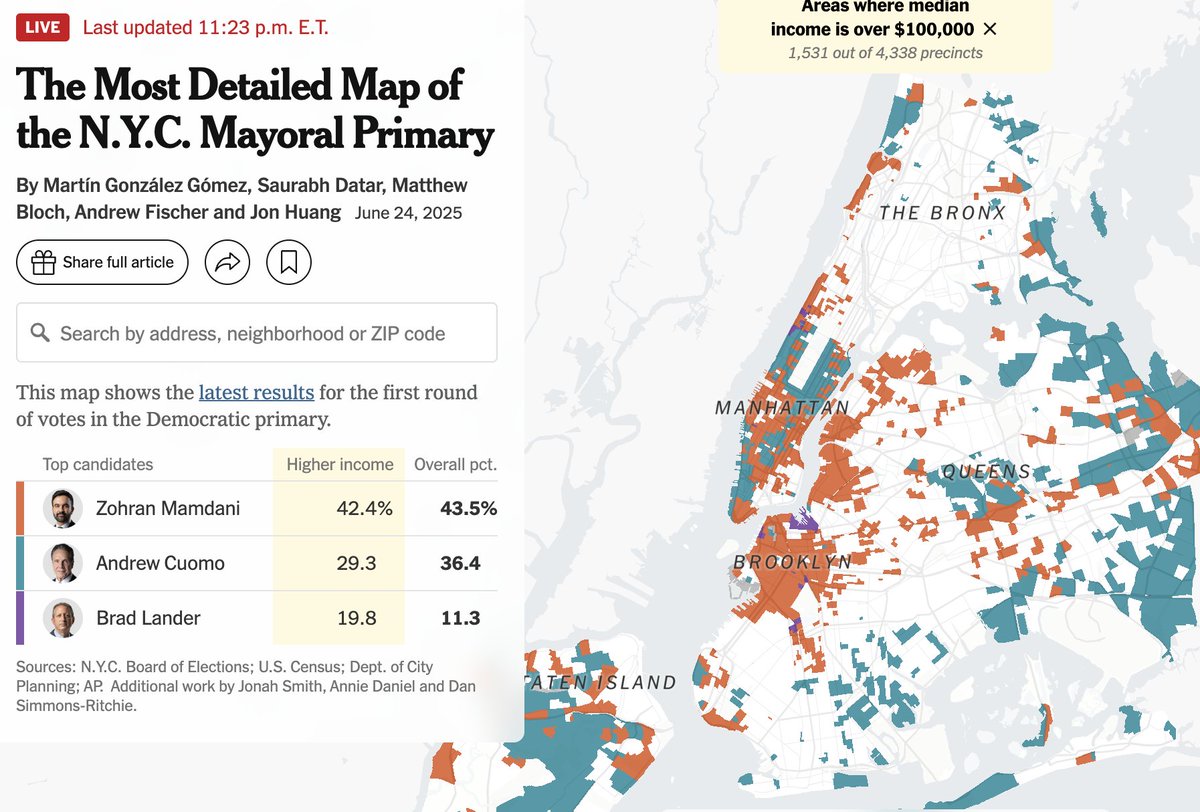
Let's take a trip down Demographics Avenue, shall we? (courtesy of this incredible tool from the New York Times)
Mamdani is winning majority Asian precincts by 15 points.
And not just South Asian bastions like Jackson Heights.
East Asian bastions like Sunset Park & Chinatown.
Mamdani is winning majority Asian precincts by 15 points.
And not just South Asian bastions like Jackson Heights.
East Asian bastions like Sunset Park & Chinatown.

Mamdani is winning majority Latino precincts by 6.5 points.
Outside of the Bronx, he cleaned up almost everywhere, including Sunset Park West & Bushwick in Brooklyn, and Corona & Woodhaven in Queens.
Outside of the Bronx, he cleaned up almost everywhere, including Sunset Park West & Bushwick in Brooklyn, and Corona & Woodhaven in Queens.

Mamdani is winning majority white precincts by 5 points
He lost the UES, UWS & wealthier parts of Manhattan
He obviously got smoked in the orthodox Jewish hubs (Borough Park, Crown Heights, South Williamsburg)
And he lost heavily ethnic white parts of South BK & Staten
But...
He lost the UES, UWS & wealthier parts of Manhattan
He obviously got smoked in the orthodox Jewish hubs (Borough Park, Crown Heights, South Williamsburg)
And he lost heavily ethnic white parts of South BK & Staten
But...

He won most of Bay Ridge in South Brooklyn (my neighborhood!), and not just the Middle Eastern parts to the east.
He dominated the "Commie Corridor" of western Queens, Brooklyn west and northwest of Prospect Park, and Morningside Heights in Manhattan.
He dominated the "Commie Corridor" of western Queens, Brooklyn west and northwest of Prospect Park, and Morningside Heights in Manhattan.
Cuomo only won majority Black precincts by 19 points. Polls had him with a much larger lead among Black voters.
Mamdani did well in gentrifying areas with more younger Black voters, including Harlem, Bed Stuy, Lefferts Gardens, and Flatbush.
He did poorly everywhere else.
Mamdani did well in gentrifying areas with more younger Black voters, including Harlem, Bed Stuy, Lefferts Gardens, and Flatbush.
He did poorly everywhere else.

Cuomo won precincts where the median household income is under $50K by 13 points.
Most of that is concentrated in the Bronx, but turnout was also pretty anemic there compared to 2021.
Most of that is concentrated in the Bronx, but turnout was also pretty anemic there compared to 2021.

Mamdani won precincts where the median household income is $50-$100K by 9 points.

Mamdani won precincts where the median household income is $100K+ by 13 points.
He was especially strong in west Queens, Brownstone Brooklyn, and most of Manhattan below Prospect Park.
He was especially strong in west Queens, Brownstone Brooklyn, and most of Manhattan below Prospect Park.
• • •
Missing some Tweet in this thread? You can try to
force a refresh