What really mattered at the NATO Summit — and what didn’t.
Ironically, the things that caused the most media noise weren’t the most important.
1/n
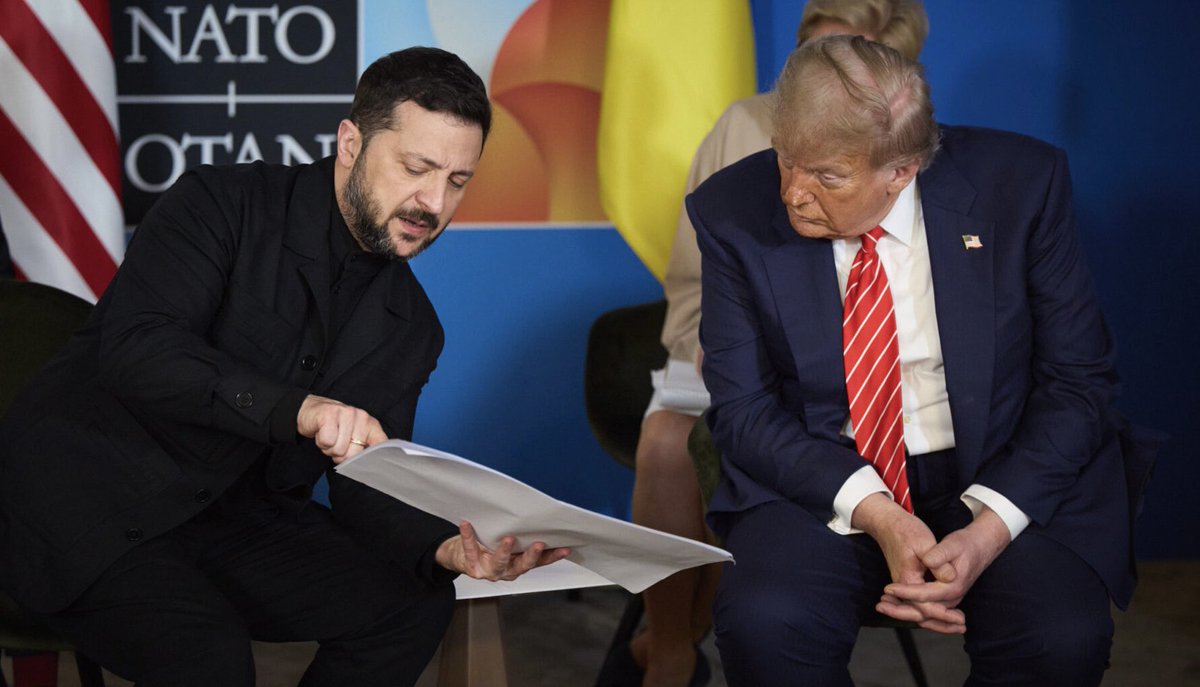
2/ Yes, the Ukrainian journalist’s polite yet firm question to Trump about Patriot missiles was a masterclass in how to speak to him: gently, like a toddler — but without backing down. A great case study in “Trump-friendly” diplomacy.
3/ And yes, Zelenskyy’s meeting with Trump was symbolically good. Trump didn’t yell or stomp his feet. But let’s be honest: he’ll likely forget the meeting by tomorrow and go back to praising Putin.
4/ In practical terms, none of that moves the needle for Ukraine’s war effort.
What did matter — but got little attention — was NATO’s decision to raise defense spending targets to 5% of GDP and to explicitly include aid to Ukraine in that spending.
5/ This changes everything. It means support for Ukraine will now be part of official defense budgets, not discretionary handouts. That’s a bureaucratic and financial game-changer.
6/ If implemented, European defense spending could soar from $500 billion to over $1.5 trillion — money russia simply can’t match.
That’s the real headline.
• • •
Missing some Tweet in this thread? You can try to
force a refresh

In 1994, under U.S. pressure, Ukraine gave up the world’s third-largest nuclear arsenal. Over 1,000 cruise missiles.
1/n
2/ Over 1,000 cruise missiles. A fleet of strategic bombers. All dismantled — with U.S. assistance — in exchange for security assurances from the U.S., the UK, and russia.
3/ This agreement was called the Budapest Memorandum.
Today, the U.S. State Department and the White House have deleted all references to this agreement from their websites.
Incredible historic video showing footage from operation “Spiderweb” — a Ukrainian strike that will go down in history as one of the most successful special operations ever conducted.
Here are some facts about the operation:
1/n
2/ Ukrainian special forces spent 1.5 years preparing and planning the attack.
3/ Special cargo containers were custom-designed (see photos) to conceal drones. The drones were hidden in wooden boxes mounted beneath the container roofs.
Very disappointing to see this coming from the Polish people. They, of all people, should know better.
A recent poll shows a troubling shift in attitudes in Poland:
1/n
2/ • 46% of Poles now believe military aid to Ukraine should be reduced or halted.
• Only 15% support the idea of sending troops for a peacekeeping mission.
• While 52% still want Poland to support Ukraine diplomatically, 29% oppose even that.
3/ The main driver behind these attitudes? Fear.
• 25% believe a russian attack on Poland is likely.
• Just 9% think the Polish army is ready.
The battle between the far left and far right begins.
As I feared, Mamdani has won the New York City mayoral race.
1/n
2/ A self-described socialist with far-left views, Mamdani has called for slashing police funding and refused to condemn slogans like “globalize the Intifada.”
Three takeaways:
3/ First, this is how Trump won in 2024. Radical “woke” politics pushed moderates and independents straight into Trump’s arms.
Russia is not over 1,000 years old, as some claim. At most, it is 900 years old — if we count from the establishment of the first political unit in the area of Moscow. The Vladimir-Suzdal Duchy, founded in 1125, is where we should begin the political history of the country now known as Russia.
1/n
2/ Rus’ began in Kyiv in the 9th century, which makes Ukraine its direct descendant, while Russia is more of a spin-off — a branch heavily influenced by the Golden Horde.
3/ Moscow was under Kyivan Rus’ influence for barely 100 years, but it remained under the rule of the Golden Horde and other Turkic powers for over 400 years. This raises the question: from whom did they actually inherit most of their political culture and traditions?



