Brain Inflammation Collaborative Profile picture
Jun 28 9 tweets 4 min read Read on X
Low-dose nicotine can help alleviate Long COVID symptoms.

Could this explain why?🧵 ID: Screenshot of a Reddit comment section of long COVID patients revealing that nicotine helped alleviate their symptoms.
To understand the nicotine hypothesis, we must start with the spike protein.

The SARS-CoV-2 spike protein contains a region similar to neurotoxic proteins found in:
- Rabies virus
- Cobra venom
- Indian krait snake venom

These neurotoxic proteins work by binding and blocking the nicotinic acetylcholine receptors (nAChR) from functioning.

Can the spike protein do the same?ID: Image of an Indian krait snake.
ID: Cartoon image revealing how ACh activates the NAChR and how some venoms do the opposite by blocking the NAChR.
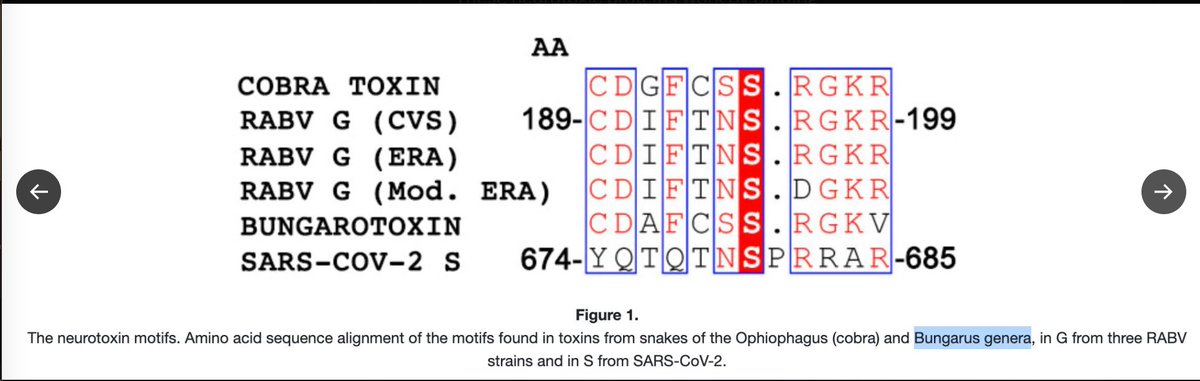
When you align the amino acid sequence of the spike with the neurotoxins, you see some similarities (red letters).

In addition, functional studies suggest spike protein fragments bind and inhibit nAChR (1,2).

Also, injecting mice with the 11 amino acid spike fragment caused an inflammatory response and a decrease in memory (3).

This was reversed by injecting choline, an activator of nAChRs (4).ID: The alignment of an 11 amino acid stretch from the SARS-CoV-2 spike protein that is similar, as show by the red letters, as the Rabies venom protein and two different snake venom proteins.
Could the spike protein be causing some Long COVID symptoms in part by interacting with and blocking nAChRs from functioning?

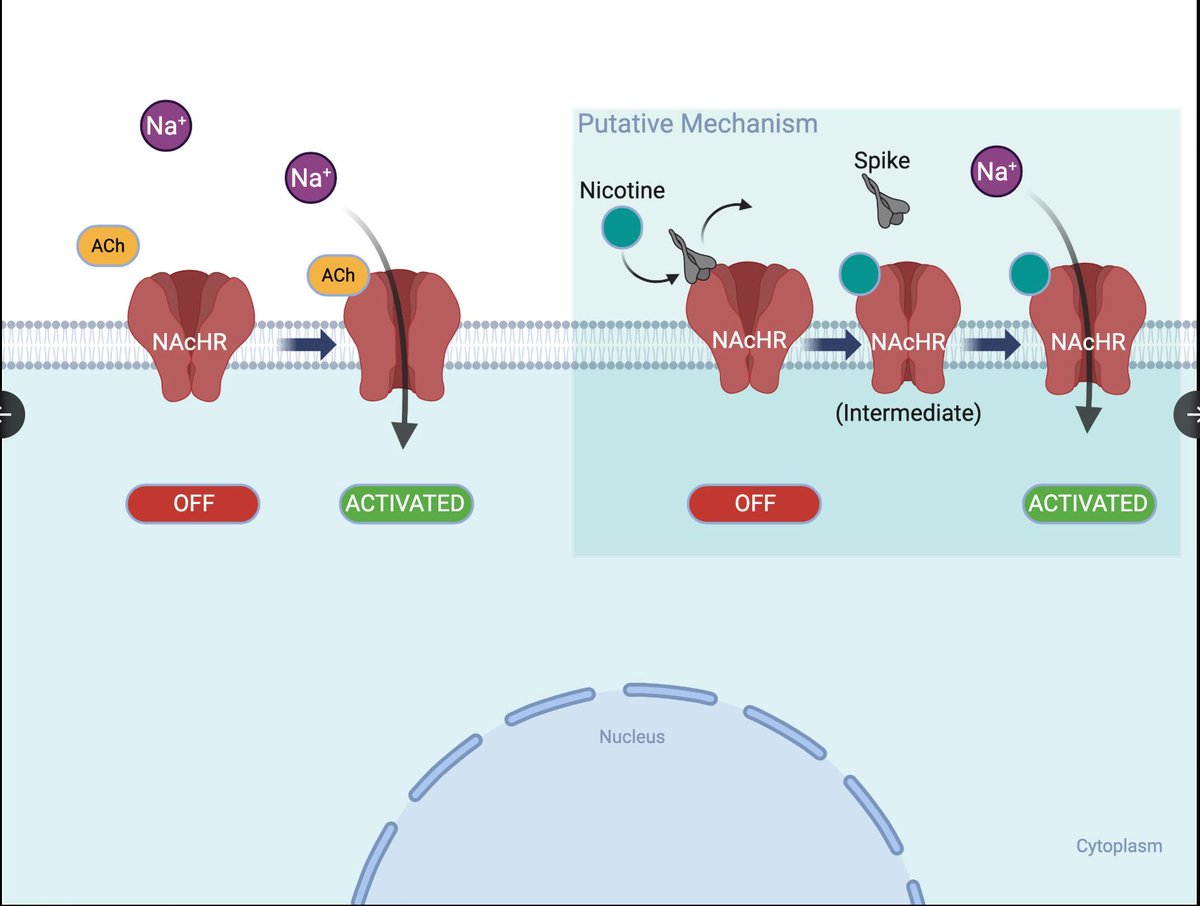
If so, nicotine, able to tightly bind nAChRs, might be able to displace the spike protein/spike fragment, turning on nAChRs.

Why might blocking nAChRs contribute to LC?ID: Cartoon revealing how nicotine is predicted to displace the spike protein from the NAcHR causing a reversal in inhibition.
nAChRs play a role in:
- Cognitive function
- Inflammation control
- Autonomic nervous system regulation

Thus, activating nAChRs could:
- reduce inflammation
- improve brain fog
The anecdotal evidence of nicotine in Long COVID isn't only on Reddit (image from 1st post).

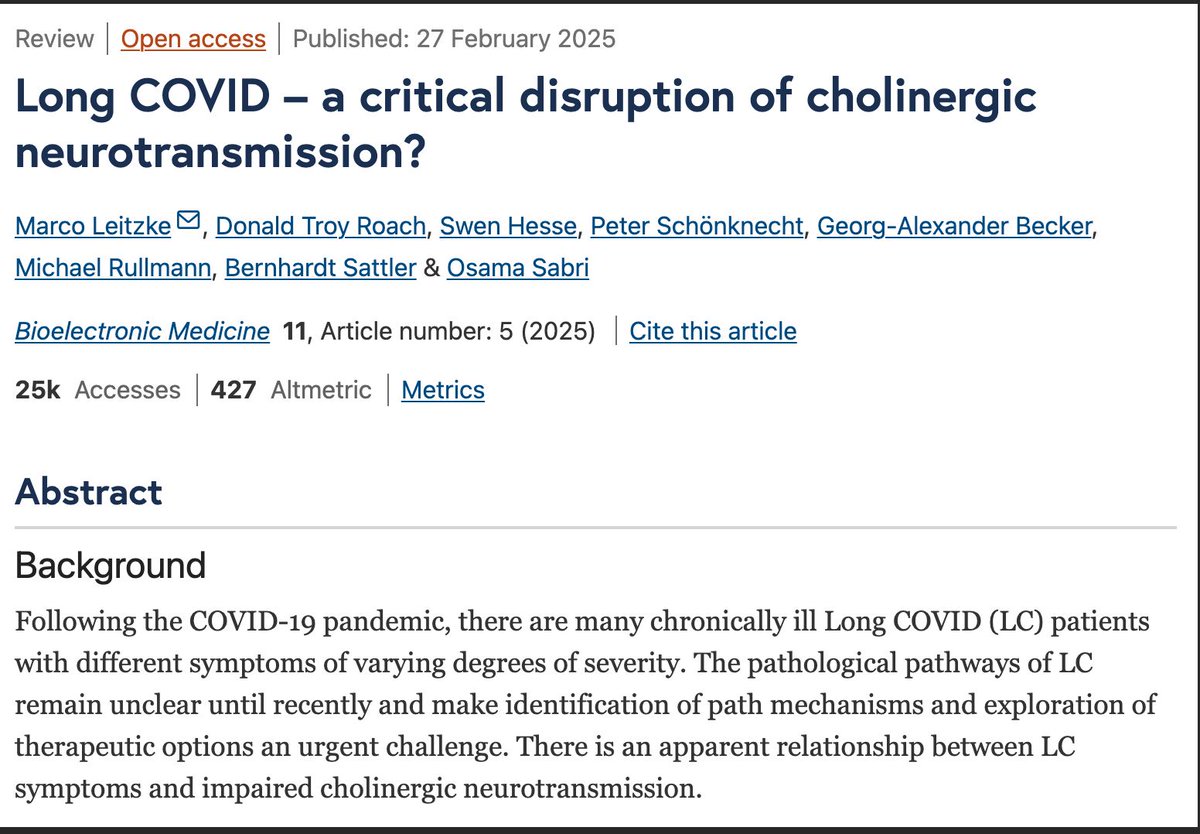
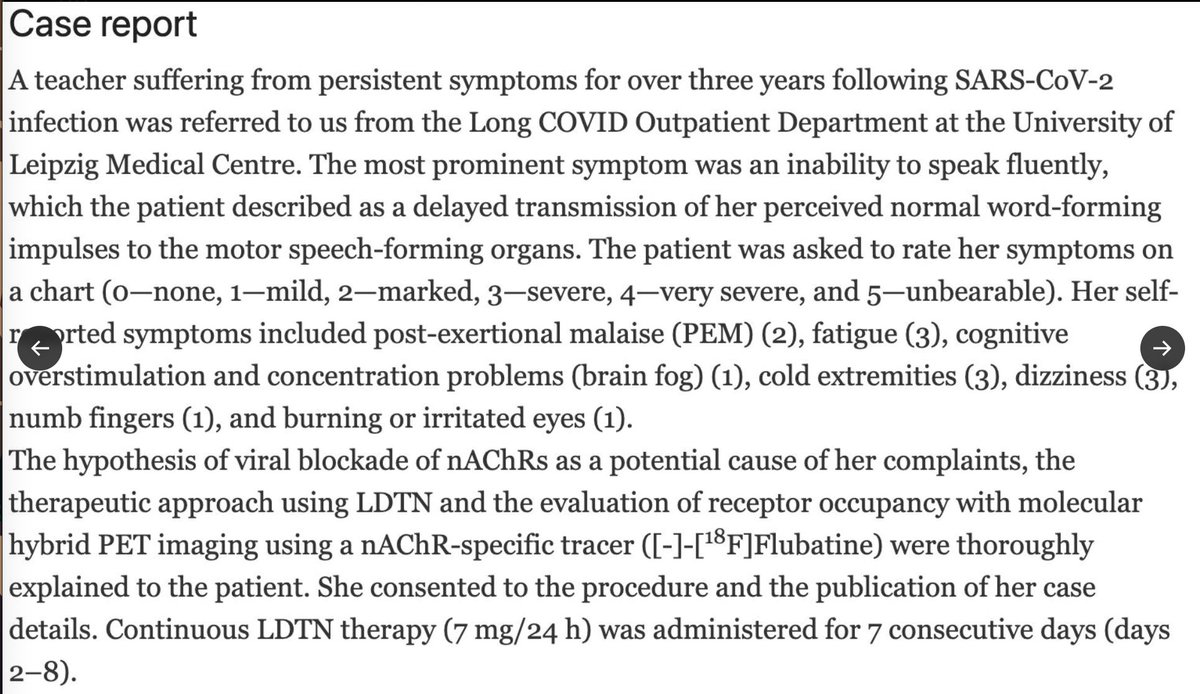
For instance, a published case report found that it helped a Long COVID patient (below).

The symptoms presented before treatment were: [1-5 rating, 1-mild > 5-unbearable]:
fatigue [3]
dizziness [3]
numb fingers [1]
cold extremities [3]
burning or irritated eyes [1]
post-exertional malaise (PEM) [2]
concentration problems (brain fog) [1]

After 7 days of continuous low dose nicotine, her complaints were reduced to:
- dizziness [1]
- irritated eyes [1]Image
Image
There are different flavors of nAChRs.

It's hypothesized that the alpha7 nAChRs are inhibited in some with Long COVID.

α7 nAChRs activation can:
- control neuroinflammation in a way that influences learning and memory
- reduce pro-inflammatory cytokines
- etc. Image
Robust clinical studies are needed to rigorously test the efficacy of nicotine in those with Long COVID.

We would speculate that nicotine would only help patients whose symptoms are caused by viral persistence.

Have you tried low-dose nicotine to treat your Long COVID (or ME/CFS)?
Literature Cited:
1. Farsalinos K, et al. IJMS. 2020. PMID: 32823591
2. Carlson EC, et al. IJMS. PMID: 36982671
3. Lykhmus, O., et al. Biochem. Biophys. Res. Commun. 2022. PMID: 35843095
4. Lykhmus, O., et al. J. Neuroimmunol. 2023. PMID: 38016403

• • •

Missing some Tweet in this thread? You can try to force a refresh

 

Keep Current with Brain Inflammation Collaborative

Brain Inflammation Collaborative Profile picture

Stay in touch and get notified when new unrolls are available from this author!

Read all threads

This Thread may be Removed Anytime!

PDF

Twitter may remove this content at anytime! Save it as PDF for later use!

Try unrolling a thread yourself!

how to unroll video
  1. Follow @ThreadReaderApp to mention us!

  2. From a Twitter thread mention us with a keyword "unroll"
@threadreaderapp unroll

Practice here first or read more on our help page!

More from @BrainInflCollab

Jun 25
Autoantibodies can cause psychosis-like conditions such as:
- delusions
- hallucinations
- impaired thinking or reasoning

But there is a problem.

Brain-attacking autoantibodies unknown to science would be nearly impossible to detect.

Here is how that could change...🧵 ID: Infographic of a quote from Dr. Sam Pleasure explaining, "we think a fraction of patients with psychosis actually have an autoimmune syndrome. Those patients need to be treated very differently from a typical schizophrenia patient, but right now, there's not a clear way to distinguish between them."
🧠 Psychosis & Autoantibodies:
Up to 10% of schizophrenia spectrum disorder patients have been reported to contain an autoantibody called anti-NMDAR that targets the brain, causing autoimmune encephalitis (AE) (autoantibody-driven neuroinflammation) (1).

However, only a few autoantibodies targeting the brain are known to science.

What if there are more?
\ The Problem:
Psychosis patients will suffer in silence if they have a brain-reactive autoantibody unknown to science.

Here is how that might change...
Read 7 tweets
Jun 21
Anti-depressants don't work for roughly 30% of people who take them, known as treatment-resistant depression (TRD).

TRD is likely not caused by a neurotransmitter imbalance but by something else...🧵 ID: Decorative image of electricity radiating from a brain shown as tiny balls of light connected to the brain by thin lines of light.
Researchers believe they have identified a cause of TRD: chronic inflammation.

Roughly 1/3 of patients with TRD are chronically inflamed.

Reducing the inflammation is associated with reduced depression... ID: Infographic quote from Dr. Golam Khandaker and immunopsychiatrist from the University of Bristol saying, "about 1/3 of patients who are resistant to antidepressants show evidence of inflammation... anti-inflammatory treatments could be relevant for a large number of people who suffer from depression."
For instance, a meta-analysis found that anti-inflammatories increased major depressive disorder remission by 79%.

Read more: buff.ly/bUNIT0XID: Infographic image explaining the results of a meta-analysis revealing that anti-inflammatory medication increased MDD remission by 79%
Read 5 tweets
Jun 19
Long COVID in adults is characterized by (protein) markers of:
- inflammation
- blood vessel clotting

However, similar studies in pediatric cohorts are almost non-existent... until now.

This study suggests that pediatric Long COVID is characterized by unique pathophysiology and isn't stress- or anxiety-induced...🧵ID: Image of a little girl laying in bed under the covers who looks like she feels ill. Her hand in placed on her forehead to check if she feels warm. To the left is an image of a brain MRI suggesting her illness is neurological in nature.
\ The Study:
Scientists from the University of Rome and Fondazione Policlinico Universitario discovered that 34 children and adolescents between the ages of 2 and 18 have an abundance of pro-inflammatory cytokines in their blood.

A subset of the cytokines have angiogenic (blood vessel growth-promoting) properties.

Read more: buff.ly/7NN1lyZID: A screenshot of the first page of the pediatric long COVID paper published in Nature.
\ The Study Continued:
The signature of protein markers was distinct from children with the following:
- Multisystem inflammatory syndrome in children (MIS-C) (27 participants)
- Acute SARS-CoV-2 infection (32 participants)
- Healthy controls (19 participants)

*MIS-C is a rare but serious condition where different body parts can become inflamed, typically following a COVID-19 infection.

Here are the proteins in the blood that were changed.
Read 6 tweets
Jun 12
It's estimated that 5.8 million young people have Long COVID. (1)

A recent study revealed that 65 of 92 (71%) children with Long COVID had a form of orthostatic intolerance, including postural orthostatic tachycardia syndrome (POTS) (2).

Here is one powerful way the connection between POTS and pediatric Long COVID is being investigated...🧵ID: Close up image of a young girl dressed in black standing in front of a black background staring hopelessly into the camera with sad eyes.
Being a kid today is hard enough.

They are forced to navigate:
- a highly polarized world
- technology overload
- cyberbullying
- etc.

If that weren't hard enough, the data suggests (1) a large subset of kids also have to manage their lifestyle-altering chronic health condition...Long COVID.

But wait, there is more.ID: A female teenager stands with arms folded staring helplessly at the ground with ear buds in her ears so she can ignore her two peers, standing on either side of her with their arms out and fingers waving in her face.
A new study from Kennedy Krieger Institute suggests that a majority of kids with Long COVID have a comorbidity... orthostatic intolerance (OI).

OI characterizes a set of symptoms that occur when standing but improve when lying down.

These symptoms can include:
- Rapid heart rate
- Body pain
- Dizziness
- Fatigue

Read more:
buff.ly/ALlPhkSID: a little girl is laying in a hospital bed with her arms folded and a thermometer in her armpit with a nurse tries feed her medicine.
Read 8 tweets
Jun 10
After two SARS-CoV-2 infections, Heather Carr became largely bed-bound and nearly unable to string together a basic train of thought.

“I cry when I try to think, now,” she said. “My brain short-circuits.”

Census data suggests there are millions more just like her in the U.S...🧵ID: Image of 31 year old Heather Carr sitting outside with her hand propping up her head as she sits hunched over wearing an N95 mask with the look of physical exhaustion on her face.
The Census Bureau's monthly Current Population Survey asks Americans if they have serious problems with their memory or concentration.

Respondents are classified as disabled if they answer yes.

Although there is no disability insurance (financial) incentive, the number answering "yes" has increased by 1.5 million since the pandemic (red line).Image
This increased from 15 to 16.5 million people from before 2020 to 2023, a 9.6% increase.

Read the full story here:
buff.ly/nQho9sZ
Read 7 tweets
Jun 8
April Burrell lived in a psychiatric hospital for 20 years.

Her catatonic state left her immobile and unresponsive.

But after 2 decades, she suddenly woke up.

Here is why..🧵 ID: Image of April Durrell as a healthy young women superimposed on a pink image of her attempting to draw a clock when she was sick compared to when she received treatment.
At the age of 21, April, a high school valedictorian and accounting major at the University of Maryland Eastern Shore, suddenly developed a severe form of schizophrenia.

Her psychosis caused visual and auditory hallucinations.

Unable to take care of herself, she was admitted to a psychiatric hospital.

Read more here:
washingtonpost.com/wellness/2023/…
Sander Markx, director of precision psychiatry at Columbia University, met April as a patient during his time as a medical student in 2000.

“She is, to this day, the sickest patient I’ve ever seen,” he recalls.

Little did he know he would cross paths with April 18 years later. ID: Image of Dr. Markx, director of precision psychiatry at Columbia University standing on the corner of a balcony with a city skyline in the background.
Read 8 tweets

Did Thread Reader help you today?

Support us! We are indie developers!


This site is made by just two indie developers on a laptop doing marketing, support and development! Read more about the story.

Become a Premium Member ($3/month or $30/year) and get exclusive features!

Become Premium

Don't want to be a Premium member but still want to support us?

Make a small donation by buying us coffee ($5) or help with server cost ($10)

Donate via Paypal

Or Donate anonymously using crypto!

Ethereum

0xfe58350B80634f60Fa6Dc149a72b4DFbc17D341E copy

Bitcoin

3ATGMxNzCUFzxpMCHL5sWSt4DVtS8UqXpi copy

Thank you for your support!

Follow Us!

:(