XFG.* "Stratus" seemed to have the best underlying momentum, until recently when samples from the US became less dominant.
🧵
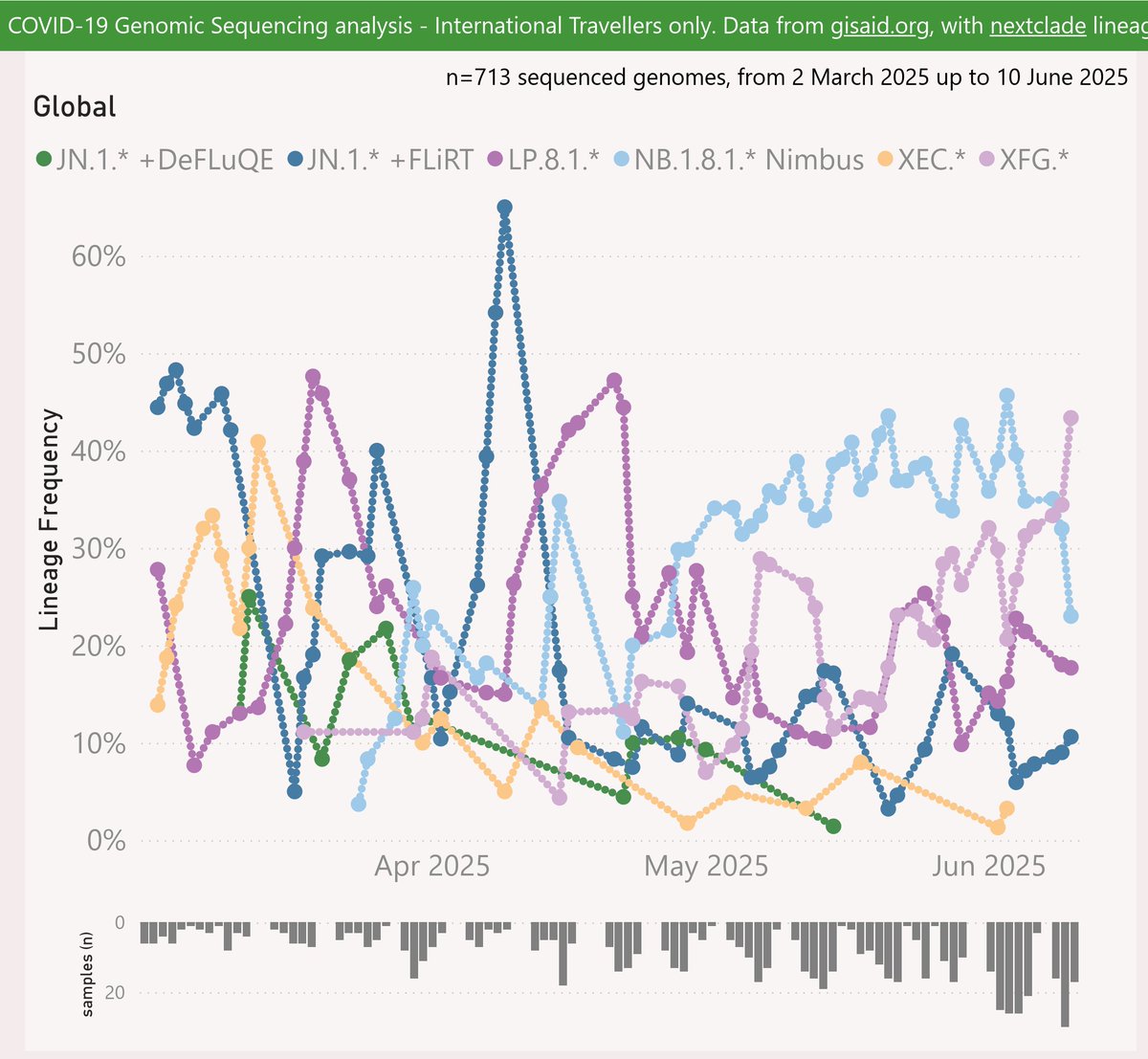
Here are the trends across all the International Traveller samples. From that perspective, XFG.* "Stratus" is now dominant for the first time, at 43%.
This dataset (mostly arrivals in the US and Japan) is arguably more random, as it is not skewed by sequencing volumes.
🧵
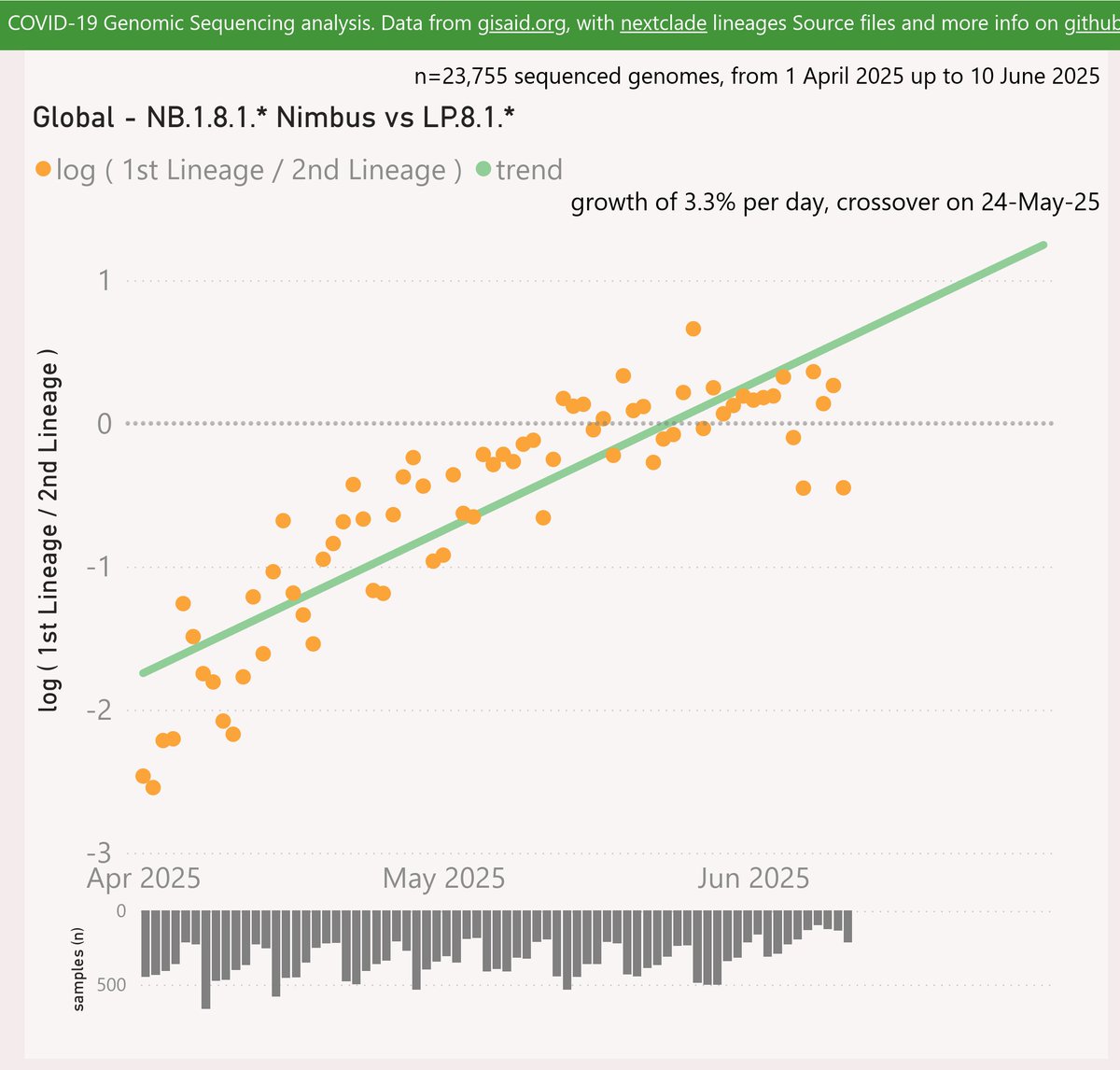
Globally, the NB.1.8.1 "Nimbus" variant is showing a slowing growth advantage of 3.3% per day (25% per week) over the LP.8.1.* variant, with a crossover in late May.
🧵
Here are the leading countries reporting NB.1.8.1 "Nimbus". There seem to be 3 tracks:
- China, Hong Kong and Thailand are reporting a clean sweep
- Singapore and Australia show steady growth to around 50%
- growth in the US and Canada has been lower.
🧵
Globally, the XFG.* "Stratus" variant is showing a stronger growth advantage of 6.3% per day (45% per week) over the LP.8.1.* variant. That shows a crossover in early June.
🧵
Here are the leading countries reporting XFG.* "Stratus". It reached 77% in India, before falling to finish at 73%. It has also shown sustained growth to 39% in the US and 34% in Spain.
🧵
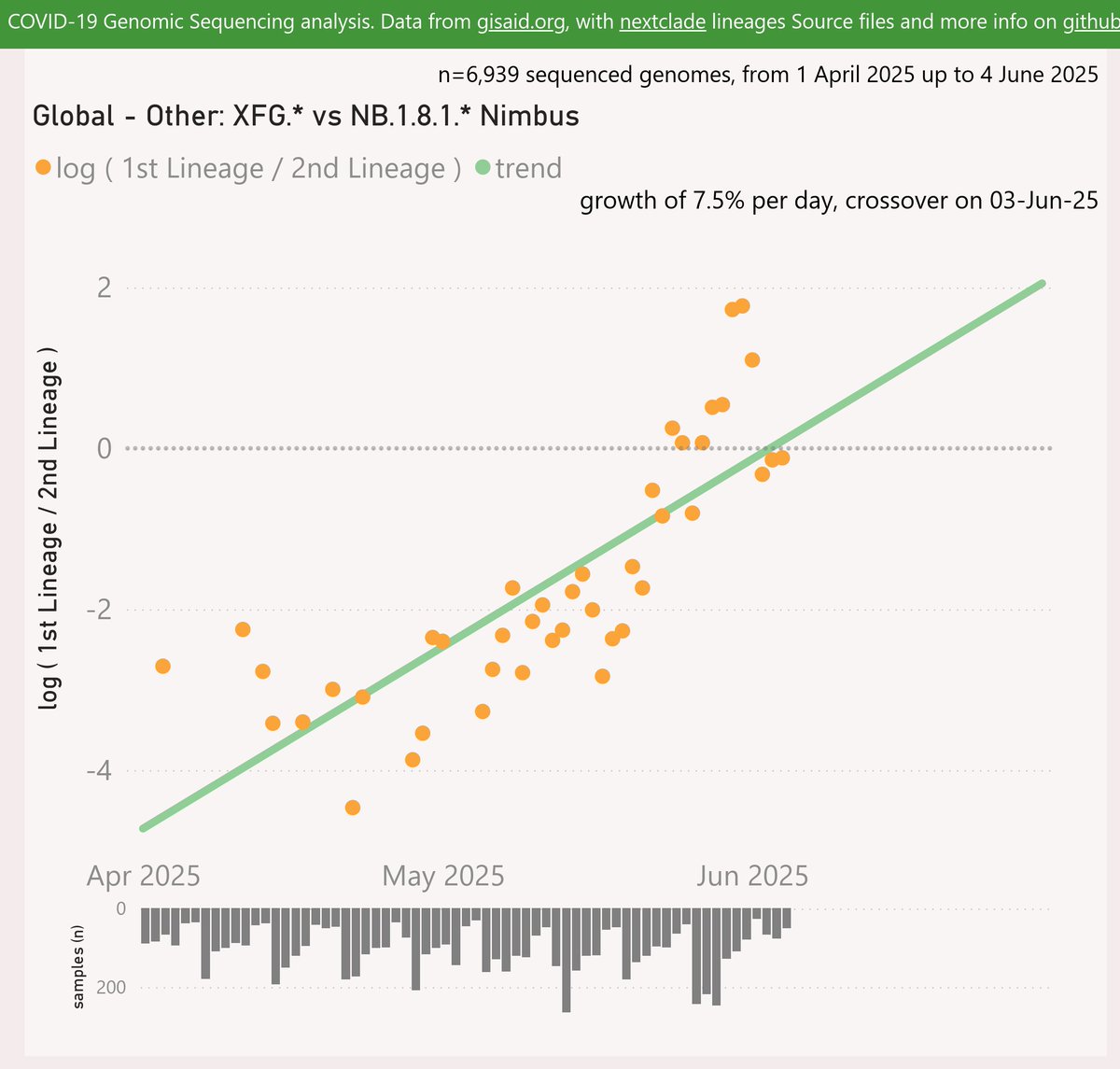
This perspective excludes all the high-volume countries and regions that I routinely report on: Australia, NZ, Europe, Canada and the US. The remaining countries are aggregated into this report.
🧵
For the "Global - Other" countries, the XFG.* "Stratus" variant is showing a strong and accelerating growth advantage of 7.5% per day (53% per week) over the NB.1.8.1 "Nimbus" variant, with a crossover in early June.
🧵
Here's the latest variant picture for the United States, to early June.
The XFG.* "Stratus" variant grew strongly to dominance at 41%, while LP.8.1.* fell to 25%.
The NB.1.8.1 "Nimbus" variant grew steadily, to 20%.
#COVID19 #USA #XFG #Stratus #NB_1_8_1 #Nimbus
🧵
For the US, the XFG.* "Stratus" variant shows a strong growth advantage of 5.9% per day (41% per week) over LP.8.1.*, with a crossover in early June.
🧵
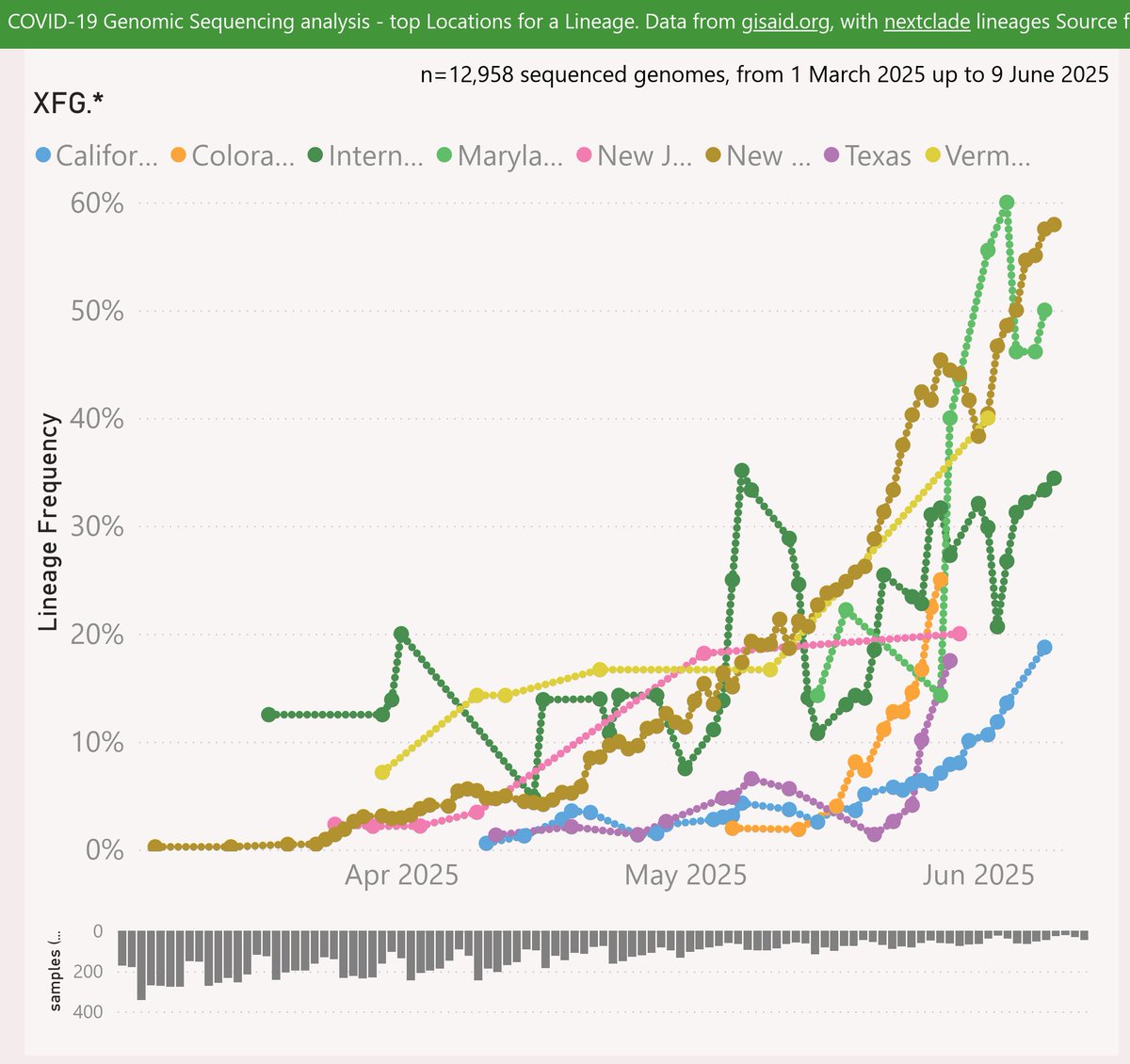
XFG.* "Stratus" has mainly been reported from New York state, rising to 58% frequency. Maryland finished at 50%. It has also been quite common among the International Traveller samples at 30-35%.
🧵
The XFG.* "Stratus" variant is also quite prevalent at around 19%. This is a novel scenario – until now I’ve only seen one or the other growing strongly in each country or region.
🧵
A double-wave seems very likely in Canada. This scenario raises the risk of rapid reinfections, for those relying on immunity from a recent infection.
🧵
The risk estimate rose sharply again last week to 1.6% “Currently Infectious”, or 1-in-64. After 7 weeks, there’s still no peak in sight.
That implies a 38% chance that someone is infectious in a group of 30.
#COVID19 #Australia
🧵
Here’s the historical series that drives the risk estimate: Staff Cases (Weekly) in Residential Aged Care, to try to put this wave into context against the other waves since 2022.
🧵
It’s perhaps a heroic assumption at this point to imagine that the testing ascertainment rates (accuracy) has remained consistent. Earlier in the pandemic there were effectively financial incentives for accurate reporting, which I understand have since been withdrawn.
🧵
I see @WHO have just added XFG.* (nicknamed "Stratus") as a "Variant Under Monitoring" (VUM).
I have it already dominant globally*, so only directing public health to pay attention to it now seems way too late to mitigate the waves it is now causing.
#COVID19 #XFG #Stratus
🧵
The odd-looking bump in the JN.1.* + FLiRT group is down to a relatively large batch of samples collected across 3 days in late May, from Kazakhstan. The LF.7.1.3 sub-variant was dominant.
That will likely be smoothed out as more data arrives from other countries.
🧵
This perspective excludes all the high-volume countries and regions that I routinely report on: Australia, NZ, Europe, Canada and the US. The remaining countries are aggregated into this report.
🧵