Ryan Hisner Profile picture
Jul 2 5 tweets 2 min read Read on X
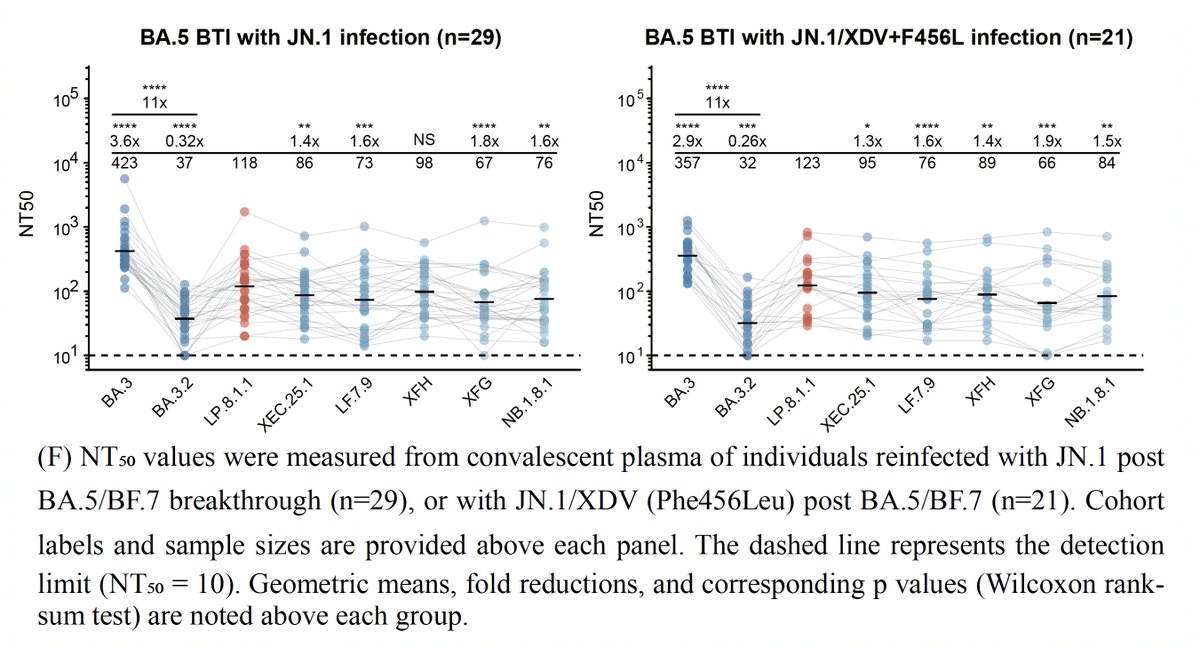
Quick BA.3.2 update. Another BA.3.2.2 (S:K356T+S:A575S branch) from South Africa via pneumonia surveillance.

This means that 40% of SARS-CoV-2 sequences from SA collected since April 1 (2/5) and 50% collected after May 1 (1/2) are BA.3.2. Its foothold seems strong there. 1/3
2 interesting aspects of the new BA.3.2:
1. ORF1b:R1315C (NSP13_R392C)—This mut is in all Omicron *except* BA.3. So this may well be adaptive.

2. S:Q183H—First known antigenic spike mut seen in BA.3.2, not a major one, but one we've seen before—eg, LB.1/JN.1.9.2.1 2/3 Image
I think the unusually long branches in the BA.3.2 tree indicate 2 things:
1. Slow growth globally—fast growth results in many identical sequences, if surveillance is sufficient

2. Undersampling—BA.3.2 most common in poorer world regions with little sequencing of late. 3/3
One quick addendum: I forgot to add that this sequence was from the North West province of South Africa, the 4th one it's been detected in.

And 5 more SA sequences (all pneumonia surveillance) were just uploaded, one another BA.3.2.2, also from North West, May 26 collection.
Since March 1, we have no sequences from the 5 provinces where BA.3.2 has not yet been detected (Northern Cape, Eastern Cape, Free State, Limpopo, Mpumalanga), so it may be established throughout the country.

Zero seqs from surrounding countries. South Africa is our sentinel.

• • •

Missing some Tweet in this thread? You can try to force a refresh

 

Keep Current with Ryan Hisner

Ryan Hisner Profile picture

Stay in touch and get notified when new unrolls are available from this author!

Read all threads

This Thread may be Removed Anytime!

PDF

Twitter may remove this content at anytime! Save it as PDF for later use!

Try unrolling a thread yourself!

how to unroll video
  1. Follow @ThreadReaderApp to mention us!

  2. From a Twitter thread mention us with a keyword "unroll"
@threadreaderapp unroll

Practice here first or read more on our help page!

More from @LongDesertTrain

Jun 29
BA.3.2 update, Chapter: "I'm Not Quite Dead, Sir"

A new sequence from a traveler to the USA from the Netherlands was uploaded yesterday, with a collection date of June 17. 1/10 Image
This was a BA.3.2.1, the branch with S:H681R + S:P1162R (not S:K356T + S:A575S).

An updated, annotated version of the BA.3.2 Usher tree pictured below.

This sequence has the first new spike mutation since BA.3.2 emerged in November 2024—S:V227L. 2/10 Image
It has an extremely rare NSP5 mutation, ORF1a:T3487S (NSP5:T224S), only in 4 of ~17 million SARS-2 seqs

Intriguingly, 3 of these 4 share something in common w/this BA.3.2.

The first—and most remarkable—is a BA.2 from England that, like BA.3.2, has the ORF7ab-ORF8 deletion. 3/10 Image
Read 11 tweets
Jun 27
@yaem98684142 @TBM4_JP This analysis is extremely flawed.

There is nothing abnormal about BA.2.86 appearing in multiple countries shortly after discovery. This has been the norm lately w/reduced surveillance. 1/
@yaem98684142 @TBM4_JP The mutational spectrum analysis is poorly done. It cites a single study looking at the mutational spectrum in *three* immunocompromised individuals. Needless to say, this sample size is WAY too small. 3/
@yaem98684142 @TBM4_JP Furthermore, the IC people examined did not give rise to highly divergent variants with a large number of spike mutations. They appear to have accumulated a very modest number of mutations, with few substitutions in spike. The sequences themselves are apparently not published. 4/
Read 7 tweets
Jun 19
Interesting recombinant showed up today from Texas. It's a mixture of B.1.595, BA.1, and some flavor of JN.1. Most of the genome is from B.1.595. The ancestry of this one is clear: it directly descends from a B.1.595 sequence collected in January 2023, also in Texas. 1/11 Image
When the B.1.595 was collected this infection was >1 yr old, w/no sign of Omicron. BA.1 ceased circulating ~1 year prior.
Now a BA.1 spike appears w/just 5 changes from baseline BA.1, none in the RBD—S12F, T76I, Q271K, R765H, S939F.

This is a zombie BA.1 spike. 2/ Image
There are only a few signs of JN.1, & they're scattered. In ORF1a, we see JN.1's V3593F, P3395H, & R3821K, but the NSP6 deletion btwn these—universal in Omicron—is absent. In
M has JN.1's D3H + T30A & E19Q (in JN.1 & BA.1), yet A63T—also in both BA.1 & JN.1 is absent. 3/11 Image
Read 11 tweets
May 31
An awesome preprint on the novel, unsung SARS-CoV-2 N* protein came out recently, authored by @corcoran_lab & Rory Mulloy. I’ve previously written on N*’s demise in XEC, the top variant in late 2024/early 2025. But…
1/34
…this preprint, along with another great study by the @DavidLVBauer, @theosanderson, @PeacockFlu & others prompted me to take a closer look...
2/34biorxiv.org/content/10.110…
...and for reasons I’ll describe below, I now believe rumors of N*’s death are exaggerated.

First, XEC is in terminal decline, replaced by variants with full N* expression, so N* is back in fashion.
3/34
journals.plos.org/plosbiology/ar…
Read 35 tweets
May 15
@DameSunshine @SharonBurnabyBC B.1.1.529 wasn't/isn't a real variant; it's a placeholder that represents a putative ancestor of BA.1/BA.2/BA.3.

Bad sequences and/or coinfections tend to get categorized as B.1.1.529:—they have enough Omicron muts to be ID'd as Omicron but so much dropout/mixed signals...
1/
@DameSunshine @SharonBurnabyBC ...that a specific designation isn't possible. Travel sequencing in the US is done by Ginkgo Bioworks. Their sequences are generally poor quality & they upload *pooled* sequences—against database guidelines. The B.1.1.529 here are likely low-quality/pooled sequences from GBW.
2/
@DameSunshine @SharonBurnabyBC I think it's entirely possible that a new, divergent variant will emerge this summer. There are hints with BA.3.2 & a 50-spike-mutation BQ.1.1 that has transmitted at least once. Other similar chronic infection-derived variants are undoubtedly lurking all over, unsequenced.... 3/
Read 4 tweets
May 2
Incredible how quickly @yunlong_cao & co provide us w/info on the latest emerging SARS-CoV-2 variants.

Already, we have great data on BA.3.2 (the divergent saltation lineage detected in South Africa & the Netherlands & NB.1.8.1, an emerging contender for global dominance. 1/9 Image
Image
BA.3.2 is a clear outlier on the antigenic cartography map—as expected given the enormous differences between its spike protein & every other circulating variant. 2/9
Image
It's unsurprising, therefore, that BA.3.2 evades antibodies from human sera more effectively than any other variant, though the degree of its superiority is striking. 3/9
biorxiv.org/content/10.110…Image
Read 9 tweets

Did Thread Reader help you today?

Support us! We are indie developers!


This site is made by just two indie developers on a laptop doing marketing, support and development! Read more about the story.

Become a Premium Member ($3/month or $30/year) and get exclusive features!

Become Premium

Don't want to be a Premium member but still want to support us?

Make a small donation by buying us coffee ($5) or help with server cost ($10)

Donate via Paypal

Or Donate anonymously using crypto!

Ethereum

0xfe58350B80634f60Fa6Dc149a72b4DFbc17D341E copy

Bitcoin

3ATGMxNzCUFzxpMCHL5sWSt4DVtS8UqXpi copy

Thank you for your support!

Follow Us!

:(