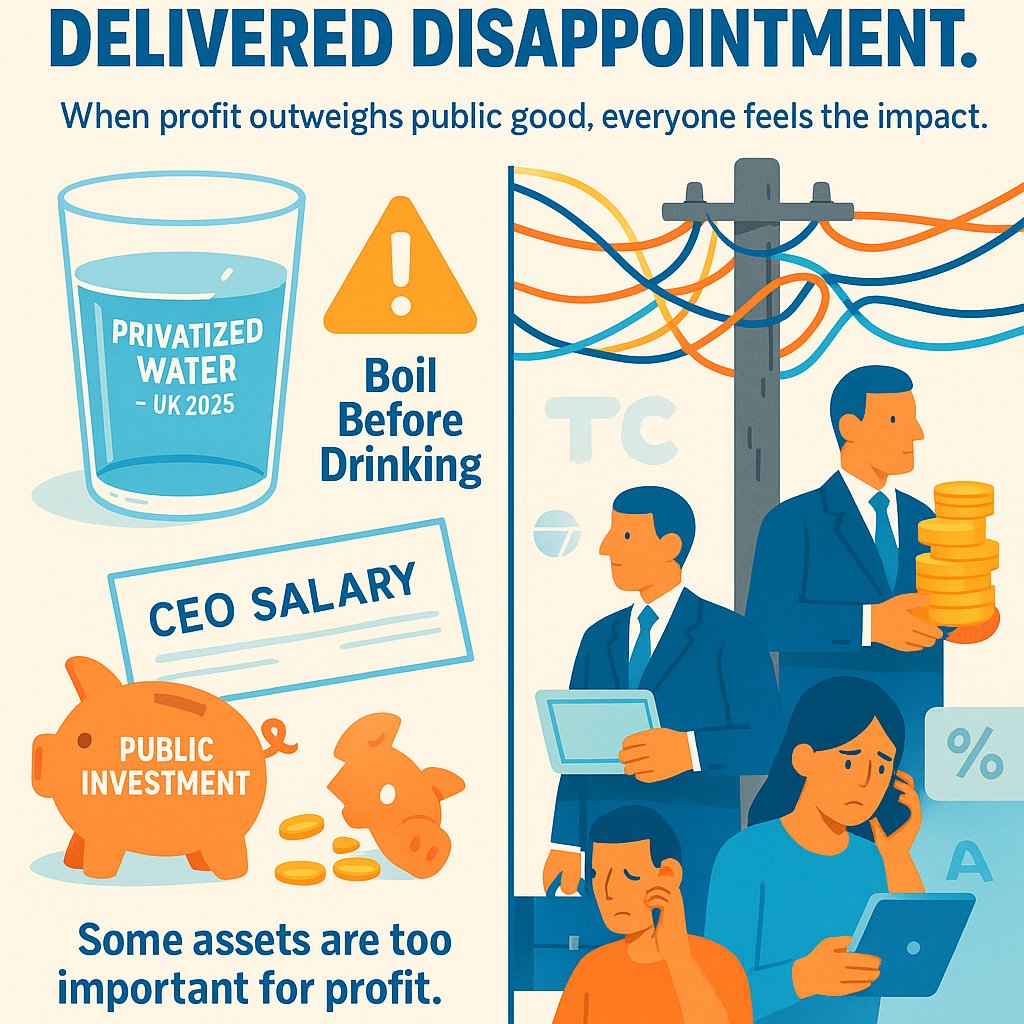
1/ I've documented how 30+ years of privatization promises have turned into economic disasters. The evidence is overwhelming that "competition fixes everything" is a dangerous myth.
4/ Telecommunications "success"? Original monopolists still dominate 40 years later. Telstra in Australia, BT in the UK. Most supposed "competitors" failed spectacularly.
5/ The hidden costs mainstream economists ignore: massive marketing budgets, CEO salary inflation, reduced long-term investment, and system fragmentation.
6/ My analysis shows that many benefits attributed to privatization would have happened anyway through technological advancement and proper public investment.
7/ Some assets should NEVER be privatized: water, power grids, and telecommunications infrastructure. They require long-term thinking, not quarterly profit maximization.
8/ The privatization experiment has failed by its own metrics. Time to admit that markets aren't magic and some services are too important for profit-driven provision.
9/ This connects to my broader critique: policies based on neoclassical theory consistently fail because the theory is fundamentally flawed.
#Privatization #Economics
• • •
Missing some Tweet in this thread? You can try to
force a refresh

1/ After 40+ years in economics, here's my verdict: the discipline is fundamentally broken and needs complete reconstruction.
Here's what real economics should look like.
3/ Real economics must embrace complexity, not equilibrium. My Minsky software shows how to model dynamic, evolving systems rather than static mathematical fantasies.
4/ Financial instability is inherent to capitalism—not an external shock. My work on Minsky's hypothesis predicted 2008 when mainstream models saw stability.
1/8 Trade deficits: Buffett warns they bleed national wealth. Mosler claims they boost real prosperity. Who’s right? My analysis settles this economic cage fight.
2/8 Buffett’s view: A trade deficit = "selling the farm." You exchange assets (bonds, land) for imports today. Over time, foreigners own your capital. Squanderville parable shows how complacency leads to colonization-by-purchase.
3/8 Mosler (MMT) counters: Wealth = your "pile of stuff." Imports grow that pile; exports shrink it. Trade deficits = free goods! Just offset money outflow with government deficits. Simple?
(1/9) Finance YouTubers are screaming Japan will crash the global economy because a municipal bond auction failed. Japan's debt is 250% of GDP, and they think this proves that a collapse is coming.
(2/9) They're confusing city budgets with national budgets—it's like panicking that Samsung will shut down because your local electronics store ran out of Galaxy phones.
(3/9) When your city spends $1000, it takes existing money from someone else's bank account. Money just moves around the neighborhood. No new money gets created.
1/ Did you learn in economics that firms always face rising marginal costs as they produce more? The real world tells a different story.
2/ Empirical research shows most firms operate with constant or even falling marginal costs as output increases. Efficiency often rises as they approach capacity.
3/ Traditional models assume diminishing marginal productivity, but real businesses get more efficient, not less, with scale.