We’re releasing the Artificial Analysis AI Adoption Survey Report for H1 2025 based on >1,000 responses from developers, product managers and executives adopting AI
The Artificial Analysis AI Adoption Survey Report examines key trends in AI usage, analyzing adoption rates, primary use cases driving AI’s growth, and demand across chatbots, coding agents, LLM model families, providers, and chip companies.
A highlights version of the report is available for download on our website for a limited time.
We unpack 6 trends defining the adoption of AI for organizations in the first half of 2025:
1)⚡ AI has hit production: ~45% are using AI in production, while an additional 50% are prototyping or exploring uses with AI
2)💡 Engineering and R&D is the clear frontrunner use case: 66% are considering AI for Engineering/R&D, well ahead of the next most popular use cases in Customer Support and Sales & Marketing
3) 📈 Google, xAI, DeepSeek gain share while Meta and Mistral lose share: ~80% are using/considering Google Gemini, 53% DeepSeek & 31% xAI Grok marking a substantial increase in demand since 2024
4) 🔄 Companies are increasingly diversifying their AI use: Average number of LLMs used/considered has increased from ~2.8 in 2024 to ~4.7 in 2025, as organizations mature their AI use cases
5) 🏗️ Organizations are taking different approaches to Build vs. Buy: 32% of respondents favor building; 27% buying and 25% a hybrid approach
6) 🇨🇳 Organizations are open to Chinese models, if hosted outside of China: 55% would be willing to use LLMs from China-based AI labs, if hosted outside of China
The survey was conducted between April and June 2025, collecting responses from 1,000+ individuals across 90+ countries.
Below we share excerpts covering select important takeaways:
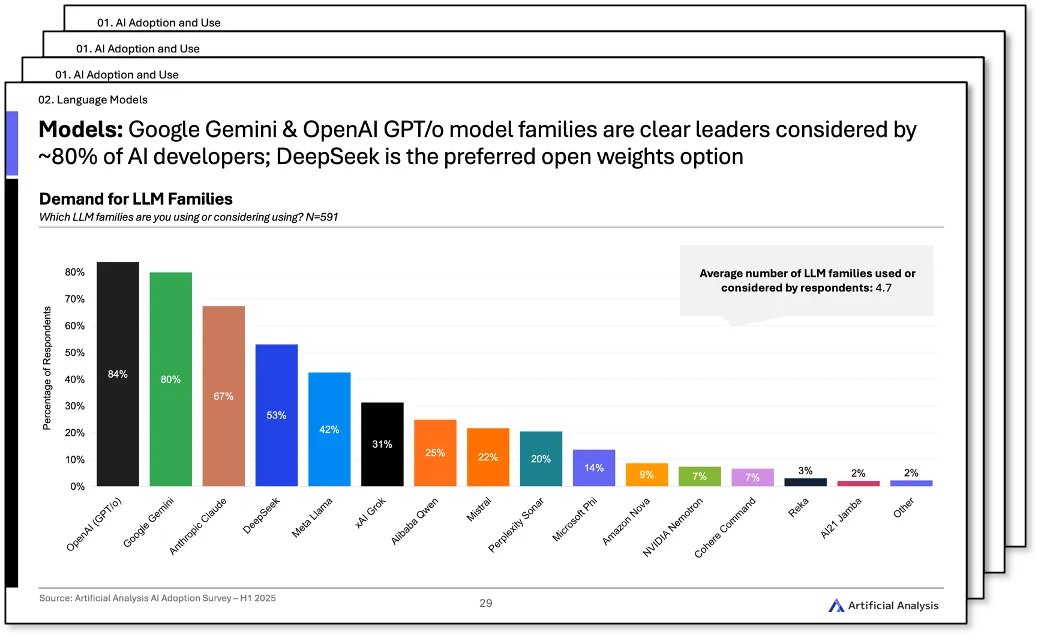
ChatGPT dominates AI chat adoption, followed by Gemini and Claude. Other notable players include Perplexity, xAI Grok and Microsoft Copilot
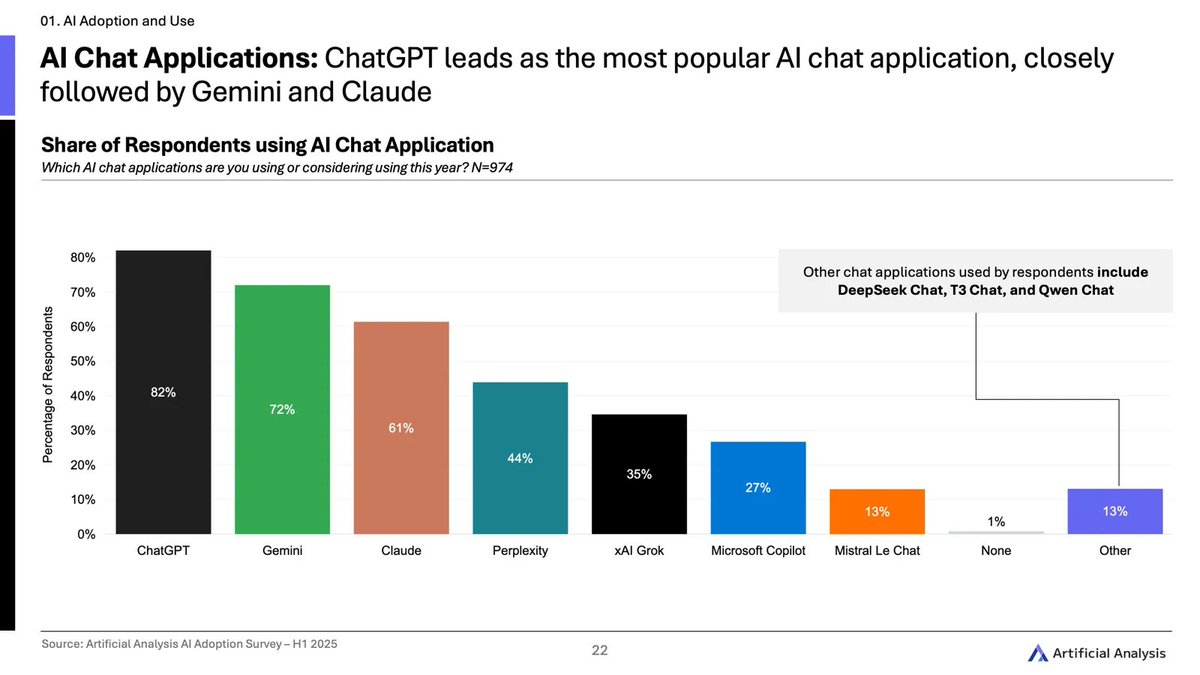
GitHub Copilot and Cursor dominate the market as the most popular AI coding tools, ahead of Claude Code and Gemini Code Assist (Note: the survey was conducted before the release of OpenAI Codex)
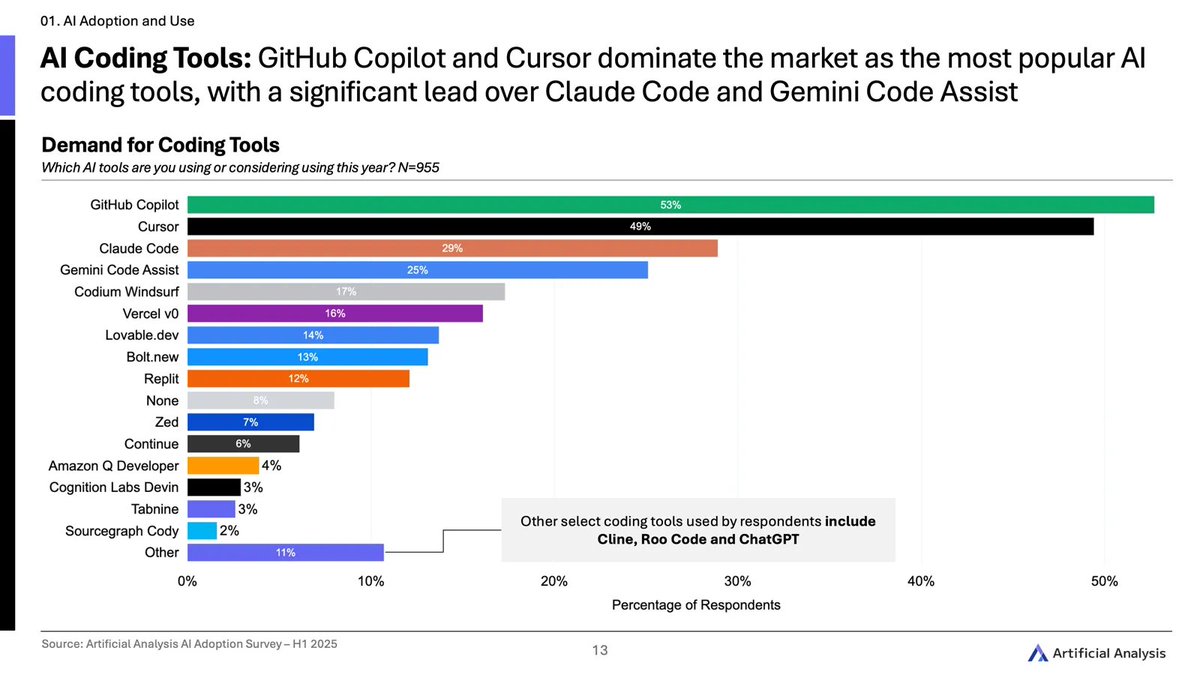
Most orgs will deploy AI in Engineering & R&D before Customer Support, Sales & Marketing, or IT & Cybersecurity; It’s also the top area for AI agent use
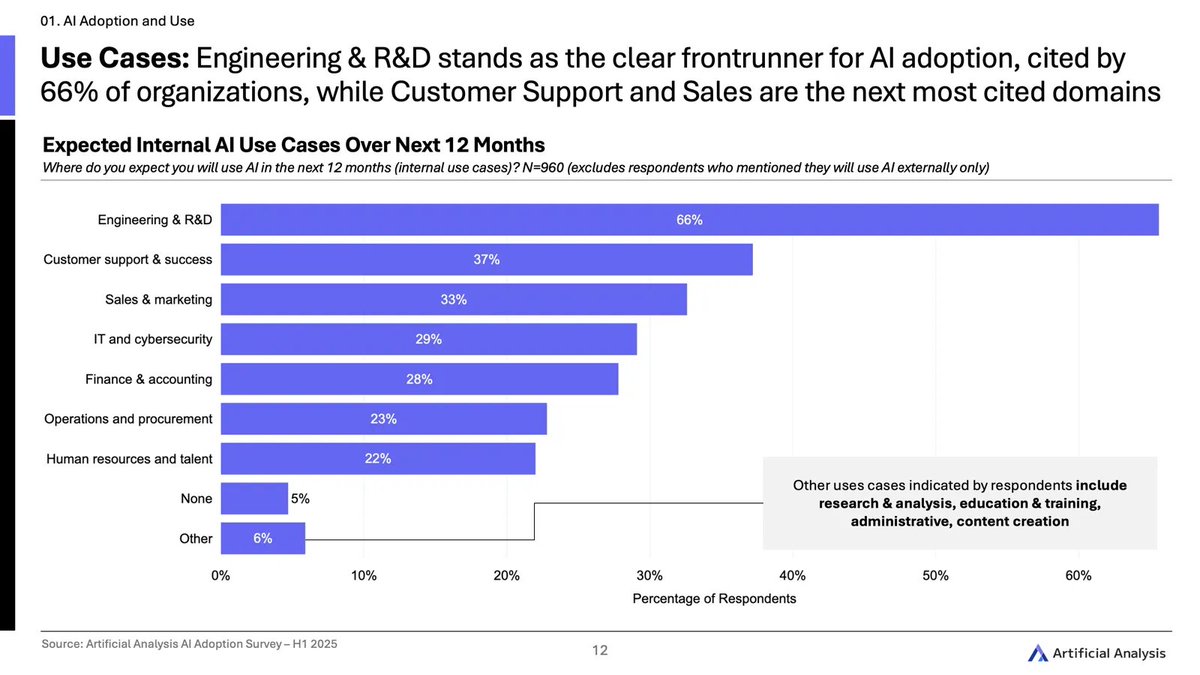
Developers consider an average of 4.7 LLM families with OpenAI GPT/o, Google Gemini and Anthropic Claude being the most popular, and DeepSeek as the top open-weights choice
The highlights version of the report is available for download on our website for a limited time.
Introducing the Artificial Analysis Openness Index: a standardized and independently assessed measure of AI model openness across availability and transparency
Openness is not just the ability to download model weights. It is also licensing, data and methodology - we developed a framework underpinning the Artificial Analysis Openness Index to incorporate these elements. It allows developers, users, and labs to compare across all these aspects of openness on a standardized basis, and brings visibility to labs advancing the open AI ecosystem.
A model with a score of 100 in Openness Index would be open weights and permissively licensed with full training code, pre-training data and post-training data released - allowing users to not just use the model but reproduce its training in full, or take inspiration from some or all of the model creator’s approach to build their own model. We have not yet awarded any models a score of 100!
Key details:
🔒 Few models and providers take a fully open approach. We see a strong and growing ecosystem of open weights models, including leading models from Chinese labs such as Kimi K2, Minimax M2, and DeepSeek V3.2. However, releases of data and methodology are much rarer - OpenAI’s gpt-oss family is a prominent example of open weights and Apache 2.0 licensing, but minimal disclosure otherwise.
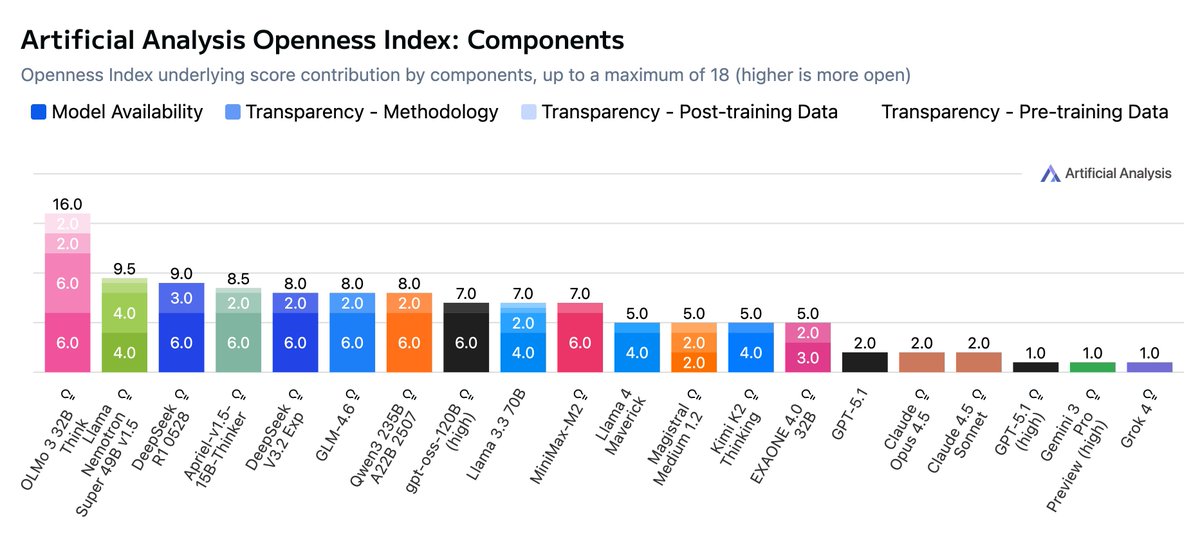
🥇 OLMo from @allen_ai leads the Openness Index at launch. Living up to AI2’s mission to provide ‘truly open’ research, the OLMo family achieves the top score of 89 (16 of a maximum of 18 points) on the Index by prioritizing full replicability and permissive licensing across weights, training data, and code. With the recent launch of OLMo 3, this included the latest version of AI2’s data, utilities and software, full details on reasoning model training, and the new Dolci post-training dataset.
🥈 NVIDIA’s Nemotron family also performs strongly for openness. @NVIDIAAI models such as NVIDIA Nemotron Nano 9B v2 reach a score of 67 on the Index due to their release alongside extensive technical reports detailing their training process, open source tooling for building models like them, and the Nemotron-CC and Nemotron post-training datasets.
📉 We’re tracking both open weights and closed weights models. Openness Index is a new way to think about how open models are, and we will be ranking closed weights models alongside open weights models to recognize the scope of methodology and data transparency associated with closed model releases.
Methodology & Context:
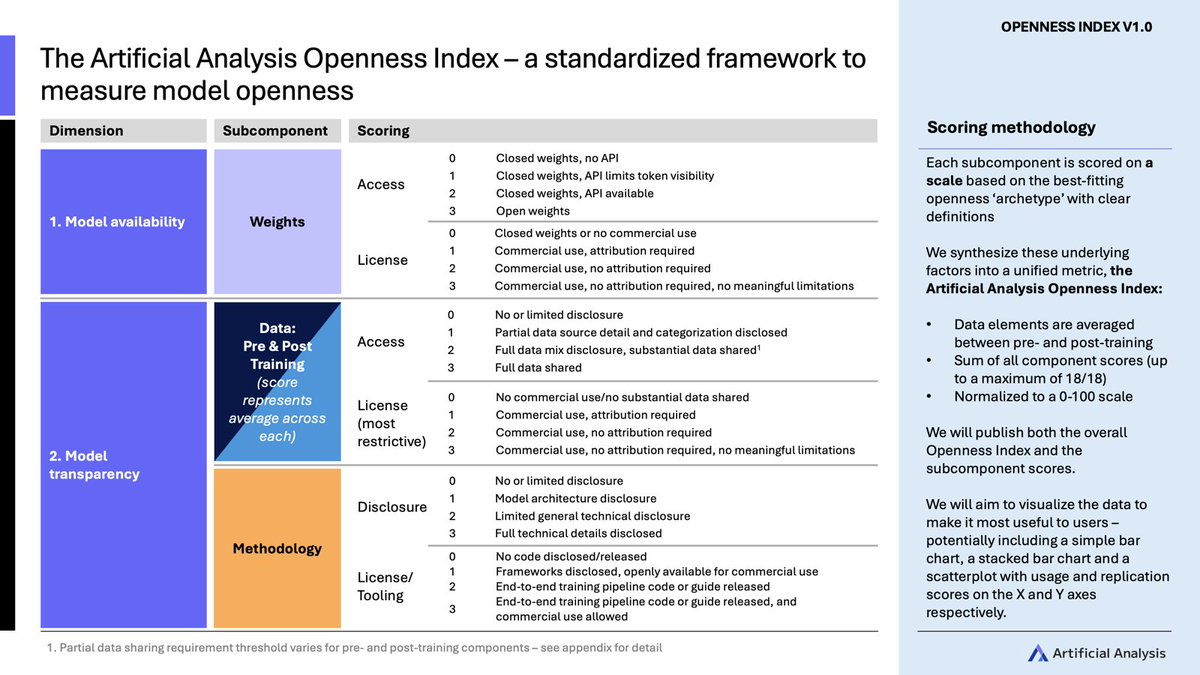
➤ We analyze openness using a standardized framework covering model availability (weights & license) and model transparency (data and methodology). This means we capture not just how freely a model can be used, but visibility into its training and knowledge, and potential to replicate or build on its capabilities or data.
➤ Model availability is measured based on the access and licensing of the model/weights themselves, while transparency comprises subcomponents for access and licensing for methodology, pre-training data, and post-training data.
➤ As seen with releases like DeepSeek R1, sharing methodology accelerates progress. We hope the Index encourages labs to balance competitive moats with the benefits of sharing the "how" alongside the "what."
➤ AI model developers may choose not to fully open their models for a wide range of reasons. We feel strongly that there are important advantages to the open AI ecosystem and supporting the open ecosystem is a key reason we developed the Openness Index. We do not, however, wish to dismiss the legitimacy of the tradeoffs that greater openness comes with, and we do not intend to treat Openness Index as a strictly ‘higher is better’ scale.
See below for further analysis and details 👇
The Openness Index breaks down a total of 18 points across the four subcomponents, and we then represent the overall value on a normalized 0-100 scale. We will continue to review and iterate this framework as the model ecosystem develops and new factors emerge.
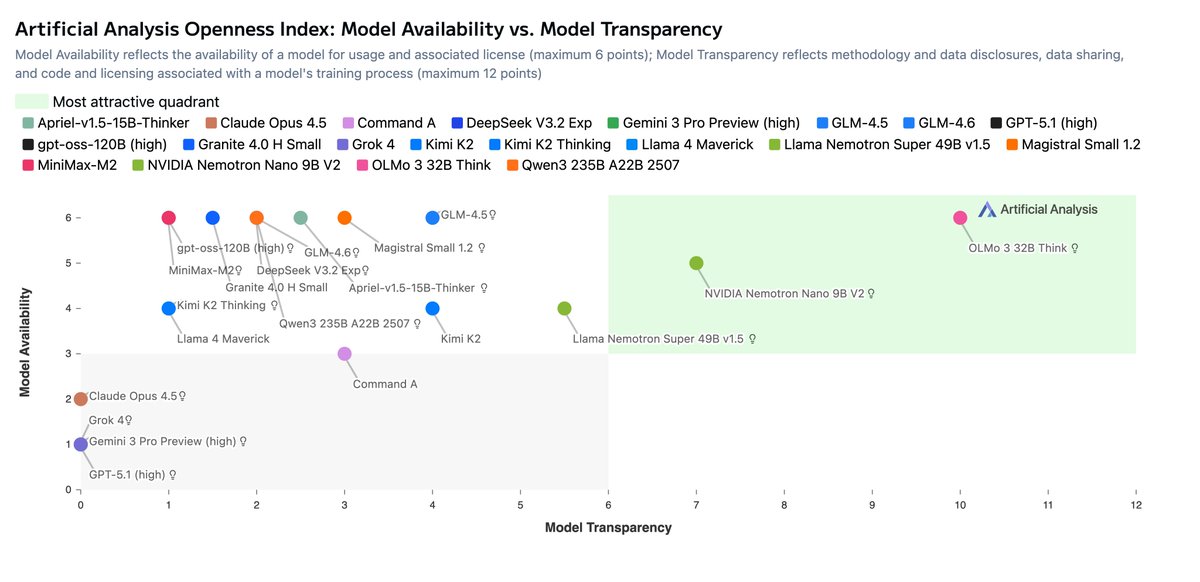
In today’s model landscape, transparency is much rarer than availability. While we see a wide range of models with open weights and permissive licensing, nearly all are clustered in the top left quadrant of the chart with lower-end transparency. This reflects the current state of the ecosystem - many models have open weights, but few have open data or methodologies.
Anthropic’s new Claude Opus 4.5 is the #2 most intelligent model in the Artificial Analysis Intelligence Index, narrowly behind Google’s Gemini 3 Pro and tying OpenAI’s GPT-5.1 (high)
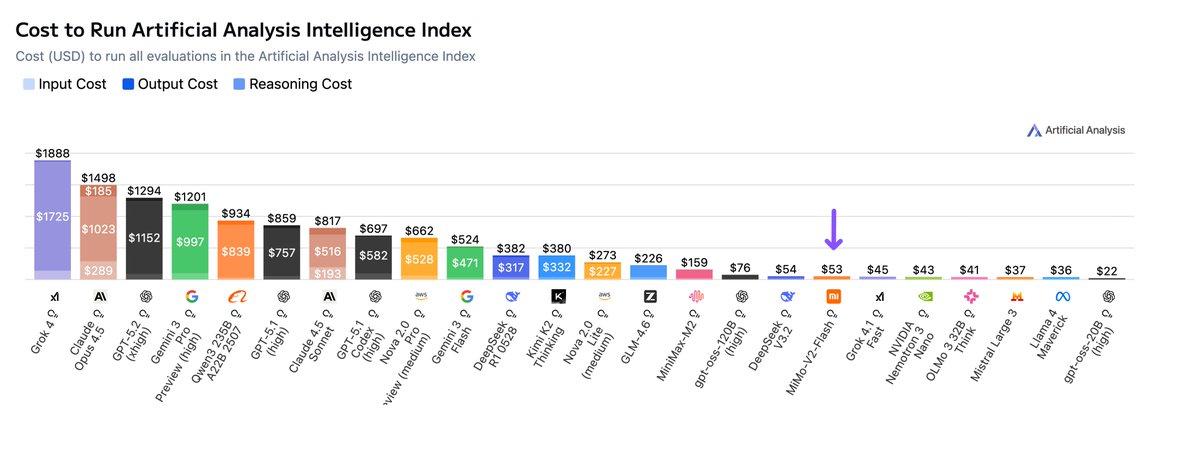
Claude Opus 4.5 delivers a substantial intelligence uplift over Claude Sonnet 4.5 (+7 points on the Artificial Analysis Intelligence Index) and Claude Opus 4.1 (+11 points), establishing it as @AnthropicAI's new leading model. Anthropic has dramatically cut per-token pricing for Claude Opus 4.5 to $5/$25 per million input/output tokens. However, compared to the prior Claude Opus 4.1 model it used 60% more tokens to complete our Intelligence Index evaluations (48M vs. 30M). This translates to a substantial reduction in the cost to run our Intelligence Index evaluations from $3.1k to $1.5k, but not as significant as the headline price cut implies. Despite Claude Opus 4.5 using substantially more tokens to complete our Intelligence Index, the model still cost significantly more than other models including Gemini 3 Pro (high), GPT-5.1 (high), and Claude Sonnet 4.5 (Thinking), and among all models only cost less than Grok 4 (Reasoning).
Key benchmarking takeaways:
➤ 🧠 Anthropic’s most intelligent model: In reasoning mode, Claude Opus 4.5 scores 70 on the Artificial Analysis Intelligence Index. This is a jump of +7 points from Claude Sonnet 4.5 (Thinking), which was released in September 2025, and +11 points from Claude Opus 4.1 (Thinking). Claude Opus 4.5 is now the second most intelligent model. It places ahead of Grok 4 (65) and Kimi K2 Thinking (67), ties GPT-5.1 (high, 70), and trails only Gemini 3 Pro (73). Claude Opus 4.5 (Thinking) scores 5% on CritPt, a frontier physics eval reflective of research assistant capabilities. It sits only behind Gemini 3 Pro (9%) and ties GPT-5.1 (high, 5%)
➤ 📈 Largest increases in coding and agentic tasks: Compared to Claude Sonnet 4.5 (Thinking), the biggest uplifts appear across coding, agentic tasks, and long-context reasoning, including LiveCodeBench (+16 p.p.), Terminal-Bench Hard (+11 p.p.), 𝜏²-Bench Telecom (+12 p.p.), AA-LCR (+8 p.p.), and Humanity's Last Exam (+11 p.p.). Claude Opus achieves Anthropic’s best scores yet across all 10 benchmarks in the Artificial Analysis Intelligence Index. It also earns the highest score on Terminal-Bench Hard (44%) of any model and ties Gemini 3 Pro on MMLU-Pro (90%)
➤ 📚 Knowledge and Hallucination: In our recently launched AA-Omniscience Index, which measures embedded knowledge and hallucination of language models, Claude Opus 4.5 places 2nd with a score of 10. It sits only behind Gemini 3 Pro Preview (13) and ahead of Claude Opus 4.1 (Thinking, 5) and GPT-5.1 (high, 2). Claude Opus 4.5 (Thinking) scores the second-highest accuracy (43%) and has the 4th-lowest hallucination rate (58%), trailing only Claude Haiku (Thinking, 26%), Claude Sonnet 4.5 (Thinking, 48%), and GPT-5.1 (high). Claude Opus 4.5 continues to demonstrate Anthropic’s leadership in AI safety with a lower hallucination rate than select other frontier models such as Grok 4 and Gemini 3 Pro
➤ ⚡ Non-reasoning performance: In non-reasoning mode, Claude Opus 4.5 scores 60 on the Artificial Analysis Intelligence Index and is the most intelligent non-reasoning model. It places ahead of Qwen3 Max (55), Kimi K2 0905 (50), and Claude Sonnet 4.5 (50)
➤ ⚙️ Token efficiency: Anthropic continues to demonstrate impressive token efficiency. It has improved intelligence without a significant increase in token usage (compared to Claude Sonnet 4.5, evaluated with a maximum reasoning budget of 64k tokens). Claude Opus 4.5 uses 48M output tokens to run the Artificial Analysis Intelligence Index. This is lower than other frontier models, such as Gemini 3 Pro (high, 92M), GPT-5.1 (high, 81M), and Grok 4 (Reasoning, 120M)
➤ 💲 Pricing: Anthropic has reduced the per-token pricing of Claude Opus 4.5 compared to Claude Opus 4.1. Claude Opus 4.5 is priced at $5/$25 per 1M input/output tokens (vs. $15/$75 for Claude Opus 4.1). This positions it much closer to Claude Sonnet 4.5 ($3/$15 per 1M tokens) while offering higher intelligence in thinking mode
Key model details:
➤ 📏 Context window: 200K tokens
➤ 🪙 Max output tokens: 64K tokens
➤ 🌐 Availability: Claude Opus 4.5 is available via Anthropic‘s API, Google Vertex, Amazon Bedrock and Microsoft Azure. Claude Opus 4.5 is also available via Claude app and Claude Code
A key differentiator for the Claude models remains that they are substantially more token-efficient than all other reasoning models. Claude Opus 4.5 has significantly increased intelligence without a large increase in output tokens, differing substantially from other model families that rely on greater reasoning at inference time (i.e., more output tokens). On the Output Tokens Used in Artificial Analysis Intelligence Index vs Intelligence Index chart, Claude 4.5 Opus (Thinking) sits on the Pareto frontier.
This output token efficiency contributes to Claude Opus 4.5 (in Thinking mode) offering a better tradeoff between intelligence and cost to run the Artificial Analysis Intelligence Index than Claude Opus 4.1 (Thinking) and Grok 4 (Reasoning).
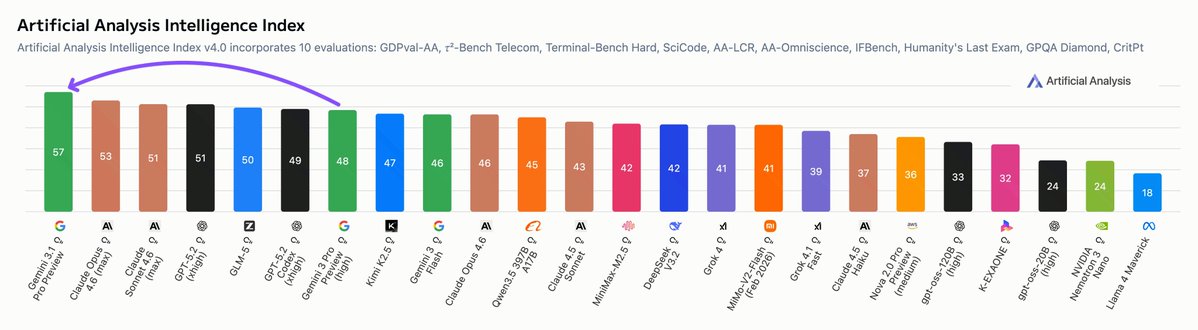
Gemini 3 Pro is the new leader in AI. Google has the leading language model for the first time, with Gemini 3 Pro debuting +3 points above GPT-5.1 in our Artificial Analysis Intelligence Index
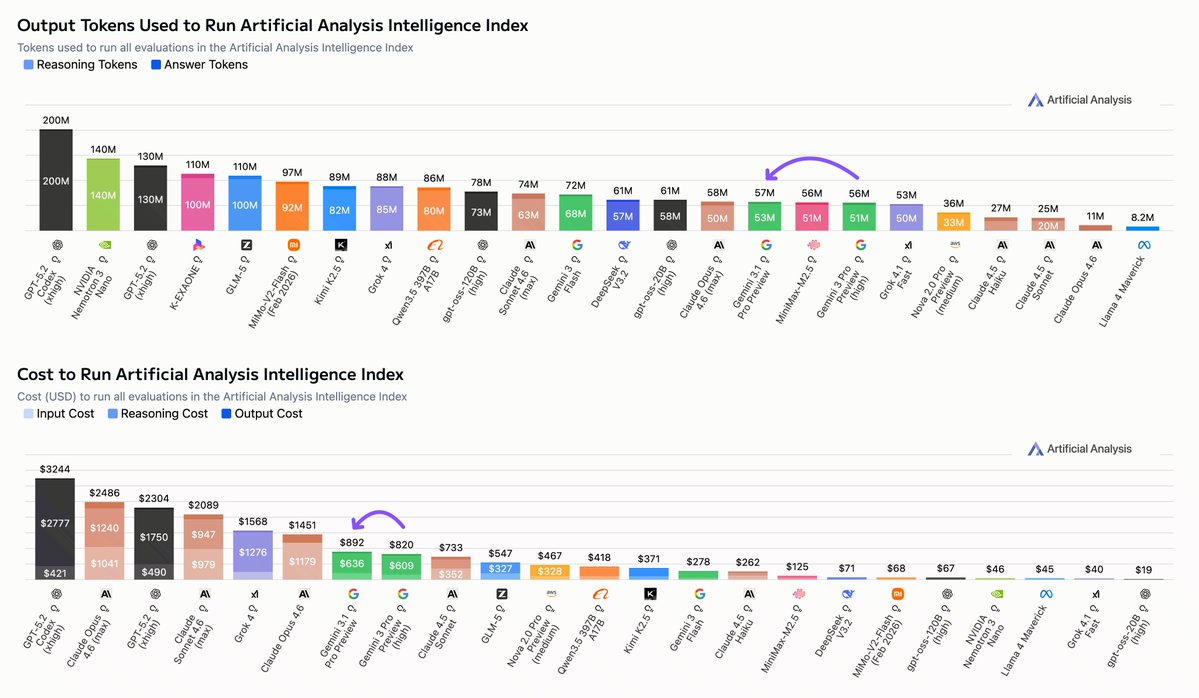
@GoogleDeepMind gave us pre-release access to Gemini 3 Pro Preview. The model outperforms all other models in Artificial Analysis Intelligence Index. It demonstrates strength across the board, coming in first in 5 of the 10 evaluations that make up Intelligence Index. Despite these intelligence gains, Gemini 3 Pro Preview shows improved token efficiency from Gemini 2.5 Pro, using significantly fewer tokens on the Intelligence Index than other leading models such as Kimi K2 Thinking and Grok 4. However, given its premium pricing ($2/$12 per million input/output tokens for <200K context), Gemini 3 Pro is among the most expensive models to run our Intelligence Index evaluations.
Key takeaways:
📖 Leading intelligence: Gemini 3 Pro Preview is the leading model in 5 of 10 evals in the Artificial Analysis Intelligence Index, including GPQA Diamond, MMLU-Pro, HLE, LiveCodeBench and SciCode. Its score of 37% on Humanity’s Last Exam is particularly impressive, improving on the previous best model by more than 10 percentage points. It also is leading in AA-Omniscience, Artificial Analysis’ new knowledge and hallucination evaluation, coming first in both Omniscience Index (our lead metric that takes off points for incorrect answers) and Omniscience Accuracy (percentage correct). Given that factual recall correlates closely with model size, this may point to Gemini 3 Pro being a much larger model than its competitors
💻 Advanced coding and agentic capabilities: Gemini 3 Pro Preview leads two of the three coding evaluations in the Artificial Analysis Intelligence Index, including an impressive 56% in SciCode, an improvement of over 10 percentage points from the previous highest score. It is also strong in agentic contexts, achieving the second highest score in Terminal-Bench Hard and Tau2-Bench Telecom
🖼️ Multimodal capabilities: Gemini 3 Pro Preview is a multi-modal model, with the ability to take text, images, video and audio as input. It scores the highest of any model on MMMU-Pro, a benchmark that tests reasoning abilities with image inputs. Google now occupies the first, third and fourth position in our MMMU-Pro leaderboard (with GPT-5.1 taking out second place just last week)
💲Premium Pricing: To measure cost, we report Cost to Run the Artificial Analysis Intelligence Index, which combines input and output token prices with token efficiency to reflect true usage cost. Despite the improvement in token efficiency from Gemini 2.5 Pro, Gemini 3 Pro Preview costs more to run. Its higher token pricing of $2/$12 USD per million input/output tokens (≤200k token context) results in a 12% increase in the cost to run the Artificial Analysis Intelligence Index compared to its predecessor, and the model is among the most expensive to run on our Intelligence Index. Google also continues to price long context workloads higher than lower context workloads, charging $4/$18 per million input/output tokens for ≥200k token context.
⚡ Speed: Gemini 3 Pro Preview has comparable speeds to Gemini 2.5 Pro, with 128 output tokens per second. This places it ahead of other frontier models including GPT-5.1 (high), Kimi K2 Thinking and Grok 4. This is potentially supported by Google’s first-party TPU accelerators
Other details: Gemini 3 Pro Preview has a 1 million token context window, and includes support for tool calling, structured outputs, and JSON mode
See below for further analysis
For the first time, Google has the most intelligent model, with Gemini 3 Pro Preview improving on the previous most intelligent model, OpenAI’s GPT-5.1 (high), by 3 points
Gemini 3 Pro Preview takes the top spot on the Artificial Analysis Omniscience Index, our new benchmark for measuring knowledge and hallucination across domains. Gemini 3 Pro Preview comes in first for both Omniscience Index (our lead metric that takes off points for incorrect answers) and Omniscience Accuracy (percentage correct).
Its win in Accuracy is actually much larger than than its overall Index win - this is driven by a higher Hallucination Rate than other models (88%).
We have previously shown that Omniscience Accuracy is closely correlated with model size (total parameter count). Gemini 3 Pro’s significant lead in this metric may point to it being a much larger model than its competitors.
Announcing AA-Omniscience, our new benchmark for knowledge and hallucination across >40 topics, where all but three models are more likely to hallucinate than give a correct answer
Embedded knowledge in language models is important for many real world use cases. Without knowledge, models make incorrect assumptions and are limited in their ability to operate in real world contexts. Tools like web search can support but models need to know what to search for (e.g. models should not search for ‘Multi Client Persistence’ for an MCP query when it clearly refers to ‘Model Context Protocol’).
Hallucination of factual information is a barrier to being able to rely on models and has been perpetuated by every major evaluation dataset. Grading correct answers with no penalty for incorrect answers creates an incentive for models (and the labs training them) to attempt every question. This problem is clearest when it comes to knowledge: factual information should never be made up, while in other contexts attempts that might not work are useful (e.g. coding new features).
Omniscience Index is the the key metric we report for AA-Omniscience, and it punishes hallucinations by deducting points where models have guessed over admitting they do not know the answer. AA-Omniscience shows that all but three models are more likely to hallucinate than provide a correct answer when given a difficult question. AA-Omniscience will complement the Artificial Analysis Intelligence Index to incorporate measurement of knowledge and probability of hallucination.
Details below, and more charts in the thread.
AA-Omniscience details:
- 🔢6,000 questions across 42 topics within 6 domains (’Business’, ‘Humanities & Social Sciences’, ‘Health’, ‘Law’, ‘Software Engineering’, and ‘Science, Engineering & Mathematics’)
- 🔍 89 sub-topics including Python data libraries, Public Policy, Taxation, and more, giving a sharper view of where models excel and where they fall short across nuanced domains
- 🔄 Incorrect answers are penalized in our Knowledge Reliability Index metrics to punish hallucinations
- 📊3 Metrics: Accuracy (% correct), Hallucination rate (% incorrect of incorrect/abstentions), Omniscience Index (+1 for correct, -1 for incorrect where answered, 0 for abstentions where the model did not try to answer)
- 🤗 Open source test dataset: We’re open sourcing 600 questions (10%) to support labs develop factual and reliable models. Topic distribution and model performance follows the full set (@huggingface link below)
- 📃 Paper: See below for a link to the research paper
Key findings:
- 🥇 Claude 4.1 Opus takes first place in Omniscience Index, followed by last week’s GPT-5.1 and Grok 4: Even the best frontier models score only slightly above 0, meaning they produce correct answers on the difficult questions that make up AA-Omniscience only marginally more often than incorrect ones. @AnthropicAI’s leadership is driven by low hallucination rate, whereas OpenAI and xAI’s positions are primarily driven by higher accuracy (percentage correct).
- 🥇 xAI’s Grok 4 takes first place in Omniscience Accuracy (our simple ‘percentage correct’ metric), followed by GPT-5 and Gemini 2.5 Pro: @xai's win may be enabled by scaling total parameters and pre-training compute: @elonmusk revealed last week that Grok 4 has 3 trillion total parameters, which may be larger than GPT-5 and other proprietary models
- 🥇 Claude sweeps the hallucination leaderboard: Anthropic takes the top three spots for lowest hallucination rate, with Claude 4.5 Haiku leading at 28%, over three times lower than GPT-5 (high) and Gemini 2.5 Pro. Claude 4.5 Sonnet and Claude 4.1 Opus follow in second and third at 48%
- 💭 High knowledge does not guarantee low hallucination: Hallucination rate measures how often a model guesses when it lacks the required knowledge. Models with the highest accuracy, including the GPT-5 models and Gemini 2.5 Pro, do not lead the Omniscience Index due to their tendency to guess over abstaining. Anthropic models tend to manage uncertainty better, with Claude 4.5 Haiku achieving the lowest hallucination rate at 26%, ahead of 4.5 Sonnet and 4.1 Opus (48%)
- 📊 Models vary by domain: Models differ in their performance across the six domains of AA-Omniscience - no model dominates across all. While Anthropic’s Claude 4.1 Opus leads in Law, Software Engineering, and Humanities & Social Sciences, GPT-5.1 from @OpenAI achieves the highest reliability on Business questions, and xAI’s Grok 4 performs best in Health and in Science, Engineering & Mathematics. Model choice should align with the the use case rather than choosing the overall leader
- 📈 Larger models score higher on accuracy, but not always reliability: Larger models tend to have higher levels of embedded knowledge, with Kimi K2 Thinking and DeepSeek R1 (0528) topping accuracy charts over smaller models. This advantage does not always hold on the Omniscience Index. For example, Llama 3.1 405B from @AIatMeta beats larger Kimi K2 variants due to having one of the lowest hallucination rates among models (51%)
Grok 4 by @xai, GPT-5 by @OpenAI and Gemini 2.5 Pro by @GoogleDeepMind achieve the highest accuracy in AA-Omniscience. The reason they do not achieve the highest Omniscience Index due to the low hallucination rates of @AnthropicAI’s Claude models
@AnthropicAI takes the top three spots for lowest hallucination rate, with Claude 4.5 Haiku leading at 28%, over three times lower than GPT-5 (high) and Gemini 2.5 Pro. Claude 4.5 Sonnet and Claude 4.1 Opus follow in second and third at 48%
Inworld TTS 1 Max is the new leader on the Artificial Analysis Speech Arena Leaderboard, surpassing MiniMax’s Speech-02 series and OpenAI’s TTS-1 series
The Artificial Analysis Speech Arena ranks leading Text to Speech models based on human preferences. In the arena, users compare two pieces of generated speech side by side and select their preferred output without knowing which models created them. The speech arena includes prompts across four real-world categories of prompts: Customer Service, Knowledge Sharing, Digital Assistants, and Entertainment.
Inworld TTS 1 Max and Inworld TTS 1 both support 12 languages including English, Spanish, French, Korean, and Chinese, and voice cloning from 2-15 seconds of audio. Inworld TTS 1 processes ~153 characters per second of generation time on average, with the larger model, Inworld TTS 1 Max processing ~69 characters on average. Both models also support voice tags, allowing users to add emotion, delivery style, and non-verbal sounds, such as “whispering”, “cough”, and “surprised”.
Both TTS-1 and TTS-1-Max are transformer-based, autoregressive models employing LLaMA-3.2-1B and LLaMA-3.1-8B respectively as their SpeechLM backbones.
See the leading models in the Speech Arena, and listen to sample clips below 🎧
Sample prompt on Inworld TTS 1 Max: “Your gut microbiome contains trillions of bacteria that influence digestion, immunity, and even mental health through the gut-brain axis.”
Inworld TTS 1 processes ~153 characters per second of generation time on average, with Inworld TTS 1 Max processing ~69 characters on average.
IBM has launched Granite 4.0 - a new family of open weights language models ranging in size from 3B to 32B. Artificial Analysis was provided pre-release access, and our benchmarking shows Granite 4.0 H Small (32B/9B total/active parameters) scoring an Intelligence Index of 23, with a particular strength in token efficiency
Today IBM released four new models: Granite 4.0 H Small (32B/9B total/active parameters), Granite 4.0 H Tiny (7B/1B), Granite 4.0 H Micro (3B/3B) and Granite 4.0 Micro (3B/3B). We evaluated Granite 4.0 Small (in non-reasoning mode) and Granite 4.0 Micro using the Artificial Analysis Intelligence Index. Granite 4.0 models combine a small amount of standard transformer-style attention layers with a majority of Mamba layers which claims to reduce memory requirements without impacting performance
Key benchmarking takeaways:
➤🧠 Granite 4.0 H Small Intelligence: In non-reasoning, Granite 4.0 H Small scores 23 on the Artificial Analysis Intelligence index - a jump of +8 points on the Index compared to IBM Granite 3.3 8B (Non Reasoning). Granite 4.0 H Small places ahead of Gemma 3 27B (22) but behind Mistral Small 3.2 (29), EXAONE 4.0 32B (Non-Reasoning, 30) and Qwen3 30B A3B 2507 (Non-Reasoning, 37) in intelligence
➤⚡ Granite 4.0 Micro Intelligence: On the Artificial Analysis Intelligence Index, Granite 4.0 Micro scores 16. It places ahead of Gemma 3 4B (15) and LFM 2 2.6B (12).
➤⚙️ Token efficiency: Granite 4.0 H Small and Micro demonstrate impressive token efficiency - Granite 4.0 Small uses 5.2M, while Granite 4.0 Micro uses 6.7M tokens to run the Artificial Analysis Intelligence Index. Both models fewer tokens than Granite 3.3 8B (Non-Reasoning) and most other open weights non-reasoning models smaller than 40B total parameters (except Qwen3 0.6B which uses 1.9M output tokens)
Granite 4.0 H Small’s (Non Reasoning) output token efficiency and per token pricing offers a compelling tradeoff between intelligence and Cost to Run Artificial Analysis Intelligence Index
In the category of Open Weights Non-Reasoning models smaller than 40B total parameters, Granite 4.0 H Small is on the frontier tradeoff between intelligence and Output Tokens Used in Artificial Analysis Intelligence Index