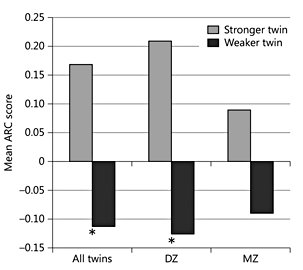
Stronger legs are associated with larger brain volume & slower cognitive decline.
🧵1/7
These findings are from a study in @KargerPublisher which tested whether muscle fitness (measured by leg power) could predict cognitive change in a healthy older population over a 10-year time interval. 2/7 karger.com/ger/article/62…

There is consistent evidence from observational studies of a protective association between levels of physical activity and subsequent cognitive ageing within the healthy population. 3/7
In this study, there was consistent and strong evidence that increased leg power at baseline was associated with improved cognitive ageing over the following 10 years. 4/7
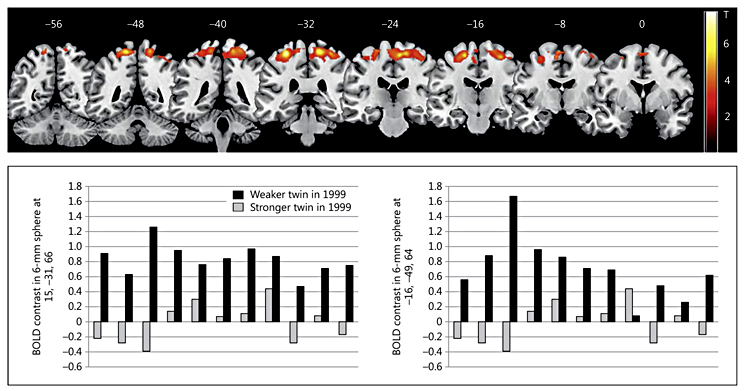
In addition, in a discordant twin study, increased leg power within twin pairs was associated with greater grey matter volumes and greater task-related BOLD activation after 12 years. 5/7
Adjustment for baseline leg power significantly reduced the relationship between grey matter and cognitive change, suggesting that prior physical power and global grey matter volume may be on the same causal pathway affecting cognitive ageing. 6/7
Overall, interventions targeted to improve leg power in the long term may help reach a universal goal of healthy cognitive ageing. 7/7
• • •
Missing some Tweet in this thread? You can try to
force a refresh

A common belief is that cognition arises from the brain.
This paper suggests that cognition is a complex multiscale information processing distributed across every single cell in the body.
🧵1/10
These findings are from a paper in @FrontNeurosci which argues that a promising way forward in understanding the nature of human cognition is to zoom out from the prevailing picture focusing on its neural basis. 2/10 frontiersin.org/journals/integ…
The idea that the mind is distinct from the body and somehow at home in the human brain has deep roots in a longstanding philosophical and scientific thinking, stretching from antiquity to the present day. 3/10
People with schizophrenia die 20 years prematurely, largely due to cardiovascular factors.
It’s time we incorporate exercise as a first-line treatment.
🧵1/12
These findings are from our paper in @jpahjournal which outlines practical strategies for exercise professionals and clinicians involved in the treatment of schizophrenia, informed by the latest evidence, to help prescribe exercise effectively. 2/12journals.humankinetics.com/view/journals/…
Schizophrenia is a chronic and disabling psychiatric disorder that affects approximately 1% of people. 3/12
Dark chocolate enhances cognitive function & releases nerve growth factors.
🧵1/9
These findings are from a study in @Nutrients_MDPI which aimed to determine the effects of the subchronic consumption of dark chocolate on cognitive function and neurotrophins. 2/9 mdpi.com/2072-6643/11/1…
During the last decade, several studies have demonstrated that cacao-containing foods such as chocolate and cocoa may have beneficial effects on human health. 3/9
These findings are from a study in @Nature which profiled the molecular responses in >2 million nuclei from the prefrontal cortex of 111 human brains, collected post-mortem from individuals with and without PTSD and major depressive disorder. 2/10 nature.com/articles/s4158…
Post-traumatic stress disorder (PTSD) is a common mental health disorder that occurs in the aftermath of serious trauma. 3/10
Higher consumption of ultra-processed foods is associated with cognitive decline.
🧵1/10
These findings are from a study in @JAMANeuro which aimed to investigate the association between ultra-processed food (UPF) consumption and cognitive decline. 2/10 jamanetwork.com/journals/jaman…
The food supply industries have increased the commercialization UPFs; such UPFs are formulations of processed food substances that contain little or no whole foods and typically include flavorings, colorings, emulsifiers, and other additives. 3/10
Screen time is associated with depressive symptoms - likely mediated by shorter sleep & worse white matter organization.
🧵1/8
These findings are from a study in @JAMAPsych which aimed to identify the association between screen time during late childhood and depressive symptoms in early adolescence. 2/8 jamanetwork.com/journals/jamap…
During adolescence, major sleep-circadian changes contribute to a delayed sleep phase; this makes adolescents vulnerable to external influences, such as screen time, which can result in insufficient sleep and poor sleep quality. 3/8