Dividendology Profile picture
Jul 18, 2025 7 tweets 3 min read Read on X
Hartford Funds recently conducted one of the most in-depth research studies on dividend stocks over the last 94 years.

The results will blow your mind.

Here is what they found: 👇
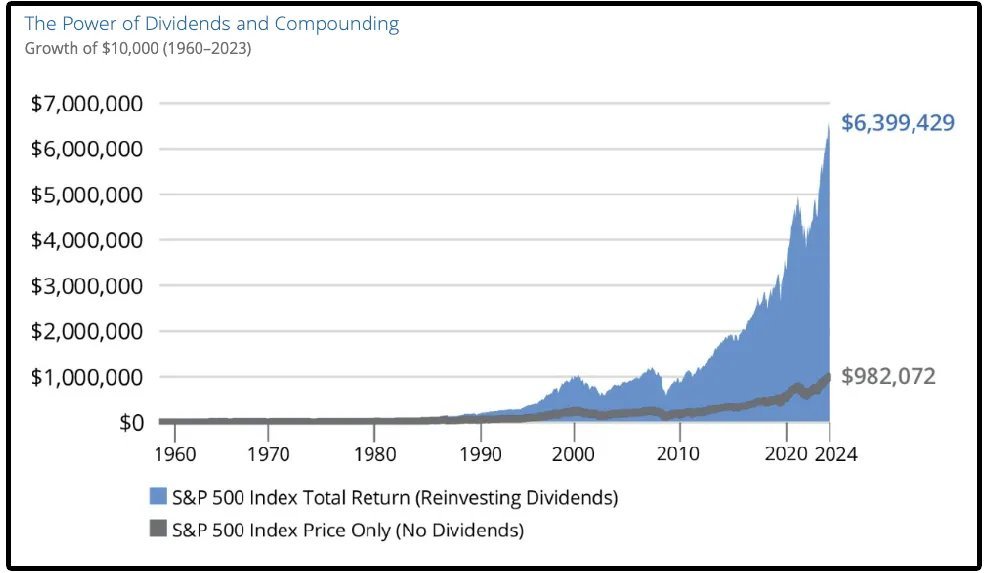
1. Since 1960, staggering 85% of the S&P 500's cumulative return has come from reinvested dividends and the power of compounding.

$10,000 invested in the S&P 500 in 1960 without reinvesting dividends?

Turned into $982,072.

$10,000 invested in the S&P 500 in 1960 while reinvesting dividends?

Turned into $6,399,429.Image
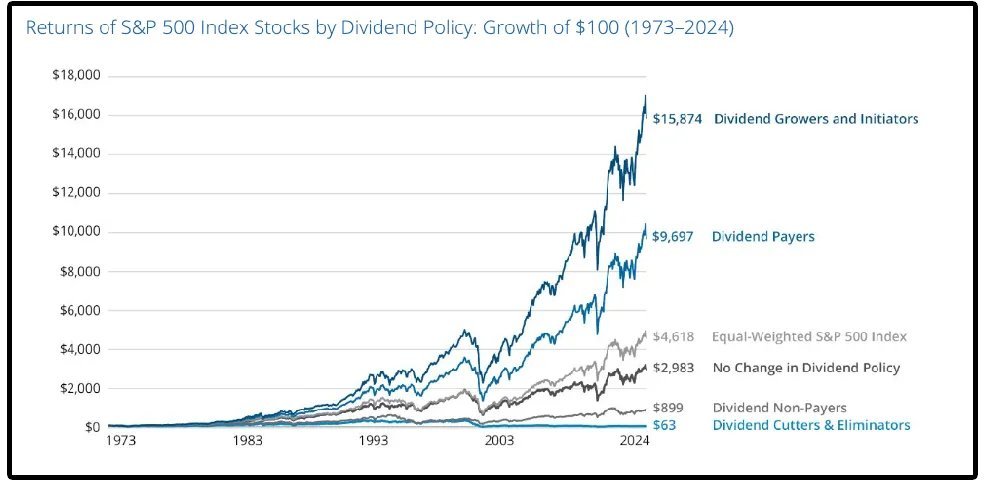
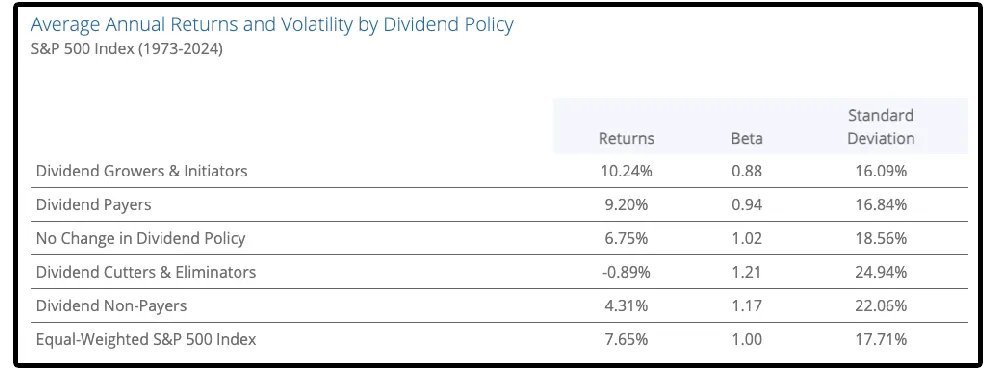
2. From 1973 to 2024, companies that grew or initiated dividends produced the highest total returns (10.2%/year).

Why would this be the case?

Think about what a stock growing its dividend often means:

- Cash flow can cover the dividend
- Management is confident earnings will continue to grow in the future
- It forces management to focus on the highest ROI projects
- Management is focused on long term objectives

Remember: Dividend growth and share price appreciation are byproducts of free cash flow growth.Image
3. Not only have dividend growth stocks provided better historical returns-

They have also been less volatile. (Lower beta and lower standard deviation) Image
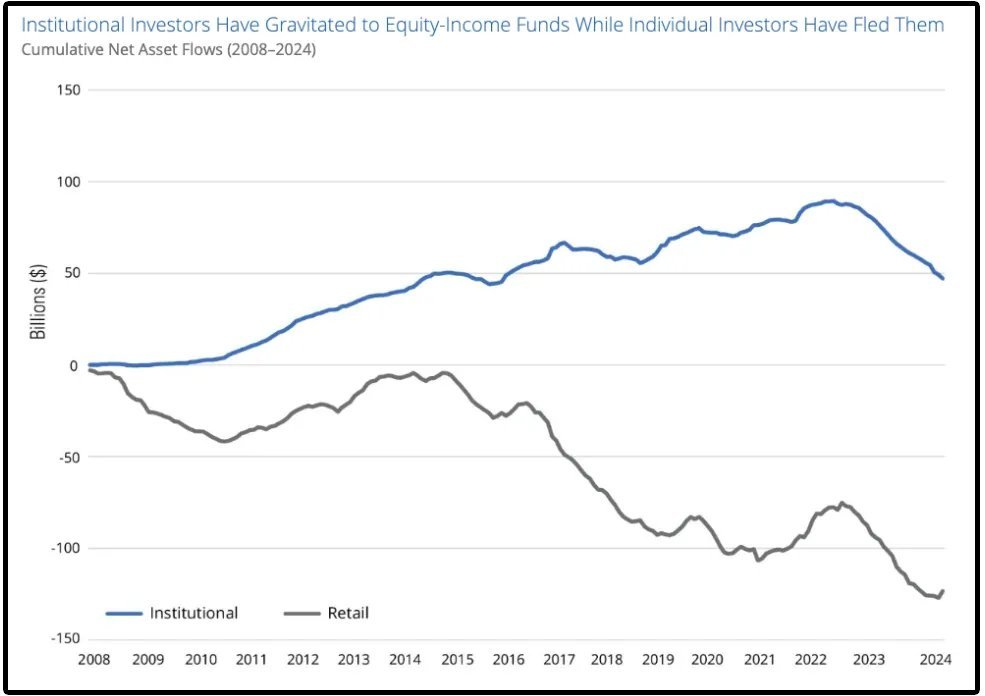
4. Since the Global Financial Crisis, there’s been a striking divergence between institutional and retail investors when it comes to income strategies.

Institutional investors have poured nearly $47 billion into equity-income funds since 2008.

Meanwhile, retail investors have pulled out nearly $123 billion from those same funds over that same time frame.

Are institutions ahead of the curve?Image
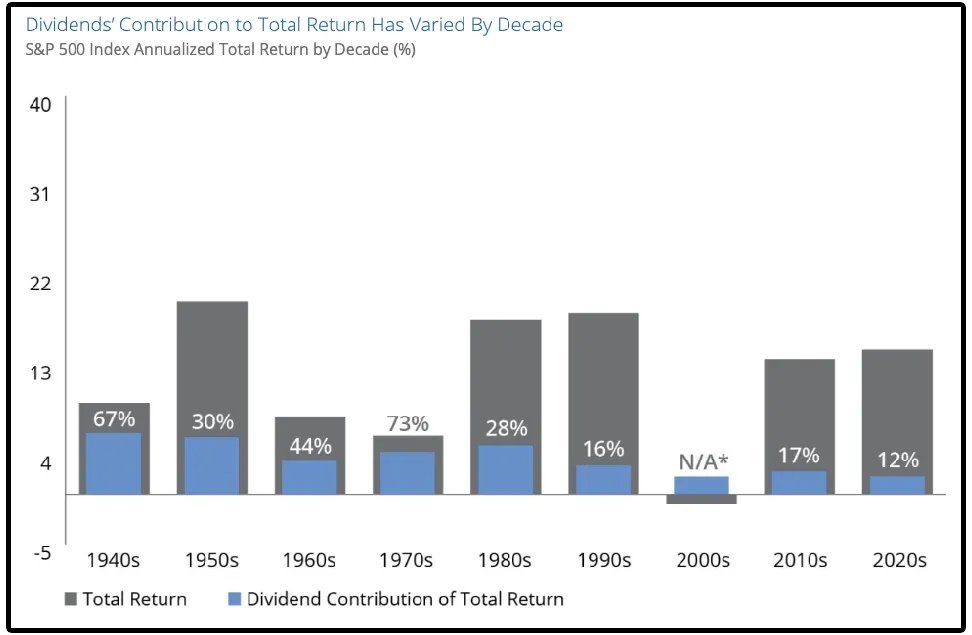
5. From 1940–2024, dividend’s contribution to the total return of the S&P 500 Index averaged 34%.

In the 1940s and 1970s, dividends accounted for over 60% of the total returns.

And in the 2000’s… The S&P 500 had negative returns.

Dividends were the only source of positive return that decade.

That’s exactly why living off dividends can help protect retirees from sequence of return risk.Image
If you want to read more, you can do so here: dividendology.com/p/the-truth-ab…

• • •

Missing some Tweet in this thread? You can try to force a refresh

 

Keep Current with Dividendology

Dividendology Profile picture

Stay in touch and get notified when new unrolls are available from this author!

Read all threads

This Thread may be Removed Anytime!

PDF

Twitter may remove this content at anytime! Save it as PDF for later use!

Try unrolling a thread yourself!

how to unroll video
  1. Follow @ThreadReaderApp to mention us!

  2. From a Twitter thread mention us with a keyword "unroll"
@threadreaderapp unroll

Practice here first or read more on our help page!

More from @dividendology

Feb 6
🧵 THREAD: High Yield ≠ High Risk

The issue?

Most investors have no idea how to assess the dividend sustainability of high yield assets.

Today, we will review the 5 major high yield asset classes, and how to analyze their dividends.
The 5 major high-yield asset classes:

💰 Covered Call ETFs
🛢️ MLPs
🏢 REITs
💼 BDCs
🧾 Preferred Shares

Each one requires a different framework to assess dividend sustainability.

Let's start with covered call ETFs:
1️⃣ Covered Call ETFs

Example: $ICAP
Current yield: ~8.5%

Many high-yield ETFs quietly liquidate themselves to fund payouts.

That’s extremely dangerous.

Why? Image
Read 14 tweets
Jan 16
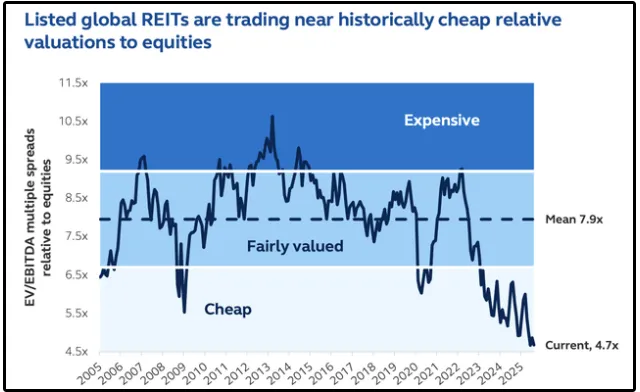
REITs are currently trading at their lowest valuations in decades.

the vast majority of investors are not positioned to take advantage of this historic opportunity.

🧵Here's a 'Mini Masterclass' on how to take advantage: Image
Sentiment surrounding REITs right now is incredibly low.

Go on to any social media platform of your choice, and you’ll quickly find that investors are writing off REITs as a ‘perpetually underperforming asset class’.

To be fair, it’s easy to see why they would come to this conclusion…

If you only look at their performance over the last three years.Image
Investors are notoriously short sighted.

And it’s a large reason why they so often underperform the market over prolonged periods of time.

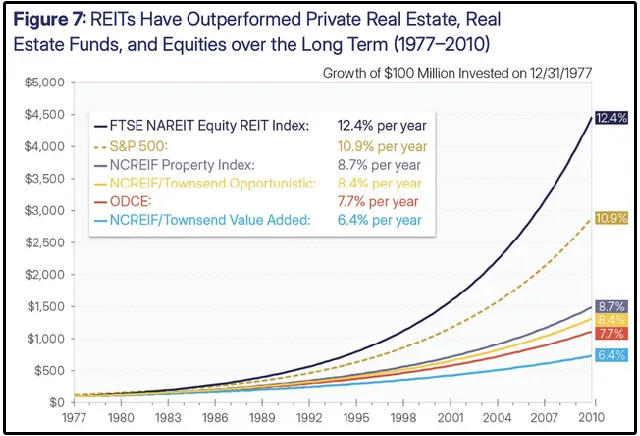
If we look at REITs performance over a 30+ year time horizon, we see dramatically different results. Image
Read 19 tweets
Dec 31, 2025
Warren Buffett has been investing in 1944!

Today was his last day as head of Berkshire Hathaway, 81 years later.

Here are 7 clips of Warren Buffett's greatest investing wisdom:
1. Warren Buffett on Buying Stocks with a MOAT:
2. Warren Buffett brilliantly explains a Discounted Cash Flow Analysis:
Read 9 tweets
Dec 15, 2025
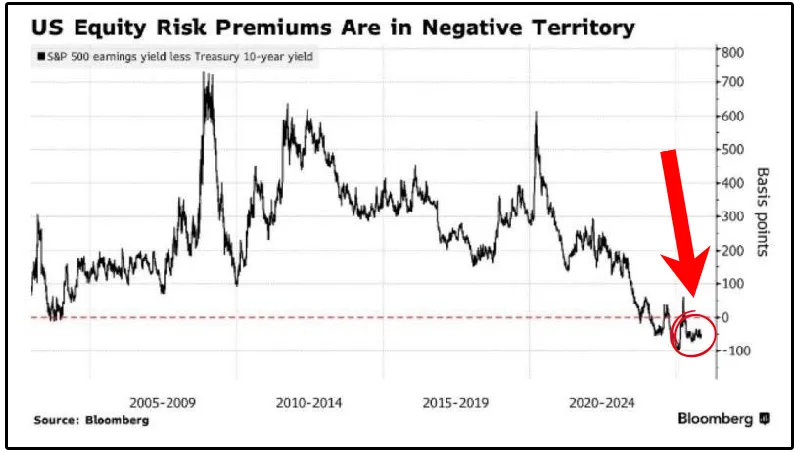
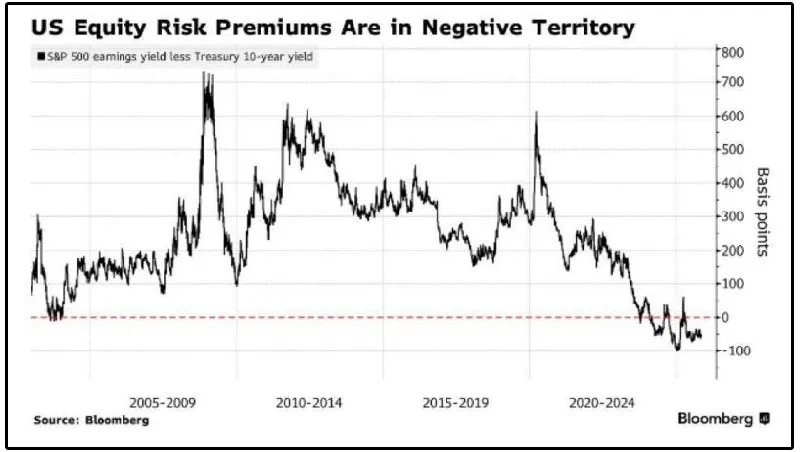
This is the most important chart you'll see today.

It shows the U.S. Equity Risk Premium (ERP), more specifically:

S&P 500 earnings yield minus the 10-year Treasury yield.

In simple terms, it answers one critical question: 👇 Image
How much extra return are investors being paid to own stocks instead of “risk-free” government bonds?

Right now, according to this chart, the answer is:

Almost nothing or even negative.

The average investor has no idea of just how radical that is.

Let’s make sure we understand exactly what this means.
To start, we must understand the earnings yield and 10-year treasury yield.

- Earnings Yield = inverse of the P/E ratio(If the S&P 500 trades at a 20x P/E, the earnings yield is 5%)

- 10-year Treasury Yield = what you earn lending money to the U.S. government

The equity risk premium is the spread between the two.

Historically:

Stocks usually offer a 3–5% premium over Treasuries

That premium compensates investors for volatility, drawdowns, and uncertainty
Read 6 tweets
Sep 21, 2025
One of the best kept secrets of the tax code?

Under the right circumstances-

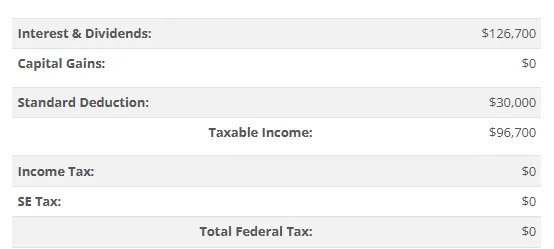
A married couple in the US can earn up to $126,700 in dividends every year and pay zero in taxes.

Here's how: (thread 👇) Image
Generating $126,700 of federal tax-free money is almost equivalent to generating a before-tax salary of $165,000 (since you would pay approximately 25% in federal taxes)!

In other words, you would need to earn $165,000 from your day job to have the exact same net pay of $$126,700 with qualified dividends.
Remember, the tax code wasn’t designed for employees; it was meant for business owners & investors.

So, how does this actually work?

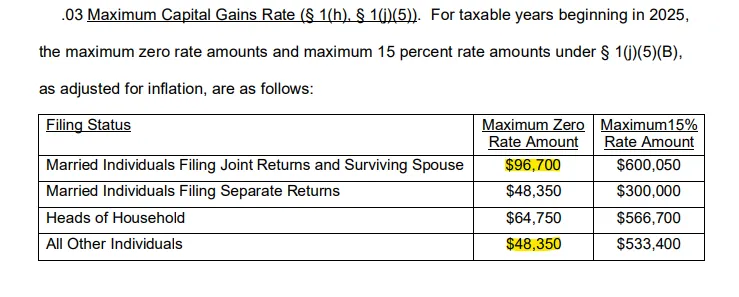
Qualified dividends get a preferential tax treatment.

According to the IRS, if your taxable income is less than $96,700 and you file jointly, you will pay $0 in tax.Image
Read 12 tweets
Sep 13, 2025
Covered Call ETFs can be great IF:

- Generate sustainable, high monthly income
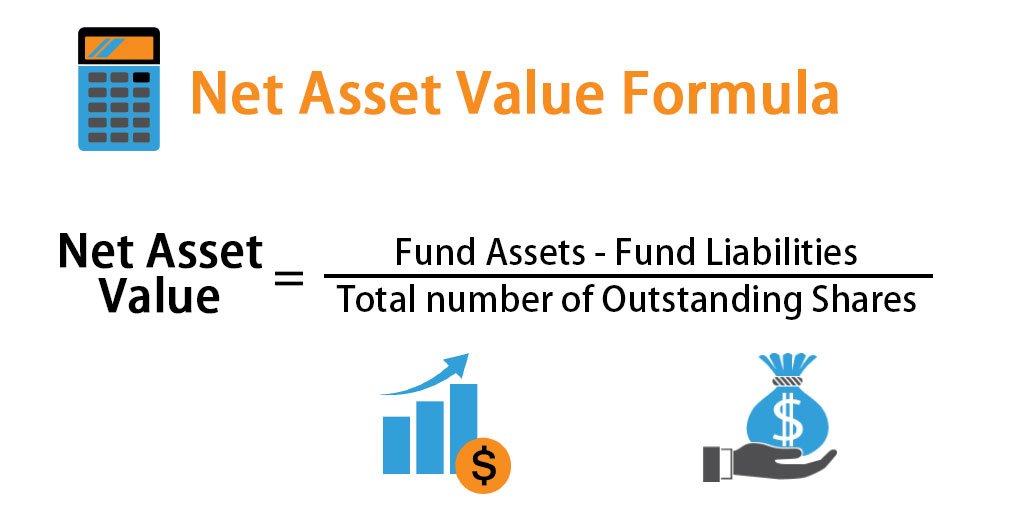
- NO net asset value decay over time
- Captures some of the upside

Here are 7 Covered Call ETFs that have met the criteria:
1. $QQQI

Yield: 13.60%
1Y Price Return: 6.9% Image
2. $SPYI

Yield: 11.70%
1Y Price Return: 3.19% Image
Read 9 tweets

Did Thread Reader help you today?

Support us! We are indie developers!


This site is made by just two indie developers on a laptop doing marketing, support and development! Read more about the story.

Become a Premium Member ($3/month or $30/year) and get exclusive features!

Become Premium

Don't want to be a Premium member but still want to support us?

Make a small donation by buying us coffee ($5) or help with server cost ($10)

Donate via Paypal

Or Donate anonymously using crypto!

Ethereum

0xfe58350B80634f60Fa6Dc149a72b4DFbc17D341E copy

Bitcoin

3ATGMxNzCUFzxpMCHL5sWSt4DVtS8UqXpi copy

Thank you for your support!

Follow Us!

:(