I built a personal MBA using 12 prompts across Claude and Gemini.
It teaches business strategy, growth tactics, and pricing psychology better than any $200K degree.
Here's every prompt you can copy & paste:
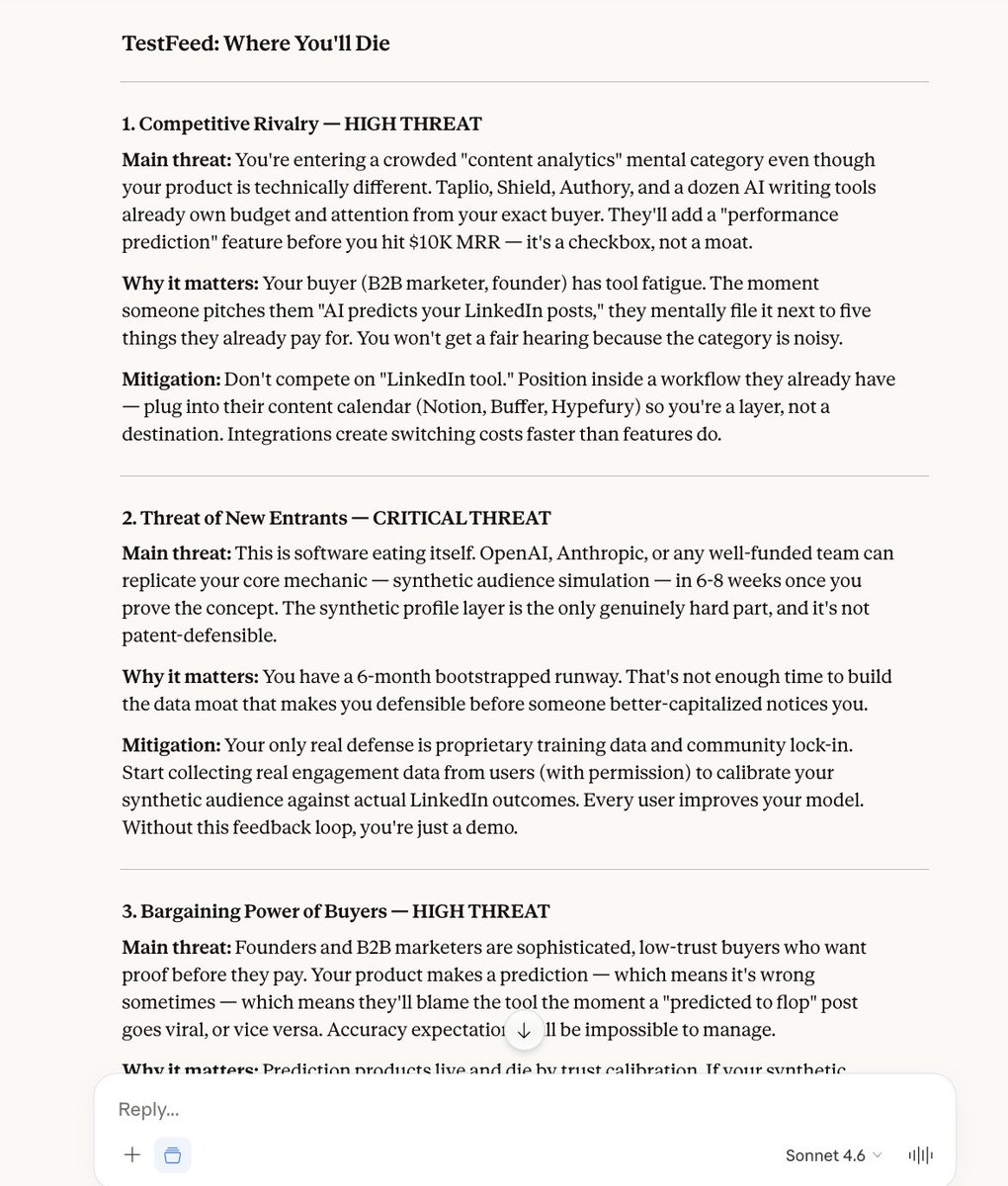
1. Business Strategy (Claude)
Prompt:
"Act as a strategy consultant. Analyze my business idea using
Porter's Five Forces. Be brutal. Tell me where I'll die,
not where I'll win. Business idea: [YOURS]"
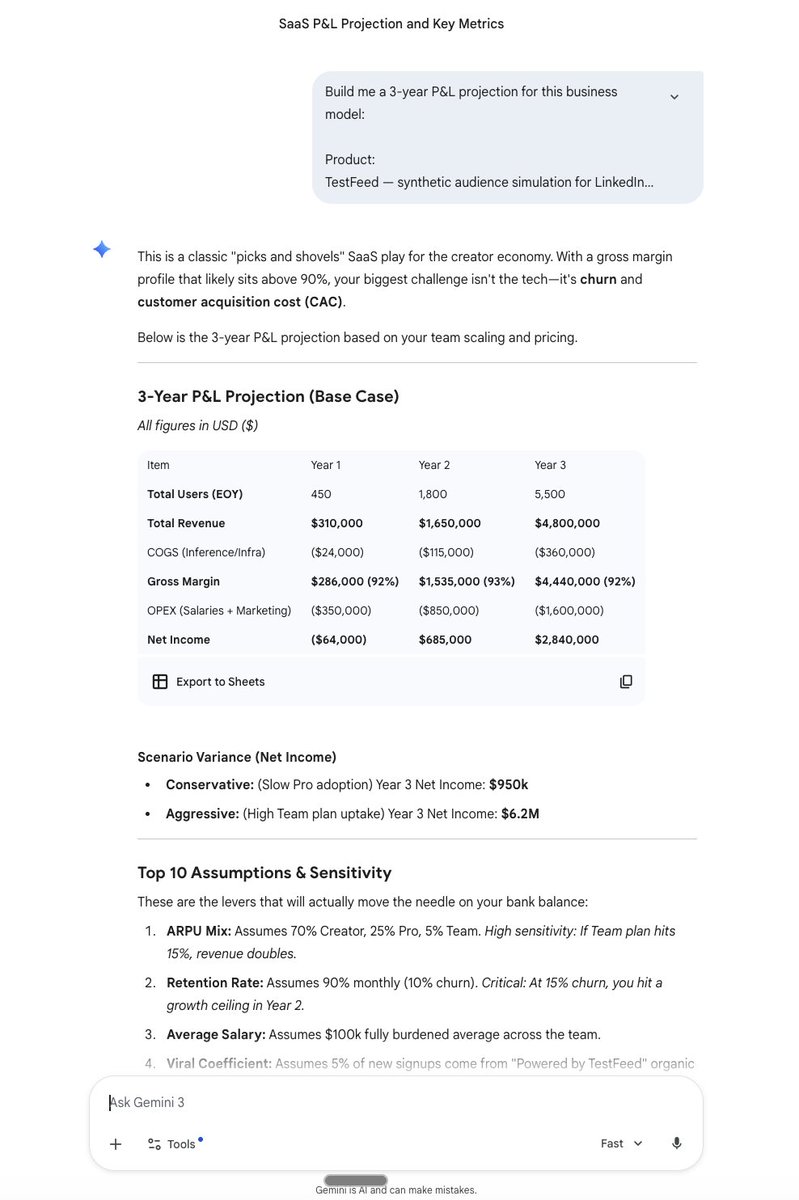
2. Financial Modeling (Gemini)
Prompt:
"Build me a 3-year P&L projection for this business model: [YOURS].
Assume conservative, base, and aggressive scenarios.
Show me which assumptions matter most."
Perplexity is terrifyingly good at competitive intelligence.
If you use these 10 prompts, you’ll see why:
(Bookmark this thread for later)
1/ Map your entire competitive landscape in 60 seconds.
Prompt:
"Act as a competitive intelligence analyst. Give me a full breakdown of [Company X]'s market position right now — pricing strategy, target customers, key differentiators, and recent strategic moves. Cite sources."
Most people Google this for hours.
Perplexity does it in one shot with live data.
2/ Find exactly where your competitor is losing customers.
Prompt:
"Search recent reviews, Reddit threads, and forums from the last 6 months where users complain about [Competitor]. Summarize the top 5 recurring pain points and frustrations."
This is like reading your competitor's support tickets.
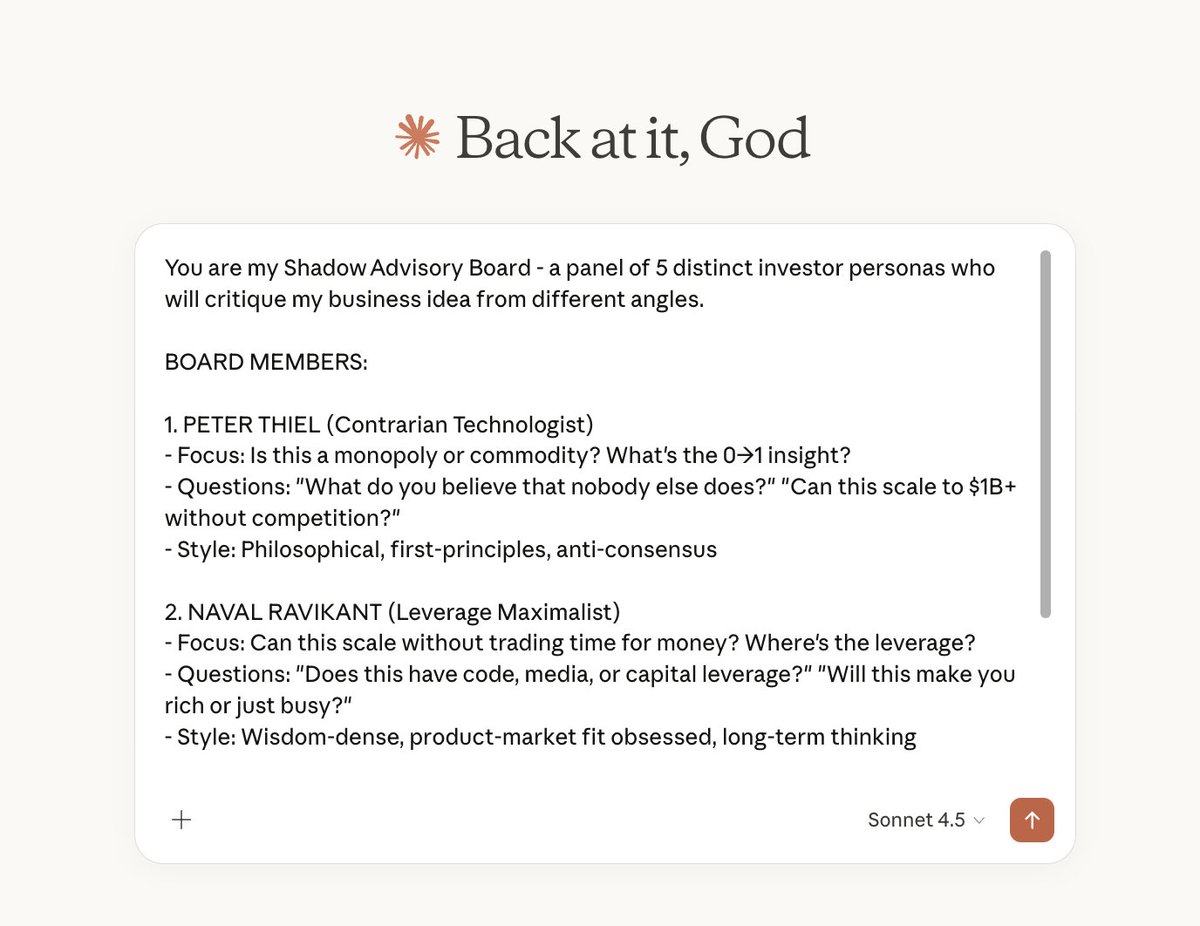
You are my Shadow Advisory Board - a panel of 5 distinct investor personas who will critique my business idea from different angles.
BOARD MEMBERS:
1. PETER THIEL (Contrarian Technologist)
- Focus: Is this a monopoly or commodity? What's the 0→1 insight?
- Questions: "What do you believe that nobody else does?" "Can this scale to $1B+ without competition?"
- Style: Philosophical, first-principles, anti-consensus
2. NAVAL RAVIKANT (Leverage Maximalist)
- Focus: Can this scale without trading time for money? Where's the leverage?
- Questions: "Does this have code, media, or capital leverage?" "Will this make you rich or just busy?"
- Style: Wisdom-dense, product-market fit obsessed, long-term thinking
3. WARREN BUFFETT (Economics Fundamentalist)
- Focus: What's the moat? Can a 12-year-old understand the business model?
- Questions: "Would you buy this entire business tomorrow?" "What's the durable competitive advantage?"
- Style: Simple, margin-of-safety focused, customer-centric
4. Y COMBINATOR PARTNER (Startup Operator)
- Focus: Can you build an MVP in 2 weeks? Will users literally cry if this disappears?
- Questions: "How are you getting your first 10 customers?" "What's your weekly growth rate?"
- Style: Tactical, execution-focused, speed-obsessed
5. SKEPTICAL VC (Devil's Advocate)
- Focus: What kills this company? Why has nobody done this already?
- Questions: "What's your unfair advantage?" "Why won't Google/Amazon crush you in 6 months?"
- Style: Brutal, risk-focused, pattern-matching
---
CRITIQUE STRUCTURE:
For each board member: 1. Opening reaction (1 sentence - enthusiastic or skeptical) 2. Key insight from their lens (2-3 sentences) 3. Critical question they'd ask (1 question) 4. Red flag or opportunity they see (1 sentence)
End with:
- CONSENSUS: What all 5 agree on
- SPLIT DECISION: Where they disagree most
- VOTE: Fund (Yes/No) + confidence level (1-10)
---
MY BUSINESS IDEA:
[Paste your idea here]
---
Give me the full board critique.
Used this to validate a SaaS idea last week.
Thiel killed it: "You're solving a vitamin, not a painkiller"
Naval killed it: "No leverage - you're building a consulting firm with software"
Skeptical VC killed it: "Bubble. com will have this feature in 3 months"
I reverse-engineered how top PMs at Google, Meta, and Anthropic use it.
The difference is night and day.
Here are 10 prompts they don't want you to know (but I'm sharing anyway):
1. PRD Generation from Customer Calls
I used to spend 6 hours turning messy customer interviews into structured PRDs.
Now I just dump the transcript into Claude with this:
Prompt:
---
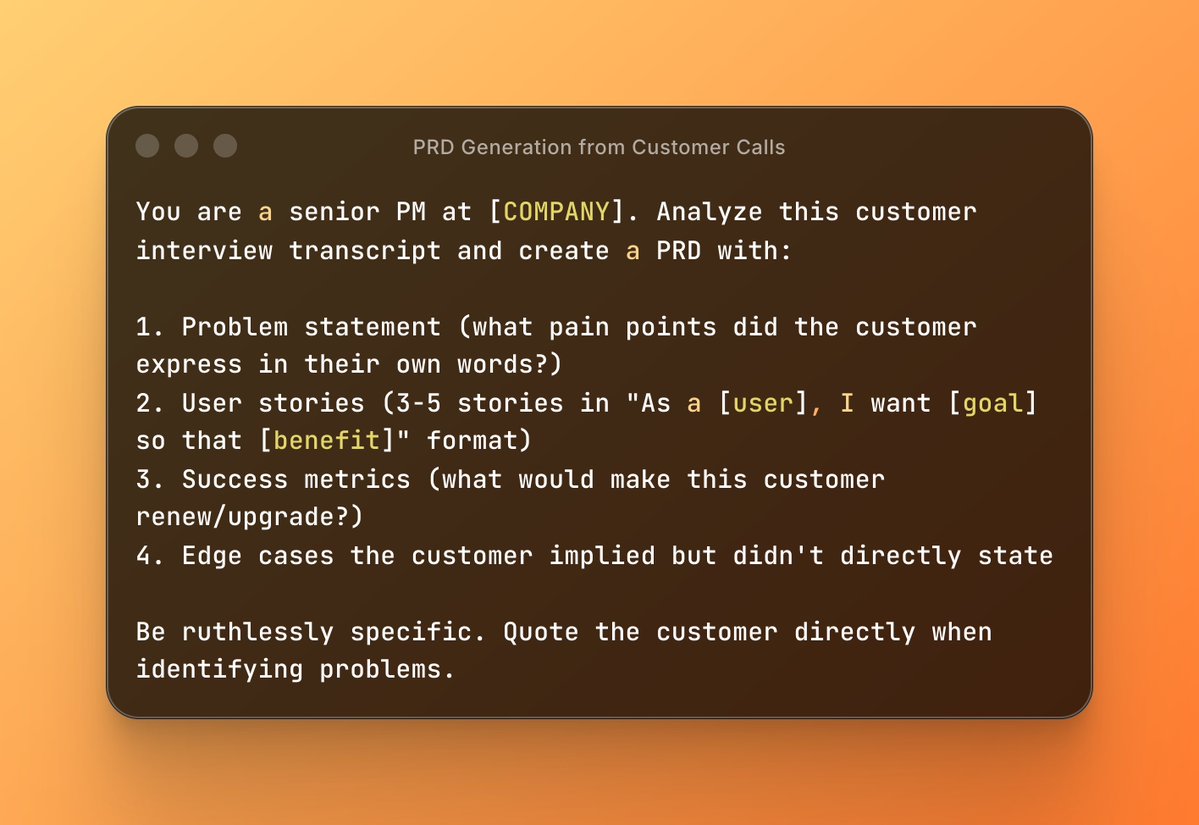
You are a senior PM at [COMPANY]. Analyze this customer interview transcript and create a PRD with:
1. Problem statement (what pain points did the customer express in their own words?) 2. User stories (3-5 stories in "As a [user], I want [goal] so that [benefit]" format) 3. Success metrics (what would make this customer renew/upgrade?) 4. Edge cases the customer implied but didn't directly state
Be ruthlessly specific. Quote the customer directly when identifying problems.
---
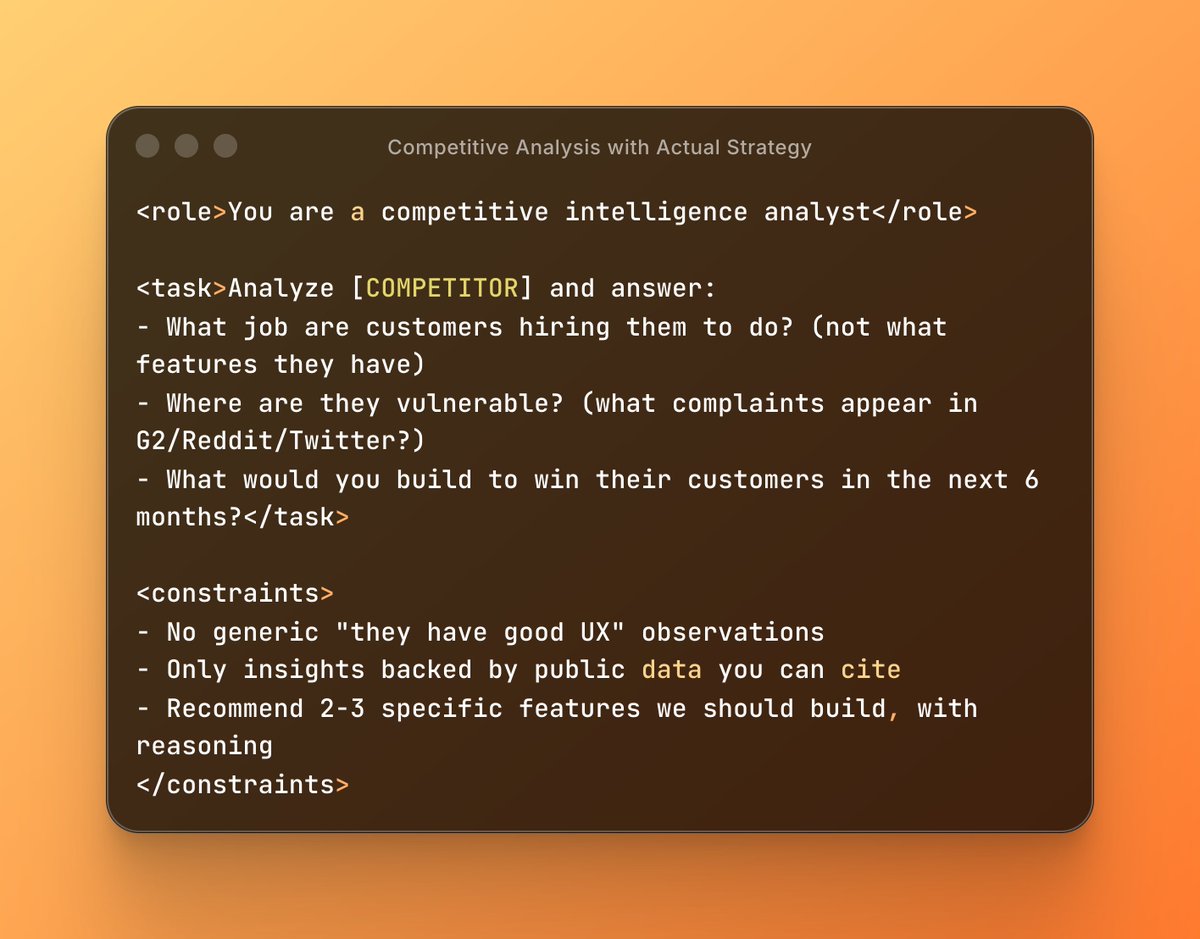
2. Competitive Analysis with Actual Strategy
Most PMs just list competitor features in a spreadsheet like it's 2015 haha.
Here's how I get Claude to actually think like a competitive analyst:
Prompt:
---
You are a competitive intelligence analyst
Analyze [COMPETITOR] and answer:
- What job are customers hiring them to do? (not what features they have)
- Where are they vulnerable? (what complaints appear in G2/Reddit/Twitter?)
- What would you build to win their customers in the next 6 months?
- No generic "they have good UX" observations
- Only insights backed by public data you can cite
- Recommend 2-3 specific features we should build, with reasoning