
Congratulations to the English Blackball Pool Federation on doing the right thing, and being vindicated in a searingly unequivocal judgment. 🧵
https://twitter.com/WomensRightsNet/status/1951222221147349131
Harriet Haynes, a man who says he is a woman (and holds a GRC), sued the EBPF for excluding him from women's competitions and teams. He complained of discrimination because of gender reassignment.
Haynes was represented by Jane Russell KC of @EssexCourtLaw and Robin Moira White of @OldSqChambers The BBPF was represented by Sarah Crowther KC and Sapan Maini-Thompson both of @outertemple.
@EssexCourtLaw @OldSqChambers @outertemple The judgment uses feminine pronouns to refer to Haynes, despite the fact that he is both biologically and for relevant legal purposes a man. 

@EssexCourtLaw @OldSqChambers @outertemple Since it is not possible to change sex, "trans woman" would be better defined as someone who *is* male *and* has the protected characteristic of gender reassignment.

@EssexCourtLaw @OldSqChambers @outertemple (Don't lose heart: the judgment gets better. A lot.)
@EssexCourtLaw @OldSqChambers @outertemple The Defendants' submissions were capable of being succinctly summarised:
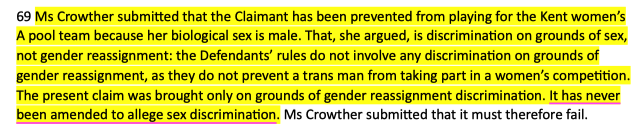
@EssexCourtLaw @OldSqChambers @outertemple Haynes' failure to plead his case as sex discrimination is a striking demonstration of the grip that gender identity ideology has on campaigners and perhaps also their lawyers.
@EssexCourtLaw @OldSqChambers @outertemple The case could have been winnable as sex discrimination: excluding Haynes because he was a man is unlawful sex discrimination unless pool is a "gender-affected activity", and that was the most factually contentious issue in the case, on which there was detailed expert evidence.
@EssexCourtLaw @OldSqChambers @outertemple But to complain of sex discrimination, Haynes would have had to admit that he was a man. It appears that that was so unpalatable to him that it was better to doom his case to failure by proceeding solely on the basis of gender reassignment discrimination.
@EssexCourtLaw @OldSqChambers @outertemple "The Claimant's position will take longer to describe" contains an ominous indication of what is to come.

@EssexCourtLaw @OldSqChambers @outertemple The judgment then sets out a passage from the Claimant's Amended Further Submissions and observes that it appears to accept that what is involved in excluding him from women's competitions is discrimination on grounds of sex.
@EssexCourtLaw @OldSqChambers @outertemple A footnote to "Amended" notes dryly that the amendment withdrew the concession that the claim must be dismissed.
@EssexCourtLaw @OldSqChambers @outertemple Para. 76 reads "Thus far, it seems to be the Claimant's stated position that (i) in view of FWS, the relevant exclusion was a matter of sex discrimination and (ii) she [sic] had not pleaded sex discrimination. I would have thought it followed that the claim must be dismissed."
@EssexCourtLaw @OldSqChambers @outertemple You would, wouldn't you?
@EssexCourtLaw @OldSqChambers @outertemple The Amended Further Submissions go on:

@EssexCourtLaw @OldSqChambers @outertemple The judge expresses polite bafflement: "It seems to me that this passage contradicts what was said in ¶9 of the same submissions, quoted above. Nor can I see how it is reconcilable with FWS."
@EssexCourtLaw @OldSqChambers @outertemple He goes on:

@EssexCourtLaw @OldSqChambers @outertemple Ouch.
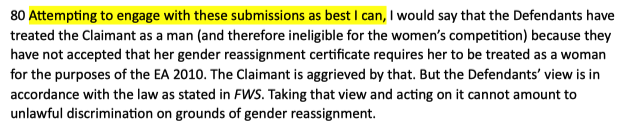
@EssexCourtLaw @OldSqChambers @outertemple Ouch some more. (Full marks to HHJ Parker for restraint; not a hint of sarcasm.)
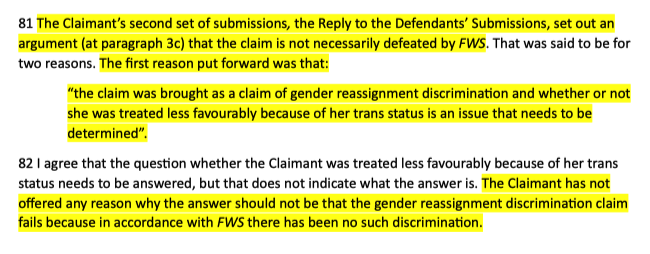
@EssexCourtLaw @OldSqChambers @outertemple The second reason put forward by the Claimant was that pool is not a gender-affected activity. The judge cannot see how that assists him, since it is now clear that he has not suffered gender reassignment discrimination, and he has not pleaded sex discrimination.
@EssexCourtLaw @OldSqChambers @outertemple Then the judge deals with C's startling attempt to argue that the passage from the judgment of the SC in FWS dealing with comparators is obiter: ie not binding because not an essential part of the court's reasoning.
@EssexCourtLaw @OldSqChambers @outertemple The judge is having none of that:

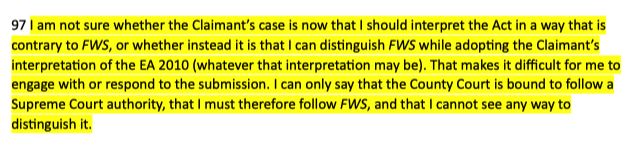
@EssexCourtLaw @OldSqChambers @outertemple Next, C appears to be arguing both that the court is bound to follow FWS, but also bound not to because of something about his article 8 and 14 rights.
@EssexCourtLaw @OldSqChambers @outertemple The judge remains commendably — one might say heroically — straight-faced, but ouch again:

@EssexCourtLaw @OldSqChambers @outertemple In any event, he observes that a County Court is bound to follow a Supreme Court authority.
@EssexCourtLaw @OldSqChambers @outertemple In a further surprising twist, C argued that if the claim was dismissed (perhaps having a faint premonition of that possibility), he should have permission to appeal because the EqA as interpreted in FWS was incompatible with the ECHR.
@EssexCourtLaw @OldSqChambers @outertemple Parties usually wait to lose before seeking permission to appeal, but the judge deals with this anyway by giving an indication of how he would deal with any application for permission to appeal if made on the same basis after judgment.
@EssexCourtLaw @OldSqChambers @outertemple While noting that incompatibility was no part of C's pleaded case, the judge is willing to consider whether there is any real prospect that he would obtain a declaration of incompatibility on appeal. The judge has the patience of a saint.
@EssexCourtLaw @OldSqChambers @outertemple It is true that the question of incompatibility was not addressed in FWS. The judge does not think this is likely to have been by oversight:
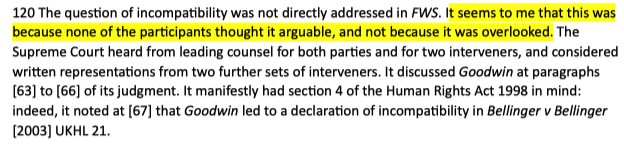
@EssexCourtLaw @OldSqChambers @outertemple He concludes that the proposed grounds of appeal have no real prospect of success, and if such an application were made to him, he would refuse it.
@EssexCourtLaw @OldSqChambers @outertemple Given the way the case was put for the C — not relying on sex discrimination, which was the only basis on which he could possibly have succeeded — the question whether pool was a "gender affected activity" for the purposes of s.195 EqA was strictly irrelevant.
@EssexCourtLaw @OldSqChambers @outertemple But since that question was fully argued and supported by expert evidence on both sides, the judge deals with it anyway.
@EssexCourtLaw @OldSqChambers @outertemple After a careful assessment of the expert evidence, he decides that pool is indeed a gender-affected activity.
@EssexCourtLaw @OldSqChambers @outertemple The claim might by now be thought to be six feet under with a stake through its heart. But the judge isn't quite done. He goes on to consider whether the exclusion of "trans women" would be justified under s.195(3) if this were a case of gender reassignment discrimination.
@EssexCourtLaw @OldSqChambers @outertemple He concludes that it would.
@EssexCourtLaw @OldSqChambers @outertemple End.
• • •
Missing some Tweet in this thread? You can try to
force a refresh






