Christian Heiens 🏛 Profile picture
Aug 2 4 tweets 2 min read Read on X
You have no idea just how much the Democratic Party has to rely on non-citizens and illegal aliens to inflate their legislative districts.

Just look at this. Nearly 25% of this Blue district's population in the Virginia House of Delegates are "non-citizens".

These people get to be counted in the census and then end up being allocated in Congressional and State Legislative districts, which artificially expands the Left's electoral power.

Democrats don't even represent Americans. They represent foreigners. Literally.Image
Image
If the allocation of Congressional and State Legislative maps were based only on US Citizens, Democrats would immediately lose 10-20% of all their seats in Congress and every State Legislature in the country.

Do you have any idea how many seats that would flip across the country?
This is just the Virginia House of Delegates, but look at how ridiculous this is.

The Democratic Party is astroturfed by foreigners.

🔵HD-2: 13% non-citizen
🔵HD-3: 11% non-citizen
🔵HD-5 9% non-citizen
🔵HD-6 8% non-citizen
🔵HD-7 8% non-citizen
🔵HD-8 20% non-citizen
🔵HD-9 13% non-citizen
🔵HD-10 8% non-citizen
🔵HD-11 12% non-citizen
🔵HD-12 15% non-citizen
🔵HD-13 15% non-citizen
🔵HD-14 16% non-citizen
🔵HD-16 12% non-citizen
🔵HD-17 8% non-citizen
🔵HD-18 10% non-citizen
🔵HD-19 14% non-citizen
🔵HD-20 20% non-citizen
🔵HD-21 13% non-citizen
🔵HD-23 10% non-citizen
🔵HD-24 10% non-citizen
🔵HD-25 9% non-citizen
🔵HD-26 12% non-citizen
🔵HD-27 15% non-citizen
🔵HD-28 9% non-citizen
🔵HD-58 9% non-citizen
🔵HD-76 8% non-citizen
🔵HD-77 12% non-citizen
Here's where you can find all of this data yourself. @StateNavigate is working to eventually build this out for the entire country at the state legislative level, but right now they've got Virginia done.

statenavigate.org/virginia/

• • •

Missing some Tweet in this thread? You can try to force a refresh

 

Keep Current with Christian Heiens 🏛

Christian Heiens 🏛 Profile picture

Stay in touch and get notified when new unrolls are available from this author!

Read all threads

This Thread may be Removed Anytime!

PDF

Twitter may remove this content at anytime! Save it as PDF for later use!

Try unrolling a thread yourself!

how to unroll video
  1. Follow @ThreadReaderApp to mention us!

  2. From a Twitter thread mention us with a keyword "unroll"
@threadreaderapp unroll

Practice here first or read more on our help page!

More from @ChristianHeiens

Mar 2
Every time the Right points out the "hypocrisy" of modern liberal regimes doing illiberal things like working to ban the AfD in Germany, arresting right-wing presidential candidates in Romania, shutting down the bank accounts of Canadian truckers, or trying to imprison Trump, liberals respond with the same unflinching argument: "Yes, we will suppress these people, because liberal democracy has the right to defend itself."

At least these people are honest about who they are and have stopped trying to hide behind the illusion of neutrality.

The old liberalism, the one that claimed to tolerate all perspectives and uphold the rule of law, is long since dead. Instead, we are left with a blunt assertion of power: "We will use force to protect our democracy because we believe it's the best order there is."

And in many ways, this is a very strong argument. Liberals can provide good evidence that their ideology has earned the right to be humanity's final ideological system.

They can point to the immense wealth, technological advancement, and social stability it has delivered for centuries. They can also claim it has stood the test of time, overthrowing monarchies, defeating fascism and communism, and crushing despots who brutalized and impoverished their peoples.

Why wouldn’t it have the right to defend itself?

But this argument comes at a price. By openly admitting that liberalism is not a neutral system but rather a hegemonic political order, its defenders have unwittingly shattered its moral authority.
Liberalism’s legitimacy was built on the claim that it was different from every other regime, that it ruled through principles rather than force and consensus rather than coercion.

The moment it justifies political repression as a necessary tool of self-preservation, it has abandoned that claim. If liberalism’s survival depends on identifying and crushing its enemies, then it is no different from any other regime that has wielded power throughout history.

This is patently obvious by now, which is why Right-wing populism has exploded over the last 15 years. The Right realizes it's being shafted by a system that no longer operates on rights and procedures. Instead, we're all increasingly subject to a system that operates on the old logic of sovereignty deciding who is included and who must be cast out.

The forces that drove cancel culture and gatekeeping in the 2010s are precisely the same forces that drive the annulment of elections and the silencing of political opposition today.

In short, liberalism has embraced Carl Schmitt’s core political truth: that all politics ultimately reduces to the friend-enemy distinction.
But what's the problem? Liberals certainly don't think there's any issue. They openly brag about it on this site all the time. Just look for any account with the usual flag or globe emojis and you'll see what I mean.

These people genuinely believe that liberalism has every right to use force to defend itself because with that force, it has ushered in a golden age for humanity.

Here's the problem.

If liberalism is no longer legitimized by universal principles but by outcomes (freedom, prosperity, technological progress, etc) then what happens when those outcomes begin to decline?

What happens when economic growth stagnates, when social trust erodes, when demographic collapse accelerates, or when institutions rot from within? If liberalism justifies itself by results alone, then its legitimacy is only as stable as its ability to deliver. And when it can no longer deliver, its justification for wielding power dissolves.

And this is exactly what's happening right now. People can instinctively feel that the game is rigged against them, and it's radicalizing them by the tens of millions.

They can't afford a house, inflation is chipping away at their standard of living, they live in increasingly low-trust societies with collapsing birth rates and replacement-level migration, they can't get married or have children, and they've seen one institution after another hijacked by overly zealous political ideologues who very explicitly wielded them in ways that shattered the public's trust.

And what happens to those who object to these things? They get crushed by the very system which claims the moral high ground for itself.

Liberalism increasingly seems less like the final form of human civilization and more like just another ruling order desperately clinging to power and frantically expanding its list of "existential threats" in an attempt to maintain control.
Read 5 tweets
Feb 18
Japan is Sleepwalking Into a Sovereign Debt Crisis

Japan’s economic predicament is the result of three decades of financial engineering designed to sustain a system that should have collapsed long ago.

This thread will explain what happened and why Japan's current path is unsustainable.
After the implosion of Japan’s massive asset bubble in the early 1990s, the country fell into a multi-decade-long period of stagnation, deflation, and weak GDP growth.

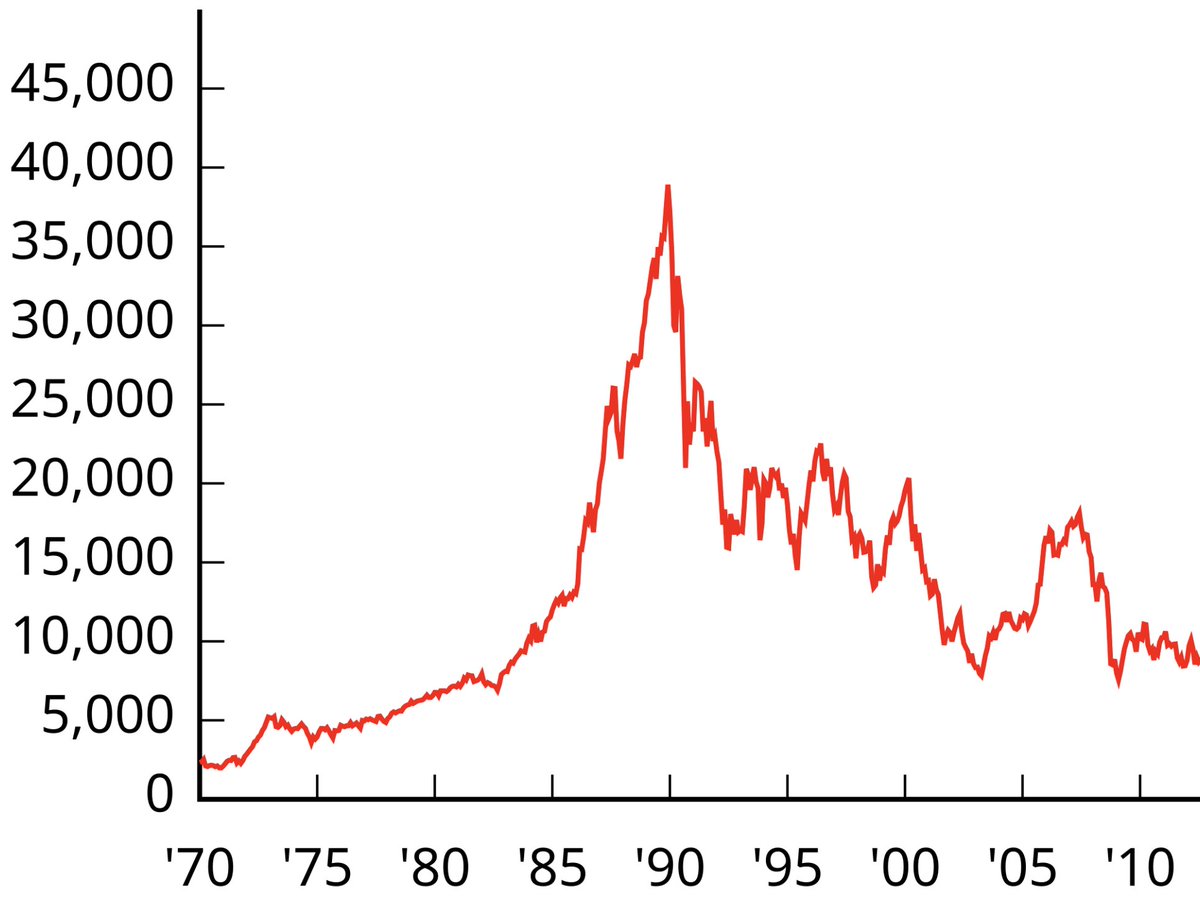
Between 1990 and 2009, the Nikkei 225 (Japan's most important stock market index) collapsed by more than 80%, one of the steepest and longest economic drawdowns in history. For context, the Dow Jones Industrial Index fell about 90% during the Great Depression but hit rock bottom just three years after the 1929 crash.Image
However, rather than allowing natural market forces to reset the economy after the 1980s bubble era, the Japanese government and the Bank of Japan embarked on an unprecedented experiment involving zero percent interest rates (and eventually negative interest rates), massive government spending, and debt monetization on a scale never attempted before.

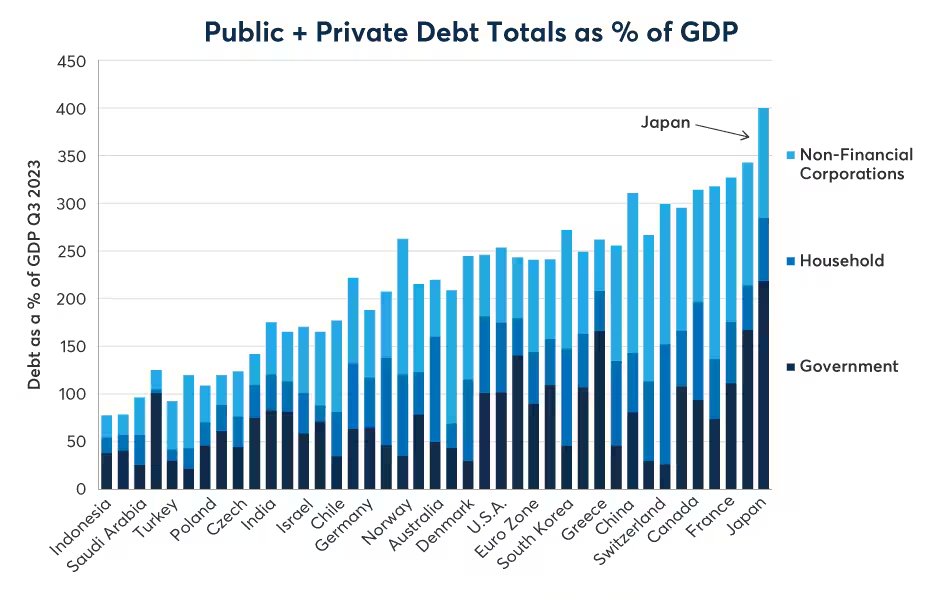
Over time, this policy framework has led to a situation where Japan’s government debt has skyrocketed to over 260% of GDP, the highest of any developed nation in the world.

So how did the Japanese government manage to become so overleveraged?

By selling bonds to the central bank.Image
Read 10 tweets
Dec 23, 2024
This is going to be a long post, so let's begin by remembering the most important fact of them all:

The Left derives much of its power through its control of key institutions in society. As Republicans, we must prioritize recapturing or dismantling these ideological bastions.

Capturing castles is paramount. Everything else is secondary.
First, take back the institutions. The federal bureaucracy is a weapon against conservatives. Fire the activists, re-implement Schedule F, and redirect agencies to enforce existing laws against Leftist overreach, particularly in areas like education (CRT & DEI initiatives among others) and immigration.

The Left wins no matter what because they can always engage in bureaucratic sabotage even when they lose an election. No longer. The Federal bureaucracy must be shredded, and the remaining vestiges must be brought to heel and made to work for us and our values, not against us and for our enemies.
Second, take control of the courts. Fast-track originalist judges. Turn the judiciary into a firewall against Leftist overreach. And launch lawsuits—lots of them. Force the Left to defend their unconstitutional nonsense everywhere and all at once.

Third, defund the enemy. Halt all government grants and subsidies to universities and NGOs pushing Leftism. Immediately stop the flood of taxpayer-backed contracts to organizations advancing anti-conservative agendas (and there's a lot of them).

Launch antitrust investigations into Big Tech and other monopolistic entities that use their platforms to suppress conservative voices. Make it clear they will only be dropped when they stop punishing Conservative viewpoints and propping up Leftist ones. If they don't, break them up.
Read 6 tweets
Nov 8, 2024
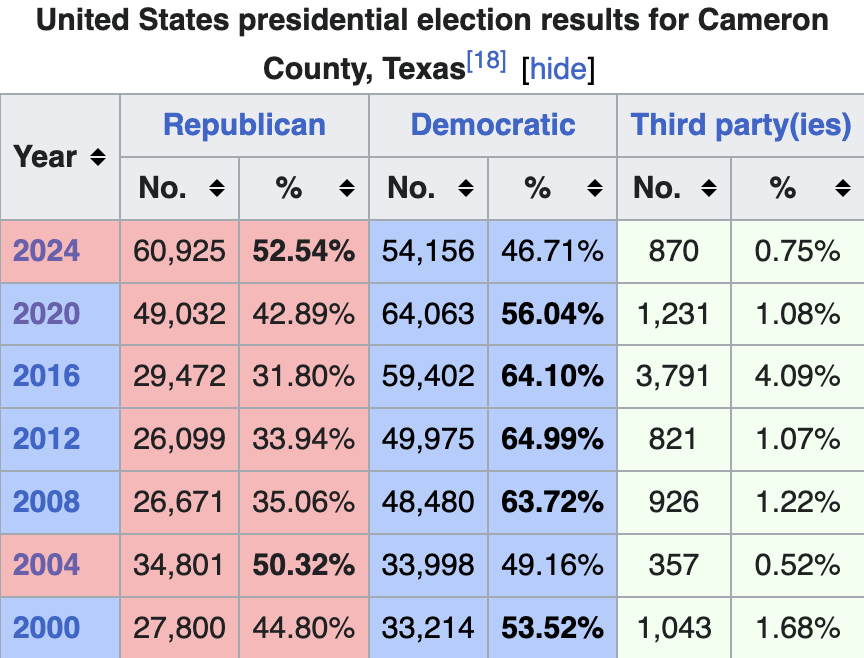
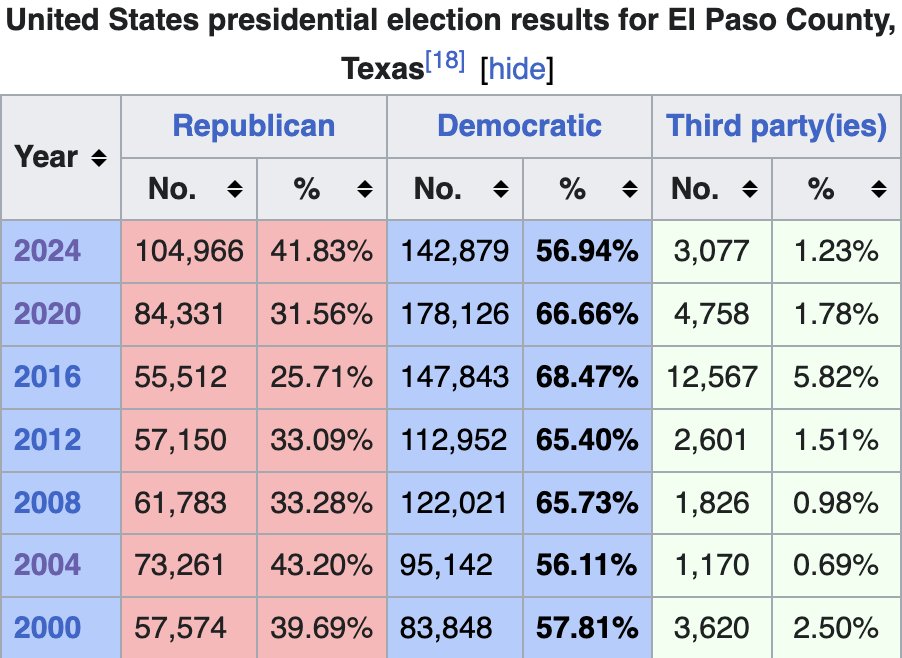
You aren't prepared to see the swing map along the Rio Grande Valley.

Blexas is dead.

Trump erased 20 years worth of Democrat gains in one night. Image
Image
Image
Image
El Paso County moved **20 points** to the Right.

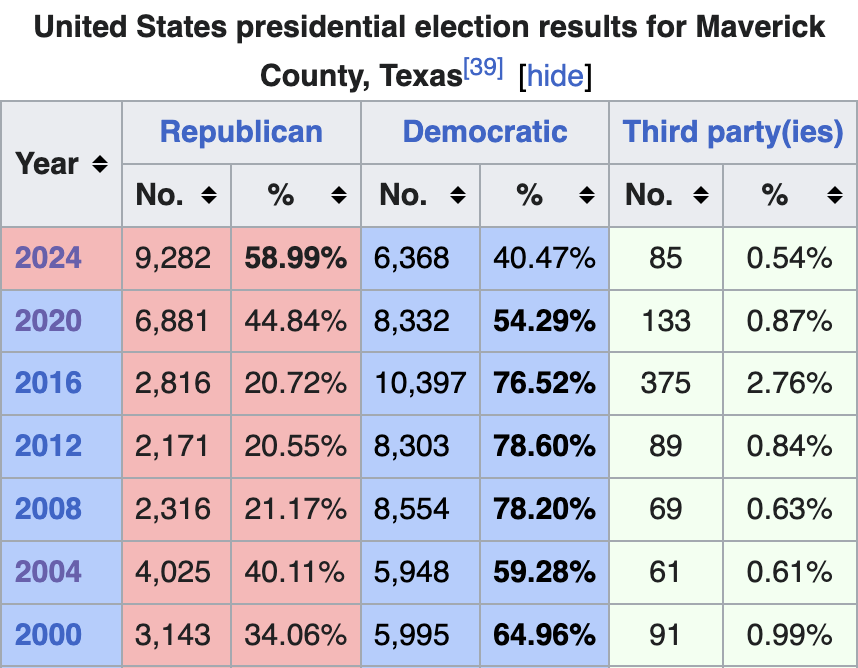
Maverick County hadn't voted for a Republican since 1928. Trump barely won 20% of the vote here in 2016 and he carried it by a 19 point margin.

That's a 72.3-point shift to the Right in just two election cycles!!! Image
Image
Look at these trends all along the Rio Grande Valley. Unbelievable.

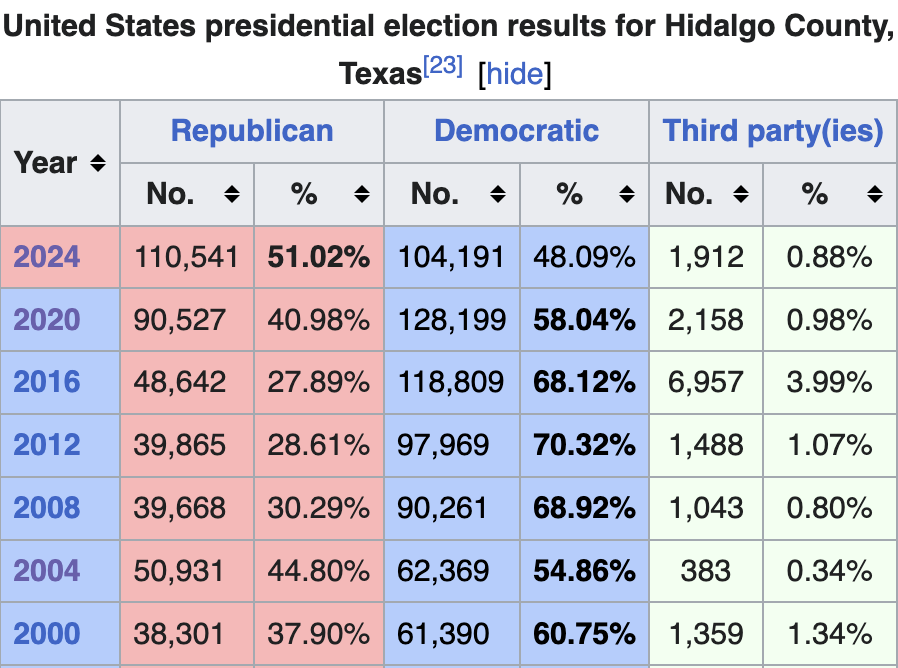
Hidalgo and El Paso are major urban centers with nearly a million residents in each county.

Trump flipped one of them outright, and won the largest vote share in a generation in the other. Image
Image
Image
Image
Read 4 tweets
Oct 3, 2024
Not enough has been said about how modernity has forged the very tools that will one day bring about its downfall.

Julius Evola and René Guénon accurately predicted and diagnosed the metaphysical disintegration that has come to engulf the West, but neither foresaw the scientific revolution that could challenge modernity on its own terms—the implications of quantum mechanics or the resurgence of idealism as a serious metaphysical challenge to materialism.

This would entail pushing the boundaries of scientific inquiry until the materialist framework collapses under its own contradictions. Only then can society be guided toward a new metaphysical understanding that aligns with traditional values and spiritual truths.

In short, there can be no successful “revolt against the modern world” until Nietzsche’s notion of the “death of God” is directly confronted, refuted, and defeated.

This is already quietly happening on the margins of philosophy and science, but we are at the beginning of the cycle, and almost no one has yet noticed this.
Below is my attempt at a short essay that may serve as the basis for a longer future post on an outlet like Substack. For now, I will try to outline what happened, why it happened, and what may come next.

Before examining the coming collapse of modernity, it’s essential to understand what came before it. For most of human history, civilizations were built on a shared metaphysical understanding of reality. Whether in Ancient Greece, Medieval Europe, the Islamic world, India, or China, societies operated on the assumption that the material world was not the only—or even the most important—aspect of existence.

Plato was one of the earliest and most influential philosophers to articulate a metaphysical framework. His Theory of the Forms argued that the material world we perceive through our senses is just a shadow of a higher, eternal reality. The Forms represent perfect, unchanging archetypes—such as Justice, Beauty, and Goodness—that exist in an immaterial realm. This realm of Forms was the true reality, while the material world was merely a pale reflection.

For Plato, human beings were not merely physical creatures. We were souls, temporarily housed in bodies, whose actual purpose was to reconnect with the higher, divine realities represented by the realm of Forms. This Platonic vision of reality formed the foundation for much of Western philosophy and religious thought.

There's a reason the Gospel of John equates Christ to the Logos. John knew his audience could identify the importance of Jesus' ministry, resurrection, and status as the Son of God through a direct association with the Platonic concept of the Logos: an eternal force that sustains and provides meaning to the universe.

Plato wasn't alone in this, either. Aristotle also saw the natural world as inherently having immense purpose and meaning. His concept of teleology—the idea that everything in nature has a purpose or end (telos)—suggested that the universe was imbued with intrinsic meaning. Everything, from the stars in the sky to the plants and animals on Earth, had a role in a larger, harmonious cosmic order.

These early metaphysical systems shaped how entire civilizations understood themselves and their place in the universe. The material world was not viewed as an end in itself but as part of a greater spiritual order.

And it wasn't limited to Ancient Greece either. If you'd like a clearer picture of how virtually every pre-modern society shared this metaphysical outlook, I recommend reading Julius Evola's "Revolt Against the Modern World."

It's a very daunting read, but the first half of that book recounts how ancient civilizations—whether in the East or the West—were guided by a spiritual worldview that permeated every aspect of life. Evola shows that virtually every great pre-modern society did not see the material world as the ultimate reality but as part of a larger divinely inspired order. Their customs, laws, and even their politics were all reflections of a higher metaphysical understanding.

This process continued into the Medieval Era. Building upon the metaphysical foundations laid by Plato and Aristotle, Christian theologians like Thomas Aquinas synthesized Aristotelian philosophy with Christian theology. Aquinas laid the foundation for a vision of the cosmos in which everything, from the lowest creature to the highest angel, had its place in the Great Chain of Being. This hierarchy reflected the natural order, which was grounded in divine will.

For medieval thinkers, metaphysics was inseparable from theology. God was not just a distant creator but the source of all existence, the ultimate reality from which everything else flowed. Human beings had a spiritual purpose—to align themselves with God’s will and partake in the divine order. For thousands of years, this metaphysical framework provided meaning, purpose, and direction for individuals and societies alike.
The metaphysical collapse that Guénon, Evola, and Nietzsche diagnosed began with the rise of modernity—a process that unfolded over several centuries, beginning with the Enlightenment. While modernity brought immense technological and scientific progress, it also undermined the metaphysical assumptions that had previously guided Western civilization.

René Descartes is often credited with laying the groundwork for the modern worldview. His famous dictum, Cogito, ergo sum (“I think, therefore I am”), marked a decisive shift in how humans understood themselves and the world around them. By grounding knowledge in human reason rather than divine revelation, Descartes initiated what would become the epistemological turn of modern philosophy.

More importantly, Descartes introduced the concept of dualism—the idea that reality is divided into two distinct substances: mind and matter. While Descartes still maintained a belief in God and the immaterial soul, his separation of mind and body laid the foundation for a radically new understanding of reality. The material world was now seen as a realm of inert, mechanistic forces, entirely separate from the realm of thought and consciousness.

This didn't happen for nefarious reasons, nor was Descartes the only one pushing for dualism. Galileo and Kepler had a hand in it as well, wishing to study the cosmos without direct interference from the Catholic Church. Dualism thus served a utilitarian purpose. By cleaving the temporal and spiritual realms in two, scientists and astronomers could study the natural world while the Church retained its dominion over spiritual matters.

This essentially gave birth to the Scientific Revolution, leading to an explosion of technological and economic growth. But for the first time, Plato's realm of Forms was permanently separated from our world. Mind and Matter were now two distinct entities with their own spheres of existence and governing bodies.

This split, combined with the West's embrace of dualism, paved the way for later thinkers to gradually abandon the realm of mind altogether, reducing reality to mere matter in motion.

Building on Galileo and Descartes, Isaac Newton revolutionized our understanding of the natural world with his laws of motion and universal gravitation. Newton’s "Principia Mathematica" provided a comprehensive mathematical framework for understanding the physical universe as a giant, clockwork machine—predictable, measurable, and entirely devoid of spiritual or metaphysical dimensions.

The Newtonian view posited that the universe was governed by deterministic laws which could be discovered through empirical observation and mathematical reasoning. This mechanistic worldview became the foundation of modern science, replacing the teleological and metaphysical systems of the past.
Read 9 tweets

Did Thread Reader help you today?

Support us! We are indie developers!


This site is made by just two indie developers on a laptop doing marketing, support and development! Read more about the story.

Become a Premium Member ($3/month or $30/year) and get exclusive features!

Become Premium

Don't want to be a Premium member but still want to support us?

Make a small donation by buying us coffee ($5) or help with server cost ($10)

Donate via Paypal

Or Donate anonymously using crypto!

Ethereum

0xfe58350B80634f60Fa6Dc149a72b4DFbc17D341E copy

Bitcoin

3ATGMxNzCUFzxpMCHL5sWSt4DVtS8UqXpi copy

Thank you for your support!

Follow Us!

:(