Christian Heiens 🏛 Profile picture
The Oracle of Virginia Emeritus • Historian • Postliberal Reactionary • Counter-Revolutionary • Austrian School Acolyte
Sep 4, 2025 • 10 tweets • 13 min read
I promised a steelman of Liberalism, and here it is.

Liberalism is the political philosophy that defends the freedom of the individual against tyranny, whether in the form of kings or the mob.

There are four essential principles that make up Liberalism:

1) Individual Liberty

Every person is born with rights that are not allotted by the state, but are rather self-evident and granted by God or Nature. These include freedom of speech, the right to worship however they please (if at all), to own property, and to associate freely with others in a system of voluntary contract without coercion from the state.

The role of the state is not to define the good life, but to protect the individual's right to Life, Liberty, and the Pursuit of Happiness, provided they are not infringing on the rights of others.

Nor is this a comprehensive list of individual freedoms, either. There are others that our founding documents recognize under the 9th and 10th amendments. The lack of a codified freedom does not mean the lack of freedom itself.

2) The Rule of Law

Power must not be arbitrarily wielded by tyrants. No one wants to live under a Caligula or a Stalin. Accordingly, authority has to be bound by a codified list of rules that even the powerful must respect and obey.

We call this codification a Constitution, a system of Checks and Balances, and an institutional framework that protects the rights of all minorities, even the individual, against both the power of the state as well as the will of the majority.

Ultimately, the Law itself must rule over society, not the will of a single powerful individual or faction.

3) Equality Before the Law

Liberalism does not promise equality of outcomes, but equality of treatment. No one is born into a higher or lower legal status. Whether rich or poor, man or woman, young or old, citizen or immigrant, each person deserves equal protection and due process under the law.

Justice is blind, and in place of the old aristocracy of blood, liberals recognize a meritocracy of talent and skill.

4) Political Pluralism and Tolerance

A liberal society is a marketplace of ideas, not the gulag of totalitarian states or the throne and altar of absolute monarchies. Disagreement is not a threat to be crushed, but a means to test out new ideas and discover what works.

And instead of adjudicating those disagreements by the sword, Liberalism promotes a republican or democratic form of government that allows all citizens to engage in a process of open debate and dialogue, and to live peacefully alongside others with different worldviews.

Liberalism holds that the state should not impose a single moral or religious doctrine or worldview, but should instead protect the rights of all. This is what it means to have a truly pluralistic and tolerant society. "Tolerance" does not imply approval. It means resisting the urge to coerce those whom you cannot convince.

---

As a former Classical Liberal myself, I believe this faithfully articulates the Liberal worldview in a way that does not constitute a strawman. And it doesn’t end with these four principles either. Liberalism has been the most successful engine of human freedom and flourishing in history.

It overthrew monarchy, built constitutional governments, ended slavery, expanded civil rights for millions who never enjoyed a say in how their own government works, raised billions out of poverty through free markets, created societies where political dissent isn’t punished with prison or death, and outlasted the twin totalitarian ideologies of the 20th century (Fascism and Communism).

If there is any ideology that deserves to claim the mantle as humanity’s final stage of political development, it is Liberalism.

So how could I and millions of others possibly oppose any of this? And not just oppose it out of habit or birth, but walk away from it after once proudly calling ourselves Liberals?

I will do my best to explain why in this thread below. This is by no means a comprehensive set of objections (that would take an entire book), but the summary is this:

"The Postliberal Right does not deny that Liberalism was born as a revolt against tyranny. We reject it because it has become a new and more nefarious form of tyranny that wears the mask of human rights and freedom while dissolving the necessary foundations for the very freedom and prosperity that Liberalism claims to cherish." There are a lot of Classical Liberals who will likely still say, "You're setting up a strawman because I'm a Classical Liberal and I do not agree with Progressivism."

These people are further up the mountain, and because they themselves haven't fallen down the slope that lies in front of them, they believe it doesn't exist.

But it does. Just because they personally haven't embraced Progressivism does not mean their worldview doesn't logically lead to Progressivism.

So how does this happen?

Let's start with the first principle.

Liberalism begins with the idea that the individual is the fundamental unit of society. He is sovereign. He may speak, believe, act, and live however he chooses, just as long as he doesn't violate another person's rights to do the same.

But what happens when two fully liberated individuals fundamentally disagree about the nature of truth? Or of morality? Or of reality itself? What happens when it's more than just two people, but instead millions? Or tens of millions? Or half of the entire country?

Liberalism has no metaphysical foundation to adjudicate those disputes. It doesn't recognize any higher truths that cannot justify themselves in liberal terms. This means it has no telos beyond individual self-actualization and no moral framework to appeal to beyond consent as defined by contract law.

And so, over time, it MUST expand the definition of rights and liberty to include not only freedom from coercion, but also freedom from ALL forms of arbitrary power and unchosen obligations imposed upon them.

This is how we got the litany of Progressive "positive rights". Women's Rights, Worker's Rights, LGBTQ Rights, Immigrant Rights, the Right to Housing, the Right to Healthcare, a man's "Right" to be called a woman, a child's "Right" to mutilate themselves, a refugee's "Right" to enter our country and be put up in a hotel by the taxpayer, and so on.

Not all Classical Liberals, or even a majority of them for that matter, voted for these things. Few still will have a problem with inherited traditions, families, religions, nations, or biological realities...but someone else eventually will. And they will appeal to the Classical Liberal's own moral logic to demand liberation from the very things Liberalism itself cannot fully justify.

Liberalism began by rebelling against very legitimate and blatant examples of tyranny, such as a cruel king or vicious dictator, but it eventually ended in a rebellion against the "tyranny" of "assigned sex at birth."
Aug 2, 2025 • 4 tweets • 2 min read
You have no idea just how much the Democratic Party has to rely on non-citizens and illegal aliens to inflate their legislative districts.

Just look at this. Nearly 25% of this Blue district's population in the Virginia House of Delegates are "non-citizens".

These people get to be counted in the census and then end up being allocated in Congressional and State Legislative districts, which artificially expands the Left's electoral power.

Democrats don't even represent Americans. They represent foreigners. Literally.Image
Image
If the allocation of Congressional and State Legislative maps were based only on US Citizens, Democrats would immediately lose 10-20% of all their seats in Congress and every State Legislature in the country.


Do you have any idea how many seats that would flip across the country?
Mar 2, 2025 • 5 tweets • 4 min read
Every time the Right points out the "hypocrisy" of modern liberal regimes doing illiberal things like working to ban the AfD in Germany, arresting right-wing presidential candidates in Romania, shutting down the bank accounts of Canadian truckers, or trying to imprison Trump, liberals respond with the same unflinching argument: "Yes, we will suppress these people, because liberal democracy has the right to defend itself."

At least these people are honest about who they are and have stopped trying to hide behind the illusion of neutrality.

The old liberalism, the one that claimed to tolerate all perspectives and uphold the rule of law, is long since dead. Instead, we are left with a blunt assertion of power: "We will use force to protect our democracy because we believe it's the best order there is."

And in many ways, this is a very strong argument. Liberals can provide good evidence that their ideology has earned the right to be humanity's final ideological system.

They can point to the immense wealth, technological advancement, and social stability it has delivered for centuries. They can also claim it has stood the test of time, overthrowing monarchies, defeating fascism and communism, and crushing despots who brutalized and impoverished their peoples.

Why wouldn’t it have the right to defend itself?

But this argument comes at a price. By openly admitting that liberalism is not a neutral system but rather a hegemonic political order, its defenders have unwittingly shattered its moral authority. Liberalism’s legitimacy was built on the claim that it was different from every other regime, that it ruled through principles rather than force and consensus rather than coercion.

The moment it justifies political repression as a necessary tool of self-preservation, it has abandoned that claim. If liberalism’s survival depends on identifying and crushing its enemies, then it is no different from any other regime that has wielded power throughout history.

This is patently obvious by now, which is why Right-wing populism has exploded over the last 15 years. The Right realizes it's being shafted by a system that no longer operates on rights and procedures. Instead, we're all increasingly subject to a system that operates on the old logic of sovereignty deciding who is included and who must be cast out.

The forces that drove cancel culture and gatekeeping in the 2010s are precisely the same forces that drive the annulment of elections and the silencing of political opposition today.

In short, liberalism has embraced Carl Schmitt’s core political truth: that all politics ultimately reduces to the friend-enemy distinction.
Feb 18, 2025 • 10 tweets • 5 min read
Japan is Sleepwalking Into a Sovereign Debt Crisis

Japan’s economic predicament is the result of three decades of financial engineering designed to sustain a system that should have collapsed long ago.

This thread will explain what happened and why Japan's current path is unsustainable. After the implosion of Japan’s massive asset bubble in the early 1990s, the country fell into a multi-decade-long period of stagnation, deflation, and weak GDP growth.

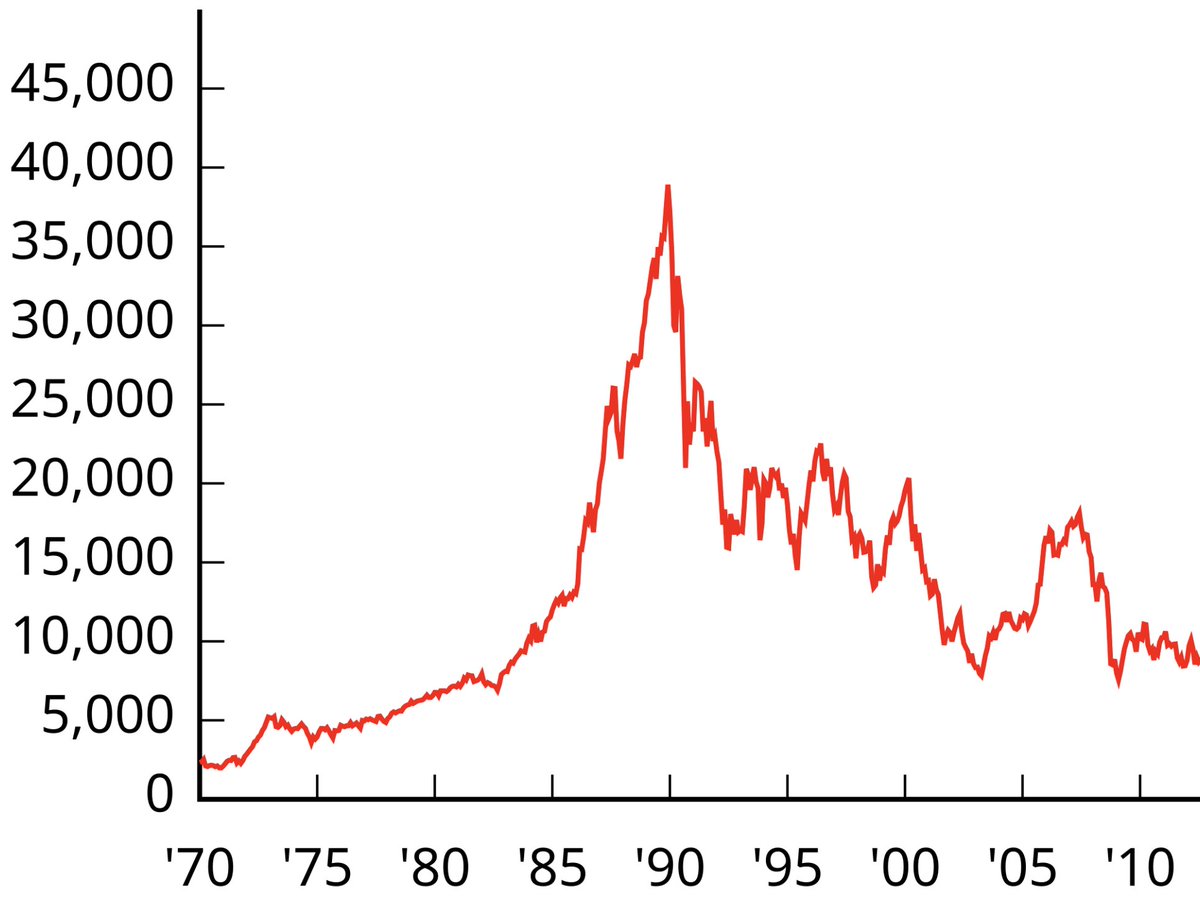
Between 1990 and 2009, the Nikkei 225 (Japan's most important stock market index) collapsed by more than 80%, one of the steepest and longest economic drawdowns in history. For context, the Dow Jones Industrial Index fell about 90% during the Great Depression but hit rock bottom just three years after the 1929 crash.Image
Dec 23, 2024 • 6 tweets • 2 min read
This is going to be a long post, so let's begin by remembering the most important fact of them all:

The Left derives much of its power through its control of key institutions in society. As Republicans, we must prioritize recapturing or dismantling these ideological bastions.

Capturing castles is paramount. Everything else is secondary. First, take back the institutions. The federal bureaucracy is a weapon against conservatives. Fire the activists, re-implement Schedule F, and redirect agencies to enforce existing laws against Leftist overreach, particularly in areas like education (CRT & DEI initiatives among others) and immigration.

The Left wins no matter what because they can always engage in bureaucratic sabotage even when they lose an election. No longer. The Federal bureaucracy must be shredded, and the remaining vestiges must be brought to heel and made to work for us and our values, not against us and for our enemies.
Nov 8, 2024 • 4 tweets • 3 min read
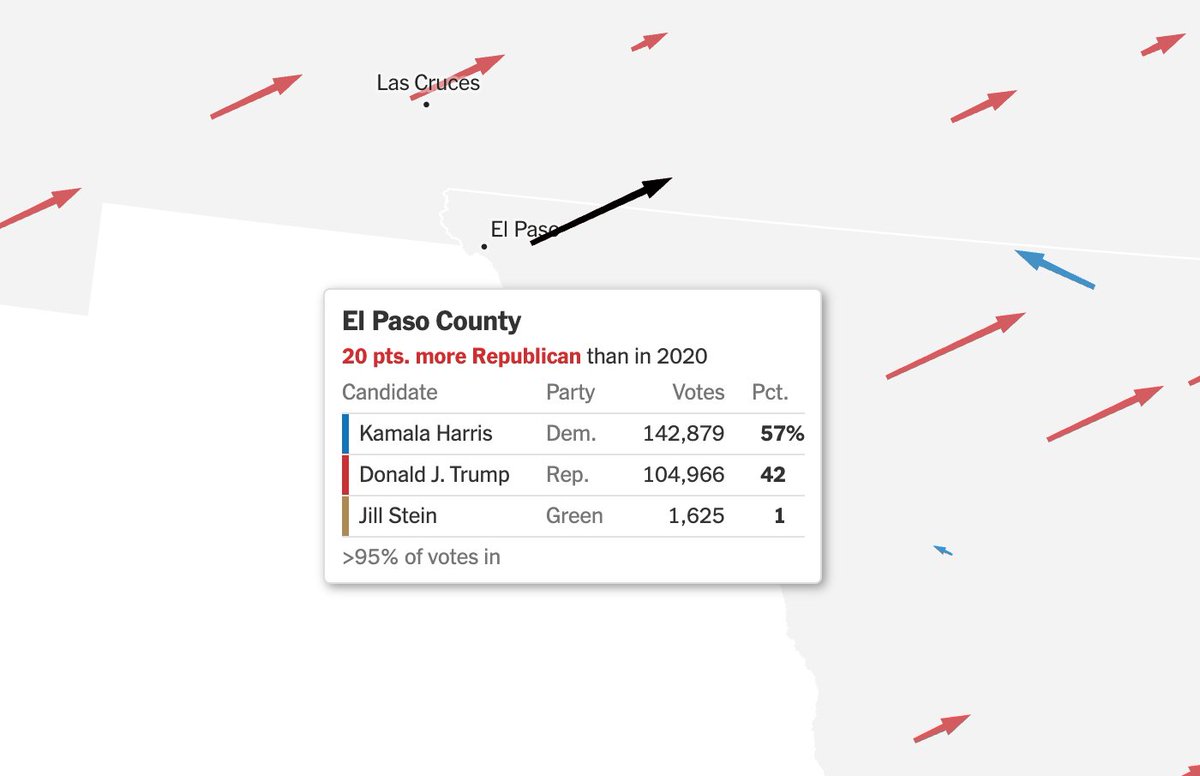
You aren't prepared to see the swing map along the Rio Grande Valley.

Blexas is dead.

Trump erased 20 years worth of Democrat gains in one night. Image
Image
Image
Image
El Paso County moved **20 points** to the Right.
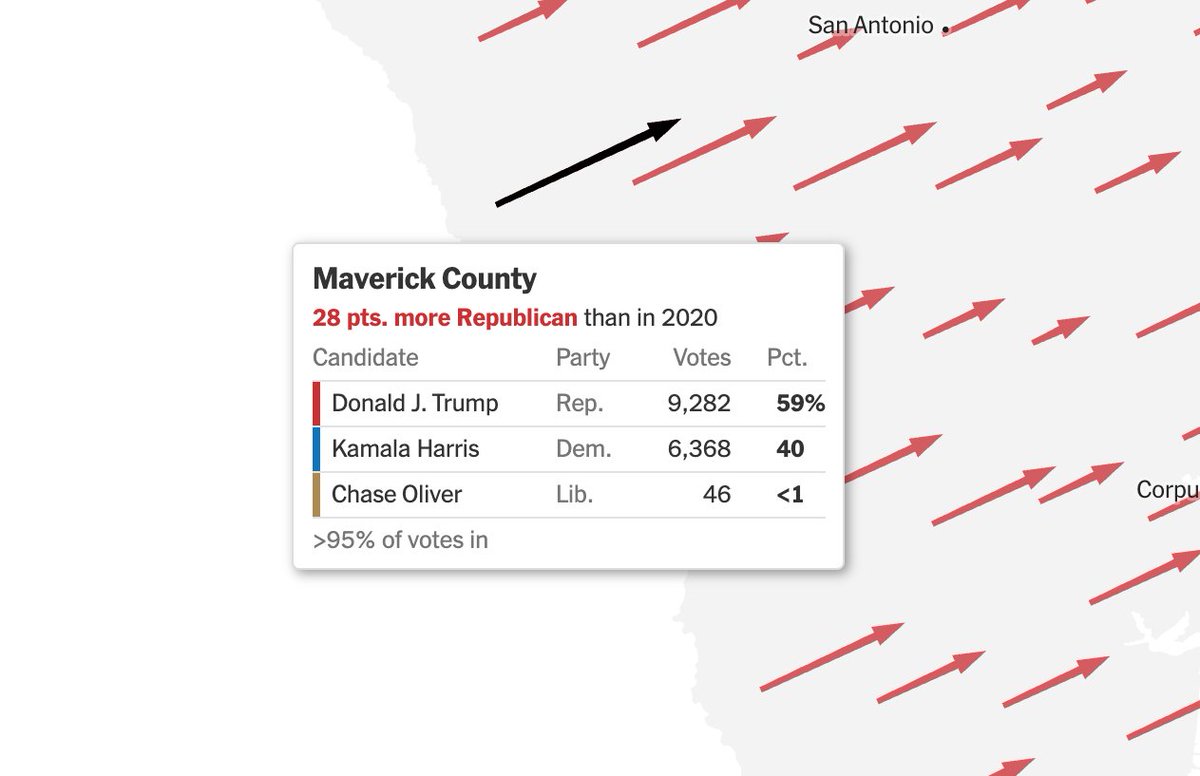
Maverick County hadn't voted for a Republican since 1928. Trump barely won 20% of the vote here in 2016 and he carried it by a 19 point margin.

That's a 72.3-point shift to the Right in just two election cycles!!! Image
Image
Oct 3, 2024 • 9 tweets • 11 min read
Not enough has been said about how modernity has forged the very tools that will one day bring about its downfall.

Julius Evola and René Guénon accurately predicted and diagnosed the metaphysical disintegration that has come to engulf the West, but neither foresaw the scientific revolution that could challenge modernity on its own terms—the implications of quantum mechanics or the resurgence of idealism as a serious metaphysical challenge to materialism.

This would entail pushing the boundaries of scientific inquiry until the materialist framework collapses under its own contradictions. Only then can society be guided toward a new metaphysical understanding that aligns with traditional values and spiritual truths.

In short, there can be no successful “revolt against the modern world” until Nietzsche’s notion of the “death of God” is directly confronted, refuted, and defeated.

This is already quietly happening on the margins of philosophy and science, but we are at the beginning of the cycle, and almost no one has yet noticed this. Below is my attempt at a short essay that may serve as the basis for a longer future post on an outlet like Substack. For now, I will try to outline what happened, why it happened, and what may come next.

Before examining the coming collapse of modernity, it’s essential to understand what came before it. For most of human history, civilizations were built on a shared metaphysical understanding of reality. Whether in Ancient Greece, Medieval Europe, the Islamic world, India, or China, societies operated on the assumption that the material world was not the only—or even the most important—aspect of existence.

Plato was one of the earliest and most influential philosophers to articulate a metaphysical framework. His Theory of the Forms argued that the material world we perceive through our senses is just a shadow of a higher, eternal reality. The Forms represent perfect, unchanging archetypes—such as Justice, Beauty, and Goodness—that exist in an immaterial realm. This realm of Forms was the true reality, while the material world was merely a pale reflection.

For Plato, human beings were not merely physical creatures. We were souls, temporarily housed in bodies, whose actual purpose was to reconnect with the higher, divine realities represented by the realm of Forms. This Platonic vision of reality formed the foundation for much of Western philosophy and religious thought.

There's a reason the Gospel of John equates Christ to the Logos. John knew his audience could identify the importance of Jesus' ministry, resurrection, and status as the Son of God through a direct association with the Platonic concept of the Logos: an eternal force that sustains and provides meaning to the universe.

Plato wasn't alone in this, either. Aristotle also saw the natural world as inherently having immense purpose and meaning. His concept of teleology—the idea that everything in nature has a purpose or end (telos)—suggested that the universe was imbued with intrinsic meaning. Everything, from the stars in the sky to the plants and animals on Earth, had a role in a larger, harmonious cosmic order.

These early metaphysical systems shaped how entire civilizations understood themselves and their place in the universe. The material world was not viewed as an end in itself but as part of a greater spiritual order.

And it wasn't limited to Ancient Greece either. If you'd like a clearer picture of how virtually every pre-modern society shared this metaphysical outlook, I recommend reading Julius Evola's "Revolt Against the Modern World."

It's a very daunting read, but the first half of that book recounts how ancient civilizations—whether in the East or the West—were guided by a spiritual worldview that permeated every aspect of life. Evola shows that virtually every great pre-modern society did not see the material world as the ultimate reality but as part of a larger divinely inspired order. Their customs, laws, and even their politics were all reflections of a higher metaphysical understanding.

This process continued into the Medieval Era. Building upon the metaphysical foundations laid by Plato and Aristotle, Christian theologians like Thomas Aquinas synthesized Aristotelian philosophy with Christian theology. Aquinas laid the foundation for a vision of the cosmos in which everything, from the lowest creature to the highest angel, had its place in the Great Chain of Being. This hierarchy reflected the natural order, which was grounded in divine will.

For medieval thinkers, metaphysics was inseparable from theology. God was not just a distant creator but the source of all existence, the ultimate reality from which everything else flowed. Human beings had a spiritual purpose—to align themselves with God’s will and partake in the divine order. For thousands of years, this metaphysical framework provided meaning, purpose, and direction for individuals and societies alike.