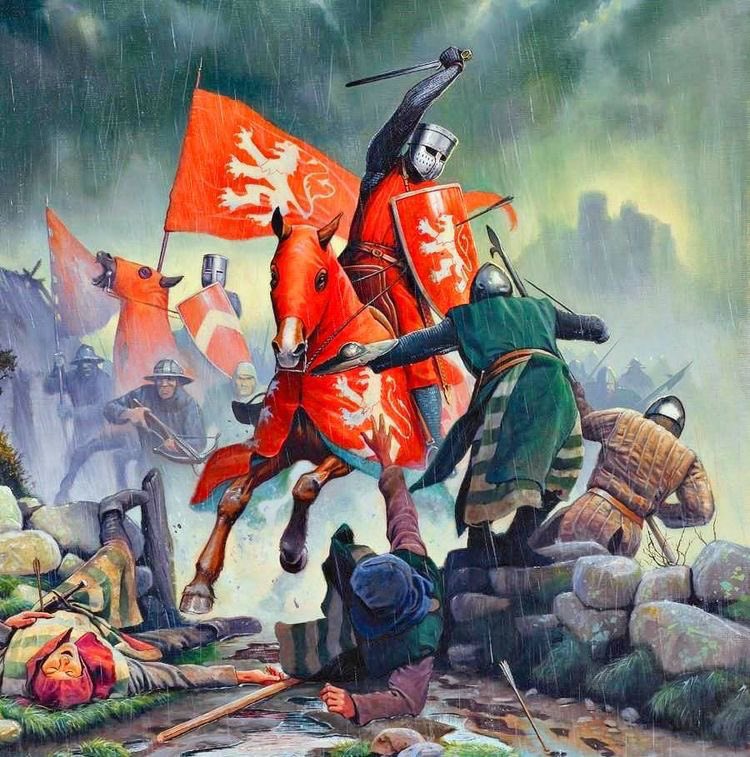
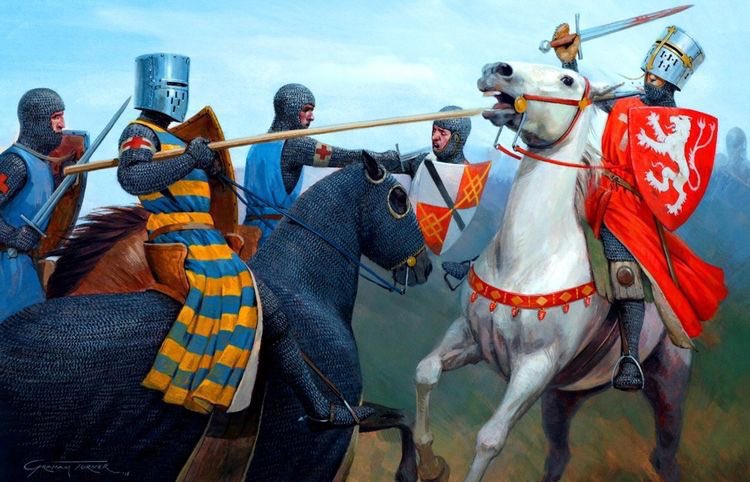
Simon de Montfort was hunted down and butchered by a medieval death squad at the Battle of Evesham.
This is how he met such a grizzly end π§΅
Misrule by the inept & inconsistent Henry III led to widespread discontent and eventually rebellion by many of the major barons in England.
This culminated in the Battle of Lewes.
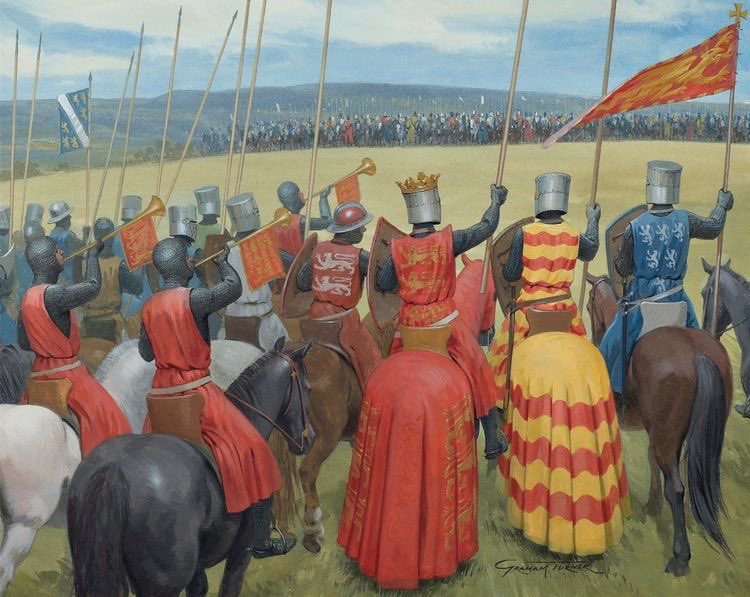
Simon de Montfort led his rebel faction to a decisive victory in which the King, Prince Edward, and the Kingβs Brother Richard were all captured.
However, Montfortβs control over the state turned out to also be deeply unpopular.
In 1264 he held a parliament in the kingβs name and for the first time two knights were summoned from each county, chosen by the county court, and were allowed to comment on general matters of state.
Montfortβs position became increasingly unstable as he was unable to cement his victory at Lewes. Ultimately, English society expected that rule was for the king, and not one disproportionately powerful baron.
Matters came to a head when Prince Edward escaped from captivity!
Prince Edward was able to rally the Welsh marcher lords to his side while Montfortβs most powerful ally, Gilbert de Clare, defected.
Edward attacked and managed to capture the forces of Simon de Montfortβs son, Simon the Younger.
Expecting to rendezvous with Simon the Younger at Evesham, Simon de Montfort & his eldest son Henry were ambushed by Prince Edward flying the Montfort banner.
Edward, breaking with the tradition of capturing noblemen for ransom or imprisonment, ordered a squad of men to hunt & kill Simon de Montfort!
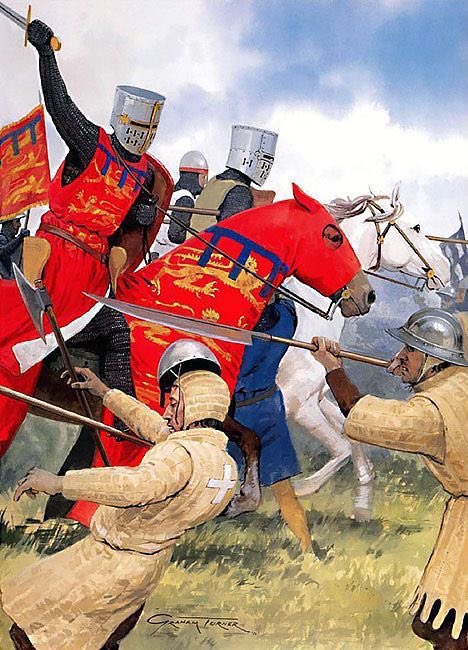
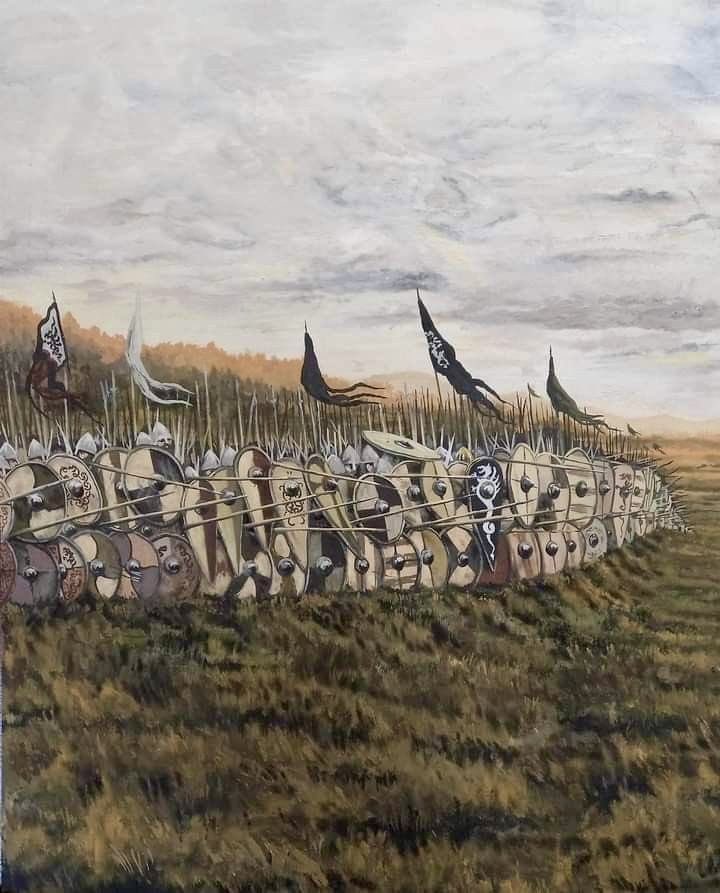
Simon de Montfort led his army on an desperate uphill charge against Edwardβs much larger army. The fighting was gruesome. Knowing that he was doomed and upon hearing that his eldest son Henry had been killed, he was recorded to have said;
βThen it is time to die.β
The men Edward sent to kill Simon de Montfort found him and he was lanced through the neck by Roger Mortimer!
His last words were said to have been βThank Godβ¦β
In the heat of the battle his body was mutilated. His head was cut off & his testicles were hung on his nose while his hands and feet were cut off and later sent to different corners of the land.
Approximately 4000 of his 5000 strong force were said to have been butchered by Edwardβs 10,000 men.
The fighting was so fierce and slaughter so great that the King himself, taken along to the battle by Montfort was only barely rescued by Roger de Leybourne.
Evesham was described as βan episode of noble bloodletting unprecedented since the Conquestβ
Royal authority was restored and Prince Edward would go on to become on of the strongest Kings of England, Edward I.
The battle was eventually described by the contemporary historian Robert of Gloucester as the "murder of Evesham, for battle it was none".

β’ β’ β’
Missing some Tweet in this thread? You can try to
force a refresh

Bohemond of Antioch was one of the most charismatic figures in the Middle-Ages!
He was a disinherited son, a bold warrior, and a crusading legend.
This is a timeline of his life and deeds!
[Thread]π§΅
β’ c. AD 1054:
Birth of Bohemond, whose baptismal name was Mark, to Robert Guiscard, the Norman conqueror of Southern Italy, and Alberada of Buonalbergo, in Italy.
β’ AD 1058:
- Robert Guiscard repudiated Bohemondβs mother when their marriage was annulled due to new rules on the degrees of kinship allowed in married.
- Guiscard marries Sikelgaita. Bohemond is now technically a bastard.
β’ AD 1073:
Robert Guiscard falls ill and Sikelgaita holds a council and persuades Robertβs vassals that her son Roger Borsa and not Bohemond, should be his heir.
β’ AD 1079:
Bohemond fights alongside his father against rebel barons in Italy.
β’ AD 1081:
Bohemond invades the Balkan territory of the Roman Empire and fights at the battle of Dyrrachium where the emperor Alexios Komnenos was severely defeated.
β’ AD 1082:
- Capture of Ioannina.
- Alexios Komnenos induces the Germans to attack Robert Guiscardβs territory in Italy and he returns and leaves Bohemond in charge.
- Bohemond captures Ioannina.
- Bohemond defeats Alexios outside of Ioannina.
β’ Bohemond besieged Arta and defeats Alexios in battle again.
One of the greatest adventures of the Middle Ages was the crusade led by Prince Edward Longshanks!
Outnumbered and hoping against hope to rescue the Holy Land from the Muslims, he befriended the Mongols and faced off against assassins and Mamluk warriors!
[Thread]π§΅
In 1260 the Mamluks won a startling victory over the invading Mongols and the Mamluk general Baibars seized power and began conquering the Christian cities of the Holy Land.
In 1268 he captured Antioch and a crusade was called in response. This was to be the Eighth Crusade led by Louis IX of France who diverted it to Tunis.
The Eighth Crusade to Tunis was an unmitigated disaster. Louis IX died in Tunis, as did his son John Tristam who was born in Damietta during the seventh crusade.
Prince Edward of England, also called Edward Longshanks, was supposed to join the crusade with his brother Edmund but they arrived after the crusade already failed.
Cicero is a famed Roman politician, writer, and orator.
But what about Cicero the general?
This is the tale of Ciceroβs Cilician adventure when was hailed as imperator by his troops!
[Thread]π§΅
When he was consul in 63 BC, Cicero famously foiled a conspiracy by Lucius Sergius Catilina to seize power in Rome.
When he discovered the plot, he put on armour and made his way to the senate to deliver a series of speeches against Cataline. The conspiracy was thwarted but Cicero remained unpopular with some for having some of the conspirators executed.
Cicero was eventually exiled when his enemies gained power in Rome. During this exile, and thanks to certain legislative requirements, he was made governor of Cilicia in 51 BC. It was not a position he wanted.
In 53 BC, Crassus led his doomed expedition against the Parthians. He was enticed into a trap and his exhausted army was savaged by Parthians horse archers at the battle of Carrhae.
Crassus died and Cassius led what was left of the army back to safety.
But then Pacorus, son of the Shah Orodes, invaded Roman territory and besieged Cassius in Antioch.
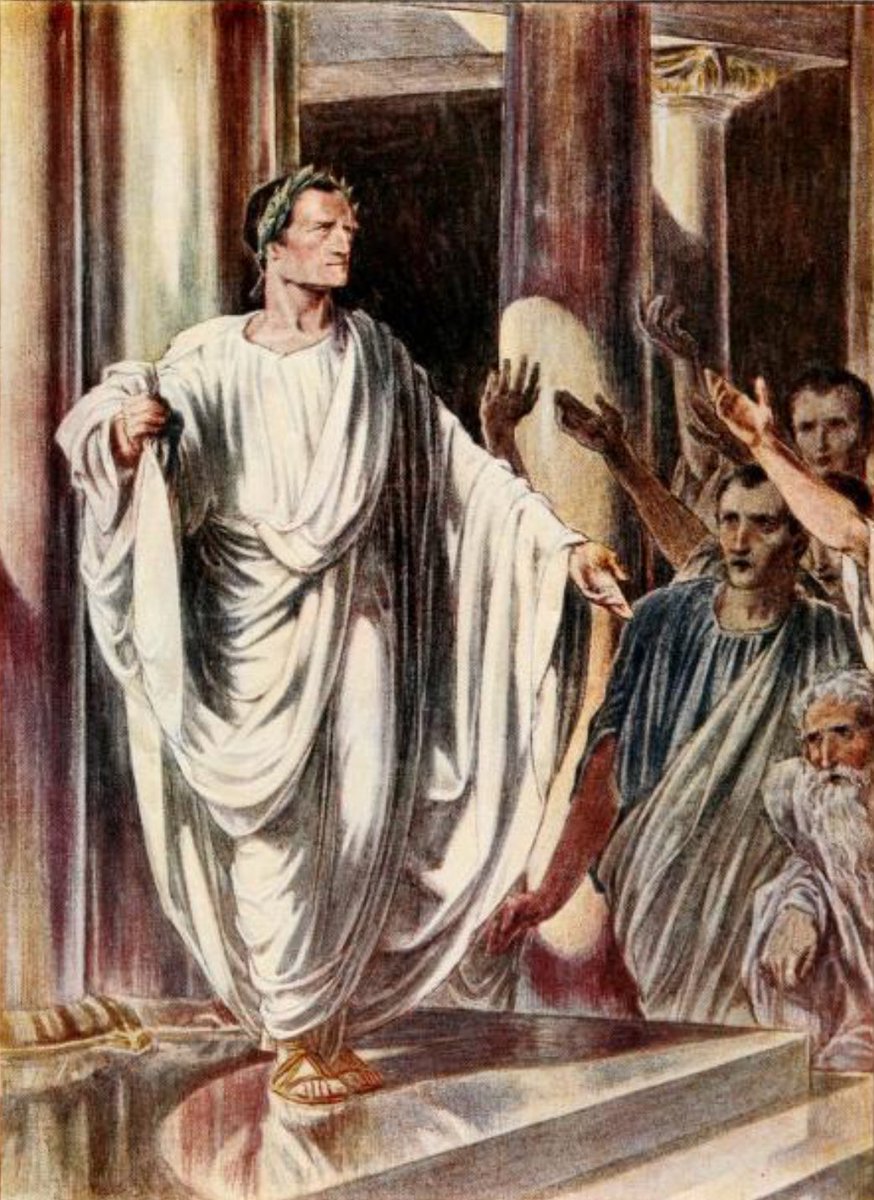
After the Roman Senate threatened to declare him a public enemy, Gaius Julius Caesar changed the history of the world foreverβ¦
And crossed the Rubicon!
[Thread]π§΅
The Roman Republic had fallen into vicious cycle of corruption, violence, and political instability. In the mid-1st century BC the three most powerful men were Julius Caesar, Pompey Magnus, and Marcus Licinius Crassus.
But Crassusβ death ended this coalition between them, and the short-lived marriage of Caesarβs daughter to Pompey could not stop either man from scheming. Pompey remained in Rome and governed his provinces from a distance while Caesar was conquering Gaul.
Plutarch tells us that βCaesar had long ago resolved upon the overthrow of Pompey, as had Pompey, for that matter, upon his. For Crassus, the fear of whom had hitherto kept them in peace, had now been killed in Parthia.β
βCaesar had entertained this design from the beginning against his rivals, and had retired, like an expert wrestler, to prepare himself apart for the combat. Making the Gallic wars his exercise-ground, he had at once improved the strength of his soldiery, and had heightened his own glory by his great actions, so that he was looked on as one who might challenge comparison with Pompeyβ
There was great tension in Rome over Caesarβs conquest of Gaul, which ended with the victorious siege of Alesia, and the end of his appointment there. Perceiving the threat, Cato persuaded the senate to make Pompey sole consul - βa more legal sort of monarchy he might be withheld from demanding the dictatorship.β
Alfred the Great and Γthelred the King fought βfor life, loved ones, and countryβ and thrashed the Vikings atβ¦
The Battle of Ashdown!
[Thread]π§΅
By 870 the Vikings βof hateful memoryβ had stormed into England and conquered Northumbria and East-Anglia!
On the 31st of December 870, after invading Wessex, a force of Vikings led from the main host was defeated at the Battle of Englefield by the Ealdorman of Berkshire, Γthelwulf, and his levies.
However, King Γthelred and his brother Alfred, having tried to capitalise on this victory were defeated by the Vikings just a few days later at the battle of Reading.
But they were βroused by grief and shameβ and rallied at Windsor.
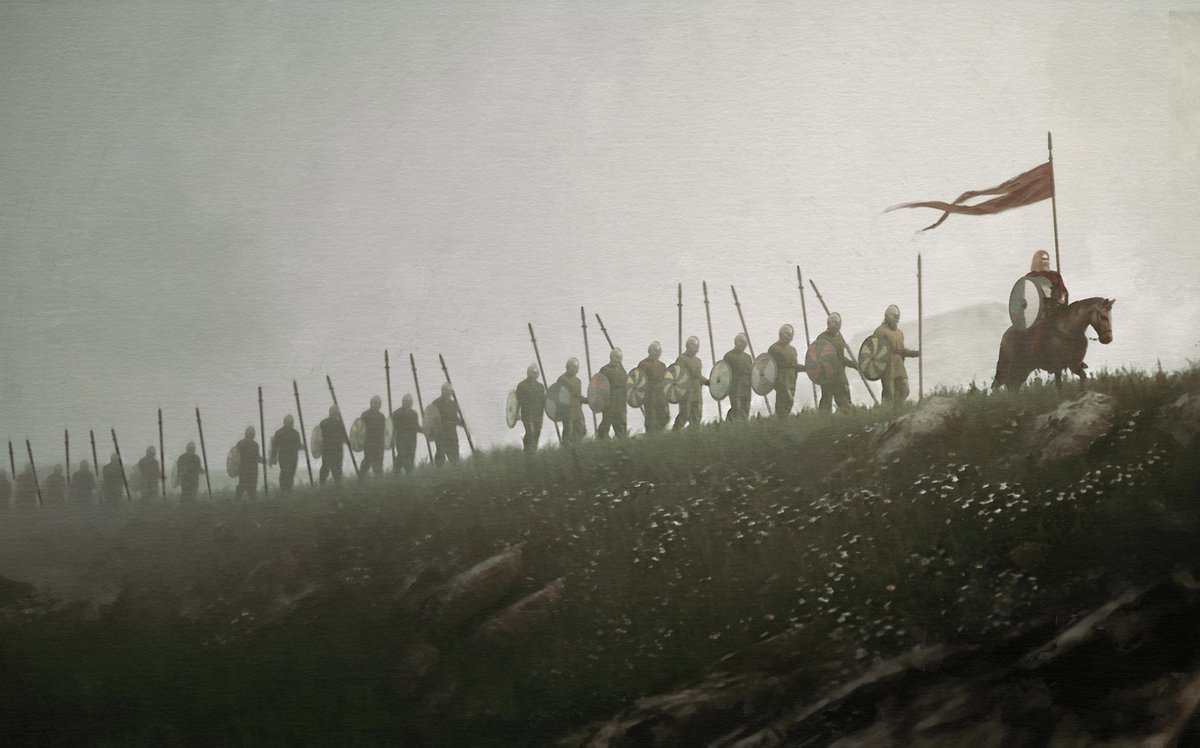
The Saxons then marched to face the Vikings again with βall their might and in a determined frame of mindβ and met them at Ashdown.
The Vikings divided their army into two contingents. One was led by kings Bagsecg and Halfdan, and the other was led by the Vikings earls.
The English did the same with Alfred facing the earls and Γthelred facing the kings.