I am normally a slavish devotee of @Dannythefink, but I think this on the Online Safety Act misses the mark profoundly (1/?) thetimes.com/comment/column…
Danny's thesis is that the OSA has just come in, and we should approach it with an open mind until we know how it's actually working. But that ignores everything about how the OSA was put together, and in particular the staggering ignorance shown by lawmakers during that process.
Everyone who knew even the slightest bit about tech had profound concerns about this law, ranging from the core idea of 'legal but harmful' speech, to the chilling effect on tech investment, to the way a law meant to target Google/Meta would actually entrench their dominance.
We at @CPSThinkTank wrote multiple reports on what a looming disaster it was, and lobbied furiously (and succesfully) to ameliorate 'legal but harmful'. But also @asi, @89up, @StartupCltn and many others. We all ran into invincible status of 'won't someone think of the children'.
@CPSThinkTank @ASI @89up @StartupCltn So the reaction to the Bill, in many quarters, is not a case of people suddenly being put out to have to verify their age before they can look at porn. It is that, to echo R Conquest, we told you so, you ****ing fools.
@CPSThinkTank @ASI @89up @StartupCltn So yes, in the wider sense, Danny is completely right that we shouldn't react hysterically to every little thing. But this is a law that everyone knew would be bad, turning out to be bad.
@CPSThinkTank @ASI @89up @StartupCltn Oh, and always worth remembering as per @meIisactu that there is a huge amount of really bad stuff still to come down the track
What many people within Labour seems to be assuming is that they have some kind of financial/policy wiggle room. They don't. (1/?)
Here are the assumptions the OBR was making in its March forecast. The numbers have already deteriorated substantially - in particular gilt yields (up), GDP (down) and inflation (up). And they may get far worse yet.
But even under those sunnier assumptions, the public finances were still being run on a wing and a prayer. In particular, to pay for her initial spending splurge, Reeves pencilled in neo-austerity for the back half of the parliament - effectively, real-terms departmental cuts.
Now the dust has settled from the local elections, it's time to talk about vote-rigging. In particular, the way in which a sinister force has been manipulating British democracy in council after council, year after year. That force? The goddamn alphabet. (1/?)
Here are the top six candidates from the ward where I live, Battersea Park in Wandsworth. Notice anything? They're in perfect alphabetical order. The same happened when I checked out another ward where a friend was standing, Wandsworth Town.
The effect is just as noticeable when the parties aren't bunched together. In Furzedown, for example, the leading four parties went ABC, ACB, ABC, ABC. What are the chances?
If migrants are net contributors, why are so many in poverty? Me for @thetimes on how Emily Thornberry blew up the Left's case for mass migration times-comment.com/thornberry-mig…
Quick summary: Thornberry cites @IPPR analysis showing that of 4.3m children in (relative) poverty, 1.5m are from migrant families. Of the 309k children affected by ILR extension, 130k could be in poverty by 2029 thanks to being denied access to benefits for longer.
@IPPR But this (of course) blows up the argument about contribution! In fact it's an explicit argument for us to do more to subsidise new arrivals, even though the risk of subsidising huge numbers of non-contributors was the big justification for ILR reform in the first place.
There are lots of reasons to be depressed about how the British state is run. But as per my @thetimes column, the story of the deregulation programme is the ultimate ‘there are no ninjas’ eye-opener. (1?)
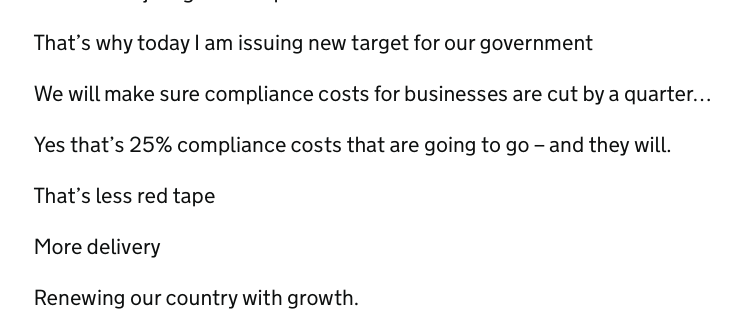
Exactly a year ago, @Keir_Starmer stood up and promised ‘fundamental reform of the British state’. This included cutting compliance costs for businesses by a quarter. But there was a problem.
Whitehall did not know how much those compliance costs were. It wasn’t even clear, at the time of the speech, what exactly the PM meant by ‘compliance costs’.
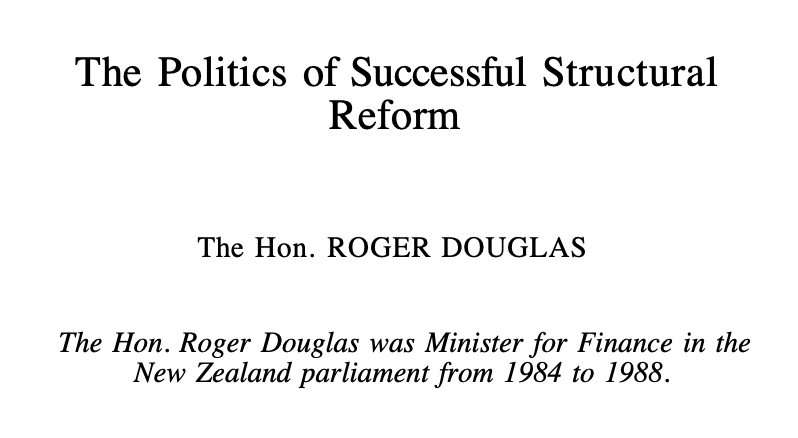
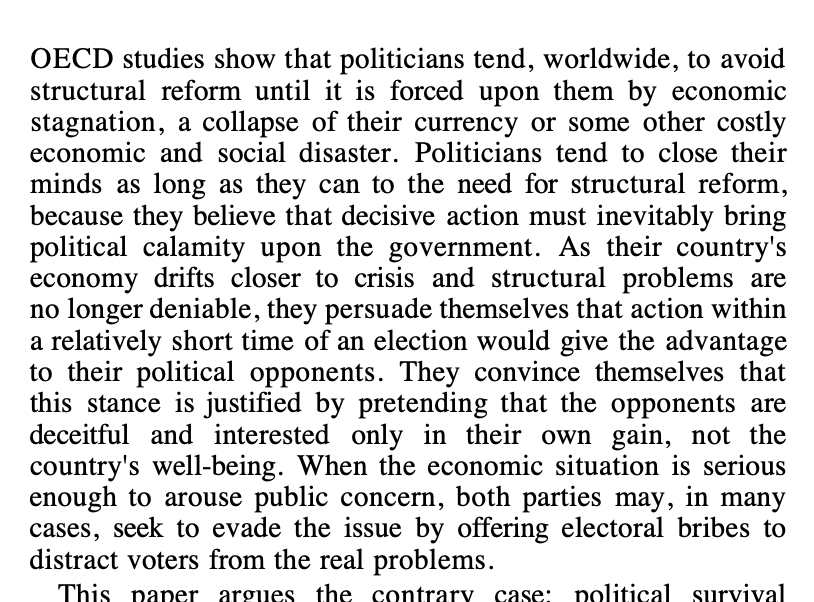
Have written my column on one of the most interesting political essays I've ever read, because it argues that essentially everything modern British politicians think about political and economic strategy is completely wrong. (1/?)
The full thing doesn't seem to be available online, but its core argument over 35 pages is, essentially, that voters are not idiots - that if you do tough, necessary stuff and explain it, you will end up in a better place than via relentless short-term pandering.
Douglas - Labour finance minister in NZ in the 1980s - basically out-Thatchered Thatcher. He argues that the stuff voters ended up hating was always where the govt chickened out - and that sweeping action is actually safer than small steps, because it outflanks vested interests.
Striking findings from @NatCen on migration. View that it is a cultural/economic negative has risen sharply post-Boriswave, but overall levels still not as negative as pre-Brexit. But there has also been huge polarisation... (1/3)
As @Sirjohncurtice says (this is screenshot from Zoom), those on right are even more -ve about migration than previously - but those on left still think it's broadly a good thing.
@Sirjohncurtice Obviously overall all the polling shows people think migration has been way too high - and as @Dominic2306 says don't even realise how high it's been - but what is new is this wide and widening gap b/t left on right on whether migration is a good thing full stop.