Andy Constan Profile picture
Aug 6 20 tweets 4 min read Read on X
"Trillions" of Foreign Pledges of USD investment that Trump controls 101.

Many of the tariff deals contain murky promises, other commitments are also being made by Middle East sovereign wealth funds and private sector entities. The idea that Trump controls these investments
Is also an important factor. It's all high drama and shiny object stuff. But I care more about the mechanics. The mechanics of a foreign USD investment in USD assets are the same as any other investment. The big question is how does one get the USD from whom and how is it raised
Let's start with a simple example. The Saudi's (directed by Trump or otherwise) make a U.S. investment. What can they invest in? There are only two investments possibles buying physical things like land, factories, infrastructure and buildings or buying stocks and bonds.
Unfortunately the term FDI which I would like to use is hung up with "control". Which muddies things. So I will use "real" investments vs "financial assets"

One thing one must expect is that the Saudis aren't "gifting" the money. They expect evidence of ownership a contract
or share ownership or an indenture etc. BUT even if it was a gift the mechanics remain.

How does a Saudi get the money? That question is answered in a few ways

1. They Sell USD assets already held
2. They sell ROW assets and buy USD with the proceeds
3. They accrue USD by selling US stuff over time
4. They borrow USD from a bank pledging sovereign assets as collateral or tap whatever unsecured credit lines they have
5. They borrow Riyal from banks and buy USD
6. They print Riyal and buy USD
That's pretty much all the ways any of these countries can fund the investment they allegedly promised to Trump.
If you think I'm missing one or more please help but it's a pretty good chance that the 6 I mention cover your suggestion if you follow the money.
Let's break them down.
1. Presumably you can see that selling a USD asset they already own is not a new
Investment in the U.S. If Trump wants the investment in T-Bills then Saudi will have to sell something longer term to fund the purchase and that has impact
If he wants it
In factories the Saudis can fund by selling U.S. treasuries. That has impact BUT net it's not new investment.

2. If Saudis sell ROW assets they already own and buy USD with the proceeds someone has to sell a USD asset to raise the USD to exchange the currency with the Saudis.
Once again there are temporary market impacts of all these flows but NO net new investment in USD Assets

3. This is tricky. The U.S. trade deficits provide Saudi with USD. That can fund new investment in U.S. assets BUT there would have to be an INCREASE relative to existing
Trade imbalances to provide and Increase in investment that Trump is describing or else the "new investment" is just the same old same old trade deficits/capital surplus equation that has been happening for decades. Ironically tariffs are designed to make
trade deficits fall! Which would lead to relative disinvestment in U.S. assets.

4. If they borrow USD from a bank that is 💯 new investment. Private sector banks leveraging up their balance sheet is good old money printing. The question is simply how much capacity does the
private sector banking system have for a particular country or its private sector entities as credits and how much credit is available overall? The answers to this question are likely found in bank leverage and capital adequacy. Could the banking system print 1TN of new money
to high quality (even sovereign credit guaranteed) credits. Probably. Maybe even 2TN. BUT that borrowing would cause a tightening in credit conditions for all folks on earth that want credit. It will have consequences. BUT it does fund the investments "promised"
5. Borrowing from a local bank in local currency except perhaps in Japan is limited given the sizes and constraints of the local banking systems but it is money printing. But then the next step is to buy USD which to raise the USD sold the seller either has to sell
USD assets like in option 2 or borrow USD like in option 4. So 5. Offers some
Capacity but devolves into either 2 or 4. But does diversify and spread out the "credit risk"

6. Saudi can issue government bonds and have its central bank buy them which "prints money"
That can devolve into 2 or 4 OR the Saudi central bank can swap its riyal with the Fed to USD which will turn the riyal printing into USD printing by the Fed and 💯 fund the investment. What's cool about the mechanics is we can see what is actually happening to fund these
Alleged promised investments

My expectation is most of it is 1. And had no net impact on USD investment but if it is 4, 5.
or 6 then we will see it as leveraging up of US, ROW banks, or Fed Swap lines. Each have their own specific impact and even though it is
Net zero impact on USD has a big impact on relative pricing of USD assets and a
Flow through to U.S.economic conditions. If Trump wants the Saudis to swap out of stocks to treasuries that's bad for growth assets. if the opposite it's bad for yields.

If it's all nonsense of
Double counting already planned or mechanical trade deficit stuff it's mostly just noise

• • •

Missing some Tweet in this thread? You can try to force a refresh

 

Keep Current with Andy Constan

Andy Constan Profile picture

Stay in touch and get notified when new unrolls are available from this author!

Read all threads

This Thread may be Removed Anytime!

PDF

Twitter may remove this content at anytime! Save it as PDF for later use!

Try unrolling a thread yourself!

how to unroll video
  1. Follow @ThreadReaderApp to mention us!

  2. From a Twitter thread mention us with a keyword "unroll"
@threadreaderapp unroll

Practice here first or read more on our help page!

More from @dampedspring

Aug 7
Today as equities melt up I wrote down for DS Members the bull case for equities. Open minded exploration of bull and bear cases at all times is my process. Markets are almost always right so a bull case must exist. Here is mine 🧵
Let's give this a try. Reasons to be bullish stocks.

Stock prices change for a combination of fundamental and flow reasons.

Why should they go up.

Fundamentals

1. Accreting realized net income is almost always a positive and currently is running at 1% a month positive influence. As long as earnings growth is running at 12% this influence simply makes stocks more valuable as they retain earnings, buyback stock, and pay dividends.

All other fundamentals are expectations based. But without a change in expectations 1 dominates

However a change in expectations if it occurs is much more powerful than this monthly drift.

Expectations.

Consensus earnings growth expectations are for at least two years of ongoing 12% earnings growth. The realized is extrapolated out two years. While determining consensus earnings past then is prone to high errors in prediction in both directions. It's likely that a continued high rate of longer term earnings growth expectations is consensus

Corporate earnings are heavily driven by two major factors NGDP and deficits. NGDP drives top line sales because it is literally top line sales and deficits drive margin (Kalecki-Levy). Breaking those two factors down currently NGDP expectations are roughly 4.5% which is a combination of 1.5% rGDP and 3% inflation. Upside to NGDP expectation is not my view but if wrong real gdp could rise based on

population growth higher than expected likely driven by immigration cuz citizen demographics is highly predictable and slow moving

Productivity growth higher than expected which could be deregulation and/or AI delivering more than expected. (Expectations are likely pretty high but they could be too low)

Inhalation expectations are pretty stable and lowish while productivity gains which real growth depends on is most likely disinflationary lowering inflation expectations easy monetary conditions and leveraging up by private and public sector can offset that and keep inflation expectations high or even rising. (Thats good for stocks and bad for bonds). So there is a case for rising NGDP expectations and rising top line expectations for
Stocks.

What about margins. The big thing for margins is deficits. Currently and most frequently the biggest fastest moving variable for deficits are policy. In particular the most volatile component is tariff revenue. What I suppose is absolutely certain is announced tariffs have only downside from here. While around the margin I could imagine further tariffs assessment that seems less likely and small. Tariffs are pretty big. I suspect tariff expectations are much lower than current tariffs as they stand. Two reasons make me believe tariff expectations are lower than current assessment. 1. They may be declared illegal by the "radical left" circuit courts and that decision is upheld by Roberts /Barrett swing votes
2. The current assessed level is likely to be partly and meaningfully paid by US consumers and corporations which will reduce demand and raise prices and in aggregate be a net NGDP hit that will be pretty meaningful and destructive to the economy and stock prices.
For those reasons future tariff assessment expectations MUST be below current. However that expectation is FAR above tariffs being completely struck down or Trump voluntarily deciding to reduce tariffs a lot. So there is clear upside for tariff reduction which is pro NGDP and also increases the deficit which flows to margin. (Good for stocks and very bad for bonds unless intervention in bond supply follows). In terms of timing of the courts the circuit got the case last week and it should take a month for it to get punted to Supreme Court. I'm not a legal scholar but I read that the circuit court is highly unlikely to rule in trumps favor. It would be a huge negative surprise to markets if they rule in favor of Trump and a modest positive if they rule against based on Expectations. I have no idea how the Supreme Court rules and if 1/n
The Trump administration can or will try another tack for tariffs if ruled against including other forms or simply ignoring the ruling however if tariffs disappear the market and the economy is not priced for the outcome.

NGDP will surge and margins will surge. The dollar and bonds will crater and stocks and hard money will moon. The Fed will be on permanent pause or hike.

Flow

The current flow is like the current earnings accrual an up and to the right influence. Daily savings growth is positive and is almost always positive except in rare cases of negative employment. That daily savings growth is typically offset by net supply of stocks. But for the last 5 years public sector share count is falling as share repurchases heavily offset insider employee liquidations from various compensation schemes and issuance of IPOs and secondaries
Stock sales.
Except during the spac bonanza the daily net flow is bullish and probably at 25-50bp per month of appreciation I measure this with my daily passive flow indicators and it is clearly bullish and has been for 5 years at least.
The next topic is expectations of net supply and demand for equities. My measurements are consistent with high expectations that this net negative supply dynamic will continue at the current strong pace. In other words passive flow expectations are quite bullish. The dominant fast moving aspects for these expectations are pace of share repurchase, pace of savings growth, issuance expectations. Share repurchase pace
Expectations remain high but this one seems a downside risk that's not yet priced as
Capex expectations are very high and to fund CAPEX a choice may need to be made going forward by the hyperscalers who dominate the share retirement landscape. There is practically zero issuance and those expectations have no downside but a burst of issuance would be a negative surprise. That's not priced. How the world is going to finance its spend on hyper scaler and AI services is unclear and issuance by the rest of the equity market seems likely to me but is not expected. Lastly as mentioned the passive flow is up and to the right and may wiggle up (bullish) or down but only a sustained
negative jobs outcome will turn this flow negative.

Lastly in my overall assessment of equities is positioning. Having already addressed gross supply and demand above the next step is investor cohort supply and demand. What I would say
First and foremost is that this doesn't matter much over a
Quarter or year but matters a lot over any monthly or shorter time
Frames. It takes days weeks or at most months to correct position underweights and overweights of cohorts. Positioning data and sentiment data supports rapid rebalancing across cohorts. When breaking down the cohorts some things are clear. Over the last quarter AUM of cohorts has shifted pretty meaningfully. Leverage of cohorts has shifted as well. I'll also cover performance vs benchmark of cohorts and vol targeting more broadly across
Cohorts.

The biggest recent change is a shift from institutional AUM to self directed AUM That shift isn't a firing of imstitutional managers. That isn't seen in data as any "firing" is heavily masked by mechanical 401k and IRA
Contributions that still occur. But the self directed cohort is increasing its self directed allocation while keeping its institutional allocation flatish. Yes retail is buying.

Hedge funds which are the other cohort are pretty stable both in an AUM flow sense and a net exposure sense and are neither massively overweight or underweight shares.

Perhaps the most bullish aspect
Across cohorts regarding flow is vol targeting. Positioning changes from vol targeting has been bullish since April. Because of the rapid but choppy decline in vol and rise in portfolio diversification measures sustained levels will result in aggregate demand for assets as
Heavy filtering of vol changed leaves cohorts under desired leverage targets at 2/n
Read 4 tweets
Aug 6
Synchronicity of thinking with @BobEUnlimited excellent piece on AI. This weekend I asked @DanielSimonyi to do some work on this topic for DSDATA 🧵 Image
Here is his write up and some helpful charts

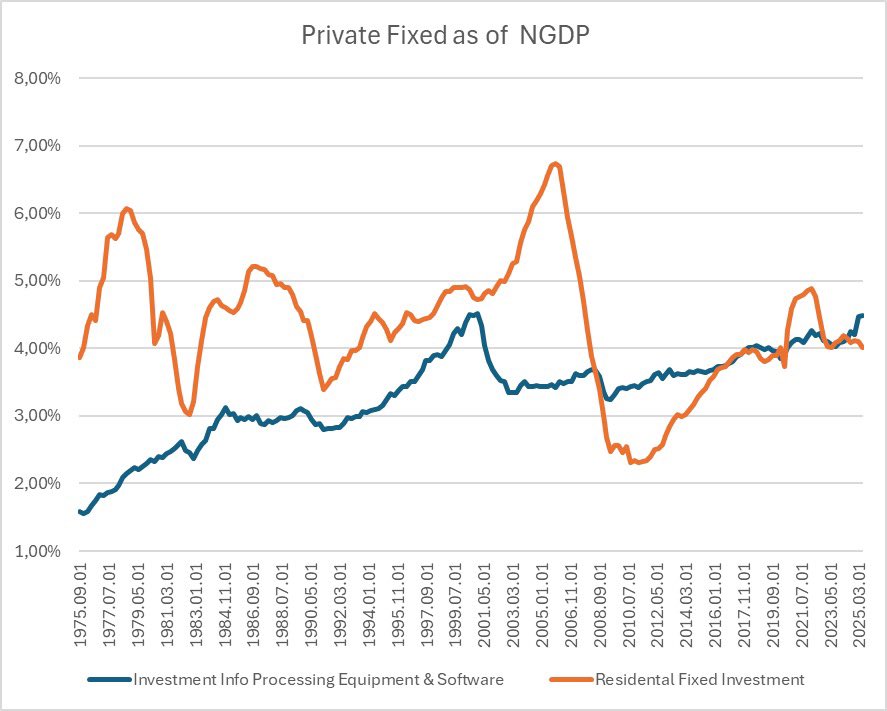
The most directly measurable impact of AI and data centers is reflected in private fixed investment in information processing equipment and software fwiw the full impact is probably somewhat higher. This category accounts for around 4.5% of GDP, with both Q1 and Q2 showing strong contributions to real GDP growth.

However, this pace is likely unsustainable going forward. The sharp acceleration in capex is likely behind us, and the recent growth rate may not be maintained. Any sustained weakness in final demand will almost certainly affect future investment, as AI demand ultimately depends on business revenues and profits, which are tied to nominal GDP. Realized and forecasted capex remain elevated, while free cash flow and cash and cash equivalents are declining for hyperscalers.
2000 level tech investment Image
Read 9 tweets
Jul 29
The Druck Myth about terming out the US debt 101. When thinking about the government finances many smart people (including Druck) make a fatal mistake and model the government as a private sector corporation or individual. Public finance is not the same as private finance.
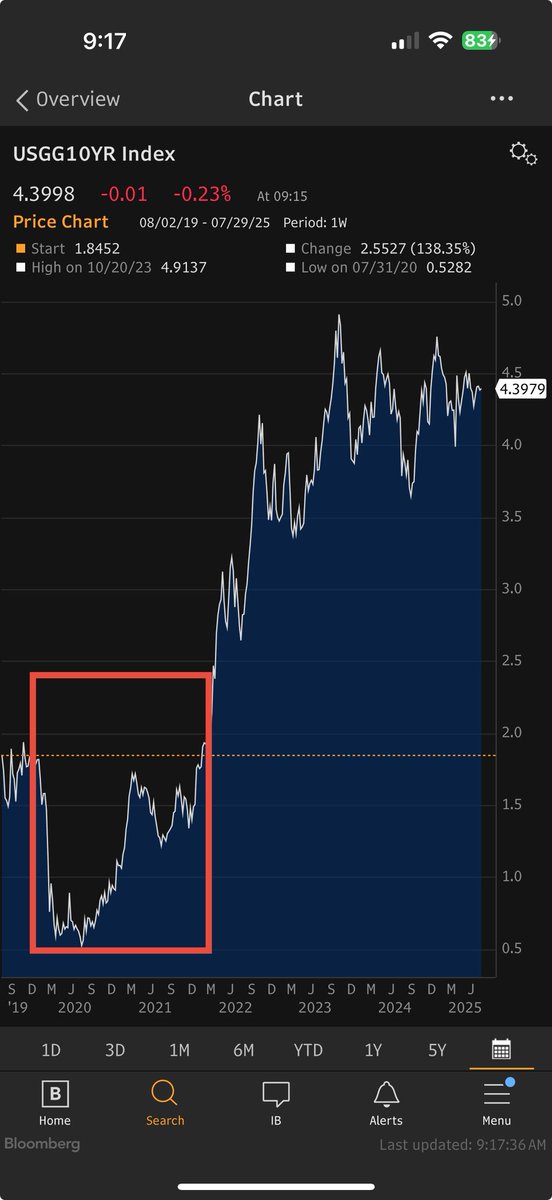
But let's assume for a moment that the Treasury was simply a market participant trying to time the market with its issuance. The period in focus is from April 2020 to March 2022. Where 10 year interest rates plunged during Covid and QE. Of that 2 year period Mnuchin was SoT Image
For 10 months and Yellen was for 14 months. So plenty of "blame" to go around if you are looking at this with an anti Yellen political bias
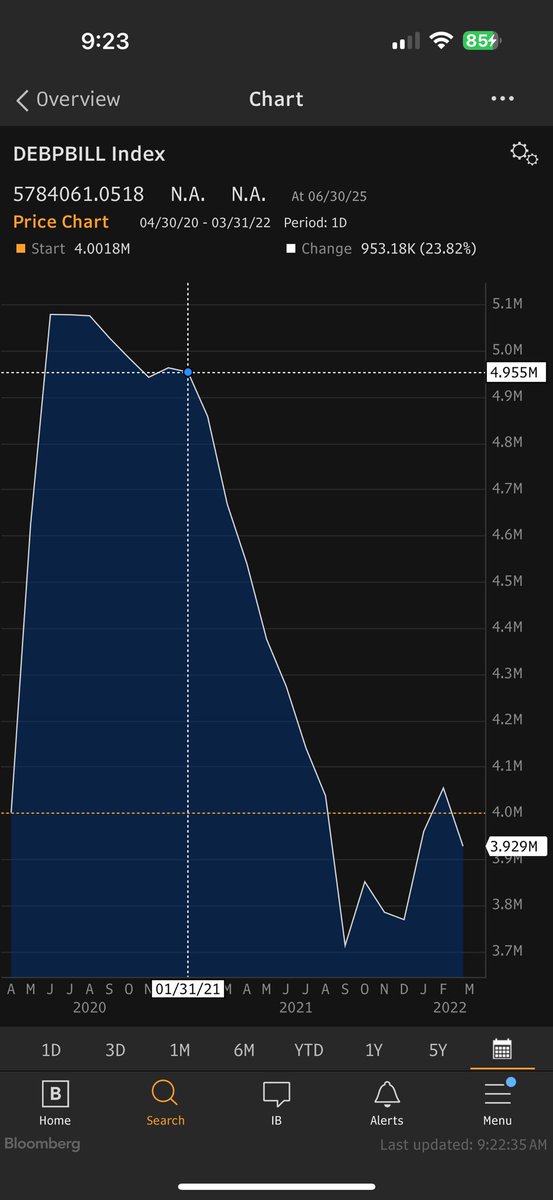
But ironically during that period ALL the TBILL issuance came during Mnuchin's reign. During that time Yellen "Termed out" 1TN of bills Image
Read 23 tweets
Jul 27
Genius Act compliant Stable coins 101 a legitimate threat to established players in the transaction space NOT a way to grow NET demand for USD or USD assets much.

People are unwilling to break down how money works and would rather kluge together lots of concepts in one 🧵 1/2
The most important red flag one should recognize when reading people's outlook for Stable coins is when they focus on AUM growth. Perhaps the most notable gaslighter is @SecScottBessent who has projected stable coin growth to be large and important as demand for US TBILLs.
I absolutely accept and believe that genius act stable coins will grow AUM and perhaps meaningfully. I also KNOW for sure that AUM growth (minting of new stable coins) will result in the minter buying US Tbills. So does Bessent! We all know this! When stable coin AUM
Read 25 tweets
Jul 12
Taking a step back 101 part 2. Policymaker tweaks - gasoline and fire extinguishers are both at play like during a crisis.

In part 1 of this thread I made a case that an excellent outcome would be a stabilization of NGDP at 4%.
4% achieved via inflation at target of 2%. Population growth at roughly 50bp and production growth at a robust but not historic high of 1.5% would be Goldilocks.

You may quibble at productictity being too low because of AI and deregulation but because of both of those being
Deflationary any bigger number for productivity may make holding inflation at 2% harder without monetary stimulus which means NGDP may stay at 4% anyway.

4% stability with a credible inflation target would almost certainly generate a lower marginal interest costs for the
Read 25 tweets
Jul 12
Taking a big step back 101 Looking at the most major single economic variable is helpful sometimes. Current YoY GDP growth is at the post Covid low of 4.7% which is still relatively hot vs history but the flight path has been clearly in descent. Policymakers would ALL like 🧵 1/2Image
To have this single variable bottom at no less than 4%, a literal "soft landing" and avoid dropping into the 3's or 2's or worse and stabilize at 4% for the next decade. Regardless of political affiliation we all should hope for this outcome.

Why should we hope for this?
Before delving into the reasons why 4% NGDP stability is "good". Let's start with some mechanics of the national debt which benefit from a stable 4% NGDP

Current US interest rate on debt held by the public is 3% ish. marginal rate is below 4%
Read 25 tweets

Did Thread Reader help you today?

Support us! We are indie developers!


This site is made by just two indie developers on a laptop doing marketing, support and development! Read more about the story.

Become a Premium Member ($3/month or $30/year) and get exclusive features!

Become Premium

Don't want to be a Premium member but still want to support us?

Make a small donation by buying us coffee ($5) or help with server cost ($10)

Donate via Paypal

Or Donate anonymously using crypto!

Ethereum

0xfe58350B80634f60Fa6Dc149a72b4DFbc17D341E copy

Bitcoin

3ATGMxNzCUFzxpMCHL5sWSt4DVtS8UqXpi copy

Thank you for your support!

Follow Us!

:(