Aravind Palraj Profile picture
Aug 6 9 tweets 3 min read Read on X
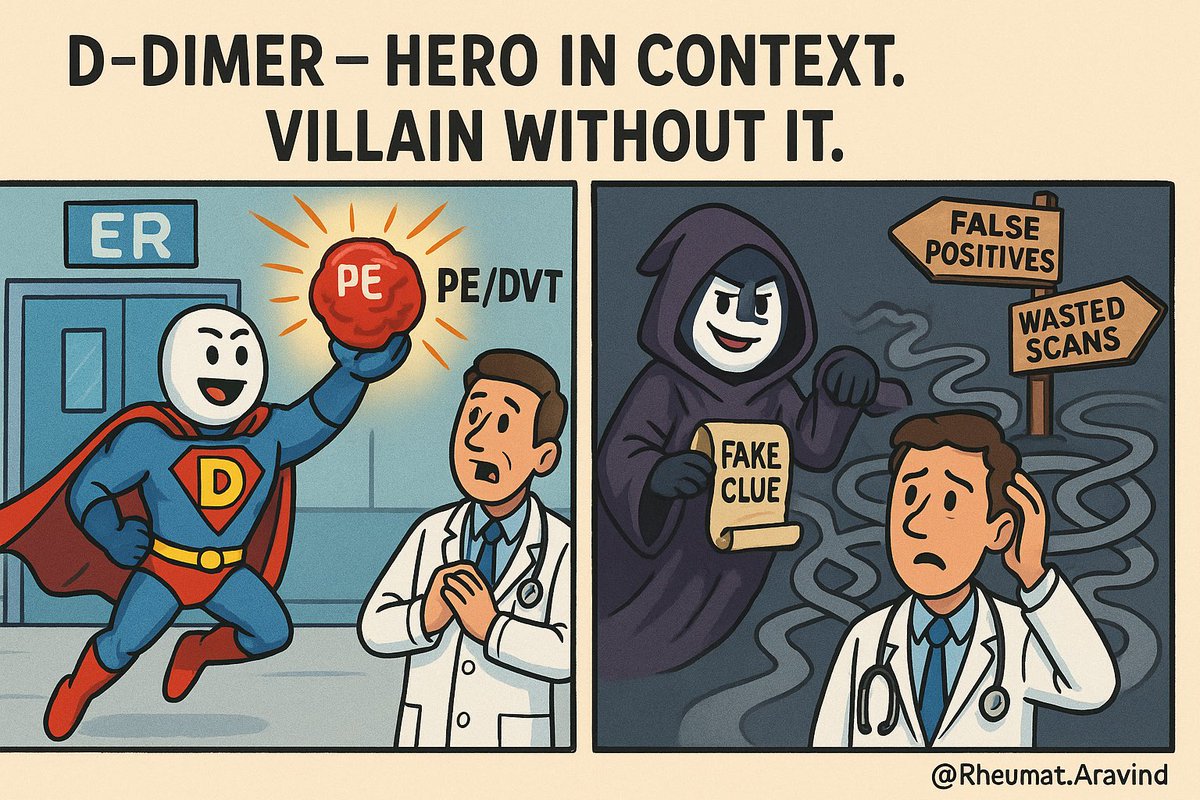
🧵D-Dimer – Diagnostic Hero or Misleading Villain?

We’ve all ordered D-Dimer.
But do we really understand what it’s telling us?
Let’s break down when D-Dimer helps—and when it just adds confusion👇
@IhabFathiSulima @DrAkhilX @drkeithsiau @CelestinoGutirr @Janetbirdope @nirmalregency @Lupusreference #MedTwitter #NEETPGImage
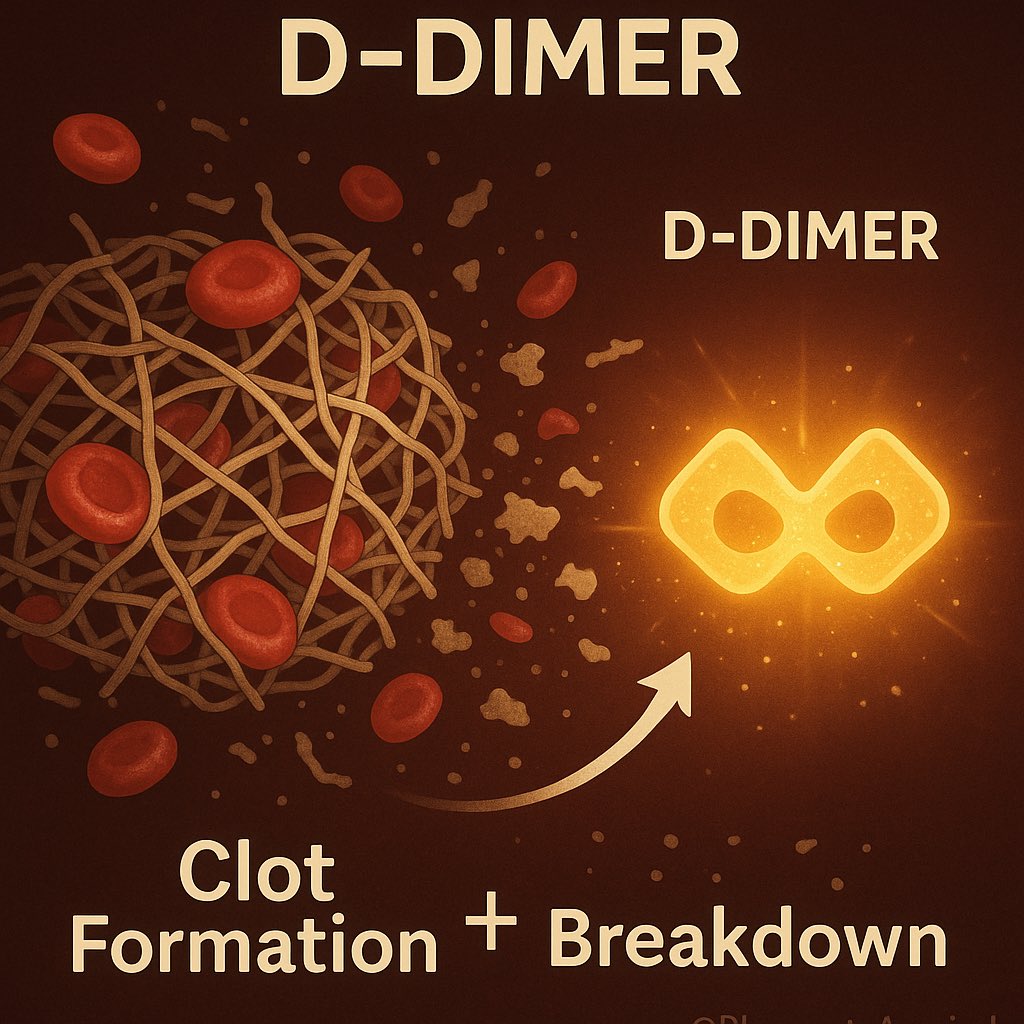
1. What is D-Dimer, really?

🧬 It’s a fibrin degradation product.
If you see it, it means the body formed and broke down a clot.

But: That doesn’t always mean pathology.
2. When is it actually useful?

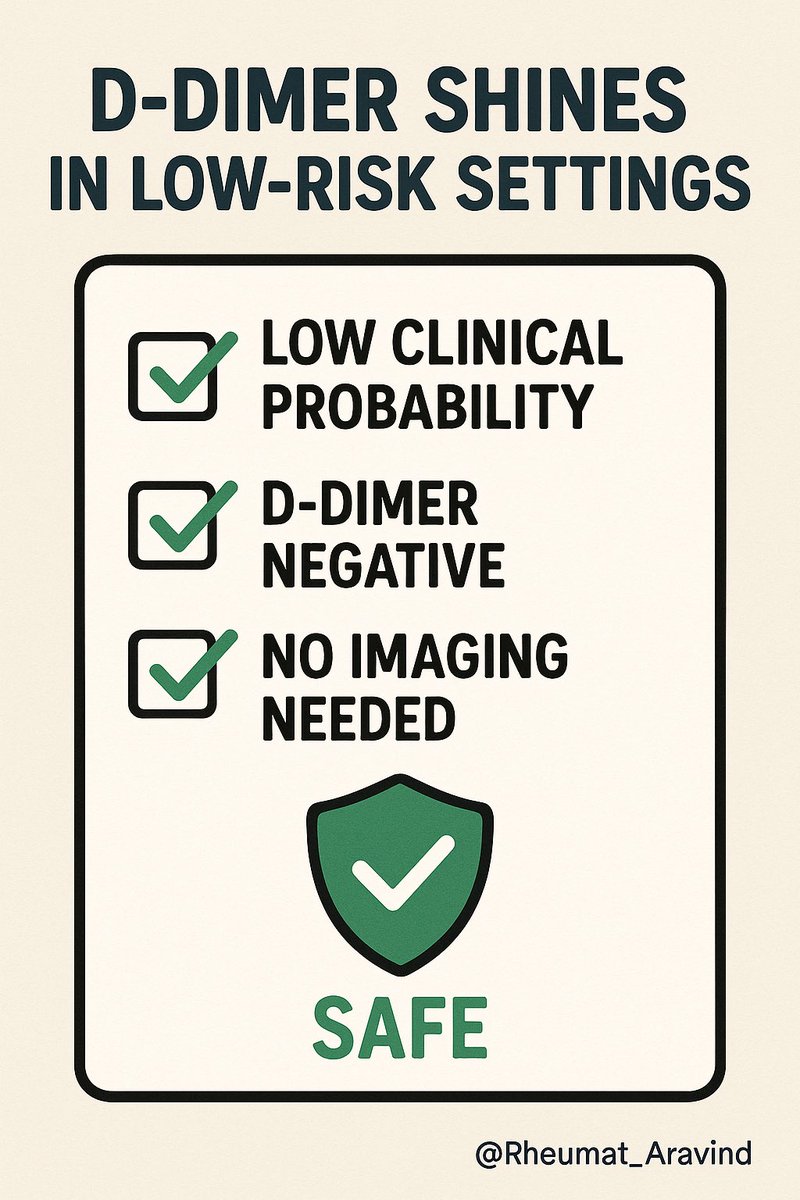
✅ Low to moderate suspicion of DVT/PE
🧠 It’s a rule-out tool
Normal D-Dimer? Great.
Abnormal? Don’t panic yet. Image
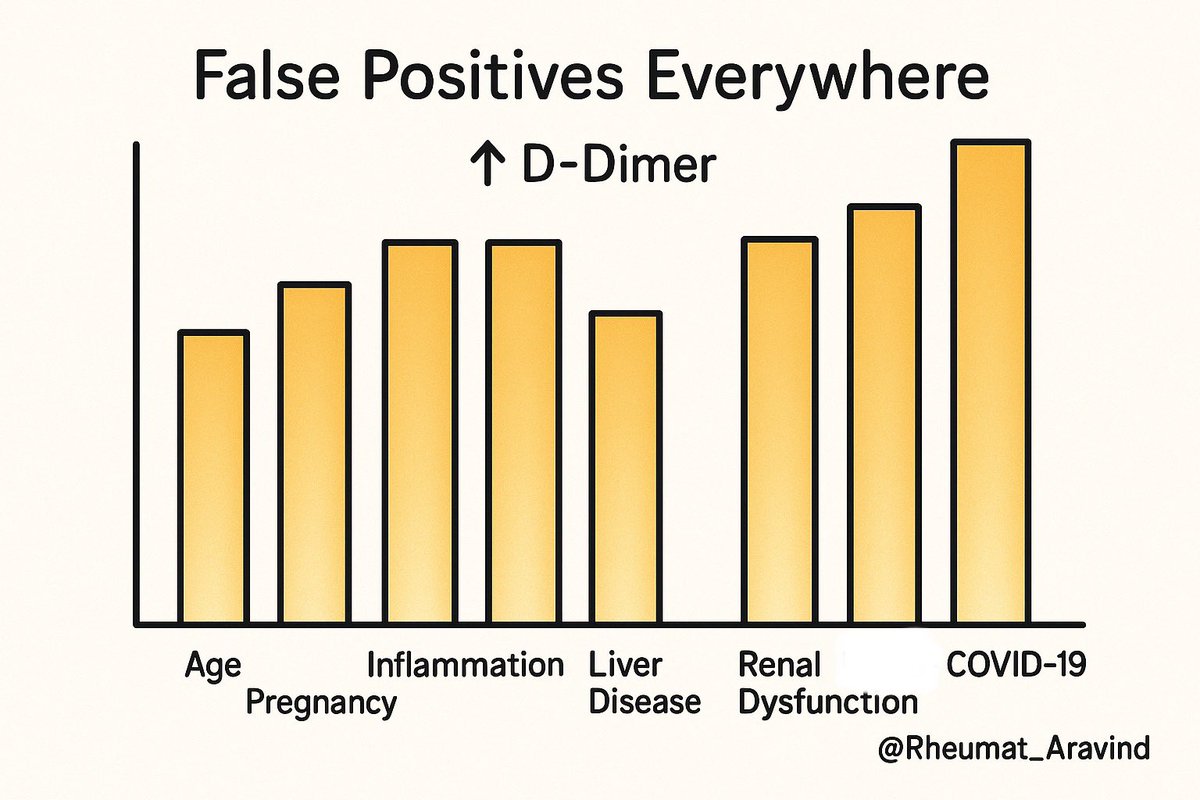
3. D-Dimer can go up for tons of reasons:

– Age > 50
– Surgery, trauma
– Infections, cancer
– Pregnancy
– SLE, vasculitis
– COVID-19
– Hospital admission itself! Image
4. Rheumatology trap: Flare or clot?

SLE patient with leg pain + raised D-Dimer?

🔍 Check pretest probability
🔄 If low → duplex or imaging
💡 Don’t anchor on D-Dimer alone Image
5. What’s an age-adjusted D-Dimer?

🧓 After age 50, D-Dimer naturally rises.
So we adjust:
Age × 10 ng/mL (FEU) = cutoff

E.g. Age 72 → cutoff is 720 Image
6. How NOT to use D-Dimer:

🚫 High suspicion? Go straight to imaging.
🚫 As a standalone test.
🚫 To monitor clot burden.
🚫 In inflammatory diseases to predict thrombosis without clinical context. Image
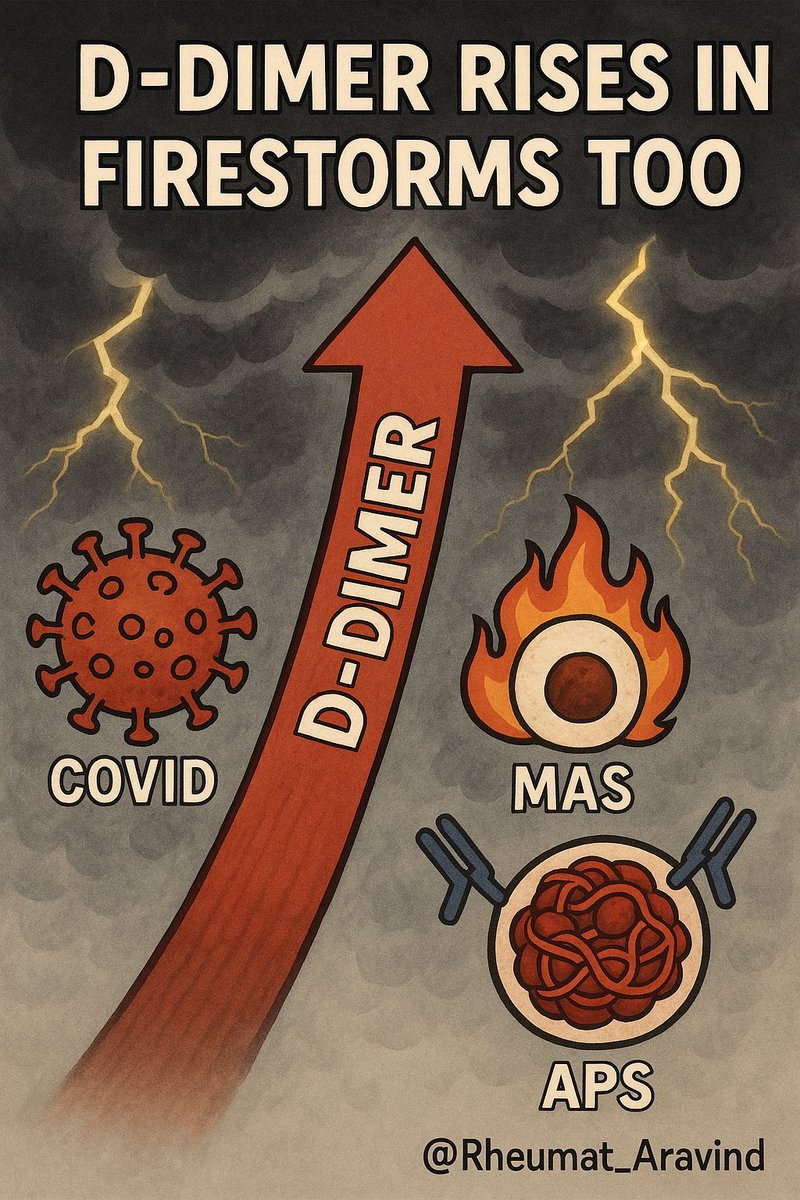
7. D-Dimer in COVID, APS, MAS?

🔴 High D-Dimer = clot risk, cytokine storm, endothelial damage
BUT: Use clinical correlation.
Don’t treat numbers in isolation. Image
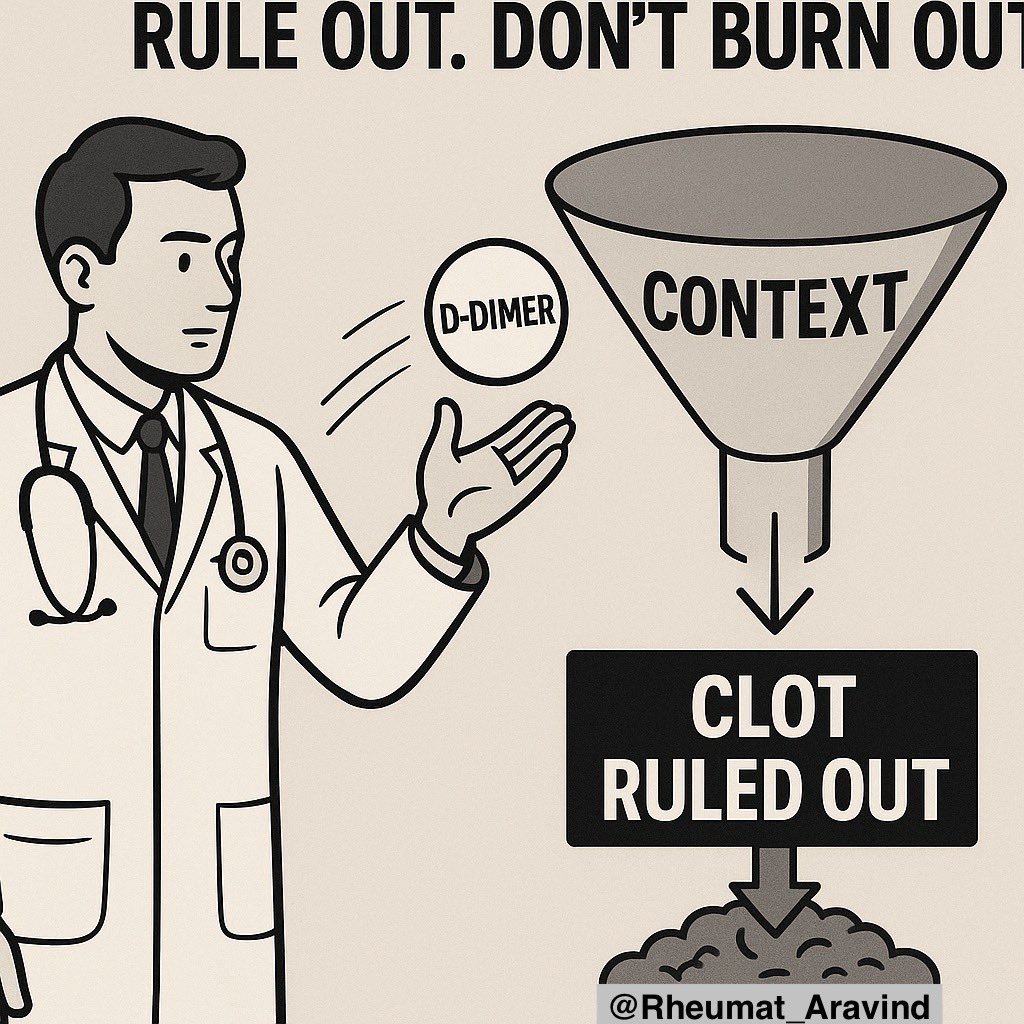
📌 Takeaway

D-Dimer is powerful in the right clinical context.
Don’t let it become a diagnostic distraction.
Use it to rule out, not stress out. Image
• • •

Missing some Tweet in this thread? You can try to force a refresh

 

Keep Current with Aravind Palraj

Aravind Palraj Profile picture

Stay in touch and get notified when new unrolls are available from this author!

Read all threads

This Thread may be Removed Anytime!

PDF

Twitter may remove this content at anytime! Save it as PDF for later use!

Try unrolling a thread yourself!

how to unroll video
  1. Follow @ThreadReaderApp to mention us!

  2. From a Twitter thread mention us with a keyword "unroll"
@threadreaderapp unroll

Practice here first or read more on our help page!

More from @Rheumat_Aravind

Aug 7
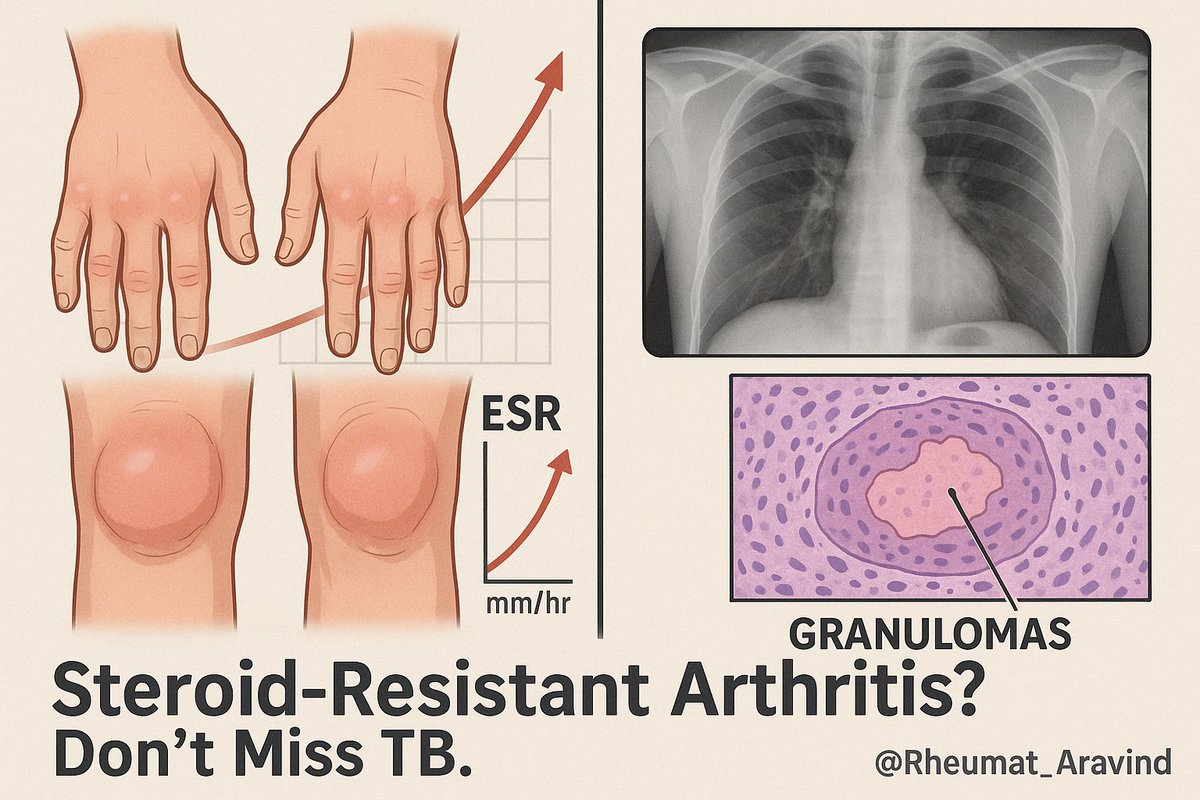
🧵 Thread: “Steroid Unresponsive Arthritis? Don’t Miss This Mimic”

A young woman with “seronegative arthritis” is on steroids for 3 months.
Still flaring. No response.
Rheumatoid? Nope.
This was TB.
Let’s break down the great mimics of inflammatory arthritis. 🧵
#Rheumatology #MedTwitter @IhabFathiSulima @DrAkhilX @CelestinoGutirr @Janetbirdope @SidhaantNangiaImage
1️⃣ Case:
28F with symmetrical arthritis, ESR 85, ANA negative.
Diagnosed as “seronegative RA.” Treated with steroids, MTX.
Symptoms persisted. Fever, weight loss, now chronic cough. Image
2️⃣ 🔍 Re-evaluation showed:
•CXR: upper lobe opacities
•Mantoux + IGRA: positive
•Synovial biopsy: caseating granulomas
= Tubercular arthritis. Image
Read 7 tweets
Aug 7
🧵 RF vs anti-CCP – Which Test Tells the Truth?

You ordered RF.
It came back positive.
But is it RA—or just rheumatoid confusion?

Let’s break down RF vs anti-CCP—and which one to actually trust 👇
@IhabFathiSulima @DrAkhilX @CelestinoGutirr @Janetbirdope @DurgaPrasannaM1 Image
1. First: What are they?

🧪 Rheumatoid Factor (RF) = an autoantibody against the Fc portion of IgG
🧪 anti-CCP = antibody against cyclic citrullinated peptides

Both are used in diagnosing Rheumatoid Arthritis (RA)—but they behave very differently. Image
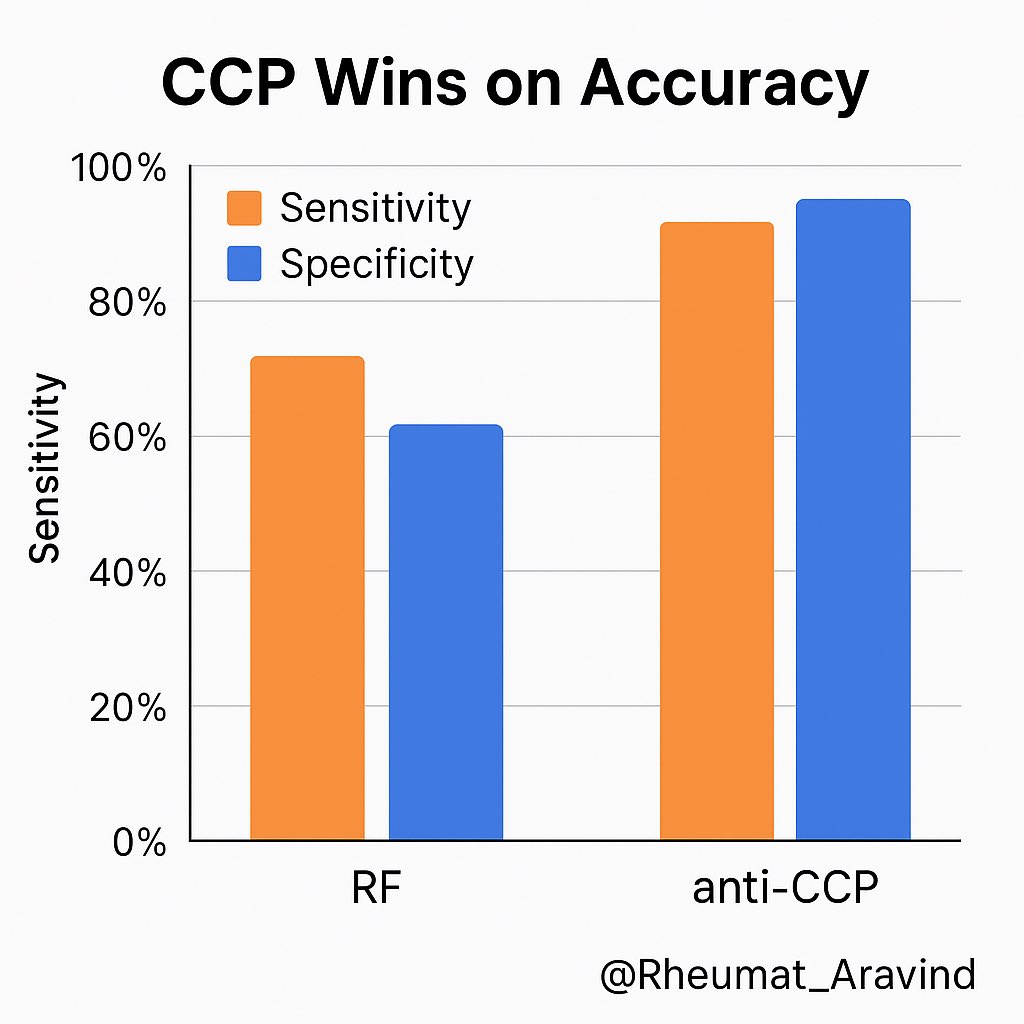
2. Sensitivity vs Specificity?

✅ RF:
– Sensitivity ~60–80%
– Specificity = LOW (many false positives)

✅ anti-CCP:
– Sensitivity ~70–80%
– Specificity >95% for RA Image
Read 10 tweets
Aug 7
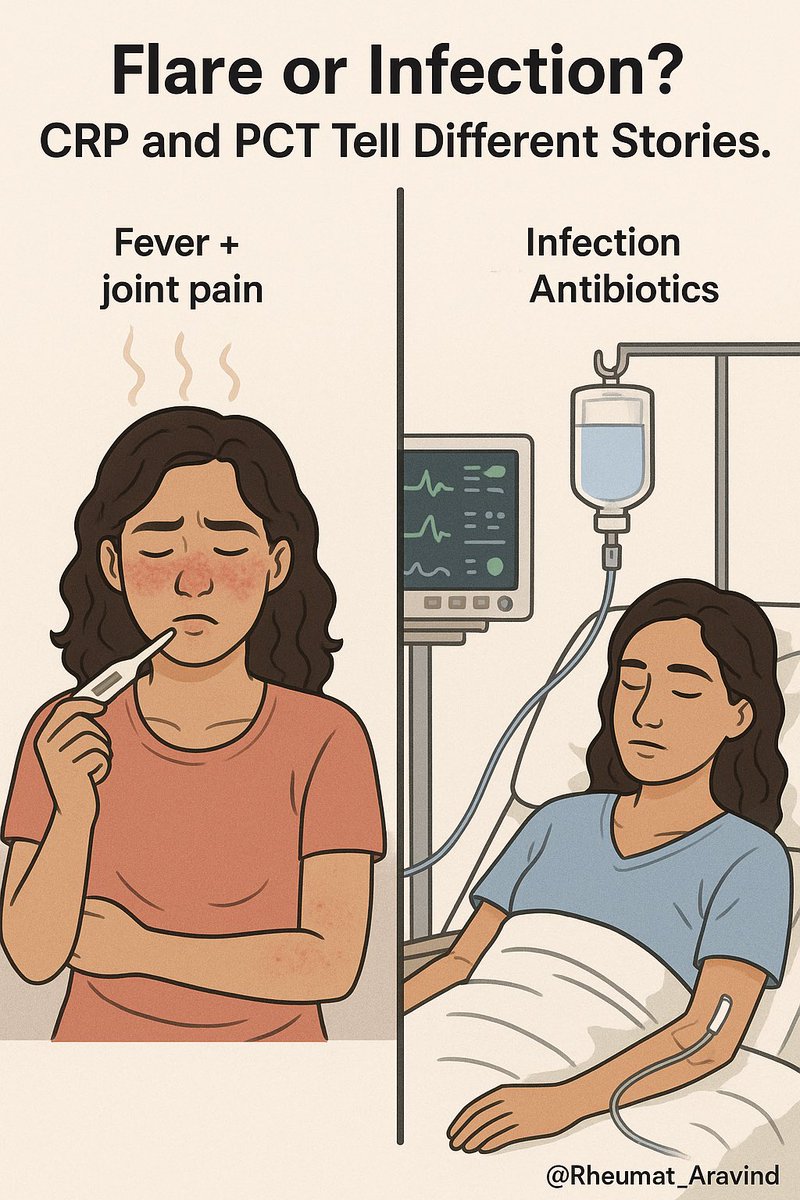
🧵 CRP vs Procalcitonin in Fever Workup 🔍
Flare? Infection? Both? Let’s break it down clinically — one step at a time.👇
#MedTwitter #Rheumatology #Infection @IhabFathiSulima @DrAkhilX @CelestinoGutirr Image
1.CRP rises in almost everything:
🔥 Infection
🦠 Autoimmune flare
💥 Trauma
🛌 Post-op
…but it’s NOT specific.
It just says, “Something’s wrong.” 😐 Image
2.Procalcitonin (PCT)?
🦠 Mostly rises in bacterial infections
↔️ Flat in autoimmune flares, MAS, AOSD
🎯 It helps when you’re stuck between flare vs infection — especially in rheum cases. Image
Read 6 tweets
Aug 6
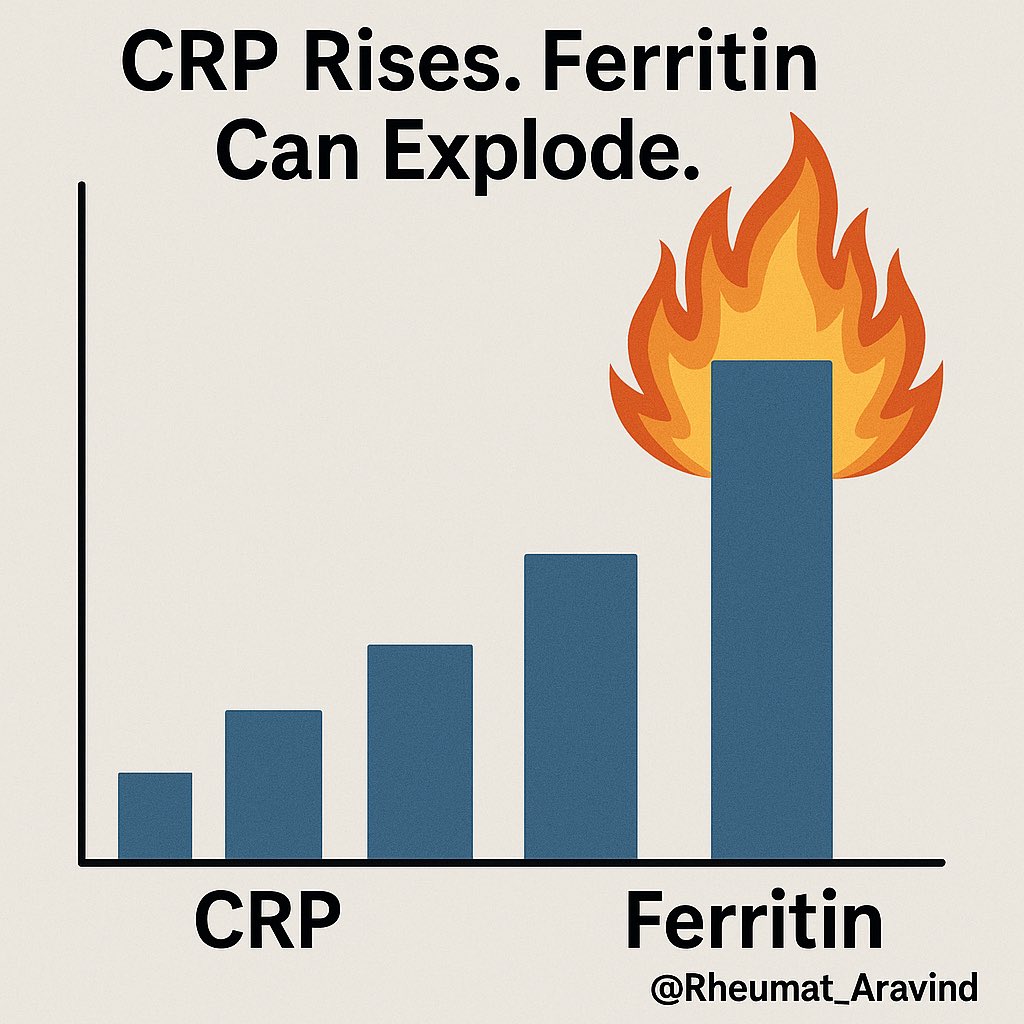
🧵 Ferritin vs CRP – When High Iron Means High Fire

CRP goes up in inflammation.
Ferritin does too—but sometimes, it explodes.
Let’s break down how ferritin behaves differently, and when to worry. 👇
@IhabFathiSulima @DrAkhilX @emcrit @Janetbirdope @Lupusreference #MedTwitter #NEETPGImage
1. First—What is Ferritin, really?

Ferritin stores iron.
But it’s also an acute-phase reactant.
So it rises in inflammation.
But unlike CRP, it skyrockets in cytokine storms. Image
2. Ferritin in Autoimmune Disease

CRP rises in most flares.
But ferritin may stay normal.
Exception?
When the immune system goes wild—ferritin blows up. Image
Read 9 tweets
Aug 5
🧵 CRP vs Procalcitonin – Inflammation vs Infection?

Both rise in systemic illness.
But they don’t speak the same language.

Let’s break down when to use CRP, when to trust Procalcitonin—and when both lie. 👇
@IhabFathiSulima @DrAkhilX @Janetbirdope @emcrit @andrewsuleh @Lupusreference #MedTwitterImage
1. First, the Basics

🩸 CRP = C-reactive protein
🧬 PCT = Procalcitonin
Both are acute phase reactants—but with different triggers. Image
2. CRP: The Generalist

🔹 Rises in any inflammation
— Infections (viral & bacterial)
— Autoimmune flares
— Trauma, surgery, malignancy

📈 Elevates within 6–8 hours
📉 Falls over 2–3 days

CRP is sensitive, but not specific. Image
Read 9 tweets
Aug 5
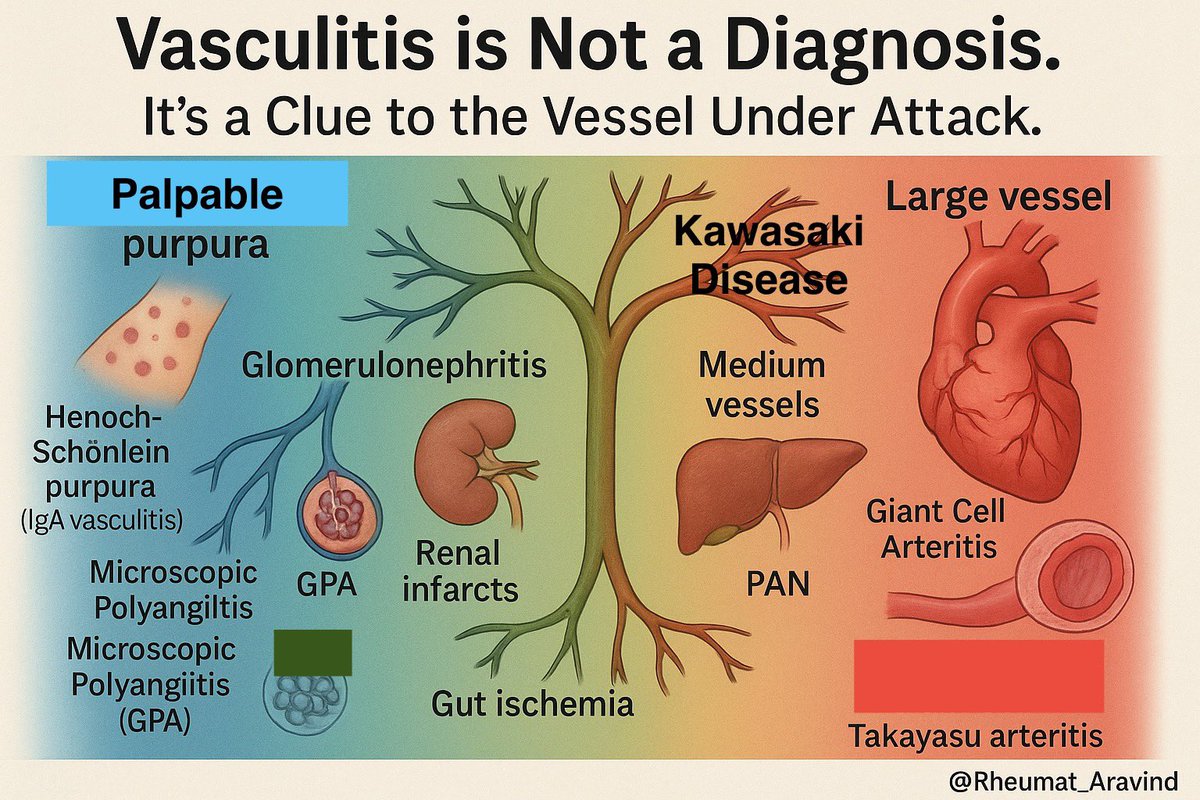
🧵 Vasculitis is Not One Disease – It’s a Spectrum
It’s not a diagnosis.
It’s a mechanism.
From small-vessel purpura to large-vessel aneurysms, here’s how to recognize and reason through the vasculitis spectrum👇
@Amansharmapgi @DurgaPrasannaM1 @12VRavindran @Kanjivellam @IhabFathiSulima @DrAkhilX #MedTwitterImage
1️⃣ Start With the Vessel Size

🔹 Large vessel: aorta and branches
🔸 Medium vessel: muscular arteries
🔻 Small vessel: arterioles, venules, capillaries
Your clues lie in which organ is hit—and how. Image
2️⃣ Large Vessel: GCA & Takayasu

🧠 GCA: headache, jaw claudication, vision loss
💪 TAK: limb claudication, BP discrepancy
Both = aortitis
Treat early. Blindness or aneurysm waits for no one. Image
Read 12 tweets

Did Thread Reader help you today?

Support us! We are indie developers!


This site is made by just two indie developers on a laptop doing marketing, support and development! Read more about the story.

Become a Premium Member ($3/month or $30/year) and get exclusive features!

Become Premium

Don't want to be a Premium member but still want to support us?

Make a small donation by buying us coffee ($5) or help with server cost ($10)

Donate via Paypal

Or Donate anonymously using crypto!

Ethereum

0xfe58350B80634f60Fa6Dc149a72b4DFbc17D341E copy

Bitcoin

3ATGMxNzCUFzxpMCHL5sWSt4DVtS8UqXpi copy

Thank you for your support!

Follow Us!

:(