Marc Johnson Profile picture
Aug 17, 2025 13 tweets 4 min read Read on X
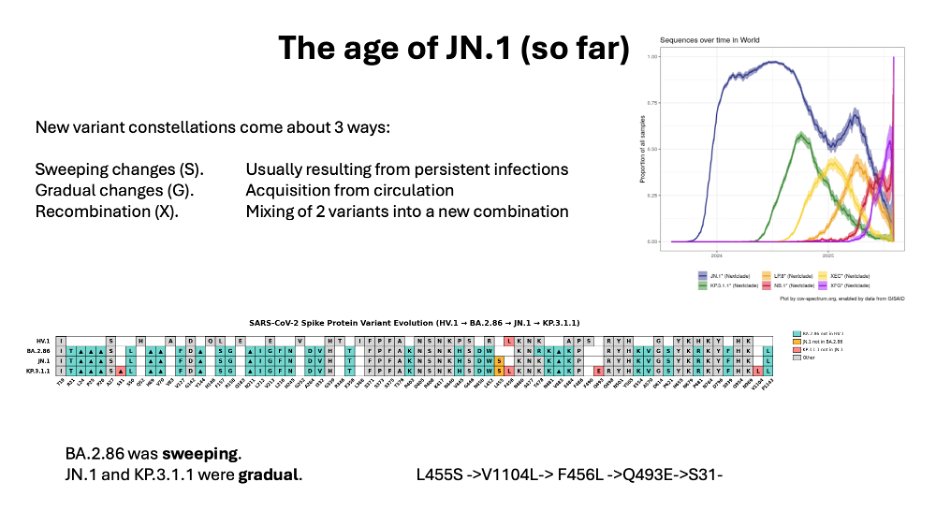
It’s been 2 years since BA.2.86 first appeared (and I’m give the variant update to SAVE on Monday), so I thought I would do a little summary about this era of SARS-CoV-2 evolution.
1/ Image
SARS-CoV-2 lineages come up with new constellations of mutations in 3 main ways.
1. Sequential acquisition of mutations during normal circulation.
2. Recombination.
3. Sweeping new lineages (almost certainly from persistent infections).
2/
BA.2.86 was one of the sweeping changes. When it first appeared in Israel I thought it was a persistent infection, most of which never spread. Then it appeared in Denmark too.
3/
A few days later it showed up on another continent.
4/
However, our immunity was holding up. There was still a class of antibodies that did a pretty good job of neutralizing BA.2.86.
However, a single AA variation changed that.
The new lineage was designated JN.1
5/
JN.1 displaced all other lineages in the world within a few months.
There was a lot of convergent evolution in the JN.1 offspring (+F456L), but no single lineage became dominant until KP.3.1.1 about 6 months later.
6/ Image
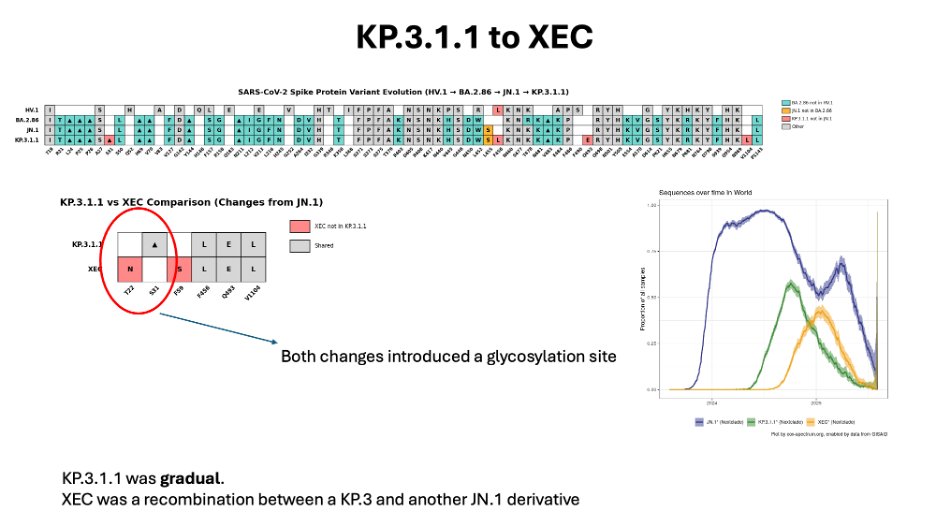
After KP.3.1.1 can the recombinant XEC.
XEC was a recombination of KP.3.1.1 with another JN.1, so KP.3.1.1. and XEC were very similar.
XEC slowly won out over KP.3.1.1, but never became world dominant.
7/ Image
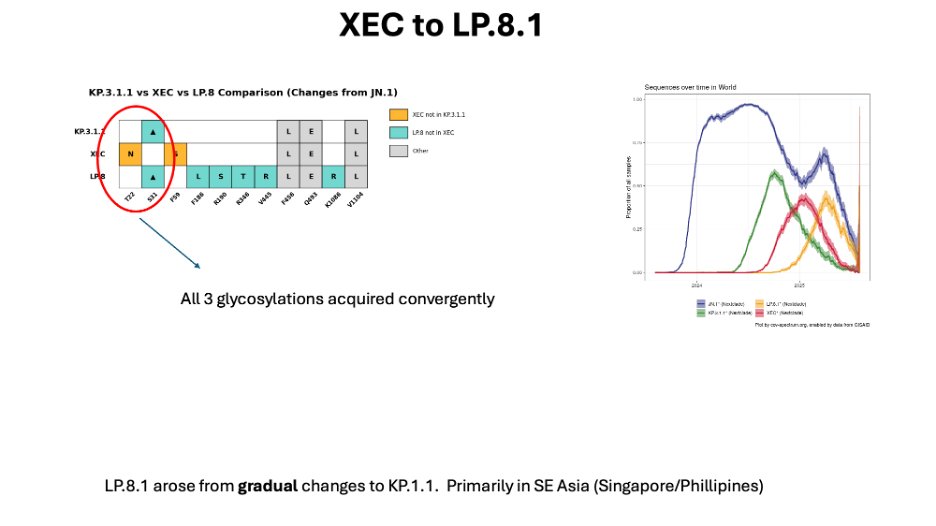
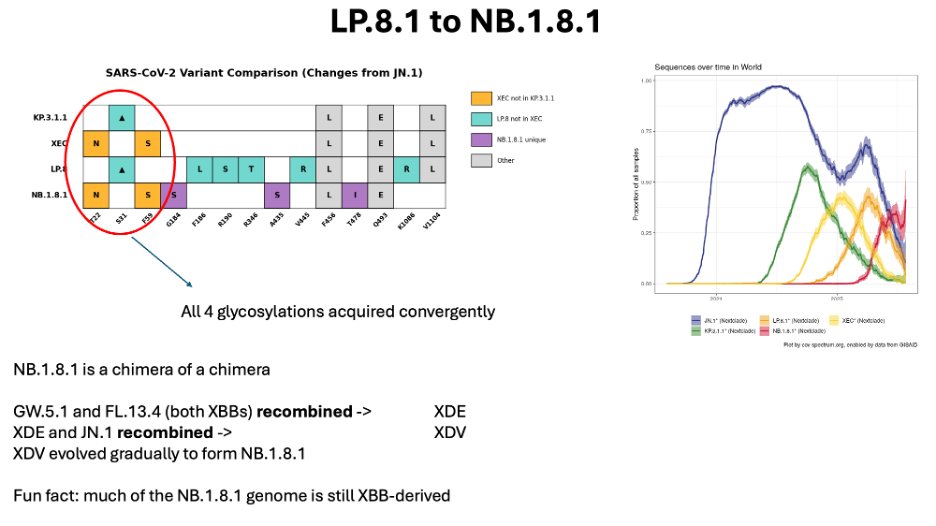
Next came LP.8.1, which was another JN.1 lineage that had been gradually evolving in SE Asia. It displaced XEC, but also did not become world dominant.
8/ Image
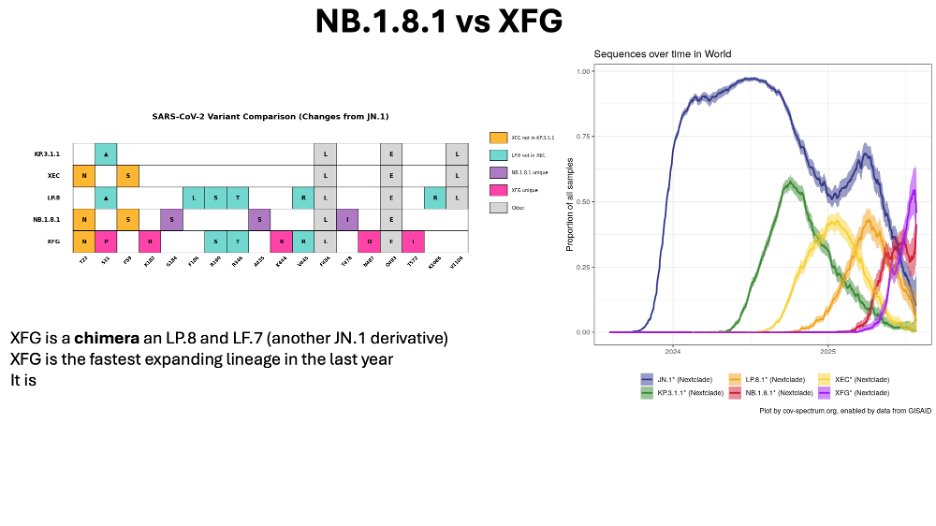
Next came NB.1.8.1, which was derived from a recombinant of a JN.1 with an even older XBB recombinant.
Fun fact, most of the current NB.1.8.1 genome is derived from XBB and not JN.1.
9/ Image
Finally, that brings us to XFG. XFG is a recombinant between LP.8.1 and another JN.1. XFG expanded more rapidly than most of the others, and is the first lineage to reach world dominance (it seems) in a year. Image
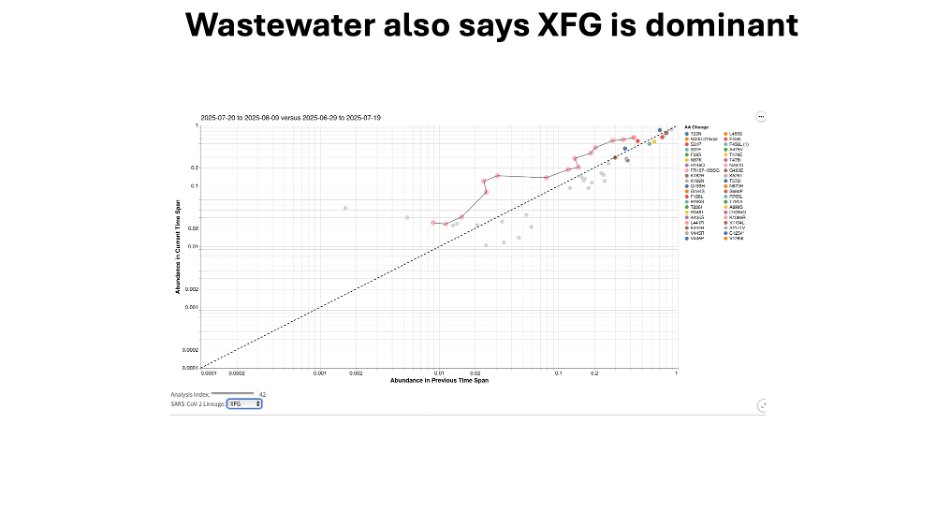
This is our US wastewater readout for XFG. Steadily growing, and appears to be over 60% of the US sequences. There is a corresponding surge (small one) in total virus, which likely is variant driven.
11/ Image
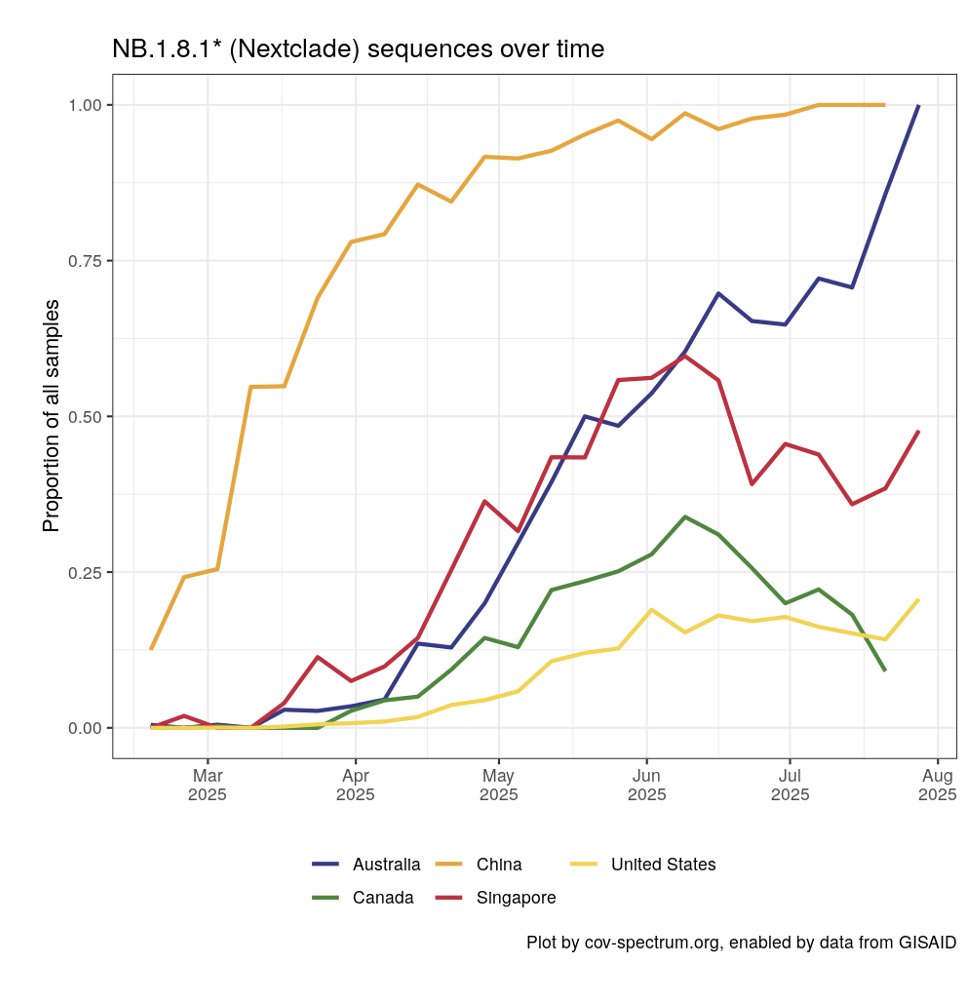
There is an odd disconnect though. NB.1.8.1 remains completely dominant in Australia and China.
12/ Image
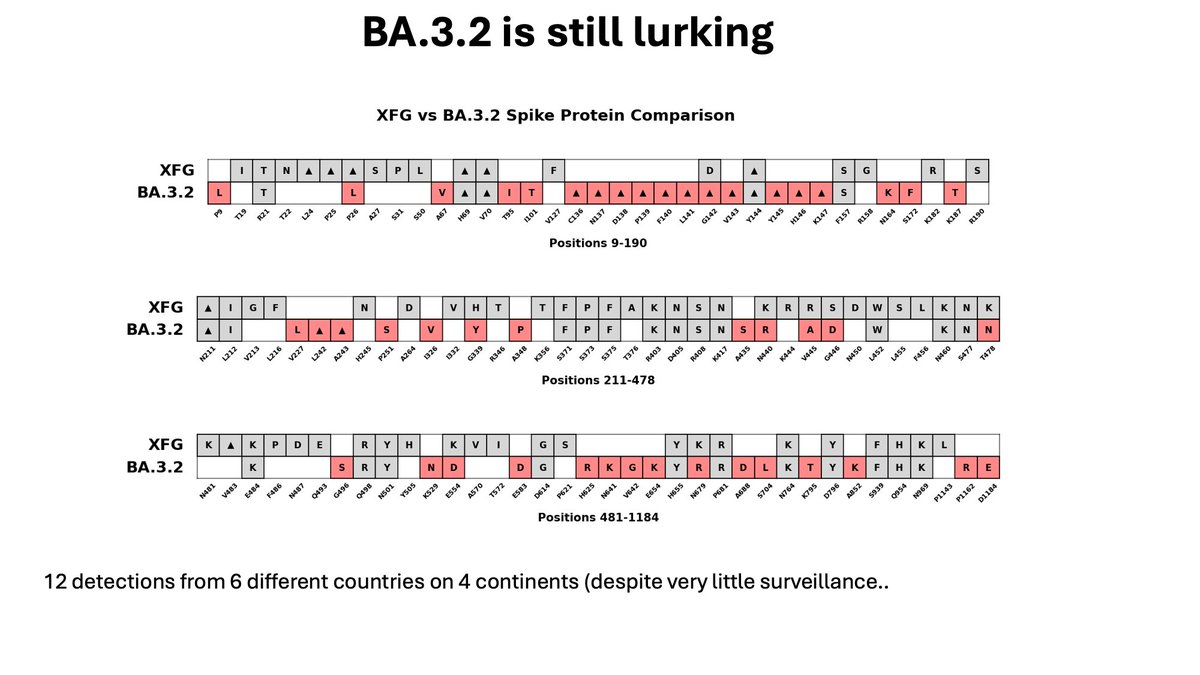
I’m not sure what is next, but we are all still keeping an eye on BA.3.2. This sweeping lineage appeared a few months ago. It hasn’t pulled a ‘JN.1’ yet, but it has appeared on 4 continents.
We’ll be watching.
13/13 Image

• • •

Missing some Tweet in this thread? You can try to force a refresh

 

Keep Current with Marc Johnson

Marc Johnson Profile picture

Stay in touch and get notified when new unrolls are available from this author!

Read all threads

This Thread may be Removed Anytime!

PDF

Twitter may remove this content at anytime! Save it as PDF for later use!

Try unrolling a thread yourself!

how to unroll video
  1. Follow @ThreadReaderApp to mention us!

  2. From a Twitter thread mention us with a keyword "unroll"
@threadreaderapp unroll

Practice here first or read more on our help page!

More from @SolidEvidence

Jan 24
We found a new (I think) cryptic lineage this week.
I know I say this all the time, but this is really weird.
Warning, this thread is for nerds only.
1/
Here’s what we do. Every week we download all of the new sequences from SRA and run a bunch of screens to look for anachronistic or cryptic lineages.

This new one popped up in 3 different screens.
2/
A good way to spot anachronistic lineages is to look for sequences that have been deleted in contemporary lineages. The virus can only undo a deletion through recombination. If we find seqs that lack the deletions, they have to be old (or contaminated with something old).
3/
Read 16 tweets
Nov 23, 2025
What should we expect this flu season?

Here’s a forecast from a wastewater perspective (because sh*t don’t lie)

1/
Background. The 4 main kinds of influenza circulating among humans (in order of severity) are:
FluA H3N2
FluA H1N1
FluB
FluC (many don’t know this one)

2/
Last season, there was a pretty even split between H1N1 and H3N2, with a little bit of FluB late in the season. At least according to CDC patient data.
3/ Image
Read 13 tweets
Nov 21, 2025
This is wild.

Remember the NJ crytic lineage?

I posted 18 months ago that the Spike was too divergent to predict ACE2 binding, and asked if someone else could figure it out.

Some colleagues took me up on it.

Guess what they found?
1/
This preprint just came out. @wchnicholas and team reconstructed and tested the NJ Spike and found that it has the tightest ACE2 binding of any SC2 Spike ever measured.
2/
medrxiv.org/content/10.110…
We first found the NJ variant in 2023 because this sewershed from NJ with 1.5 million people because it regularly had a sequence that was a reversion to the bat sarbeco sequence, which is common in cryptics.
3/

Read 9 tweets
Oct 31, 2025
Can you take a quarter cup of composite sewage, simply ask ‘what’s in there?’, and find out all of the pathogens circulating in that community?

That is the question we asked in our latest pre-print.

Turns out you can.
1/
medrxiv.org/content/10.110…
We are not the first group to do unbiased sequencing of wastewater to monitor circulating viruses, but I think we are the first to ever do it at this scale.

Weekly wastewater samples for 18 months, totaling over 85 Billion sequence reads.

2/ Image
Among the ‘known’ viruses, there was a fairly even split between bacteria viruses (phages) and eukaryotic viruses.
This was just raw reads though, if you look at diversity there was considerably more species of phages.
3/ Image
Read 23 tweets
Oct 24, 2025
Help me out, I’ve got another wastewater virus mystery.

This one really blows my mind.
1/
Starting in the late 2023, + @securebio have been doing ultra-deep metagenomic sequencing of the virome from Columbia, MO wastewater.

We’ve collected and sequenced sample for over 90 consecutive weeks.
2/Lung.fish
We sequence about a billion reads per sample. That’s generated about 16TB of data from this site so far.

To put this in perspective for people my age, it would take a stack of 3.5 in floppy disks 200 miles high to store this data.
3/
Read 12 tweets
Oct 17, 2025
It looks like Coeur d’Alene, ID cryptic is gone for now, but it has still managed to answer a lot of lingering questions for me about SARS-CoV-2 evolution, and what to expect next.

Here's a whole genome summary and interpretation.
1/ Image
For a long time cryptic lineages were all from pre-Omicron lineages.

I started wondering:

Will there be Omicron cryptics?

If so, will they have the same evolutionary trajectories as the pre-Omicron cryptics?

ID shows that the answer to both questions is yes.
2/
We don’t do a lot of whole genome sequencing, so I sent 3 samples to @dho lab, who got fantastic sequences for all 3.
These samples were virtually 100% cryptic, so we have nearly complete coverage of the genome for a change.
3/ Image
Read 12 tweets

Did Thread Reader help you today?

Support us! We are indie developers!


This site is made by just two indie developers on a laptop doing marketing, support and development! Read more about the story.

Become a Premium Member ($3/month or $30/year) and get exclusive features!

Become Premium

Don't want to be a Premium member but still want to support us?

Make a small donation by buying us coffee ($5) or help with server cost ($10)

Donate via Paypal

Or Donate anonymously using crypto!

Ethereum

0xfe58350B80634f60Fa6Dc149a72b4DFbc17D341E copy

Bitcoin

3ATGMxNzCUFzxpMCHL5sWSt4DVtS8UqXpi copy

Thank you for your support!

Follow Us!

:(