Most people think of money as something concrete, cash in hand or deposits in a bank account. That is an illusion. Money is not a fixed thing. It is a web of asset and liability relationships across the entire financial system.
Your deposit is an asset to you but a liability to the bank. A Treasury bond is an asset to investors but a liability to the government. Strip it down and you see: every dollar is a claim. Money is a balance sheet relationship.
This is why money and credit can be interchangeable. When a bank extends a loan, no new physical money is created. Instead, a loan (asset) and a deposit (liability) are born simultaneously. Purchasing power emerges from accounting, not from the Fed's printing presses.
Most of what we call money is actually credit. Promises to pay in the future dominate the financial system. Credit is spending power, and it dwarfs the amount of physical currency in circulation.
There is no universal definition of money.
There is NO rule that says money is a store of value or medium of exchange!!
What matters is confidence in those relationships. Every asset is someone else’s liability. Duration risk measures the uncertainty of value through time. Credit risk measures the uncertainty of repayment. These are the true foundations of money.
Once you see money this way, the illusion disappears. There is no fixed ideal of a dollar. There is only a shifting system of claims, promises, and liabilities. Understanding that system is the starting point for decoding capital flows.
Capital flows are the movement of these claims across the risk curve. When credit risk is perceived to be low, capital rotates outward into riskier assets. When risk rises, capital retreats inward toward safety. Money is the language. Flows are the motion.
This is why macro begins with money. The structure of assets and liabilities defines the system. The flows of capital across that system are the signal. If you track the flows, you see the regime shifts before they appear in headlines.
There is a full list of educational primers on these moving parts here:
Everyone has become a Fed watcher, but no one understands HOW the flows of capital are happening
As we move into Jackson Hole this week, we are very likely to see a shift in monetary policy, but the key will be understanding HOW this is transmitted into markets
🧵👇
If you understand the macro context for flows and how positioning is set up, then you will understand how Jackson Hole will be transmitted into markets.
This will frame all of the changes we see in interest rates, equities, and crypto.
First, we are in a period of time where growth AND inflation are accelerating.
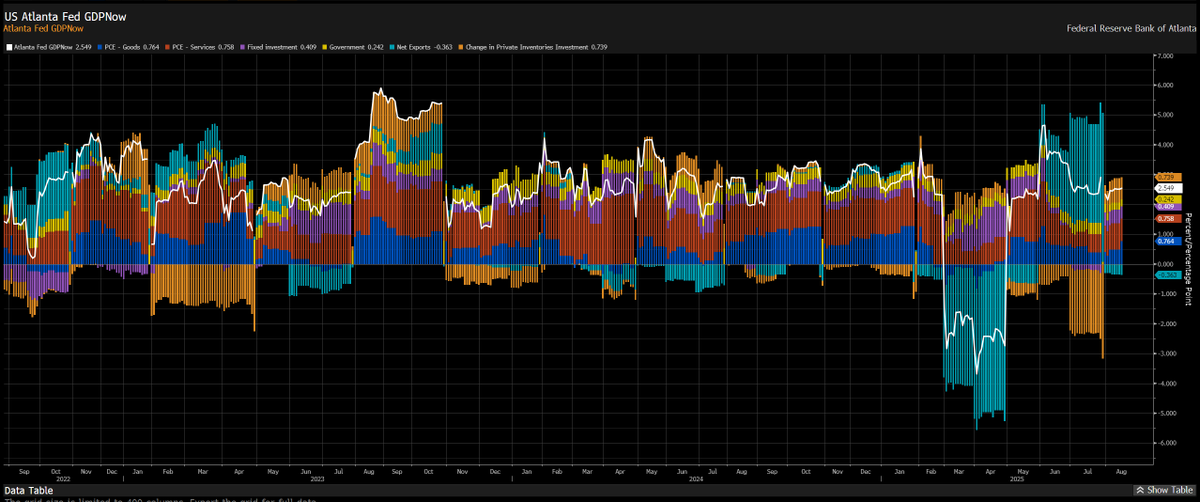
The Atlanta Fed nowcast is running at 2.5% and long end rates have retraced the entire move they made from the NFP print.
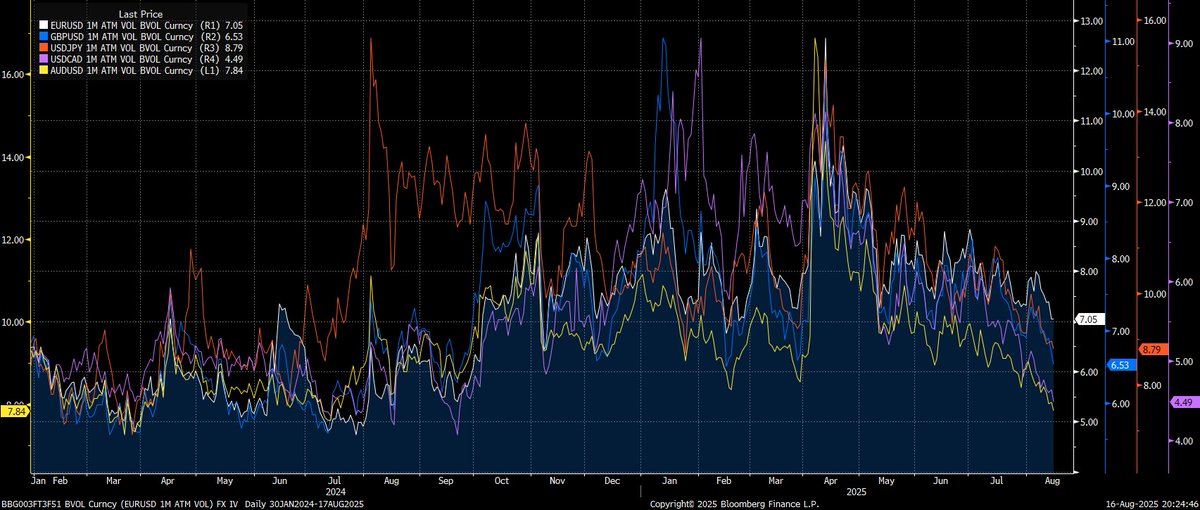
We are seeing an incredibly aggressive compression in FX volatility as stocks bid and bonds face significant headwinds
This is directly linked with the credit cycle thesis I have been laying out
Let me break down 3 important things to watch for this 🧵
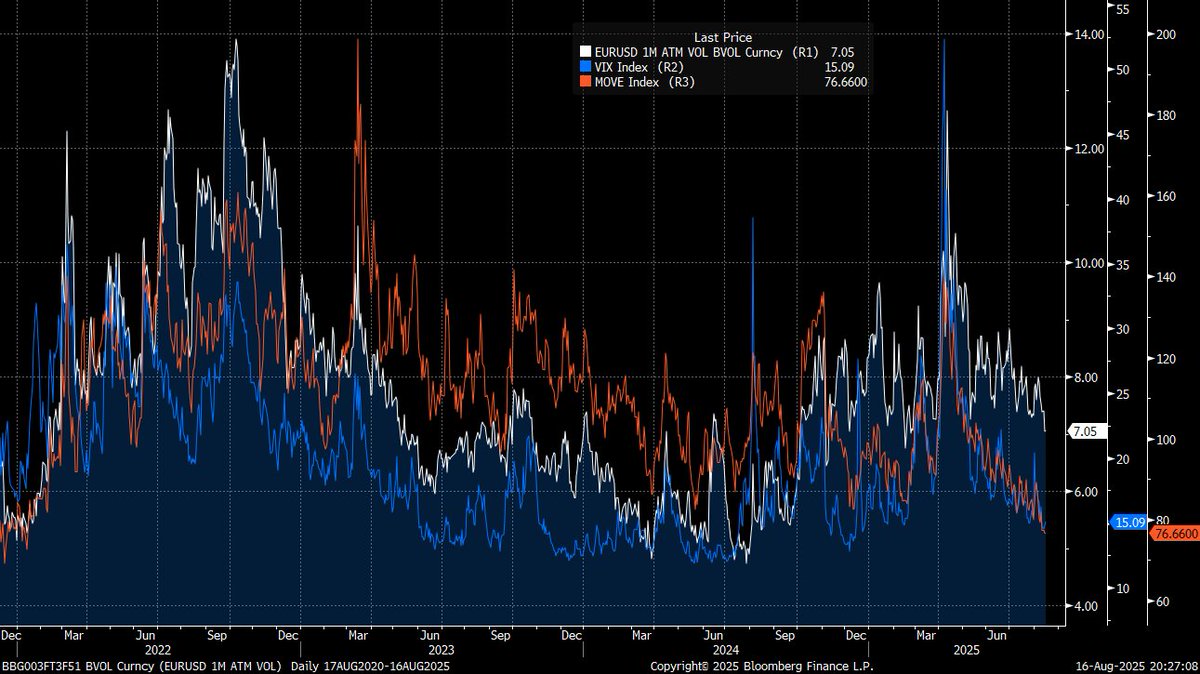
1) FX volatility is inherently linked with the VIX and MOVE Index.
Notice these move in lockstep which makes total sense because every asset is not only a view on the underlying security but also the currency its priced in.
Cuts or hikes by the Fed are not inherently bullish or bearish for the credit cycle
It is all about HOW these relate to underlying growth and inflation
If you can understand this relationship+positioning, you can know WHEN to exit the train before the bear market 🧵👇
I have been laying out the bullish view for equities for months now and have been running long trades in equities and Bitcoin. You can see the initial views and trades I laid out here:
There is this entire narrative that cuts by the Fed is bullish risk assets. This is fundamentally incorrect and not historically accurate. The full video where I explain the scenarios is below but here is the main idea: the Fed can cut or hike interest rates and equities/Bitcoin can rally or sell off depending on the underlying growth regime.
All markets are about supply and demand. When the Fed changes interest rates, this is only one side of the equation. The other side is how much money is in the system via growth and inflation.
The price action in stocks continues to confirm the macro regime I've laid out
1)The Credit Cycle is in full swing, causing melt-up mode
2)Inflation risk is greater than recession risk
All of this is coming to the macro end game moment where volatility shocks everyone 🧵👇
On the CPI print today, we are seeing stocks UP and bonds DOWN. Why? because we need to unwind all the bears who thought a single NFP print meant a recession.
As I laid out earlier this week, the play continues to be stocks bidding and bonds at risk of selling off
When stocks are bidding and bonds are selling, it is an indication that INFLATION RISK IS GREATER THAN RECESSION RISK. Everything for this idea was laid out in the interest rate report:
As we move into the CPI print this week, flows are going to adjust for higher inflation risk
The MAIN idea for the next month: Inflation Risk Is GREATER Than Recession Risk
This is a full breakdown of the context and flows into inflation prints this week 🧵👇
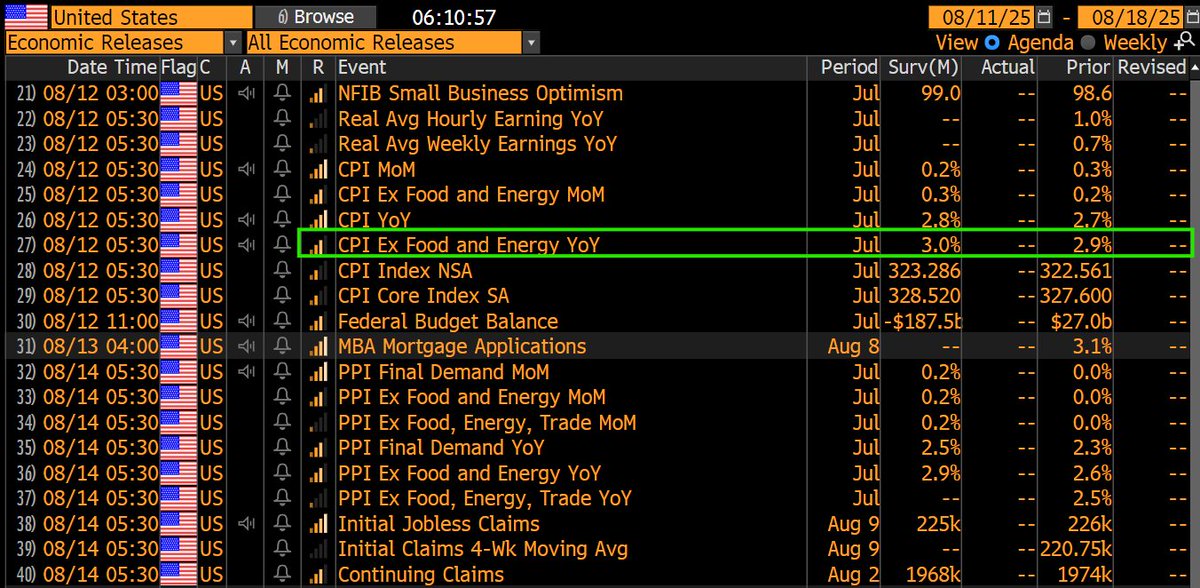
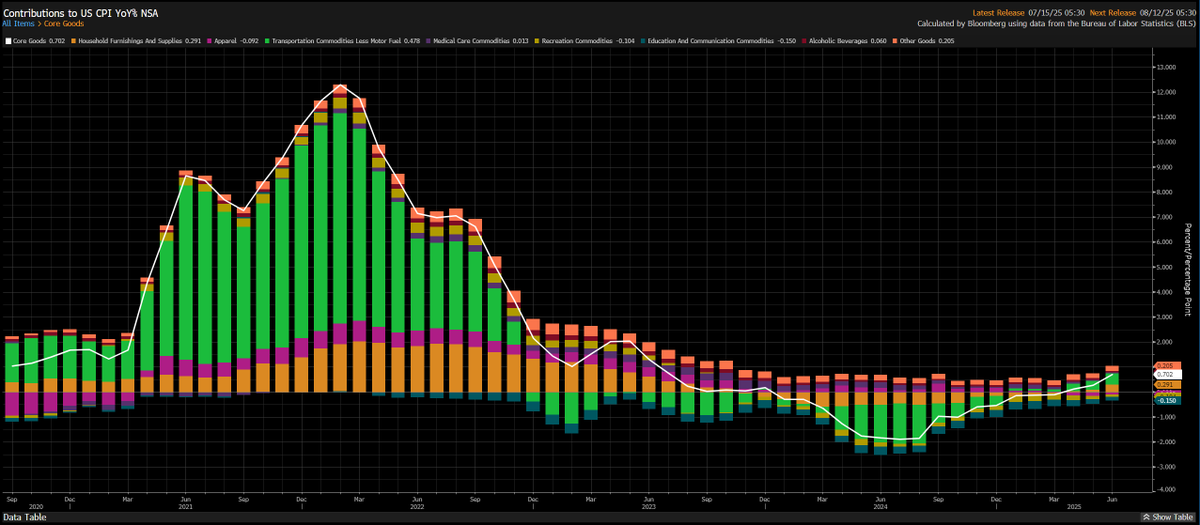
Consensus is expecting a 10bps acceleration in core CPI. What people continue to get wrong is that they think inflation is only tariff-driven and thereby transitory. This is creating a gap in markets where the Fed and other people are "looking through" inflation.
This action of "looking through" inflation and labeling it transitory is in itself an incorrect interpretation of the underlying dynamics AND increases the likelihood of inflation turning into a bigger problem.
All of us know that core goods have been accelerating for months now