Michael Albert, MD Profile picture
Aug 25, 2025 1 tweets 1 min read Read on X
🚨 Real-World GLP-1 Data: Vanderbilt Obesity Clinic Study (n=2,306)

Clinical trials showed 15–21% weight loss with semaglutide & tirzepatide. But how do patients actually fare in practice?
- - -
Key Findings:
📊 Median treatment duration: 10.7 months (50% discontinued by 12 months)
💉 Only 23% reached semaglutide 2.4 mg, 28% reached tirzepatide 15 mg
⚖️ Weight loss for those who continued treatment:
• 6 months: –9.4%
• 12 months: –14.4%
🏥 13.6% had medication-related ER visits (mostly GI side effects)

Context:
This was not a typical setting—patients had multidisciplinary support and NO-COST medication access through employer insurance bundles.

Reality Check:
✅ With the right care model, real-world outcomes can approach RCTs
❌ Most patients never reach target doses
❌ Half stop treatment within a year

👉 The gap between “can work” and “does work” remains large. Sustained success appears tied to comprehensive care models that most patients can’t easily access.
🔗…ubs.pericles-prod.literatumonline.com/doi/10.1111/do…Image

• • •

Missing some Tweet in this thread? You can try to force a refresh

 

Keep Current with Michael Albert, MD

Michael Albert, MD Profile picture

Stay in touch and get notified when new unrolls are available from this author!

Read all threads

This Thread may be Removed Anytime!

PDF

Twitter may remove this content at anytime! Save it as PDF for later use!

Try unrolling a thread yourself!

how to unroll video
  1. Follow @ThreadReaderApp to mention us!

  2. From a Twitter thread mention us with a keyword "unroll"
@threadreaderapp unroll

Practice here first or read more on our help page!

More from @MichaelAlbertMD

May 19
A patient asked me this week if they could stop their obesity medication.

I told them what the data says:
67% of people who stop regain almost everything within a year.

That's not a failure of willpower. That's biology. And we finally have trials that prove it.Image
1/ ECO 2026 just changed the conversation in obesity medicine. For 3 years, every major meeting asked: how much weight can we lose? Istanbul asked something different: how do we keep it? Here's what we learned. 🧵
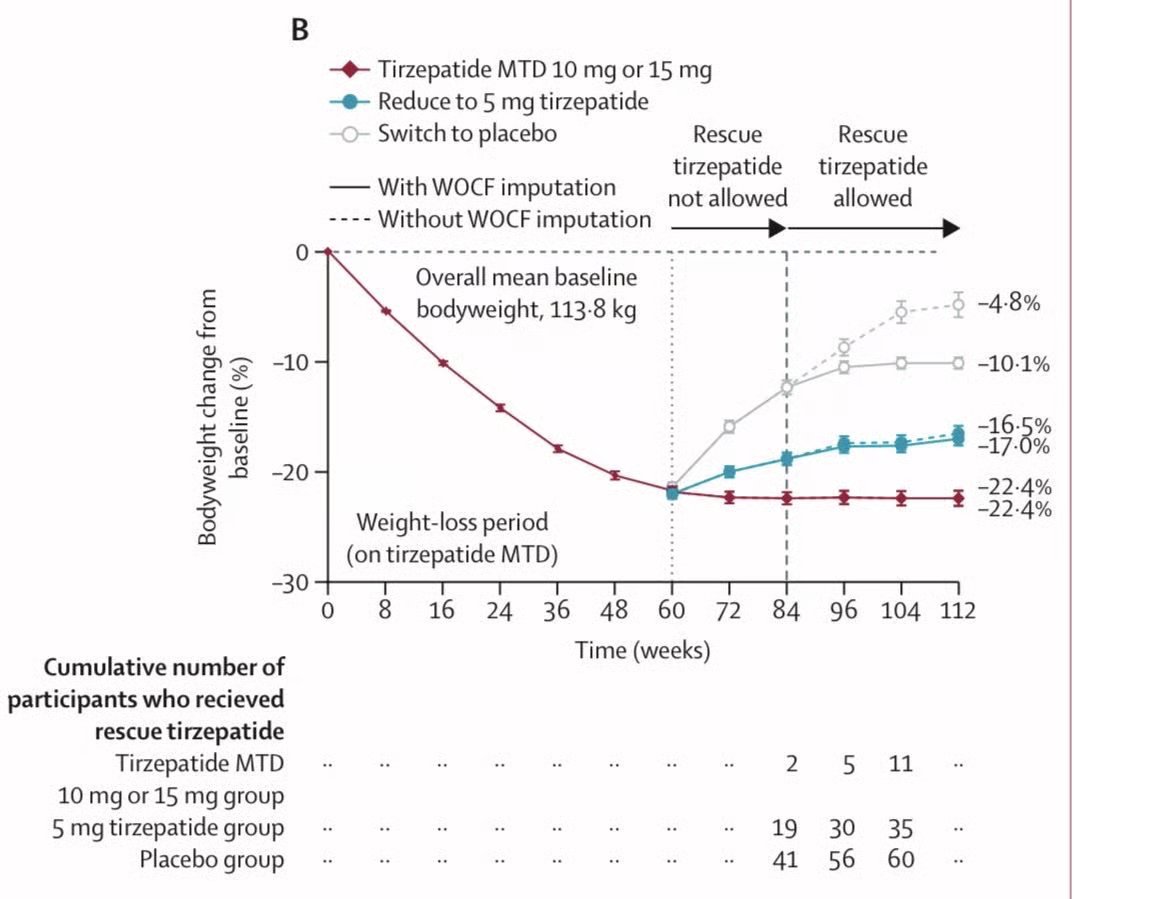
2/ SURMOUNT-MAINTAIN published in The Lancet this week. After losing 22% of their weight on tirzepatide, patients were randomized to continue full dose, drop to 5 mg, or switch to placebo. The results were unambiguous. Image
Read 9 tweets
May 11
1/ I'm a physician.
I just left traditional healthcare. Image
2/ I spent years inside the system.
7-minute visits.
Portal messages answered three days later by someone the patient had never met.

Care fragmented across platforms built around billing codes — not people.
3/ I'm not sure there's any going back.

Last week, I joined Vineyard as Chief Medical Officer and Staff Physician.

It's a direct-care virtual cardiometabolic clinic operating in all 50 states.

No insurance gatekeeping. Built around the patient and physician experience.
Read 7 tweets
Apr 8
Every morning I take five things.
A statin. Ezetimibe. Psyllium. Creatine. A multivitamin.

Once a week, I add a sixth: tirzepatide.

No rapamycin. No NMN. No Bryan Johnson protocol.

Here's what the evidence actually says—and why I left everything else out. 🧵
1/ Every morning I take five things.
A statin. Ezetimibe. Psyllium. Creatine. A multivitamin.

Once a week, I add a sixth: tirzepatide.
I used to raise an eyebrow at longevity stacks. Then I realized I'd quietly built one—each addition requiring enough evidence to clear the same bar I hold my prescriptions to.
2/ The plaque that ruptures at 62 was building in the third decade or earlier.

Ference et al. (JACC 2015): Mendelian randomization shows lifetime LDL exposure reduction yields ~3× greater CV risk reduction than RCTs achieving equivalent LDL lowering.

My LDL in 2018: 127. Today: 41.
The compounding logic means earlier is disproportionately better.Image
Read 9 tweets
Apr 4
I'm 36. I'm a physician. I take a statin—and ezetimibe—every day.

No symptoms. No cardiac history. Just an honest read of the evidence.

Here's what I found—and why I stopped waiting for a reason to act.
1/ I take a statin and ezetimibe every day.
My LDL in 2018: 127 mg/dL.
My LDL today: 41 mg/dL.

Here's exactly what changed — and why the evidence earned my confidence.🧵
2/ The CTT Collaboration pooled 27 RCTs and 170,000+ patients.
Each 1 mmol/L drop in LDL → ~21% relative reduction in major vascular events.

Even in low-risk people. Even in people who "seem fine."

That's not a secondary prevention story. That's a primary prevention story.
Read 9 tweets
Apr 1
The cholesterol wars are over.

LDL won.

New guidelines. Four landmark trials. An oral PCSK9 inhibitor that matches injectables. And data proving we should be treating patients we currently aren't.

Here's everything clinicians need to know. 🧵
1/ The 2026 ACC/AHA Guideline just retired 10-year-old guidance and brought back something crucial: explicit LDL-C numeric targets.

Not "treat to benefit." Treat to a number.

<55 mg/dL for most established ASCVD. <70 for high-risk primary prevention.

Eleven societies signed off.
2/ Ez-PAVE just answered a question cardiology has avoided for years:

Is <55 mg/dL actually BETTER than <70 mg/dL in secondary prevention?

3,048 patients. Head-to-head RCT. The answer:

10 mg/dL difference in achieved LDL → 33% reduction in MACE. NNT ~32 over 3 years.

For a target adjustment.
Read 9 tweets
Sep 1, 2025
🌍 The world is preparing to be transformed by nutrient-stimulated hormone-based therapies (NuSHs) like GLP-1 medications.

However, here’s the problem: more than 99% of clinics aren’t ready to deliver them at scale.

Here’s why ⬇️ 🧵benefitspro.com/2025/08/05/glp…Image
1⃣ Insurance navigation
Most clinics lack the workflows and staff necessary to obtain prior authorizations efficiently.

Even though >50% of their patients (modest estimate) could qualify for these medications, they can only push through a handful of approvals because:
🔹Prior auth processes are slow and fragmented
🔹There’s little reimbursement to justify hiring dedicated support
pmc.ncbi.nlm.nih.gov/articles/PMC11…
2⃣ Clinical infrastructure
These aren’t “set-and-forget” drugs. Patients often need:
🔹Slower titration schedules
🔹Dose adjustments
🔹Ongoing counseling & support
🔹Side-effect management (remember: >50% of users experience side effects)

Most clinics don’t have systems in place to deliver this kind of continuous, specialized care. diabetesjournals.org/care/article-a…Image
Read 8 tweets

Did Thread Reader help you today?

Support us! We are indie developers!


This site is made by just two indie developers on a laptop doing marketing, support and development! Read more about the story.

Become a Premium Member ($3/month or $30/year) and get exclusive features!

Become Premium

Don't want to be a Premium member but still want to support us?

Make a small donation by buying us coffee ($5) or help with server cost ($10)

Donate via Paypal

Or Donate anonymously using crypto!

Ethereum

0xfe58350B80634f60Fa6Dc149a72b4DFbc17D341E copy

Bitcoin

3ATGMxNzCUFzxpMCHL5sWSt4DVtS8UqXpi copy

Thank you for your support!

Follow Us!

:(