Crime is way down in D.C.
Is it because the National Guard is arresting tons of people, or something else?
While there have been a lot of arrests, crime is down too much for that to be all.
Let me tell you about one of my favorite crime papers. It's about police presence🧵
Is it because the National Guard is arresting tons of people, or something else?
While there have been a lot of arrests, crime is down too much for that to be all.
Let me tell you about one of my favorite crime papers. It's about police presence🧵
In 2010, the British government issued a report. The report held that there was far too much unnecessary spending going on in policing.
As a result, London's Metropolitan Police saw a 29% budget cut.
To save money, the city shut down 70% of its police stations.
As a result, London's Metropolitan Police saw a 29% budget cut.
To save money, the city shut down 70% of its police stations.

The mayor's office worked to shut down police stations without reducing the number of frontline officers they employed.
They tried to make sure the remaining stations would be equally distributed around the city, so that police could plausibly still cover everything.
They tried to make sure the remaining stations would be equally distributed around the city, so that police could plausibly still cover everything.

This change made it so that different areas of the city were different distances from a police station.
If you look at the distances before and after the shutdown, the change is oftentimes remarkable.
If you look at the distances before and after the shutdown, the change is oftentimes remarkable.

But c'est la vie.
Sacrificed had to be made to ensure the city's budget didn't run afoul of the law and its fiscal base.
When it comes to keeping frontline officers out and about, the mayor's office at least managed to do that. But they did cut down on admin!
Sacrificed had to be made to ensure the city's budget didn't run afoul of the law and its fiscal base.
When it comes to keeping frontline officers out and about, the mayor's office at least managed to do that. But they did cut down on admin!

So far so good?
Just as long as the police can still feasibly do their jobs, you should still get all the benefits of policing—or at least, that's what they thought.
Comparing census blocks where stations remained open to those where they closed, violent crime spiked overnight.
Just as long as the police can still feasibly do their jobs, you should still get all the benefits of policing—or at least, that's what they thought.
Comparing census blocks where stations remained open to those where they closed, violent crime spiked overnight.
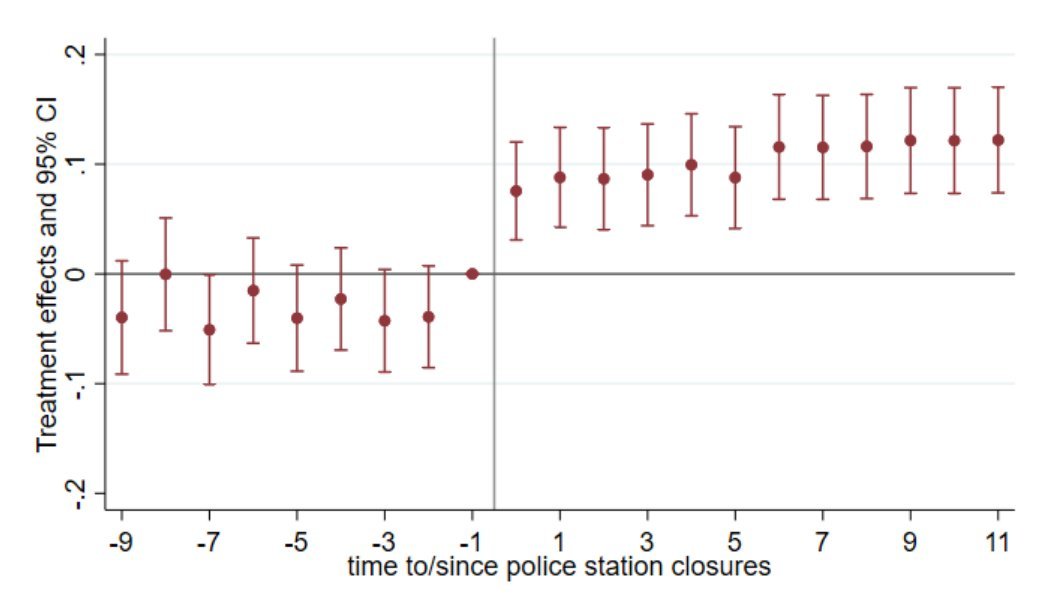
Violent crime went up ~11% in areas where stations were shut down.
In fact, the closer an area was to a police station that got shut down, the greater the increase in crime.
Those are the areas that now had the fewest police; criminals were responding to mere officer presence!
In fact, the closer an area was to a police station that got shut down, the greater the increase in crime.
Those are the areas that now had the fewest police; criminals were responding to mere officer presence!

But remember how they didn't fire any frontline officers? That means they redistributed them to the remaining stations.
We can use that fact to see a direct corollary to what's happening in D.C. right now. At the remaining stations, crime went down a lot.
We can use that fact to see a direct corollary to what's happening in D.C. right now. At the remaining stations, crime went down a lot.

Unfortunately, with police being more distant, that means more crime and less effective policing when they finally do manage to make their way over to calls.
Clearance rates fell by about 0.7%, and they fell most in locations police disappeared from the most.
Clearance rates fell by about 0.7%, and they fell most in locations police disappeared from the most.

Though violent crime went up in total, and officers became less effective, was it worth it? There's a dollar—or pound sterling—value to criminal victimization, so we can do the calculations, and...
Not worth it.
Cost-benefit calculations suggest each £1 of saved cost £3-7.
Not worth it.
Cost-benefit calculations suggest each £1 of saved cost £3-7.

There are, by now, tons of studies like this, and they tend to come to the same conclusions.
Namely, that police being in an area deters crime.
But generally America doesn't seem to get this. Compared to peer countries, America is extremely underpoliced.
Namely, that police being in an area deters crime.
But generally America doesn't seem to get this. Compared to peer countries, America is extremely underpoliced.

America has far more prisoners per capita than nations like Australia, Portugal, and Germany, but it has a much lower number of police per capita.
If America caught up and police exerted the effects the literature suggests, America could have lower crime and fewer prisoners.
If America caught up and police exerted the effects the literature suggests, America could have lower crime and fewer prisoners.

We're seeing a microcosm of that right now, in D.C.
Crime is down compared to the same time last year, and it's down so far that it's hard to come to any other conclusion.
We can provide further support for the idea the Guard are deterring crimes by a paper on D.C.
Crime is down compared to the same time last year, and it's down so far that it's hard to come to any other conclusion.
We can provide further support for the idea the Guard are deterring crimes by a paper on D.C.

Terror alerts are not the sort of thing normal day-to-day criminals think about
In fact, most crimes are 'in the moment', and they occur without any sort of premeditation, just because criminals are so liable to blow up at a moment's notice
So, why does the terror level matter?
In fact, most crimes are 'in the moment', and they occur without any sort of premeditation, just because criminals are so liable to blow up at a moment's notice
So, why does the terror level matter?

It matters because when the level is higher, more police are deployed in Washington D.C.
On days where the city is on high alert and more police are out, the number of crimes that happen falls considerably, by about 6.6%.
On days where the city is on high alert and more police are out, the number of crimes that happen falls considerably, by about 6.6%.

But high alert days don't distribute police evenly throughout the District.
They're primarily concentrated on District 1—the National Mall.
As it happens, that's where about half of the high alert crime reduction happens. Crime on the Mall falls by 15% during high alert!
They're primarily concentrated on District 1—the National Mall.
As it happens, that's where about half of the high alert crime reduction happens. Crime on the Mall falls by 15% during high alert!

It's clear why crime is way down in D.C., and why it will continue to be down compared to recent years, so long as the surge is ongoing.
It's because criminals fear police. They act a little less hastily and fewer people die as a result.
That's the power of police presence.
It's because criminals fear police. They act a little less hastily and fewer people die as a result.
That's the power of police presence.

If you want lower crime, you don't need to go all-in; you don't need a bunch of National Guard running around.
You just need to Fund the Police: increase the number of cops!
Or do what @growing_daniel does and effectively increase cop numbers by cutting their paperwork in half.
You just need to Fund the Police: increase the number of cops!
Or do what @growing_daniel does and effectively increase cop numbers by cutting their paperwork in half.

Sources:
ifs.org.uk/publications/p…
marginalrevolution.com/marginalrevolu…
journals.uchicago.edu/doi/10.1086/42…
workatastartup.com/companies/abel…
ifs.org.uk/publications/p…
marginalrevolution.com/marginalrevolu…
journals.uchicago.edu/doi/10.1086/42…
workatastartup.com/companies/abel…
• • •
Missing some Tweet in this thread? You can try to
force a refresh