🧵 Thread: Ancient Indian Time Calculations 🕰️
Sanatan Dharma doesn’t just speak of spirituality - it gives one of the most detailed frameworks of time measurement in the world, from billions of years to milliseconds.
Let’s dive into this timeless wisdom 👇
Sanatan Dharma doesn’t just speak of spirituality - it gives one of the most detailed frameworks of time measurement in the world, from billions of years to milliseconds.
Let’s dive into this timeless wisdom 👇
1️⃣ Kalpa
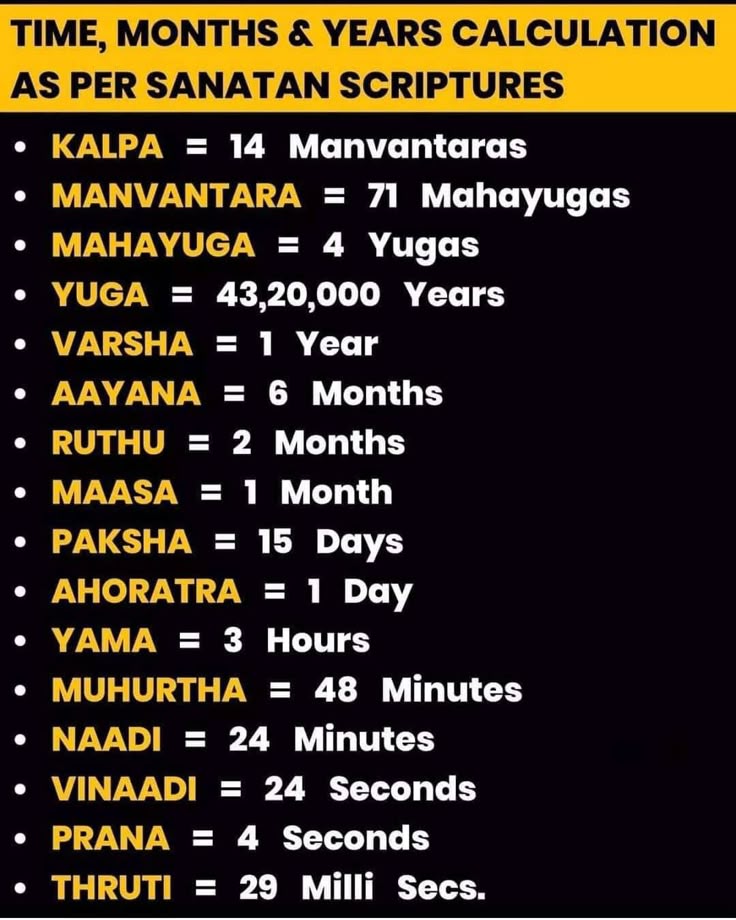
A Kalpa = 14 Manvantaras
In modern terms, it equals 4.32 billion years - the lifespan of one day of Lord Brahma. Science now estimates Earth’s age around the same number. Coincidence? Or divine accuracy?
A Kalpa = 14 Manvantaras
In modern terms, it equals 4.32 billion years - the lifespan of one day of Lord Brahma. Science now estimates Earth’s age around the same number. Coincidence? Or divine accuracy?
2️⃣ Manvantara
Each Manvantara = 71 Mahayugas
This is the reign of one Manu (cosmic ruler). We are in the 7th Manvantara ruled by Vaivasvata Manu. Each spans millions of years of cosmic evolution & dharmic cycles.
Each Manvantara = 71 Mahayugas
This is the reign of one Manu (cosmic ruler). We are in the 7th Manvantara ruled by Vaivasvata Manu. Each spans millions of years of cosmic evolution & dharmic cycles.
3️⃣ Mahayuga
One Mahayuga = 4 Yugas (Satya, Treta, Dvapara, Kali).
Together = 4.32 million years.
We are in Kali Yuga, the age of decline, lasting 432,000 years. Already 5,100+ years have passed since it began.
One Mahayuga = 4 Yugas (Satya, Treta, Dvapara, Kali).
Together = 4.32 million years.
We are in Kali Yuga, the age of decline, lasting 432,000 years. Already 5,100+ years have passed since it began.
4️⃣ Varsha to Paksha
1 Varsha = 1 Year
1 Aayana = 6 Months
1 Ruthu = 2 Months
1 Maasa = 1 Month
1 Paksha = 15 Days
This cosmic calendar aligns with lunar & solar movements, showing how deeply Sanatan Dharma observed nature.
1 Varsha = 1 Year
1 Aayana = 6 Months
1 Ruthu = 2 Months
1 Maasa = 1 Month
1 Paksha = 15 Days
This cosmic calendar aligns with lunar & solar movements, showing how deeply Sanatan Dharma observed nature.
5️⃣ Ahoratra & Yama
1 Ahoratra = 1 Day (24 hours)
1 Yama = 3 Hours
Our ancestors divided time into yamas (watches) for rituals, meditation & life rhythm. Even today, many temples follow Sandhya timings based on this.
1 Ahoratra = 1 Day (24 hours)
1 Yama = 3 Hours
Our ancestors divided time into yamas (watches) for rituals, meditation & life rhythm. Even today, many temples follow Sandhya timings based on this.
6️⃣ Muhurtha to Thruti
1 Muhurtha = 48 Minutes
1 Naadi = 24 Minutes
1 Vinaadi = 24 Seconds
1 Prana = 4 Seconds
1 Thruti = 29 Milliseconds
This precision shows that our Rishis had an atomic understanding of time thousands of years ago - long before modern atomic clocks.
1 Muhurtha = 48 Minutes
1 Naadi = 24 Minutes
1 Vinaadi = 24 Seconds
1 Prana = 4 Seconds
1 Thruti = 29 Milliseconds
This precision shows that our Rishis had an atomic understanding of time thousands of years ago - long before modern atomic clocks.
Why it matters
Sanatan Scriptures didn’t just track time, they showed us that life itself is part of a grand cosmic rhythm—from the blink of an eye to the lifespan of Brahma Ji.
Eternal. Infinite. Divine.
Sanatan Scriptures didn’t just track time, they showed us that life itself is part of a grand cosmic rhythm—from the blink of an eye to the lifespan of Brahma Ji.
Eternal. Infinite. Divine.
🔁 Repost this if you’re amazed by the genius of our Rishis.
📿 Follow @Its_Me_Jasraj for more hidden gems of Sanatan Dharma, history & science.
📿 Follow @Its_Me_Jasraj for more hidden gems of Sanatan Dharma, history & science.
• • •
Missing some Tweet in this thread? You can try to
force a refresh