arctotherium Profile picture
Sep 14, 2025 21 tweets 11 min read Read on X
Continued thread on the 1965 book "An Oxford History of the American People." Morison isn't flattering towards the Quebecois, seeing them as ingrates for their disdain for their tolerant conquerors. Image
French & Indian War began with a disaster, with total annihilation only stopped by the Indians mutilating captured prisoners instead of pursuing defeated foes. Brits turned things around, Quebecers created a stabbed-in-the-back myth about the Bourbons. Image
Image
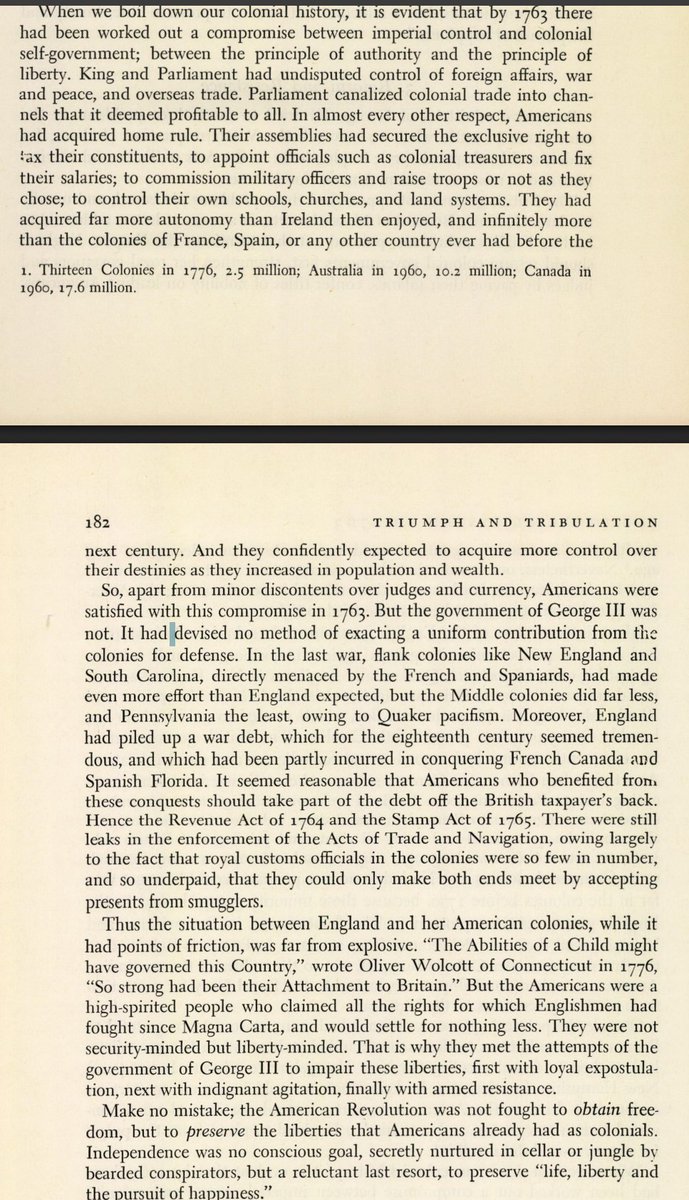
The American Revolution was to *maintain* their liberties as Englishmen against an overweening Parliament and King, not expand them. Image
The importance of the genocidal frontier warfare of Indian fighting. British regulars protected Indian refugees in Philadelphia from "the Paxton Boys" who were only bought off with the promise of bounties for redskin scalps. Image
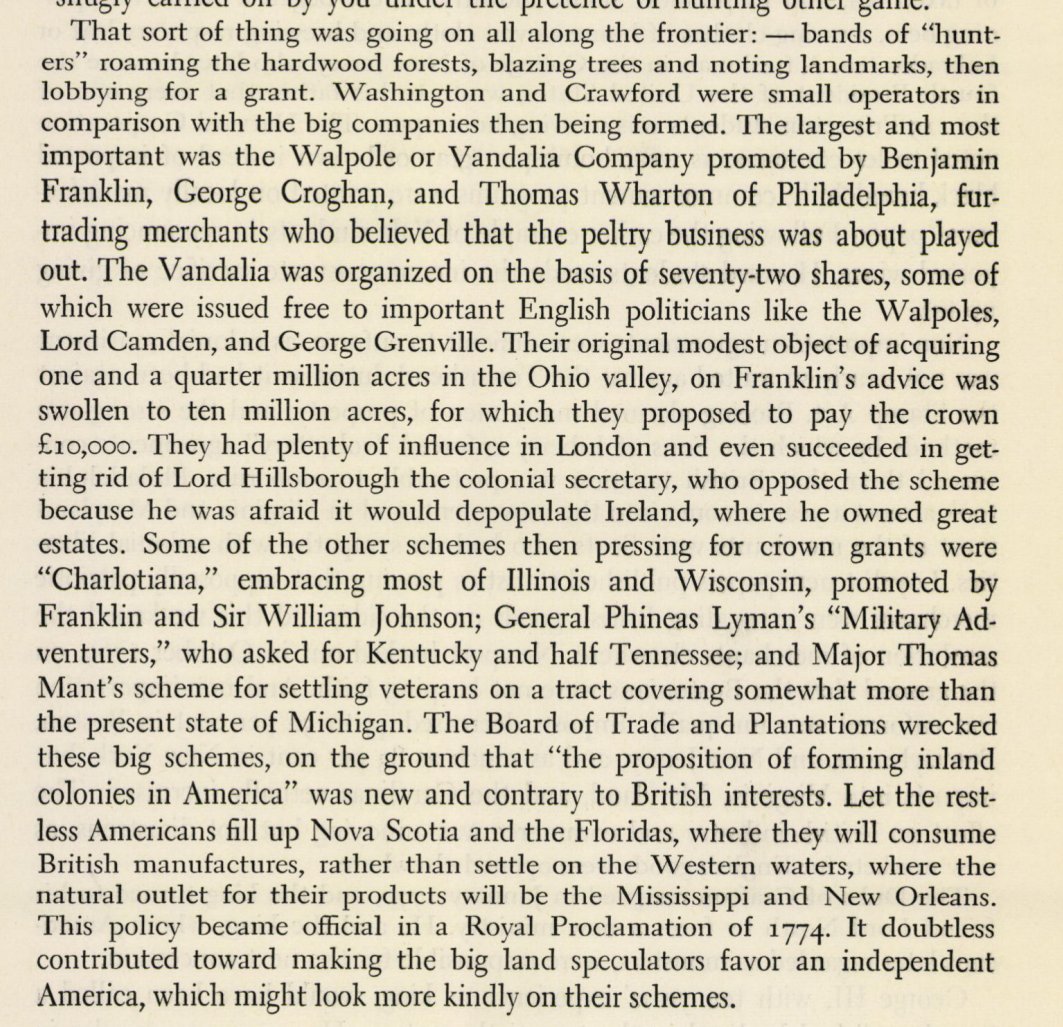
The Royal Proclamation of 1763 banned westward expansion, turning prominent land speculators and the frontiersmen, not especially sympathetic to the coastal Sons of Liberty, against the British. Image
Image
Many English Whigs supported the Patriots as bearing the standard of English liberty against the monarchy, as King George III tried to centralize power in himself. Image
Lord North attempted to bribe Ben Franklin into mediating with the angry colonists; this turned Franklin from a Whig advocate of compromise into an independence advocate himself. Even after taking up arms it took a year to declare independence; even patriots wanted a compromise. Image
Image
All the "mystic chords of memory" of Americans were English, making independence very psychologically difficult. Continental Congress asked for dominion status as a final compromise, but were turned down by King George III, who refused to recognize rebels. Image
Image
"Altogether, the private soldier of the War of Independence was so badly fed, clothed, and cared for, and often so badly led, too, that one is surprised and grateful that any continued to fight." Revolution very dependent on French financial and naval support. Image
Image
Image
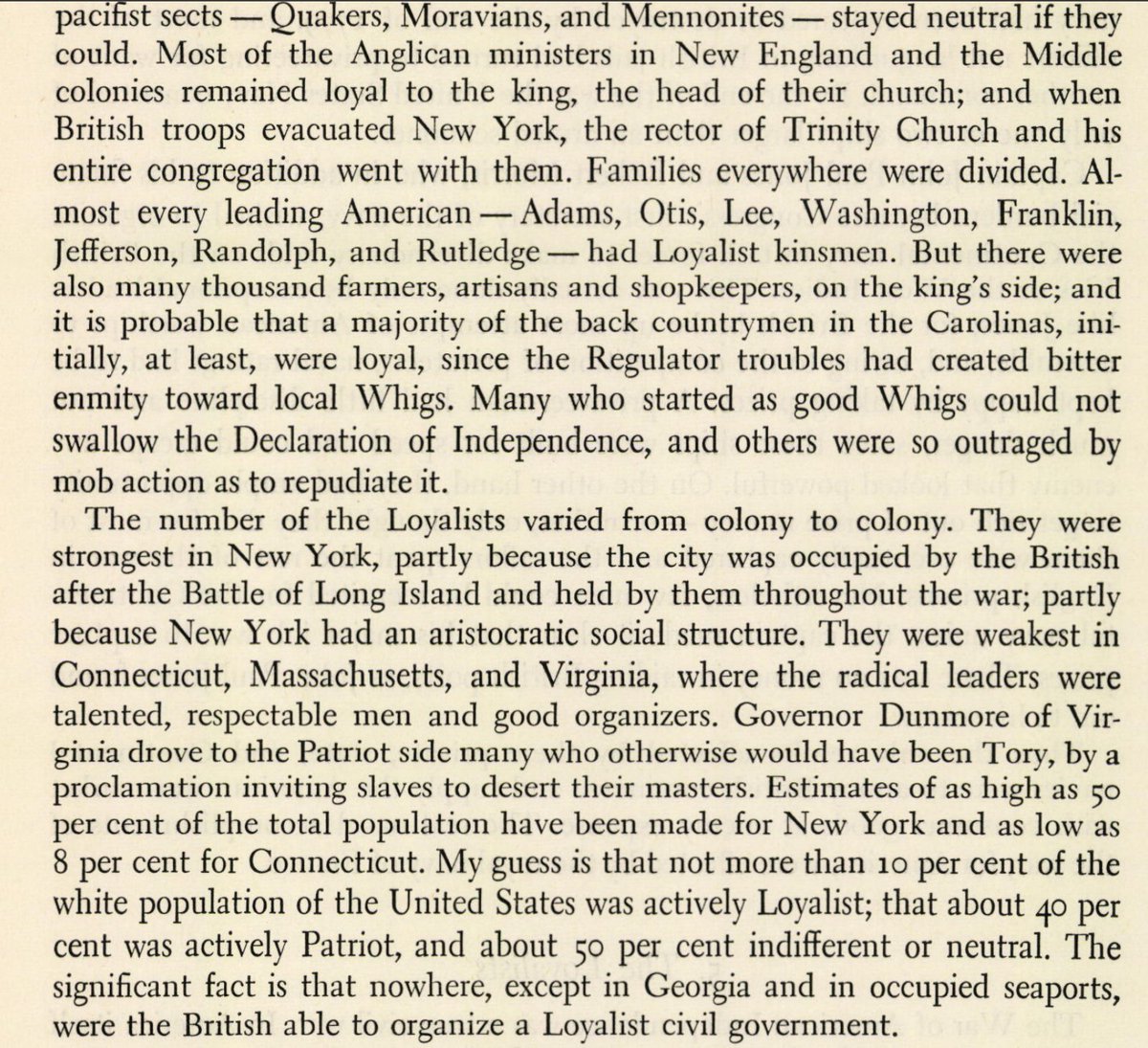
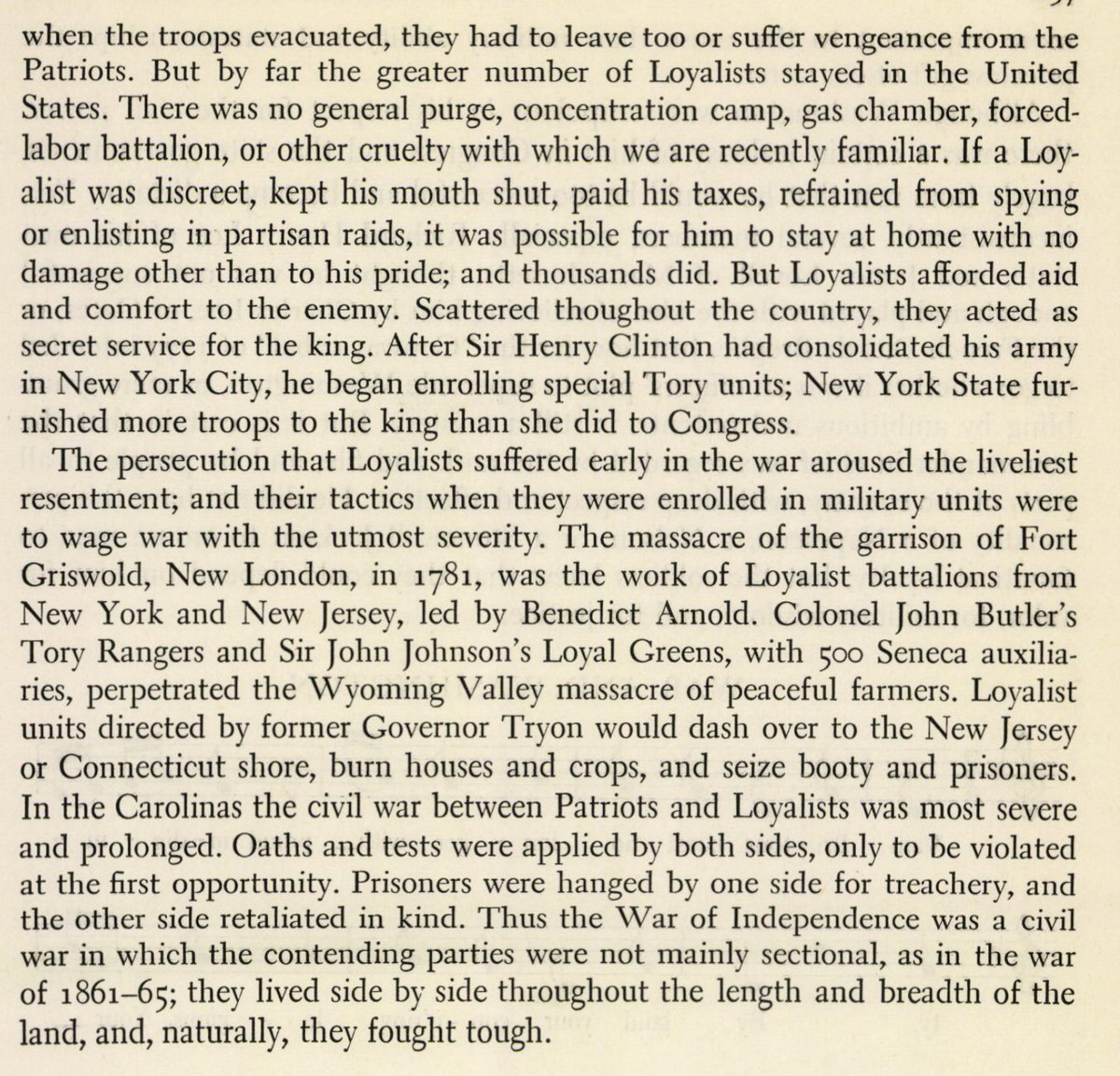
Morison estimates a ratio of 4:1:5 Patriots:Loyalists:Neutrals in the colonies. Contra some later tales, Loyalists were not especially persecuted after the war, though during it there were confiscating and bloody reprisals on both sides. Image
Image
Image
Washington turning himself into a great figure of history through sheer character, deliberately embodying what was best about the American spirit. Image
The New Jersey campaign. New Jerseyans were initially neutral, but German looting turned them against the British, and Washington eventually won after repeated losses and orderly retreats. Image
Image
Image
Image
One of the defining features of the Revolution: because the whole countryside was in arms, unlike quiescent European peasants, the British Army had a very tough time leaving the coast where they had naval supremacy. Couldn't militarily subjugate the colonies. Image
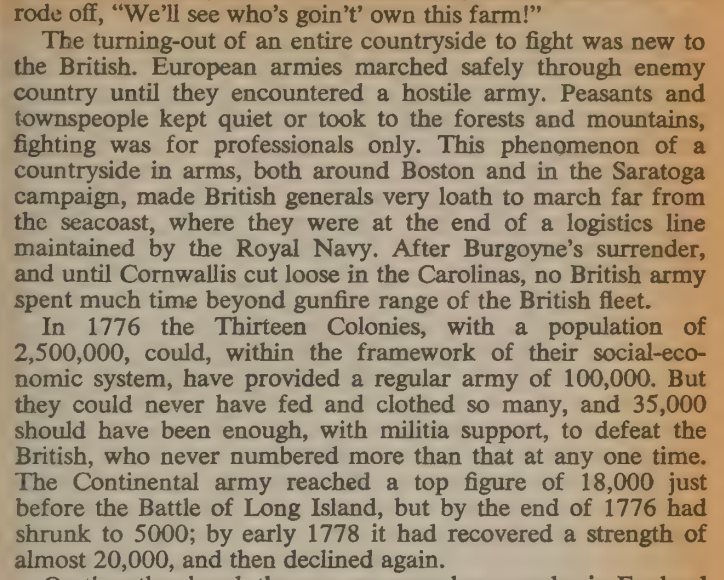
French logistical and naval support was essential for the Americans to actually win rather than just survive, however. American Army coordinated much better with the French Navy than the British Army did with the Royal Navy. Image
Image
Image
Image
One of the unusual things about the American Revolution: there were no purges. Why? Because the American Revolutionaries were building off the English status quo, not starting from scratch. Image
The South recovered quicker than the North, horseraces continued to be popular. US was extremely dependent on British exports before the war, took a while to recover from their loss. Image
Image
No loyalists were expelled after the war, though 80,000 emigrated voluntarily. Image
The first Catholic Church in the US was consecrated in 1785. Image
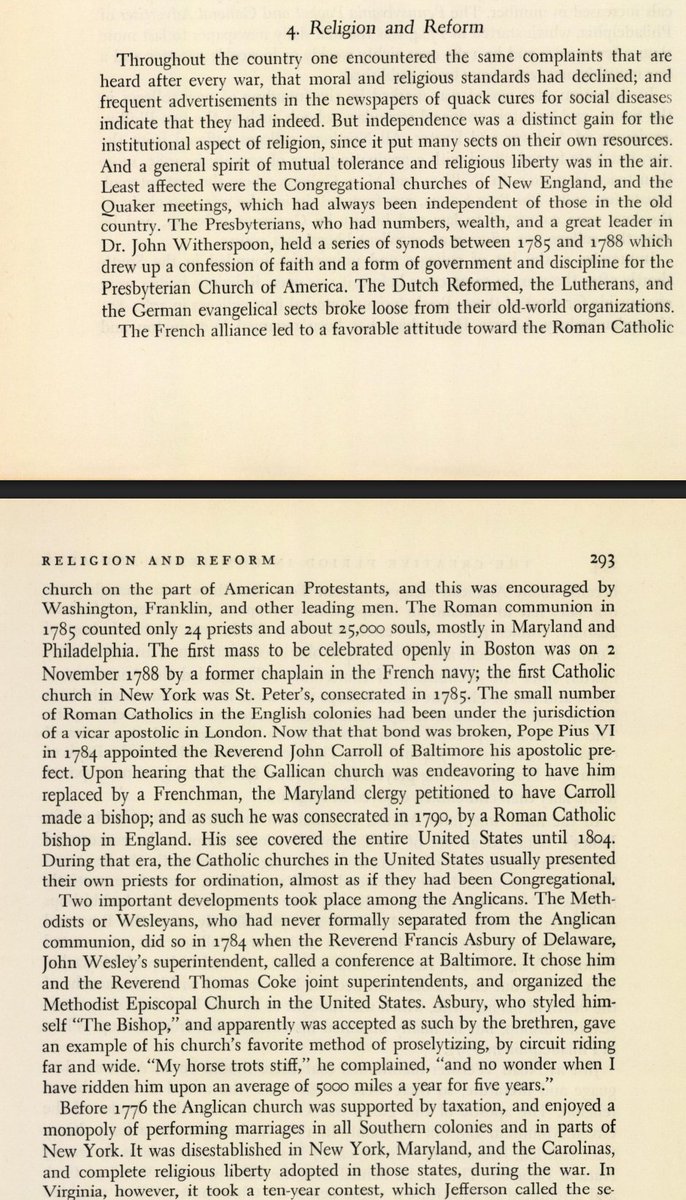
Shay's Rebellion: leaders were not executed and some of their demands were met. But the rebellion scared states into the Constitution. Franklin wanted to open convention assemblies with a prayer, but they lacked the money for a chaplain. Image
Image
Morison had a very high opinion of the Constitution, seeing it as the crowning achievement of 18th century America, a work of geniuses for building a sovereign union of sovereign states. 60 years later, I don't think his belief has held up. Image
Image
Only one big cleavage in supporters vs opponents of the Constitution: the supporters were younger and more vigorous, the opponents older.
Both Washington and Franklin were Federalists, but Washington supported a Bill of Rights to appease the Anti-Federalists. Image
Image

• • •

Missing some Tweet in this thread? You can try to force a refresh

 

Keep Current with arctotherium

arctotherium Profile picture

Stay in touch and get notified when new unrolls are available from this author!

Read all threads

This Thread may be Removed Anytime!

PDF

Twitter may remove this content at anytime! Save it as PDF for later use!

Try unrolling a thread yourself!

how to unroll video
  1. Follow @ThreadReaderApp to mention us!

  2. From a Twitter thread mention us with a keyword "unroll"
@threadreaderapp unroll

Practice here first or read more on our help page!

More from @arctotherium42

Jun 21
Thread with excerpts from the 'Pretorians' section of TR Fehrenbach's "Fire and Blood: A History of Mexico" (1973). In 1821, postcolonial nation-building seemed easy; the only example was the USA. But the US was homogenous, well-led, free, and already had an identity. Image
Mexico was the reverse, with no history of self-rule, the criollo/casta/indio split, and no great leadership. The two major factions were the 'continuistas' (conservatives) and the 'reformistas' (liberals). Image
Image
Mexico was the reverse, with no history of self-rule, the criollo/casta/indio split, and no great leadership. The two major factions were the 'continuistas' (conservatives) and the 'reformistas' (liberals). Image
Image
Read 20 tweets
Jun 21
Excerpts from TR Fehrenbach's "Fire and Blood: A History of Mexico" (1973) on the Mexican War of Independence. The Mexican criollos were far less impressive than their South American counterparts, and produced no leaders equal to Bolivar or San Martin. Image
Where the South American criollos quickly declared independence upon the French conquest of Spain, the Mexican ones dithered. Acting quickly, the local peninsulares coup'd the government and the criollos accepted it. Image
Image
With the criollos basically accepting Spanish domination, leadership of the independence struggle passed to men like Miguel Hidalgo, who turned it from a (hopefully) bloodless coup to a social and race war. Image
Read 12 tweets
Jun 21
Thread with excerpts from the Colonial New Spain portion of TR Fehrenbach's 'Fire and Blood: A History of Mexico' (1973). His view is that New Spain would have remained permanent divided and stagnant if not for the northern frontier. Image
The true frontier of New Spain was not the thinly-populated and stagnant (almost identical when the Anglos showed up as in the 17th century) New Mexico, but much further to the south, in the arid regions only a little north of the Valley of Mexico. Image
Image
The frontier lacked civilized Indians who could be reduced to slaves, and was instead populated by energetic mestizos and criollos, working owned ranchos for a market rather than owning huge estates for prestige. Image
Read 16 tweets
Jun 20
A few excerpts from "Years of Peril and Ambition: US Foreign Relations 1776-1921." Several terms from the Treaty of Paris, especially that Britain would abandon its Great Lakes forts and the US would have the right to navigate the Mississippi, were not upheld. Image
Image
Americans who moved into Spanish Louisiana retained "allegiance to the United States and displayed open contempt for their nominal rulers." Imagine that. Image
An 1810, American immigrants to Spanish West Florida seized control of Baton Rouge, proclaimed an independent republic and requested annexation by the US, though this failed. Image
Image
Read 15 tweets
Jun 15
More excerpts on Colonial Mexico from TR Fehrenbach's "Fire and Blood" (1973). Fehrenbach saw the discovery of silver in Mexico, mostly in the arid north, as a disaster, as it led to Spain administering Mexico as a loot box rather than developing the productive economy. Image
Image
The thinly-populated, but silver-rich North became a military frontier. Image
The suspicious Spanish Crown gave those born in Spain, the peninsulares, a monopoly on offices (and commerce) in New Spain. As offices were the main route to upwards mobility, the local creoles resented this. Image
Read 22 tweets
Jun 15
Thread with excerpts from the colonial Mexico portion of "Fire and Blood: A History of Mexico" (1973). Image
The Catholic Monarchs who united Spain reined in the aristocracy, abolished serfdom, disempowered the Castilian parliaments, and ended all noble presumptions to royal powers and revenues, creating a new bureaucracy (with a new army) to run the state loyal to themselves. Image
Spain combined this modern bureaucratic state and army with maintenance of privileges for the old nobility and an almost medieval religious mindset. Image
Image
Read 25 tweets

Did Thread Reader help you today?

Support us! We are indie developers!


This site is made by just two indie developers on a laptop doing marketing, support and development! Read more about the story.

Become a Premium Member ($3/month or $30/year) and get exclusive features!

Become Premium

Don't want to be a Premium member but still want to support us?

Make a small donation by buying us coffee ($5) or help with server cost ($10)

Donate via Paypal

Or Donate anonymously using crypto!

Ethereum

0xfe58350B80634f60Fa6Dc149a72b4DFbc17D341E copy

Bitcoin

3ATGMxNzCUFzxpMCHL5sWSt4DVtS8UqXpi copy

Thank you for your support!

Follow Us!

:(